#159) The House I Live In (1945)

23380_1_large

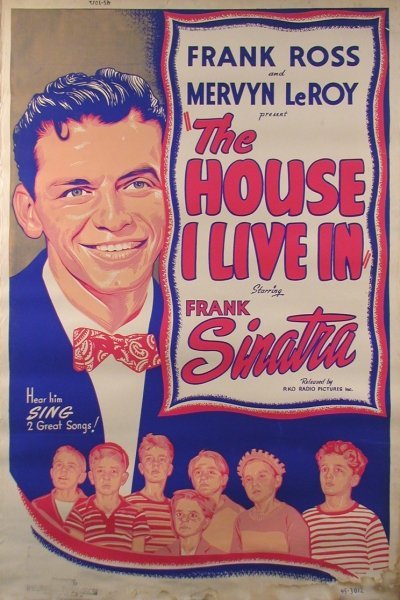
#159) The House I Live In (1945)

OR “A Man and His Musings”

Directed by Mervyn LeRoy

Written by Albert Matlz

Class of 2007

The Plot: While on a smoke break from recording his latest album, Frank Sinatra (Frank Sinatra) witnesses a group of kids bullying another child because he is Jewish. Frank stops the boys and teaches them an important lesson about what it truly means to be American. And then he sings a song and…oh I get it. The house is America! It all makes sense now!

Why It Matters: The NFR says the film “exhorts the message of religious tolerance and post-war hopefulness.” And then they just tell you what happens in the short.

But Does It Really?: Meh. It’s an interesting little time capsule of America picking up the pieces following the war, and it’s fun to see Sinatra early in his career, but the film very much shows its age, and then it’s over before it can really make an impact. I can’t help but wonder what other movies could have gotten this spot on the list. For now let’s just say my opinion of this film is “The Fence I Sit On”.

Everybody Gets One: Producer Frank Ross was best known for his work on this, the 1939 version of “Of Mice and Men”, and the 1953 epic “The Robe”, the first CinemaScope film. Ross also wrote the screenplay to the 1943 comedy “The More the Merrier” starring his then-wife Jean Arthur.

Wow, That’s Dated: A quick reference to smallpox, casual pipe smoking in a recording studio, and – brace yourselves – frequent usage of the term “Japs”. And with the amount of WWII films I have yet to cover, this will only get worse.

Title Track: The title song was written in 1942, with music by Earl Robinson and lyrics by Abel Meeropol. Both men were members of the Communist party whose work dried up through the Blacklist. Yeah, we’d hate for America to be subverted by two songwriters preaching religious tolerance.

Seriously, Oscars?: In lieu of competing in the Live-Action Short category, the Oscars went ahead and gave “The House I Live In” an honorary Oscar, one of the rare shorts to achieve this honor. The film also won a Golden Globe in the short-lived category “Best Film Promoting International Understanding”.

Other notes

  • In addition to the composers, screenwriter Albert Maltz would be blacklisted within a few years of this film’s release. Sinatra tried to get Maltz a screenwriting job in the early ‘60s, but a public outcry led to Sinatra backing down. You can cut the irony with a machete.
  • I guess I’m just used to older Sinatra, but I was struck by how young Frank is in this. He was 29 during filming, and that’s a face of a man who’s still married to his first wife and has yet to have an infamous career slump.
  • Any write-up on Abel Meeropol will be quick to mention that he also wrote “Strange Fruit”, and this page will be no different.
  • Say what you will about Sinatra, no Auto-Tune.
  • In a nice bit of cost cutting, the conductor in the film is played by this film’s composer, Axel Stordahl.
  • “Nazi werewolves”. It’s not just the phrase Frank uses to describe the bullies; it was also the name of my high school alt-rock band.
  • But seriously, are they Nazis that turn into werewolves, or werewolves that believe in some sort of “master species”? I feel like this is some uncharted science-fantasy historical fiction territory. Get on it, Internet!
  • Yes, never persecute any one religion, because we all worship the same God. …Wait, what?
  • Oh my god, stop saying “Jap”! It’s kinda hard to take this film’s social message seriously when they keep vilifying the Japanese.
  • Wow, these kids are really patient while Frank sings at them. The kids I know would have bolted two bars in.

Legacy

  • Sinatra included “The House I Live In” in his repertoire for many years, even singing it at the Statue of Liberty rededication in 1986.
  • Paul Robeson covered the song in 1947, including the verse about racial equality deleted from this film.
  • Ladies and gentlemen, Patti LaBelle!

Listen to This: Nine years after “The House I Live In”, Sinatra recorded the album “Songs for Young Lovers”. In the interim years he had gone through a slump, a divorce, a comeback, a second marriage (to Ava Gardner, no less), and an Oscar for “From Here to Eternity”; and this, the definitive Sinatra album, defines this era of the Chairman’s career. “Songs for Young Lovers” was one of the first 50 recordings selected by the National Recording Registry in 2002.

#158) Blazing Saddles (1974)

blazing_saddles_xlg

#158) Blazing Saddles (1974)

OR “Pie Fight at the O.K. Corral”

Directed by Mel Brooks

Written by Brooks & Norman Steinberg & Andrew Bergman & Richard Pryor & Alan Uger. Story by Bergman.

Class of 2006

The Plot: When the town of Rock Ridge comes between him and his railroad construction, Attorney General Hedy Hedley Lamarr (Harvey Korman) hatches a plan. He gets a black railroad worker named Bart (Cleavon Little) appointed sheriff, in the hopes that his race will cause the all-white town to vacate the land. Bart, alongside has-been gunslinger the Waco Kid (Gene Wilder), helps defend Rock Ridge from a brute named Mongo (Alex Karras), a Marlene Dietrich-esque chanteuse (Madeline Kahn), and Lamarr’s band of criminals and Methodists. All of this wrapped in a comedy that skewers every Western, takes down the racial inequality of the ‘70s, and doesn’t so much break the fourth wall as it does bulldoze it to the ground.

Why It Matters: The NFR calls it a “riotously funny, raunchy, no-holds-barred Western spoof” and praises Brooks and the cast. There’s also a detailed essay by NFR staple Michael Schlesinger.

But Does It Really?: Full disclosure: This is my favorite Mel Brooks movie. Some are better films overall, but this one makes me laugh the hardest. Brooks managed to take a dying genre and a script by five writers and turn in into one of the funniest films ever. And in the midst of all the lowbrow humor, Mel comments on American racism more effectively than most “message movies”. There’s the frequent refrain of “you could never make ‘Blazing Saddles’ today”, and that may be true, but when the original is this good, why would you want to?

Shout Outs: Lots of films spoofed in this one, notably NFR entries “High Noon”, “The Treasure of the Sierra Madre”, “Morocco”, “Cabaret”, and “Destry Rides Again”. And keep an ear out for a brief allusion to Mel’s own “The Producers”.

Everybody Gets One: Writer Andrew Bergman, actors Cleavon Little, Harvey Korman, Alex Karras, and Count Basie.

Wow, That’s Dated: Racial politics aside for one moment, let’s instead focus on the cultural references that were already dated in 1974: Mel and company note such obscurities as Richard Dix, Dr. Gillespie, Olsen & Johnson, “You Do Something To Me”, and most importantly, Randolph Scott.

Title Track: We get ourselves one hell of a title song!

Seriously, Oscars?: In a year dominated by “The Godfather Part II” and “Chinatown”, the Academy was hip enough to give “Blazing Saddles” three nominations: Editing, Song (for the title number), and Supporting Actress for Madeline Kahn. The film lost all three nominations, but thanks for inviting them to the party. And sadly, in his plight to destroy Rock Ridge, Harvey Korman risked an almost certain Academy Award nomination for Best Supporting Actor.

Other notes

  • In the “You couldn’t make it today” discussion, I would argue that they have. Jordan Peele’s “Get Out” is, like “Blazing Saddles” before it, a film that tackles racism in America through an unconventional genre (in Peele’s case, a horror film). The comparisons end there, but “Get Out” is as much a comment on racism today as “Blazing Saddles” was for the ‘70s.
  • How did Cleavon Little not become a film star after this? His performance is flawlessly charming, sympathetic, and uproariously funny. It’s a shame his film career never took off.
  • This film brings about what I call “The Mel Brooks Ratio”: the more screen-time Mel Brooks has in his own movie, the worse it is. “Young Frankenstein”? No Mel, a classic. “Life Stinks”? Well…
  • Harrumph!
  • Gene Wilder is the last person you would expect to play a washed-up alcoholic gunslinger (Gig Young was originally cast), but whatever quality the Waco Kid needed, Gene had it and boy does it work.
  • A western spoof with fart jokes doesn’t need to have outstanding cinematography, but there’s some excellent work being done throughout by Joseph Biroc. Fun Fact: He also filmed “It’s a Wonderful Life”!
  • REDFACE WARNING. I love this movie, but you don’t get off that easy, Mel.
  • Ah, the infamous campfire scene. Burton Gilliam’s inaugural flatulence changed movies, and definitely not for the best.
  • Speaking of iconic moments, I shouldn’t laugh at Mongo punching a horse, but here we are.
  • Two words: “I’m Tired”. Oscars, you nominated the wrong song.
  • Speaking of, I’ve always had a soft spot for Madeline Kahn. She was one the rare actresses in the vein of Carole Lombard who could be simultaneously funny and sexy. Kahn was consistently great no matter the movie (and she did a few turkeys in her time).
  • During this viewing I realized that there isn’t a single excessive scene in the film. Elements of certain scenes are unnecessary, but every scene either advances the plot or develops character. Find me a modern comedy that does that.
  • That ending is very bizarre. But hey, if you’re going to write yourself out of a corner, that’s a fun way to do it.
  • Here are just a few of my favorite lines:

“Well, that’s the end of this suit.”

“If you shoot him you’ll just make him mad.”

“The bitch was inventing the candygram.”

“Mongo only pawn…in game of life.”

“Hey where are the white women at?”

“They lose me right after the bunker scene.”

And the best line not in the movie: “You’re sucking on my arm.”

Legacy

  • This was Mel Brooks’ first bona fide hit as a director. When “Blazing Saddles” was released, Mel was already working on his next project; a screenplay by Gene Wilder called “Young Frankenstein”.
  • Try this one on for size: Mel had a stipulation in his “Blazing Saddles” contract that if Warner Bros. wanted to maintain the rights to the film, they’d have to produce a sequel or a TV series within six months of the film’s release. Nowhere did it say that the TV series ever had to air, so for four years Warner Bros. filmed a TV show called “Black Bart” starring Louis Gossett Jr. that was never intended to be seen. When Warner Bros. finally gave up on a sequel, they cancelled the show and gave the rights back to Mel. The pilot for “Black Bart” aired only once on CBS. Weird, right?
  • “Blazing Saddles” still gets referenced and quoted quite a bit, but probably by no one more than Mel himself.
  • A confident black leader takes over a bigoted town, where have I seen the real-life, mostly inspiring but ultimately depressing version of this? Hmmm…

#157) The Power of the Press (1928)

Power_of_the_pressmp

#157) The Power of the Press (1928)

OR “Go, Cub, Go!”

Directed by Frank Capra

Written by Sonya Levien. Story by Frederick A. Thompson.

Class of 2005

The Plot: Clem Rogers (Douglas Fairbanks Jr.) is a cub reporter who dreams of writing a major scoop. He gets his chance when his editor (Robert Edeson) sends him to investigate the murder of the city’s D.A. (Charles Clary). While at the scene of the crime, Clem sees a young woman trying to escape. She turns out to be Jane Atwill (Jobyna Ralston), the daughter of the mayor (Edwards Davis), and Clem’s prime suspect. What follows is an examination of journalistic integrity, a takedown of political corruption, and the seeds Frank Capra planted that will eventually bloom into full-grown “Capra-corn”.

Why It Matters: Wow, this gets one of the shortest blurbs for any NFR entry. They call it a “[d]exterous newspaper yarn” and give the briefest of plot synopses. It always baffles me when the NFR doesn’t defend one of its own choices.

But Does It Really?: If I were writing the NFR blurb (and I’m not, but I wouldn’t turn down the offer), I would say that “The Power of the Press” represents Frank Capra’s beginnings in film during the silent era. He had only been directing for six years, but “Press” features many Capra hallmarks, primarily an idealist central figure caught in a cynical and corrupt institution, whose honesty and strong convictions win out in the end (and gets him the girl, of course). Capra also throws in some of his other favorites: a romance that stems from conflict, a memorable supporting cast, and even some clever dialogue (via intertitles, naturally). The film is not a popular classic nor a cultural benchmark, but it holds up well and exhibits the confident skill of a young director who will go on to help define the sound era.

Shout Outs: Marie makes a quick reference to “The Big Parade”.

Everybody Gets One: Most of the supporting cast, as well as screenwriter Fred Thompson, who would go on to achieve fame on “Law & Order”. Special mention to Charles Clary as D.A. Nye, aka “The vic”.

Wow, That’s Dated: Lots of old-timey journalism staples like newsies and references to Arthur Brisbane. Plus the practice of wearing your press pass in your hatband, not around your neck in a frou-frou lanyard.

Seriously, Oscars?: The 2nd Academy Awards is the only Oscar ceremony where there were no official nominees in any category (though the Academy would later announce de facto nominees based on their records). With this in mind, we don’t know for sure if “The Power of the Press” was in the running for any Oscars. But don’t worry, Capra will get his due.

Other notes

  • Capra is credited as “Frank R. Capra” for this one. The R stands for Rosario.
  • Ah, the bustling newsroom of early cinema. Say hi to Walter Burns for me. Either one.
  • When did we stop naming boys “Clem”?
  • Douglas Fairbanks Jr. looks like a cross between Fred Astaire and Buddy Ebsen. Oh, and Douglas Fairbanks Sr., I guess.
  • Why the green tint during the outdoor scenes? Are they down the street from Three Mile Island?
  • If nothing else, this film is a pretty thorough overview of how newspapers used to be printed. It’s like there are little men living in your office copy machine!
  • Atwill’s opponent in the mayoral election is named – and I swear I’m not making this up – Robert Blake. He couldn’t have shot the D.A. because he went back to Vitello’s to collect his gun that he had left there (Look it up, that was his actual alibi).
  • Neat cinematography all of a sudden. Chester Lyons and Ted Tetzlaff were having some fun that day.
  • “Li’l Marie”? I had her first album!
  • Yeah, calling the woman you accused of murder “little girl” will not help her stop crying.
  • Marie doesn’t want to be Blake’s “Prisoner of Zenda”. She should talk to Clem about that.
  • Drunken title cards. Nice touch.
  • “This is a man’s job. You go to the Times office and wait for me.” [Deep exhale]
  • Idealism and a strong morality, sure, but Clem also has a lot of dumb luck on his side.
  • Did we skip something? It appears a few scenes are missing from this film’s surviving print. Thankfully it’s nothing pertinent. Helps with the pacing, actually.
  • A car chase at 62 miles per hour!? What recklessness!
  • “The Power of the Press” features an early Columbia Pictures logo. Instead of a torch, the woman in the logo is holding a…bidding paddle?

Legacy

  • The subgenre of movies where journalists are noble heroes, like “All the President’s Men” and “Absence of Malice” and…everything right now.
  • Speaking of, is “The Post” any good? I want to see it, but I don’t hear a lot of buzz around it.

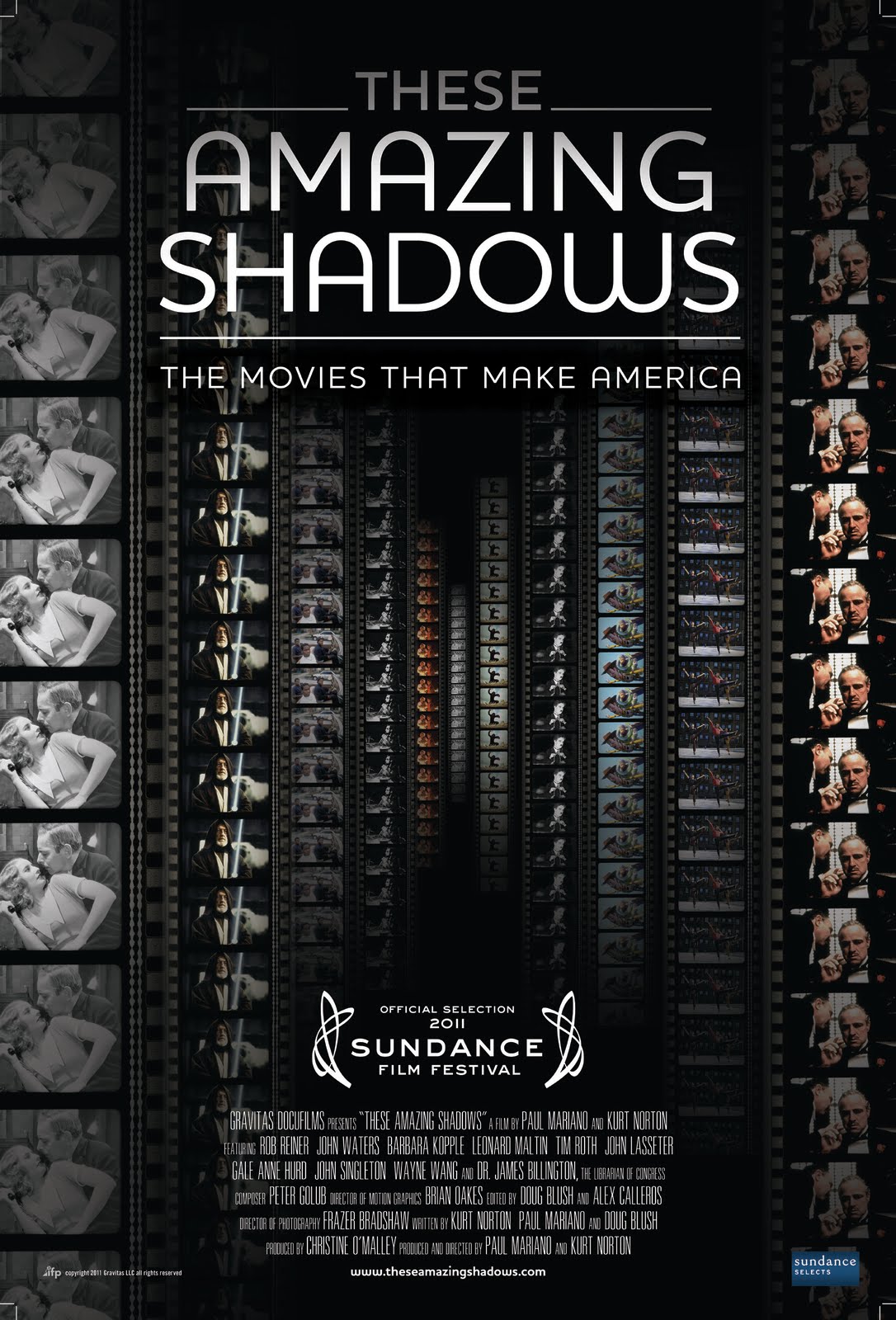
These Amazing Shadows (2011)

shadows

These Amazing Shadows (2011)

OR “National Film Registry: The Movie: The Motion Picture: Tokyo Drift”

Directed by Paul Mariano & Kurt Norton

Written by Mariano & Norton & Douglas Blush

Today marks the one-year anniversary of “The Horse’s Head”! To celebrate me writing about watching movies for a year, I watched a movie about all the movies that I have/will watch and write about.

Released back when the National Film Registry had a mere 575 films on the list, “These Amazing Shadows” is a standard talking-head documentary about the creation of the National Film Registry and its efforts to preserve American film. Interviews are conducted with a variety of subjects: from those who select the films, to those whose work is being preserved. Clips from the honored films are highlighted throughout. Covered topics include proper preservation, racial and cultural representation, the early success and later sidelining of women in the film industry, film as a historical document, and the overall power of the movies. Ultimately the best description of the NFR comes at the end, when it is compared to preserving family photos: This is what we want to show future generations. This is what was important to us.

While conventional in its approach, “These Amazing Shadows” is a rare glimpse into what it takes to become an NFR film. I applaud the filmmakers for making a movie about movies that doesn’t talk down to those who study film, nor alienates those who don’t. If you’re a film nut like me, you’ll get a lot out of this. Personally, “These Amazing Shadows” is a lovely opportunity for me to not only revisit the great films I’ve already watched for this blog, but also to get excited for the films I have yet to see (except you, “Birth of a Nation”). I look forward to the controversial/confusing inclusion of “These Amazing Shadows” on the National Film Registry in 2021.

Shout Outs: By my count there are 126 Registry titles featured in this film (35 of which I have already covered on this blog).

Title Track: NFR preservationist George Willeman utters the title about 17 minutes in. It seems a bit forced, but it works. I personally prefer one of their alternate titles, “To Protect and Preserve”. I wish I had come up with that.

Seriously, Emmys?: “These Amazing Shadows” premiered on PBS in December of 2011, and didn’t get a single Emmy nomination in 2012. Come on, TV Academy! How do you have 900 categories and still not nominate something? What about “Best Adapted Writing for a Nonfiction Unstructured Special Class Program (Non-Prosthetic)”?

Other notes

  • Ted Turner was an asshole for colorizing these films in the first place (even arrogantly referring to them as “my movies”), but without him we wouldn’t have a government-funded film preservation agency. So thank/fuck you, Ted Turner.
  • Of the first 25 films, “The Learning Tree” always gets the shaft. Its only appearance in this film is its poster during the end credits. Come on NFR; you picked it, show some support!
  • Do you think it gets awkward in the meeting room when one of cinematographer/board member Caleb Deschanel’s films comes up for consideration? At the time of filming, only one of his movies (“The Black Stallion”) had made the cut. And how often do you think Leonard Maltin tries to get “Gremlins 2” inducted?
  • Why is Tim Roth being interviewed? “Pulp Fiction” wasn’t on the list yet.
  • “Very often history proves [The Oscars] wrong.” In the case of Best Picture winners (the point this part of the film is trying to make), that’s not true. So far, about 60% of all eligible Best Picture winners have made the cut. Not an exceptional record, but not a rarity either.
  • Hey, don’t knock “Thriller”. It’s awesome!
  • At some point I would love to visit the Library of Congress Packard Campus in Culpeper, Virginia. It may be my personal Mecca.
  • Don’t burn rare film nitrate to prove your point! We can take your word for it!
  • Shout-out to “The Greatest” the 1977 Muhammad Ali film that’s playing at the same theater as “Star Wars”. Coincidentally, both films feature James Earl Jones.
  • The film is quick to switch over to the original unaltered “Star Wars” when the situation dictates (to the point where the dip in quality is noticeable), but manages to overlook using a shot from the “E.T.Special Edition. The added cape effect is the giveaway. Don’t think I didn’t notice.
  • At face value, having George Takai as a talking head in this film is a bit random. But then you hear him talk about his own experience in a Japanese internment camp and you realize how important it is to not only preserve that footage (“Topaz”) but also to hear about the experience from those who were there.
  • It’s nice to put a face to some of the people whose names I recognize as NFR essay authors.
  • Rob Reiner insists that “The Princess Bride” should be on the list. Give it five more years, Meathead.
  • Filmmaker Barry Jenkins only had a handful of shorts to his credit at the time of this film, but not only is he interviewed, he’s on the National Film Preservation Board. I’m sure we can expect “Moonlight” to make the cut in 2026.
  • Rights clearance to “Apocalypse Now”? Check. Rights clearance to “The End” by The Doors? Well…
  • Debbie Reynolds is only in this film for a hot second, but it’s enough to make me miss her and appreciate how much she did for the preservation of classic movies throughout her life. And now I have something completely unrelated in my eye…

Thanks for joining me for the first year of “The Horse’s Head”. There’s plenty more to come. As always, Happy Viewing!


Tony

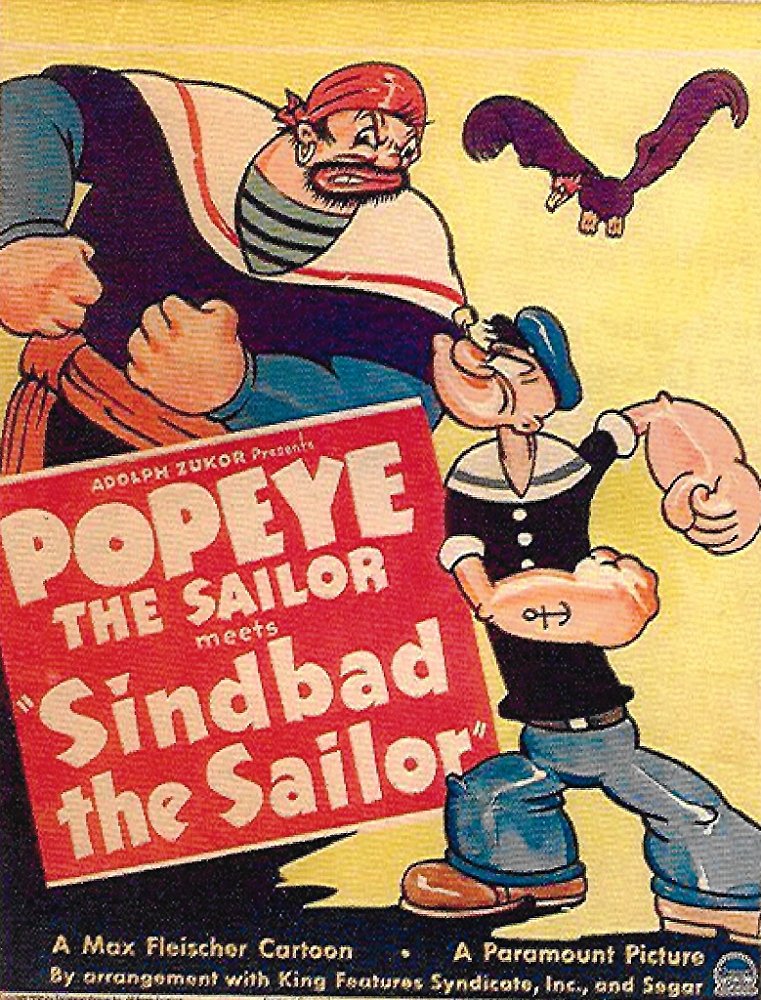
#156) Popeye the Sailor Meets Sindbad the Sailor (1936)

MV5BOWZiNmU0ZTgtODJlZC00MWExLTk5NjctNTVmNGMyM2VkYmNkXkEyXkFqcGdeQXVyMDMxMjQwMw@@._V1_SY1000_CR0,0,761,1000_AL_

#156) Popeye the Sailor Meets Sindbad the Sailor (1936)

OR “Hey World, I Yam What I Yam!”

Directed by Dave Fleischer

Class of 2004

The Plot: Three times the length of an average “Popeye” short (and the first in color), Popeye the Sailor (voiced by Jack Mercer) finds himself in an epic showdown with the legendary Sindbad the Sailor (as “played” by Bluto, voiced by Gus Wickie). Sindbad kidnaps Olive Oyl (voiced by Mae Questel), and Popeye must save her. But first he has to get through Sindbad’s island, filled with wild animals and monsters and very realistic set pieces. Good thing he always carries a can of spinach.

Why It Matters: The NFR mentions Popeye’s popularity in the ‘30s, “matched only by Mickey Mouse”, and then calls this short a “classic” and praises the sets. And that’s about it.

But Does It Really?: If you’re going to have only one “Popeye” short on the Registry, this is a good choice. It has all the conventions you want (Bluto kidnaps Olive, Popeye eats his spinach, Wimpy is Wimpy), plus the animation is an impressive undertaking of scope and presentation. Its inclusion is a no-brainer for me. The whole short is, well, strong to the finish.

Shout Outs: Sindbad states that Boola would “frighten King Kong”, an ape that definitely didn’t exist in the 17th Century. Speaking of, what’s the time frame on this one? Did Popeye time travel to the Abbasid Caliphate? Or is Bluto just claiming to be Sindbad in an Emperor Norton-type scenario?

Everybody Gets One: While not his only NFR appearance, it should be noted that Jack Mercer was the official voice of Popeye from 1935 to his retirement in 1980. Stage actor Gus Wickie took over the voice of Bluto from William Pennell for a brief time in the ‘30s, but he got the short that counts. And that’s Dave and Max’s brother Lou Fleischer as the voice of Wimpy.

Wow, That’s Dated: Dynamos as a major power source. And that’s the danger of getting permanent tattoos.

Seriously, Oscars?: The first of the two-reel Popeye Features, “Sindbad” was nominated for Best Animated Short Subject, but lost to Disney’s “The Country Cousin”. Enjoyable to be sure, but nowhere near as impressive an undertaking as “Sindbad”. A Popeye short never won in this category.

Other notes

  • No, that’s not a typo. The name of the title character is “Sindbad” with the extra D. It’s an acceptable alternative to “Sinbad”, no doubt an alternate translation from the original Arabic.
  • I know it’s a rough print, but the cast list only lasts for, like, two frames. Where’s Orson Welles when you need him?
  • This film makes use of the Fleischer “Steroptical Process”; backgrounds built from live action models with the animation superimposed over them. It gives a sense of dimension and depth similar to Disney’s multiplane camera.
  • For those of you keeping score: Number of NFR films directed by Oliver Stone: 0. Number of NFR films featuring J. Wellington Wimpy: 1. (2019 Update: With the inclusion of “Platoon”, this is no longer the case, but for 15 years this stat was absolutely true!)
  • Speaking of, despite his love of food being on display in this short, Wimpy does not say his classic line “I’ll gladly pay you Tuesday for a hamburger today.”
  • I thought Popeye could only perform feats of strength after he’s eaten his spinach. Yet he breaks down a brick wall earlier in the short with no problem. Did he switch to Kool-Aid?
  • Is Popeye a ventriloquist or does he project his thoughts?
  • I’m sure some Lit major out there is pissed that this version doesn’t follow the Sindbad legend too closely.
  • Where does Boola the two-headed giant fit into God’s plan?
  • Personally I don’t care for canned spinach. I prefer the leaf kind.

Legacy

  • The Fleischers made two more “Popeye Features”: 1937’s “Popeye the Sailor Meets Ali Baba’s Forty Thieves” and 1939’s “Aladdin and His Wonderful Lamp”. Both followed this film’s structure of Popeye walking through live-action miniatures and beating up characters from the Arabian Nights.
  • Ray Harryhausen cites this film as an influence on his own take on the Sindbad lore, fellow NFR entry “The 7th Voyage of Sinbad”.
  • “A live–action film adaptation of Popeye? I know, let’s get the guy who directed ‘The Long Goodbye’!”
  • I guess we were going to have an animated film sometime in the last few years? Popeye may be stuck in development hell for a while.
  • But seriously, is Popeye still a thing? Do kids know who he is? I watched him growing up, but that don’t mean nothin’ these days.