#742) Little Fugitive (1953)
OR “Joey’s Day Out”
Directed & Written by Raymond Abrashkin (aka Ray Ashley), Morris Engel, and Ruth Orkin
Class of 1997
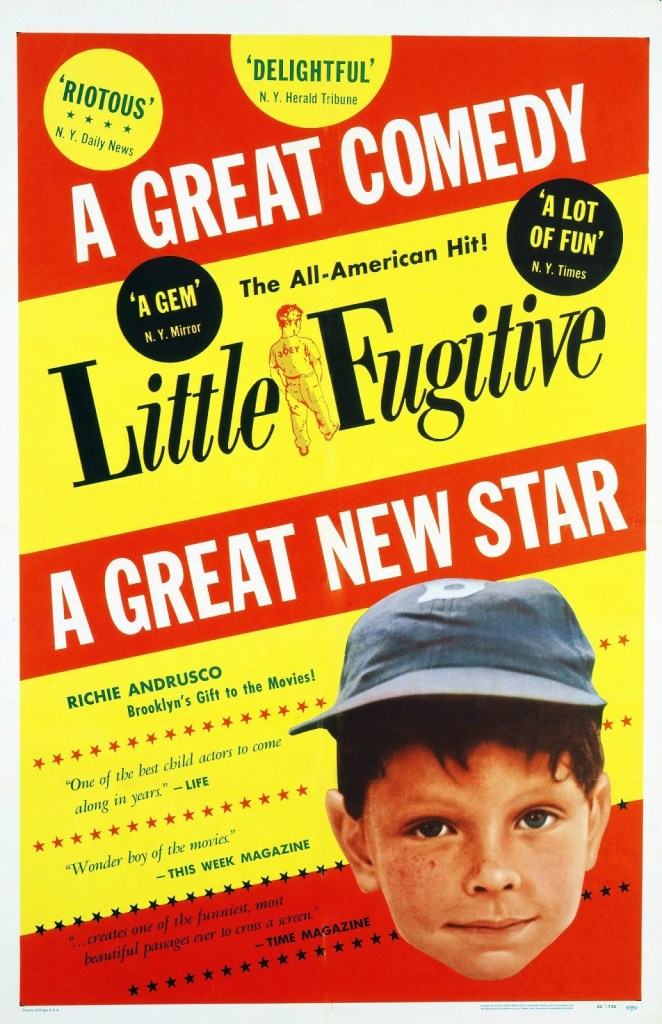
The Plot: Joey Norton (Richie Andrusco) is a seven-year-old boy living in a Brooklyn apartment with his older brother Lennie (Richard Brewster) and their mother (Winifred Cushing). When their mother leaves for a few days to take care of their grandmother, Lennie must cancel his plans to visit Coney Island and look after Joey instead. While playing with their friend Harry (Charlie Moss) and his dad’s rifle, Lennie and Harry prank Joey into thinking that Joey has fatally shot Lennie. Afraid that the police will get him, Joey takes the six dollars left for him by his mother and runs away to Coney Island. What follows is Joey’s adventures playing the games and riding the rides at the island’s Steeplechase Park, which in the hands of our trio of filmmakers becomes an endearing look at the world from a child’s perspective.
Why It Matters: The NFR praises the film’s “deft, mostly hand-held camera work” and the “unaffected acting” of Richie Andrusco. Unfortunately, the NFR write-up gets the brothers’ names mixed up, referring to Andrusco’s character as “Lennie” throughout the write-up. Whoops.
But Does It Really?: Despite being one of the Registry’s more obscure titles, “Little Fugitive” stands on the unique piece of ground I’m looking for in an NFR entry. While Hollywood was still producing lavish spectacle, three New Yorkers created an authentic, documentary-like story with a distinctiveness that holds up over 70 years later. Admittedly, I found the film’s opening scenes a bit grating, but once Joey took off for Coney Island, I could see what the filmmakers were going for and found the experience to be quite pleasant. A yes for “Little Fugitive” on the NFR, a quick, enjoyable movie and a harbinger of the independent film movement.
Everybody Gets One: Morris Engel was a photographer by trade, though in 1939 he got into filmmaking when he served as cinematographer on “Native Land” by his friend and fellow NFR director Paul Strand. During WWII, Engel was a photographer in the Navy, where he would have used the Cunningham Combat Camera, a small, chest-mounted movie camera that could be used in combat areas. After the war, Engel modified the Cunningham to make it less cumbersome for general use, and after unsuccessfully pitching a series of shorts utilizing this technology to different distributors, decided to go all in on a feature. “Little Fugitive” was created by Engel, his wife Ruth Orkin (an established photographer in her own right), and Raymond Abrashkin (credited here as Ray Ashley), a writer and colleague of Engel’s when they worked at the liberal newspaper PM in the early 1940s.
Wow, That’s Dated: Steeplechase Park (the amusement park on Coney Island that Joey visits), was already in decline by 1953, and the park closed after its 1964 season. The former site of Steeplechase Park has been developed and re-developed over the years and is currently home to the minor league stadium Maimonides Park. While a handful of rides from the neighboring Coney Island parks continue to operate, the Parachute Jump tower is the only remnant of Steeplechase Park still standing.
Seriously, Oscars?: At a time when independent films getting Oscar nods was unheard of, “Little Fugitive” managed to break in with one nomination for its Original Story. Abrashkin, Engel, and Orkin lost to Ian McLellan Hunter Dalton Trumbo for “Roman Holiday”.
Other notes
- Despite the title, “Little Fugitive” is not another Harrison Ford prequel series a la “The Young Indiana Jones Chronicles”.
- “Little Fugitive” was shot on a budget of $87,000 (about a million today). Richie Andrusco was not a child actor, being “discovered” by Engel and Orkin while riding the carousel at Coney Island. He was paid $250 a week (about $3000 today) for his performance. Thanks to the discreetness of Engel’s custom-made handheld camera, filming on Coney Island mainly went unnoticed by the public. Due to the camera’s limitations, however, only the picture was recorded, meaning the entire soundtrack was created after filming and editing.
- I will say from personal experience that this movie gets the older/younger brother dynamic down, though it goes on long enough without variation to become annoying. Thankfully, things improve once the film picks up steam and ditches the dialogue.
- The six dollars Joey and Lennie’s mother leaves them for groceries is about 70 dollars in today’s money. That is one very trusting mother.
- The NFR loves films like this that showcase slices of life in New York’s boroughs in the mid-20th century: this, “On the Bowery”, “In the Street”, “A Bronx Morning”. Always an important counterpart to the glamourous image of Times Square we associate with this period of the Big Apple.
- Ah yes, the antiquated innocence of childhood gunplay. Obviously, the conversation regarding firearms and their proximity/accessibility to children is very different today than it was in 1953, so you have to take this part of the movie with a grain of salt.
- Like I said, the movie really comes together once Joey heads off to Coney Island. The film’s bread-and-butter is long, dialogue-free scenes of Joey being a natural seven-year-old boy, running around like a kid in a candy shop and having adventures. It’s all very charming.
- The photographer that takes Joey’s picture in the cowboy cutout is played by Will Lee, the only professional actor in the cast. Lee was still about 20 years away from playing his most iconic character: Mr. Hooper on “Sesame Street”.
- Why does every hot dog in this movie look disgusting? I mean, hot dogs are disgusting, but these specific ones even more so. It must be how they’re cooked.
- The Coney Island scenes have a very similar vibe to the short “Johnny at the Fair”. “’Jiminy,’ thinks Johnny, ‘if only I could get a ride in one of those.’”
- My favorite part of the movie is the runner of Joey trying to knock down the milk bottles, practicing in-between games and improving over time. They don’t hit you over the head with it, just a child trying to reach a goal all by himself, conveyed solely through great visual storytelling.
- When Joey realizes he has run out of money and can’t do the pony rides, he heads to the most crowded beach I’ve ever seen (apparently this was a recurring issue at Coney Island). I laughed pretty hard once Joey realizes he can make money by depositing empty soda bottles he finds on the beach. Turns out business is booming for Joey that day; good thing we don’t litter this much anymore, right? [Nervous laughter]
- Jay Williams plays Jay, the pony ride attendant who assists Joey, and the only adult in this entire movie who questions why a seven-year-old is wandering around Coney Island alone. While Williams was primarily a writer, he did briefly perform stand-up at the Borsch Belt in the 1930s. He has a very genuine, sweet rapport with Joey.
- Look closely during the summer storm and you’ll see “The Greatest Show on Earth” advertised on the marquee of a nearby movie theater. If Joey went to the movies instead of Steeplechase Park, he too might have become one of the most influential movie directors of all time.
- As “Little Fugitive” was coming to its natural conclusion, I had the feeling that the film was going to have a cute ending where everything gets wrapped up neatly. It did, but I admit they stuck the landing and cut to the credits quickly enough that it didn’t overstay its welcome.
Legacy
- “Little Fugitive” was distributed by Joseph Burstyn Inc., which also distributed such acclaimed independent/international films as “Umberto D.” and “Fear and Desire”. After premiering at the Venice Film Festival in September 1953, “Little Fugitive” opened in New York that October, the first major release of a film shot with a handheld 35mm camera. The film was a hit, earning $500,000 in box office revenue.
- In addition to its surprise Oscar nomination, “Little Fugitive” won the Silver Lion at the 1953 Venice Film Festival. Typically, the Silver Lion goes to the film that came in second place to the Golden Lion recipient, but that year the jury had such a hard time choosing a winner they decided not to give out a Golden Lion and instead gave the Silver Lion to six films, including “Little Fugitive”, “Ugetsu”, and “Moulin Rouge” (the John Huston one).
- Of our creative trio, only Morris Engel continued filmmaking (Orkin co-directed their follow-up “Lovers and Lollipops” before returning to photography, and Abrashkin never made another film). Engel’s later films were shorts and home movies that have remained widely unseen by the public. Engel and Orkin were married until Ruth’s death in 1985. Morris Engel died in 2005, living long enough to see “Little Fugitive” make the NFR.
- Raymond Abrashkin would go on to co-write the “Danny Dunn” book series with “Little Fugitive” actor Jay Williams. Sadly, Abrashkin died of ALS only seven years after the release of “Little Fugitive”.
- To the best of my knowledge, at the time of this writing Richie Andrusco is still alive, and while “Little Fugitive” was his only film performance, he made a few TV guest spots, as well an appearance in a 2008 documentary on Morris Engel.
- The biggest cultural impact “Little Fugitive” has had on film came just a few years later, when Francois Truffaut used a similar documentary-style filmmaking approach when directing his breakthrough film “The 400 Blows”. Truffaut would go on to say that without “Little Fugitive”, there would be no French New Wave movement. How about that?
- And finally, “Little Fugitive” received a remake in 2006 by filmmaker Joanna Lipper. Other than the modern setting, the only major change is that now Joey and Lennie’s dad is not only still alive, but he’s in prison and he’s Peter Dinklage. The remake was well-received by critics and seems to have neither enhanced nor hurt the legacy of the original.
Further Clicking: Be sure to check out the “Little Fugitive” page on Morris Engel’s official website, which includes some rare behind-the-scenes photos of the film’s production, in color no less!
 The Horse's Head
One thought on “#742) Little Fugitive (1953)”