
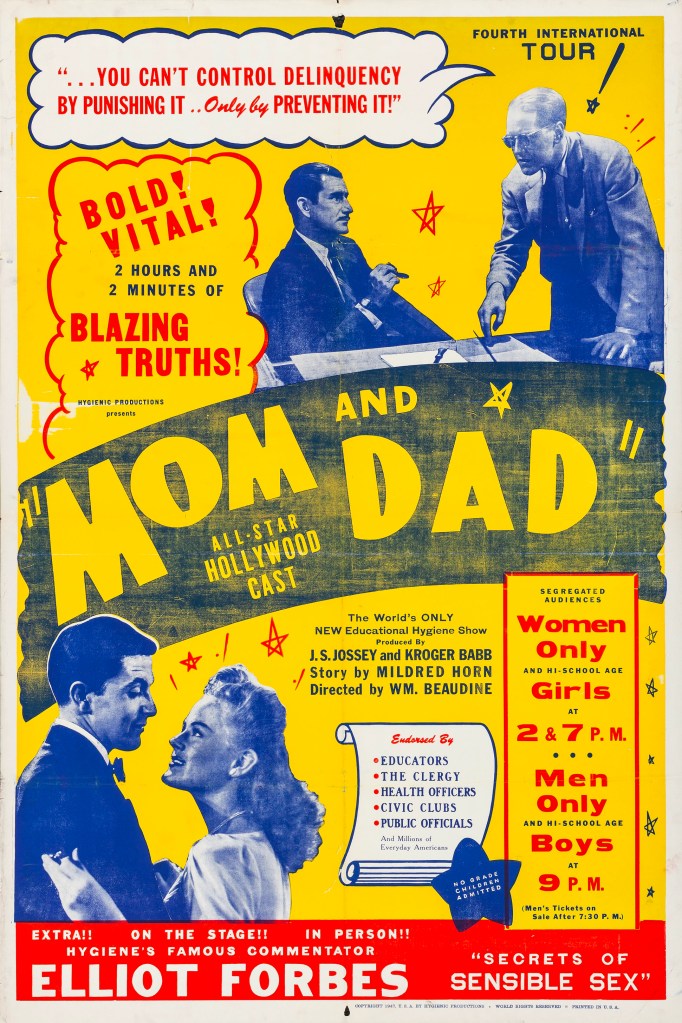
#791) Mom and Dad (1945)
OR “The Talk: The Motion Picture”
Directed by William Beaudine
Written by Mildred Horn
Class of 2005
The Plot: Joan Blake (June Carlson) is a teenager whose parents have conflicting views on their daughter’s budding maturity; father Dan (George Eldridge) thinks Joan should go to dances and start dating boys, while mother Sarah (Lois Austin) wants to protect Joan’s virtue by refusing to acknowledge any of this. When Joan sneaks out of the house to go on a date with fast-talking new kid Jack Griffin (Bob Lowell), they end up at Lovers’ Lane doing something shameful off-screen. A month later, Joan learns that she’s pregnant with Jack’s baby, and that Jack has died in a plane crash. Worried about how her parents will react, Joan doesn’t know who to turn to. Ultimately, she confides in Mr. Blackburn (Hardie Albright), a teacher recently fired for talking about sex education in his class, who blames Mom and Dad for their children’s lack of knowledge and awareness. But all of this is just an excuse to show some very graphic sexual hygiene films, including multiple on-camera births!
Why It Matters: The NFR cites the film as “[t]he most successful sex-hygiene exploitation film of all time”, and an essay by film professor/exploitation expert Eric Schaefer is a tribute to the film’s producer,“America’s Fearless Young Showman” Kroger Babb.
But Does It Really?: This is definitely one of the NFR’s more bizarre entries. Not only is “Mom and Dad” the rare exploitation film on this list, it’s also representation of Kroger Babb, one of the more notorious and unabashed showmen in film history. Plus, thanks to the film’s frank and controversial discussion of pregnancy and venereal diseases, you’ll definitely learn something, so you have to give Kroger points for that. “Mom and Dad” has the unique qualities I’m looking for in an NFR title, and if you’re willing to stomach some of the sex ed footage in the film’s third act, it’s an unforgettable viewing experience.
Everybody Gets One: Howard “Kroger” Babb began his professional career as a sports writer before working as the publicity director for a theatrical circuit. In 1939, Babb joined Cox and Underwood, a production company specializing in roadshow presentations of exploitation films. Depending on which version you believe, Babb was either inspired to make “Mom and Dad” based on his experience promoting “Dust to Dust” (a Cox and Underwood acquisition about teen pregnancy), or after learning about high school girls in Burkburnett, Texas getting impregnated by officers from the nearby Sheppard Air Force Base. Either way, Babb founded his own production company (Hygienic Productions) and partnered with J. S. Jossey of Monogram Pictures to make “Mom and Dad” for as cheaply as possible. Among Babb’s shameless promotional tactics for “Mom and Dad” was having an advance team arrive into towns about to screen the movie and write letters of protest to local churches and clubs!
Wow, That’s Dated: Mainly all the euphemisms the film uses in lieu of actual scientific terms. It’s not sexual activity, it’s “student romances”. It’s not venereal disease, it’s “social disease”. And easily the most cringe-inducing, Joan’s not pregnant, she’s “in trouble”. Yikes.
Other notes
- To help keep costs down, Babb assembled a team of behind-the-scenes talent from various Poverty Row studios in Hollywood known for being able to shoot an entire film in less than a week. Director William Beaudine (a silent film veteran famous for only shooting one take of a scene) completed production on “Mom and Dad” in six days on a budget of $65,000 (about $1.2 million today).
- Due to different cuts mandated by censor boards over the years, there are multiple edits of “Mom and Dad”. The version I watched was an Academy Archive restoration from three separate prints, which as best I can tell is the most complete edit of the film known to exist. The only scene missing that I found in my research was the film’s prologue: A sing-along rendition of “The Star Spangled Banner”. Clearly the word “pandering” was not in Kroger Babb’s vocabulary.
- Speaking of pandering, the film follows up the opening credits with a foreword attributed to the producers which announces the film’s thesis statement in no uncertain terms: “IGNORANCE IS A SIN – KNOWLEDGE IS POWER”. We won’t get rabble-rousing prologue text like this again until “Star Wars”.
- The dance sequence at the beginning of the film is presumably an attempt to pad out the runtime in order to be distributed as a feature. In addition to the love triangle between Joan, her date Alan, and flyboy Jack, we get a song (“Where Shall We Dream Tonight?”), a jitterbug dance competition, and a group of acrobats! What does any of this have to do with sexual hygiene? Am I reading too much into some of these acrobatic positions?
- Despite her leading role as Joan, June Carlson’s filmography didn’t really amount to a lot. In fact, “Mom and Dad” was one of Carlson’s last films before marrying movie producer Donald C. McKean and leaving showbiz to raise their children. As for the rest of the cast, I don’t have much to say, other than Mom sorta looks like if Danny Kaye played Cinderella’s Stepmother.
- Lots of ‘40s phraseology in this one, including the traditional use of the phrase “making love”. This leads to the disturbing-by-today’s-standards line from Joan: “Alan couldn’t make love if his mother did want him to.” God this movie is weird.
- When Joan and Jack sneak off to a nightclub for their forbidden date, we get another song (the vaguely suggestive “That’s What You Do”) that doesn’t serve the plot in any way. Alright, it’s feature-length! Move on!
- Mr. Blackburn isn’t allowed to teach sex education because of a few protests from the local women’s club, led by Joan’s mother. Good thing we don’t let the suppressed morality of the vocal minority dictate rules and laws now, right? …Right?
- Oh, and Mr. Blackburn’s actor Hardie Albright has another NFR connection: he’s the voice of Bambi during that movie’s “Twitterpated” sequence. Huh.
- I didn’t like that Jack boy from the start. Always pushing himself on Joan and manipulating her into having sex at Lovers’ Lane. And then, once Joan gets pregnant, he dies in a plane crash? So he doesn’t have to deal with any of this? That fucker.
- While the film does address such taboo subjects as underage sex and pregnancy, it’s all by implication. It’s a lot of people not finishing their sentences. “You mean she’s…”
- During its original theatrical run, “Mom and Dad” had an intermission in which “Famous Hygiene Commentator” Elliot Forbes would appear in person in the theater to lecture the audience on sex hygiene. In reality, “Elliott Forbes” was a local actor helping Hygiene Productions sell two books on the subject: “The Digest of Hygiene for Father and Son” and “The Digest of Hygiene for Mother and Daughter”. These books were edited by Mildred Horn, the film’s screenwriter and common-law partner of Kroger Babb. Man, it was a lot easier to con people back then. Side note: In at least one predominantly African-American theater that played “Mom and Dad”, the lecture was given by Jesse Owens, the former Olympic athlete who was attempting to diversify as his athletic offers started to dry up.
- The last third of “Mom and Dad” is definitely the hard sell, as Mr. Blackburn (now re-hired as the school’s sex education teacher) shows his students multiple educational shorts on the subject. We start off easy with an explanation of the female menstrual cycle (seen it) and how an ovum is fertilized by a sperm, but then “Mom and Dad” quickly becomes the second NFR title to feature an on-camera natural childbirth! It’s not as distressing as the one in “All My Babies”, but still tough to watch. This is followed by a second on-camera birth, this time via C-section. And just when you think it’s over, Mr. Blackburn shows another short graphically showcasing how syphilis and gonorrhea can destroy your body (including footage of both male and female sex organs effected by these diseases). “Mom and Dad” is in the “Pink Flamingos” category of NFR movies you shouldn’t watch right after a meal. It’s enough to make you choose celibacy (well…almost).
- In the midst of my own difficulties viewing these sex ed films, I managed to laugh out loud when the narrator tells us that venereal diseases are studied by “technicians trained in the use of a microscope”. Did people in the ‘40s not know how easy it is to use a microscope?
- Apparently there were two versions of this film’s ending: Joan gives birth to the baby and either a) the baby is stillborn or b) the baby is given up for adoption. I think I got the stillborn ending, but it’s spoken of very vaguely so I can’t tell for sure. Incidentally, the doctor delivering the news to Joan’s family is played by Francis Ford, older brother of John Ford and director of fellow NFR film “Unmasked”.
- As Joan’s brother Dave thanks God for taking care of his sister, we dissolve to the final shot: an unidentified man at a desk addressing the camera and telling us to let the theater management know how much we enjoyed the film “by your applause”. [Shakes fist in air] Kroger!
Legacy
- Despite not receiving a Production Code seal of approval and being banned in several states, “Mom and Dad” earned $16 million in its original theatrical run, making it one of the most financially successful films of the 1940s. Kroger Babb claimed that each of the film’s investors got a return rate of 63 times their investment.
- “Mom and Dad” attracted its share of controversy, with Kroger Babb being sued multiple times (he claimed over 400 times) to prevent “Mom and Dad” from being shown in theaters, with Babb always citing the film’s educational value as his defense. In the late 1940s, Babb eliminated the educational shorts from “Mom and Dad” and re-released the film under the name “Side Road”. This trimmed version saw competition from such similar films as “Because of Eve”, “The Story of Bob and Sally”, and “Street Corner”, all of which were created to cash in on the surprise popularity of “Mom and Dad”.
- Kroger Babb continued to produce and distribute movies for the next 25 years, although none of his later films ever equaled the success of “Mom and Dad”. Notable entries include “The Lawton Story” (about an Oklahoma town’s passion play), “One Too Many” (about alcoholism), and “She Shoulda Said No!” (which condemned marijuana a la “Reefer Madness”).
- Among the filmmakers influenced by “Mom and Dad” was John Waters, which…yeah I should’ve seen that coming.
 The Horse's Head
One thought on “#791) Mom and Dad (1945)”