As always, it’s quite the eclectic bunch, including several that I can’t believe hadn’t made the cut yet (“Imagine”? “Stairway to Heaven”? Where have you been?). Especially noteworthy is the Super Mario Bros. theme, further proof that the NRR is less stingy about the “National” qualification than the NFR (though the argument can be made that Super Mario has made a large enough impact on American pop culture). And shoutout to Crosby, Stills, Nash and Young, who I mentioned back in my “Woodstock” post hadn’t made the NRR yet. We did it!
Thanks for reading. Next post coming soon. Very soon. Like, right now.
The Plot: San Francisco liberals Matt & Christina Drayton (Spencer Tracy & Katharine Hepburn) are surprised when their adult daughter Joanna (Katharine Houghton) returns home unannounced. There’s an even bigger surprise when she brings home her fiancé, African-American doctor John Wade Prentice (Sidney Poitier). Despite their outspoken support of Civil Rights, Matt & Christina must now acknowledge their hypocritical discomfort with their daughter’s interracial relationship. An invitation to dinner is extended to not only John, but also his parents visiting from Los Angeles (Roy Glenn & Beah Richards) and family friend Monsignor Ryan (Cecil Kellaway). Looks like the appetizer for this meal is an extended dialogue on racial tolerance.
Why It Matters: The NFR mentions the film’s “movie milestones” as well as its “then-novel plot”, but the only superlatives go to Sidney Poitier for “his customary on-screen charisma, fire and grace.”
But Does It Really?: Like most of Stanley Kramer’s filmography, “Guess Who’s Coming to Dinner” is an Important Movie of its time. While the premise was controversial in 1967, the film has become almost quaint, and not without its own insensitive viewpoints. Regardless, “Dinner” is a time capsule of an important issue in the ’60s political landscape, as well as the final pairing of Tracy & Hepburn before Tracy’s passing. “Dinner” is worthy of NFR recognition, but if you’re looking for a more relevant representation of ’60s race relations, stick with “In the Heat of the Night“.
Everybody Gets One: After a string of New York theater productions, Katharine Houghton landed the role of Joanna Drayton thanks to her aunt: Katharine Hepburn (Houghton’s mother is Kate’s sister Marion). Although her film career never took off, Houghton still works as an actor and playwright, and often reflects on “Dinner” and her aunt in interviews.
Wow, That’s Dated: We will discuss the film’s stance on miscegenation in ’60s America as we go. Among the other dated items are references to Governor Lurleen Wallace, the Watusi, “We Can Work It Out“, and Arnold Palmer (the golfer, not the drink).
Seriously, Oscars?: Second only to “The Graduate” at the box office, “Guess Who’s Coming to Dinner” received 10 Oscar nominations, tied with “Bonnie and Clyde” for the most nominations. “Dinner” screenwriter William Rose took home Original Screenplay, and Katharine Hepburn received her second Best Actress Oscar. Hepburn did not attend the ceremony out of respect for Louise Tracy, present in the event of a win for her late husband.
Other notes
By 1967, Spencer Tracy and Katharine Hepburn had made eight films together, and had been romantically involved for over 25 years. Tracy’s health was in sharp decline, ailing from both hypertensive heart disease and type 2 diabetes. In order to make “Dinner”, Hepburn and Stanley Kramer put their salaries in escrow to cover Tracy’s insurance risk (Columbia wouldn’t insure him), and Tracy only filmed for three hours a day.
You’re all lucky Sidney Poitier is so damn charming. Poitier successfully balances John’s polite and respectful attitude towards Joanna’s parents with his steadfast personal convictions. It helps that Poitier was genuinely intimidated by Tracy and Hepburn, opting to perform his closeups to two empty chairs.
There is a 14 year age gap between John and Joanna, and an 18 year age gap between Poitier and Houghton! This is certainly the most progressive readout on the Michael Douglas Scale. I’m sure someone will bring up this concern in the movie. Any minute now…. Wait for it…
While Hepburn’s Oscar win may have been the result of sympathy for Tracy’s death, she is quite good in this. It’s fun to watch the openly progressive Kate play a woman forced to confront her inherent hypocrisy, and with Kate we see Christina’s inner struggle. Who knows if Hepburn’s performance is better than Anne Bancroft’s or Faye Dunaway’s, but it is certainly worthy of a trophy.
The film makes an effort to address every possible argument regarding interracial marriage, but no mention is made of the violent hate crimes against African-Americans throughout the ’60s. The film’s “love conquers all” thesis is optimistic and romantic, but given all that has transpired since (especially in recent years), it seems shallow to an almost dangerous degree. Keep in mind that this movie was directed and written by white people, which would no doubt be met with outcry today.
I’m enjoying Cecil Kellaway’s enthusiastic performance as Monsignor O’Stereotype. Fun Fact: Kellaway’s cousin was Edmund Gwenn, aka Kris Kringle from “Miracle on 34th Street“.
Christina telling her racist co-worker Hillary to “get permanently lost” is a highlight, though the moment has been repeated to death in every white savior movie of the last 50 years.
The Mel’s Drive-In that Tracy and Hepburn visit is still open! Side note: The man whose car Matt hits in the parking lot is played by D’Urville Martin, future “Dolemite” director.
Shoutout to Isabel Sanford, TV’s Louise Jefferson, as the Drayton’s maid Tillie. Sanford still has to play the stereotypical sassy domestic, but Tillie is a little more dimensional. Plus she gets that great monologue where she tells off John.
Despite this movie being an original script, it feels like an adaptation of a stage play. Kramer tries to spice it up with dolly shots and vistas of San Francisco, but it’s ultimately two hours of good actors talking on the same set.
The second half of the movie parallels “12 Angry Men” as various characters make their arguments and try to convince the others to “vote” their way. Good stuff, but it doesn’t help the “filmed play” vibe.
Roy Glenn and Beah Richards are just a tad too young to be Sidney Poitier’s parents, but they help elevate the material and bring some extra energy to the proceedings. Richards in particular nails her one monologue.
Already dated by the time the film came out: Mr. Prentice mentions that interracial marriage is illegal “in 16 or 17 states”. While true during production, the Supreme Court deemed anti-miscegenation laws unconstitutional in the landmark case of “Loving v. Virginia” in June 1967. Kramer opted not to cut the line, though he did delete a joke about Martin Luther King following King’s assassination in April 1968.
Spencer Tracy’s climactic summation is worth the wait, though it is hard to separate Matt’s final speech from Tracy’s final performance. Katharine Hepburn is genuinely tearing up in the background.
Legacy
Seventeen days after filming was completed on “Guess Who’s Coming to Dinner”, Spencer Tracy died of a heart attack in his home at the age of 67. “Dinner”, his final film, would be released six months later.
“Guess Who’s Coming to Dinner” was a hit across America, including the south, which prompted studios to reconsider how they market films with BIPOC leads.
“Dinner” is still referenced throughout pop culture, primarily for its title. At least seven sitcoms have named an episode “Guess Who’s NOT Coming to Dinner”, but the best variation goes to the 1973 adult film “Guess Who’s Coming”.
Why mention the 2005 Bernie Mac/Ashton Kutcher remake “Guess Who” when I could bring up Jordan Peele’s spiritual remake “Get Out” instead?
And finally, Carl Fredricksen from “Up” was partially modeled after Spencer Tracy from this movie, complete with glasses.
As a life-long Californian, I have yet to visit New Orleans or witness a Mardi Gras parade. While I had a lot of fun researching New Orleans’ Mardi Gras celebration, this post can only scratch the surface of my findings. For more information, I recommend the city’s Mardi Gras website, as well as Arthur Hardy’s annual Mardi Gras Guide (more about Mr. Hardy later).
The Plot: As the title suggests, “Mardi Gras Carnival” is footage from New Orleans’ annual Mardi Gras parade on February 22nd 1898, specifically the floats from local parade group (or “krewe”) the Rex Organization. In just under two minutes, the excitement and festivity of Mardi Gras is captured, as well as an appearance by Rex, the King of Carnival (Charles A. Farwell) atop his throne. “Mardi Gras Carnival” is not only the earliest known film of New Orleans’ annual celebration, but the earliest known film of New Orleans period.
Why It Matters: The NFR write-up is mostly an appreciation of the Eye Filmmuseum (who rediscovered the film) and their efforts to preserve silent movie over the years. The only film-specific description in the write-up is the mention of “dazzling floats, paraders and spectators (almost all wearing hats).”
But Does It Really?: No doubt about it, “Mardi Gras Carnival” is on this list because of its “lost-and-found” status (aka its “Belloq film” status, because I refuse to let that go). But in addition to its rediscovery, “Mardi Gras Carnival” is an important and rare document of its time, and a good excuse for people like me to do a deeper dive into this time-honored tradition. New Orleans’ Mardi Gras parade is a world-renowned event, and a registry of American film would be incomplete without it.
Nobody Gets One: “Mardi Gras” joins the elite group of NFR films lacking documentation of who actually filmed it. Someone’s kicking themselves right about now. What we do know is that it was filmed by American Mutoscope, later known as Biograph and makers of such NFR films as “Rip Van Winkle” and “A Corner in Wheat“. “Mardi Gras” was filmed on Mutoscope’s 68-millimeter film stock, which doesn’t have the sprocket holes of your typical film strips, and therefore can record a picture quality equivalent to an IMAX movie.
Wow, That’s Dated: In terms of Mardi Gras traditions, the big difference is the appearance of the Boeuf Gras (“Fatted Ox”). Representing the last meat you can eat before Lent, the Boeuf Gras is presented in this film as an actual bull on one of the parade’s floats (and looking none too happy about it). Although the Boeuf Gras is still a part of the Mardi Gras tradition, it is more humanely represented as a papier-maché.
Other notes
First and foremost, a super oversimplified history of Carnival/Mardi Gras. First observed in medieval Europe, Carnival is a period of debauchery through January and February leading up to Ash Wednesday and the beginning of Lent, the more repentant 40 day observance prior to Easter Sunday. The day before Ash Wednesday -Fat Tuesday (or in French, “Mardi Gras”)- is the apex of the Carnival season, when most of the major parades take place. Mardi Gras came stateside in 1699, when the Le Moyne brothers were sent by King Louis XIV to explore the Louisiana territory (still owned by France at this point). The first organized Mardi Gras celebration in the Louisiana territory was in Mobile, Alabama in 1703 by French settlers, with the celebration spreading throughout French Louisiana. Although the date of the first Mardi Gras celebration in New Orleans (the then-capital of French Louisiana) is unknown, the first Mardi Gras parade in New Orleans was in 1857, organized by the Mistick Krewe of Comus. While there are many Mardi Gras parades across the United States, New Orleans’ is the most famous and most popular.
The Rex Organization was founded in 1872, initially as a way of honoring visiting royalty Grand Duke Alexei of Russia. To this day, the Rex Krewe continues to play a major role in Mardi Gras celebrations, and has held more parades than any other krewe in New Orleans history.
The Rex Krewe’s parade theme for 1898 was “Harvest Queens”, which I feel would take on a whole new meaning nowadays. Each float was a different crop, with “Mardi Gras Carnival” prominently featuring the Pineapple float, which includes several riders dressed as pineapples. …I guess you had to be there.
The silver bells that you see inbetween each float were meant to represent the 25th anniversary of the Rex Krewe (which was actually the year before but who cares?).
Funnily enough, in all my research I couldn’t find anything that could conclusively tell me which street this was filmed on. If the Rex Krewe took the same route in 1898 that they do today, it’s most likely that “Mardi Gras Carnival” was filmed from a spot on St. Charles Street, where the bulk of their route is. Any locals willing to verify this?
The climax of both parade and film is the King of the Carnival float, with Rex himself (as played by local Charles A. Farwell) waving his scepter at the crowd. Farwell’s granddaughter, Lynne Farwell White, was shown the film upon its discovery, and called seeing footage of her grandfather for the first time “a special moment”.
To the best of my knowledge, the only other NFR film that involves Mardi Gras is the last bit of “Easy Rider“. Very different approach, of course.
One major aspect of Mardi Gras that appears to be missing from the film is bead tossing. The tradition of throwing trinkets from parade floats is almost as old as the parade itself, with different krewes throwing different items from their floats as per their traditions, with beads and medallions being most well known. As for the other thing most outsiders (myself included) know about bead tossing: the official Mardi Gras website has a pretty thorough debunking of the common misconception that a woman needs to, ahem, show herself in order to get beads. That is not, nor has it ever been, a thing.
Legacy
After its production in 1898, “Mardi Gras Carnival” seems to have disappeared completely. Cut to the 1980s, when Arthur Hardy, the aforementioned Mardi Gras guide publisher, first learned of the film’s existence from a listing in a silent film catalog. Hardy’s attempts over the years to locate the film, including reaching out to various film archives like AMPAS and the Library of Congress, were unsuccessful. In anticipation of the Rex Krewe’s 150th anniversary in 2022, and its upcoming exhibition in New Orleans’ Louisiana State Museum, Hardy requested the museum try to find the film. The museum contacted lawyer and Rex Organization historian Will French, who in turn reached out to his friend Mackenzie Roberts Beasley, a film archivist at the Eye Filmmuseum in Amsterdam. In March 2022, “Mardi Gras Carnival” was discovered in the Eye Filmmuseum’s archives (though how it got all the way to Amsterdam is anyone’s guess). “Mardi Gras Carnival” was screened for the first time in June 2022, shortly thereafter becoming a permanent fixture in the Louisiana State Museum, and being inducted into the NFR six months later.
Mardi Gras is still going strong in New Orleans, as is the Rex Krewe, who will have 26 floats in this year’s parade. Incidentally, their theme for 2023 is “Palio Di Siena”, so I assume there will be lots of horses.
As for my own annual Mardi Gras traditions, I will be giving up the same thing I give up for Lent every year: Lent.
Six years is the iron anniversary, so enjoy this…horse with a nose piercing?
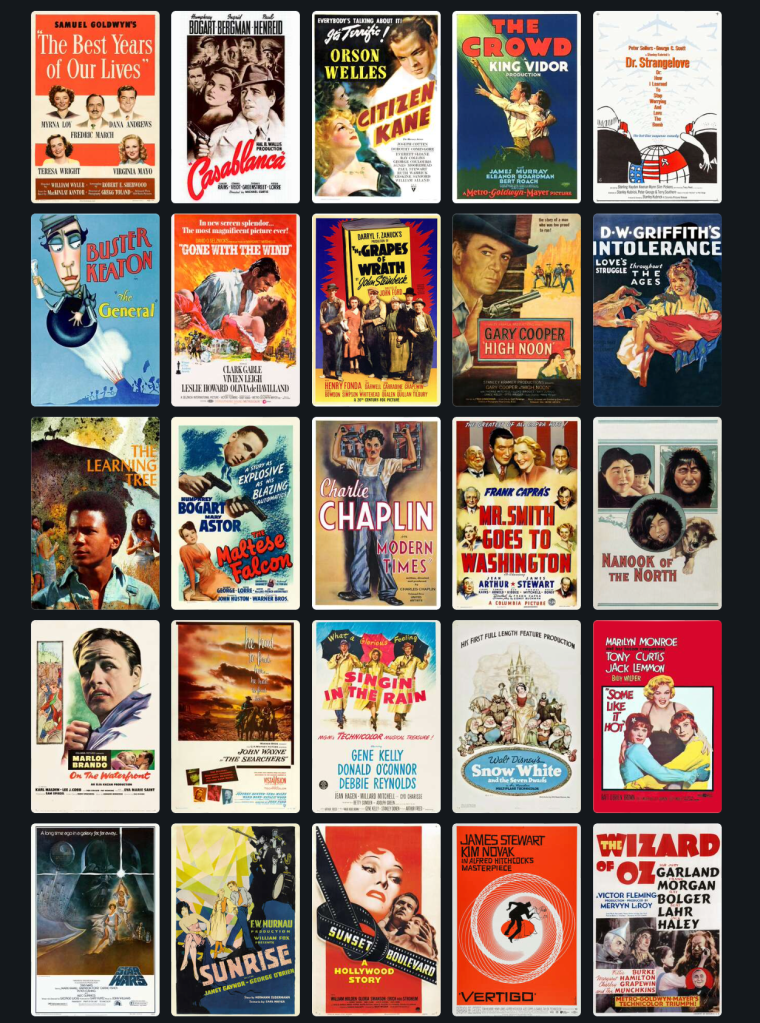
It’s the 6th anniversary of The Horse’s Head! As I reflect on the 600+ movies I have covered so far on the blog, I wanted to do something a little different. This is a list of my 100 favorite movies I have covered on the blog so far. Please keep in mind this is not my pick for the 100 greatest movies ever, nor my 100 all-time favorites. Think of these more as my Horse’s Head staff picks. Most were favorites before I started this list, but a surprising amount are movies I discovered here for the first time. Presented in alphabetical order, because ranking takes too much time.
Thanks for sticking with me for six years. More to come.
Happy Viewing,
Tony
12 Angry Men (1957)
2001: A Space Odyssey (1968)
Airplane! (1980)
All About Eve (1950)
All That Jazz (1979)
All the President’s Men (1976)
Anatomy of a Murder (1959)
The Apartment (1960)
Back to the Future (1985)
Beauty and the Beast (1991)
Blazing Saddles (1974)
Bonnie and Clyde (1967)
Casablanca (1942)
Chinatown (1974)
The Conversation (1974)
Cool Hand Luke (1967)
Destry Rides Again (1939)
Disneyland Dream (1956)
Dog Day Afternoon (1975)
Do the Right Thing (1989)
Dr. Strangelove (1964)
The Empire Strikes Back (1980)
E.T. the Extra-Terrestrial (1982)
Eve’s Bayou (1997)
Fantasia (1940)
Forrest Gump (1994)
Freedom Riders (2010)
The Front Page (1931)
Funny Girl (1968)
The Godfather (1972)
The Graduate (1967)
Grey Gardens (1975)
Groundhog Day (1993)
Growing Up Female (1971)
Hair Piece: A Film for Nappyheaded People (1984)
The Heiress (1949)
It’s a Wonderful Life (1946)
Jaws (1975)
The Kidnappers Foil (c. 1936-c. 1952)
Lambchops (1929)
Laura (1944)
Let’s All Go to the Lobby (1957)
The Maltese Falcon (1941)
Marty (1955)
Mary Poppins (1964)
The Middleton Family at the New York World’s Fair (1939)
Multiple SIDosis (1970)
The Muppet Movie (1979)
The Music Box (1932)
The Music Man (1962)
My Fair Lady (1964)
National Velvet (1944)
Network (1976)
A Night at the Opera (1935)
North by Northwest (1959)
Pariah (2011)
Peege (1972)
Peter Pan (1924)
Planet of the Apes (1968)
Precious Images (1986)
The Producers (1967)
Psycho (1960)
Pulp Fiction (1994)
Raiders of the Lost Ark (1981)
Rear Window (1954)
Rebecca (1940)
Roman Holiday (1953)
She’s Gotta Have It (1986)
The Shop Around the Corner (1940)
Show People (1928)
The Silence of the Lambs (1991)
Singin’ in the Rain (1952)
Snow White and the Seven Dwarfs (1937)
Some Like It Hot (1959)
The Sound of Music (1965)
Star Wars (1977)
Stop Making Sense (1984)
A Streetcar Named Desire (1951)
Sunset Boulevard (1950)
The T.A.M.I. Show (1964)
Theodore Case Sound Test: Gus Visser and His Singing Duck (1925)
The Plot: Alike, aka Lee (Adepero Oduye), is a Black teenager struggling to keep her sexual identity hidden from her parents (Charles Parnell and Kim Wayans), to the disappointment of her out-and-proud best friend Laura (Pernell Walker). Although Alike’s parents suspect their eldest daughter is gay, they say nothing, dismissing it as a phase and focusing instead on their deteriorating marriage. As Alike starts to develop feelings for her classmate Bina (Aasha Davis), the struggles of teenage emotions are only further exacerbated by the pressure Alike feels to conform to parents’ ideals. It’s a touching coming-of-age movie that introduced us to the filmmaking talents of Dee Rees.
Why It Matters: The NFR gives a rundown of Dee Rees’ journey to making “Pariah”, calling it “a key film in modern queer cinema”. Kim Wayans’ “emotional performance” is also highlighted.
But Does It Really?: Spoiler: This post will be one of my total gush-fests. This was my first time watching “Pariah”, and I absolutely loved it. All throughout “Pariah”, I was reminded of an important rule in filmmaking: No matter what kind of movie you’re making, always tell your truth. In a remarkably confident feature film debut, Dee Rees shows us her truth about being a Black queer woman in America, and the result is an emotionally gripping, pitch-perfect movie. “Pariah” is a film that I’m embarrassed to admit was not on my radar, but I’m glad the film exists, and especially glad the NFR has inducted it, guaranteeing that future generations of film lovers will seek out this wonderful film.
Everybody Gets One: Born and raised in Nashville, Tennessee, Dee Rees initially had zero filmmaking aspirations, until her job in brand management found her on a shoot for a Dr. Scholl’s commercial. She enrolled in NYU’s Tisch School of the Arts and was mentored by, among others, Spike Lee, who hired Rees as an intern on his film “Inside Man” (Lee would subsequently be an executive producer on “Pariah”). It was also during her time at NYU that Rees came out to her parents, and she wrote “Pariah” as a way of working through how she was feeling at the time. For her graduate thesis, Rees took the first third of her “Pariah” script and made it into a short film, with actors Adepero Oduye, Pernell Walker, and Sahra Mellesse appearing in both the short and the eventual film.
Wow, That’s Dated: Although there isn’t too much that dates “Pariah” to the late 2000s, we do get plenty of flip-phones, plus a passing reference to the ancient art of CD burning.
Seriously, Oscars?: No Oscar love for “Pariah”, but the film did receive its share of critics awards, and won the John Cassavetes Award (best film made for under $500,000) at the Independent Spirit Awards.
Other notes
Like many an indie before and after, “Pariah” was shot on a shoestring budget. In fact, at no point during production did Rees and her team have the entire budget at the same time, instead applying for various grants, and then applying for more once that money ran out. In addition, because they believed in the film’s importance, the crew worked on the film for free, only getting paid their rates after “Pariah” got a distribution deal, which was never guaranteed.
One of Dee Rees’ production hacks bears repeating for its sheer brilliance. The “Pariah” team could not afford a location manager for on-location shooting, so Rees hired a realtor, who showed her a three-story brownstone in Brooklyn that wasn’t selling (this being the Recession and all). Rees rented the brownstone for two months, with each story serving as a different character’s apartment. Genius!
The moment that got me hooked on this movie was watching Lee, on the bus coming home from a lesbian bar, changing into more “feminine” clothes before she gets home. This simple moment told me everything I needed to know about this movie and its protagonist, and I was feeling for Lee every second after that.
Shoutout to this whole ensemble, especially Adepero Oduye, who convincingly plays a teenager even though she was in her early 30s during production! Co-star Aasha Davis was in her late 30s, and adheres to a version of my patented “Ponytail Stratagem” called the “Headband Subterfuge”: the use of a headband to make yourself appear younger. Bina’s rarely without one in this film. Side note: Aasha Davis is currently a regular on “Drunk History”!
This may be the first NFR movie to feature a strap-on. I say “may” because I still haven’t seen “Boys Don’t Cry”, the only other movie on this list that could realistically have one. [UPDATE: Make that two]
One of the things I noticed about the acting in “Pariah” is – interestingly enough – connected to its cinematography. The film is shot mostly in close-ups and mediums. There are very few wide-shots, giving the whole film an intimate, borderline claustrophobic feel. This of course means that the acting can’t be too broad, as it would appear overblown when shown on a big screen. The “Pariah” cast across the board does a wonderful job of playing their characters with realistic subtleties.
Shoutout to Kim Wayans, wonderfully powerful as Audrey, and the first member of the Wayans family to make the NFR. I predict Marlon will be the next one thanks to his work in “Requiem for a Dream”. Kim also gets the only line in the movie that got a genuine laugh from me: “Too much lip gloss”.
Two notes on Charles Parnell: 1) With his rich, commanding tone, it is no surprise he has found a steady career in voiceover and 2) He most recently appeared in “Top Gun: Maverick” which, since my “Top Gun” post from two years ago, has finally been released and is like the greatest movie of all time or something like that I guess.
I didn’t take a lot of notes during my viewing of “Pariah” – always a good indication that I’m enjoying the movie – but there was something even more incredible about this viewing for me. I didn’t feel my usual urge afterwards to do a lot of research or over-contextualize the film for this blog post. Part of that is because the film is so recent, with admittedly a shorter legacy. But more importantly, the film felt so real to me. It was alive. I believed these characters as real people, and felt for them in their struggles. I bought the film’s reality so much that I didn’t want to pull back the curtain and learn about the actors or the process, and it was a few days before I finally felt up to the task. I can’t think of another movie that had this kind of effect on me.
Overall, my reaction to “Pariah” was the same as Mrs. Alvarado’s reaction to Lee’s poem at the end: All I could really do when the movie ended was nod my head and say “Yeah…yeah…” The film said everything it needed to say, and said it beautifully. Also, at 86 minutes, thank you Dee Rees for reminding us all that great movies don’t need to be so goddamn long.
A few takeaways from the end credits: “Pariah” is one of the few movies to credit its background extras, and is most likely the first NFR movie to be partially funded by Kickstarter.
Legacy
“Pariah” premiered at the Sundance Film Festival in January 2011, with Focus Features picking up the distribution rights, giving the film a limited release of 24 theaters in December 2011. “Pariah” was only the second Black queer film by a woman to receive a major release (the first was fellow NFR entry “The Watermelon Woman”). While the film did okay in its run, it was a critical success, and even got a shoutout from Meryl Streep at that year’s Golden Globes! In the last decade-plus, “Pariah” consistently appears on critics list of great films by queer directors.
Dee Rees’ next film was the HBO movie “Bessie” (with Queen Latifah as Bessie Smith). Her next theatrical film was 2017’s “Mudbound” which earned Rees an Oscar nomination for Adapted Screenplay, the first Black woman ever to be so honored.
The 2010s saw an uptick in more diverse films getting made and recognized, including such notable films about Black queer identity as “Tangerine” and “Moonlight”. While we still have a long way to go making sure Black queer voices are heard in American films, “Pariah” is one of the movies that helped open the door a little wider.