#22) All the President’s Men (1976) [Original 2017 Post]

all_presidents_men

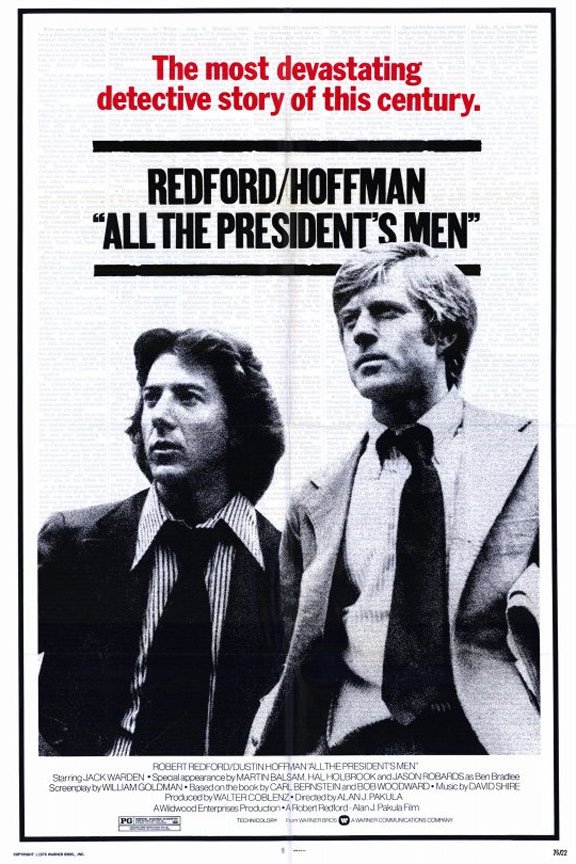
#22) All the President’s Men (1976)

OR “Watergate-gate”

Directed by Alan J. Pakula

Written by William Goldman. Based on the non-fiction book by Carl Bernstein and Bob Woodward.

Class of 2010

The film’s post-Oscar noms trailer

This is my original post about “All the President’s Men”. You can read the revised and expanded version here.

The Plot: It’s 1972 and there’s a break-in at Washington D.C.’s Watergate complex. Rookie Washington Post reporter Bob Woodward (Robert Redford) is sent to investigate, and learns that a few of those convicted have CIA connections. Under the guidance and support of editor Ben Bradlee (Jason Robards), Woodward is paired up with fellow reporter Carl Bernstein (Dustin Hoffman) and the two continue their research. What they find may be the biggest scandal of the 20th century, as well as the reason why we now have to add the suffix “-gate” to any political controversy.

Why It Matters: The NFR praises Pakula’s “taut directing” and calls the film “a rare example of a best-selling book transformed into a hit film and a cultural phenomenon in its own right”.

But Does It Really?: Oh yes. Not only is it a great representation of ‘70s politics during the actual decade, but it is also a surprisingly suspenseful film. It’s a lot of talking and a lot of dry politics (plus it’s a story that everyone knows the ending to), but between Pakula, Goldman, and cinematographer Gordon Willis, the film keeps you at attention trying to figure out just how Woodward and Bernstein pulled this all off. A great reminder that the truth is a very powerful thing, and no one – NO ONE – is immune to it.

Everybody Gets One: This is the only appearance on the Registry for future Oscar nominees Hal Holbrook & Jane Alexander, future Oscar winner F. Murray Abraham, TV stars Meredith “Mrs. Keaton” Baxter, Polly “Flo” Holliday & Dominic “Junior” Chianese, stage actors Penny Fuller & John McMartin, former actor/current scumbag Stephen Collins, and Watergate security guard Frank Wills (For real, that’s the actual Watergate security guard playing himself).

Wow, That’s Dated: Well, journalism as a high-profile, respected profession, am I right folks? But seriously, there are the usual things like rotary/pay-phones. But I think the most impressive dated part of this is all the research they had to do without the aid of the Internet. Which is a shame because I found this Wikipedia page that would have saved them a lot of time.

Seriously, Oscars?: In a very competitive year that included “Taxi Driver”, “Network” and “Rocky”, “All the President’s Men” was nominated for eight Oscars and won four; Adapted Screenplay for Goldman, Supporting Actor for Jason Robards (a perfectly fine performance from someone who didn’t make a lot of films), Art Direction (I presume for its detailed recreation of the Washington Post office), and Sound (For essentially the first and last 30 seconds of the film). Despite nominating Robards and Jane Alexander (for a performance that clocks in at around 5 minutes), the Academy failed to nominate either Redford or Hoffman. In addition, the Oscars continued their proud tradition of snubbing Gordon Willis.

Other notes

  • That has got to be one of the best opening shots in any movie. Now that’s how you start a film!
  • How did Martin Balsam get the credit “Special Appearance by”? And why are so many actors listed in the credits as “Guest Stars”? This ain’t “The Love Boat” for crying out loud!
  • Bob Woodward wishes he were that handsome in real life.
  • Seeing as how this is a blog about the National Film Registry, I feel obligated to mention that a scene in this film takes place at the actual Library of Congress.
  • This film features a mini-reunion of 2 Angry Men: Jurors #1 & #7 (Martin Balsam & Jack Warden, respectively). Also, Balsam co-starred with Jason Robards in one of my favorite movies; 1965’s “A Thousand Clowns”. It seems like every time these two got together, one of them won an Oscar.
  • I appreciate that this film does not give a crap about either Woodward or Bernstein’s personal lives. Pakula and Goldman (as well as Redford and Hoffman) recognize that this story is much bigger than any of them.
  • A scene was written but not included in the final cut in which Washington Post publisher Katharine Graham questions Woodward. The story goes that for this one scene they tried to get such heavy-hitters as Lauren Bacall, Patricia Neal, and Geraldine Page to play Ms. Graham. I wonder what happened?
  • Side-note; the potential casting of Lauren Bacall as Katharine Graham intrigues me because she had been divorced from Jason Robards for about 6 years at this point in time. Layers upon layers that never were.
  • Did you know that Richard Nixon delivered his famous “I’m not a crook” speech at the Contemporary Resort at Walt Disney World? It’s not directly connected to this film, but it’s a weird fact that I feel bears repeating.

Legacy

  • Hmmm…. journalists trying to take down a corrupt president. Something seems…nope, there’s nothing wrong here.
  • This film gave us the phrase “Follow the money” (something the real Deep Throat never actually said), as well as mainstreaming the phrases “non-denial denial” and the ever-popular “ratfucking”.
  • Woodward and Bernstein’s follow-up book, “The Final Days”; essentially the post-Watergate events from Nixon’s point of view. The book was eventually turned into a TV movie starring the always-dependable Lane Smith.
  • The 1999 film “Dick”; which suggests that Nixon was actually taken down by Kirsten Dunst and pre-fame Michelle Williams.
  • Hal Holbrook’s critically acclaimed solo show “Deep Throat Tonight!”
  • Chris Carter has said that this film was a major influence on that there “X-File” show.
  • Best Picture Oscar Winner “Spotlight”, which features Ben Bradlee’s son as a major character and definitely emphasized the “All the President’s Men” parallels during its Oscar campaign.

Further Viewing: “All the President’s Men Revisited”; a documentary on Watergate 40 years after the fact, with some observations from Redford and Hoffman about the film. Stay tuned towards the end to see Ben Stein cry.
Things I’d Like to See Happen at This Year’s Oscars


JIMMY KIMMEL

  • For her 20th nomination, Meryl Streep wins a free 8-inch sandwich from a participating Quiznos.
  • John Travolta spends 45 minutes trying to introduce “Moana” star Auli’i Cravalho.
  • “La La Land” only wins one category: Best Internet Backlash.
  • Instead of presenting Best Picture, Warren Beatty & Faye Dunaway just make out the whole time.
  • Dev Patel wins Supporting Actor, leads audience in high-energy flash mob.
  • Producers realize halfway through the show they hired the wrong Jimmy.
  • Winner gets cut off by orchestra, bludgeons musical director Harold Wheeler to death with their Oscar.
  • Through the magic of modern CGI, Best Visual Effects presented by slightly off-looking Peter Cushing.
  • They introduce something called “Electoral Oscars”.
  • The Academy finally gets around to nominating “Hoop Dreams”.
  • One of the night’s big winners declares, “Isn’t this all kinda phony?”
  • Entire ceremony cancelled, replaced with 3-hour “ShondaLand” marathon.

#21) Michael Jackson’s Thriller (1983)

thriller-jpg1#21) Michael Jackson’s Thriller (1983)

OR “NFR Meets MTV”

Directed by John Landis

Written by John Landis & Michael Jackson. The song “Thriller” written by Rod Temperton.

Class of 2009

Watch the entire video here.

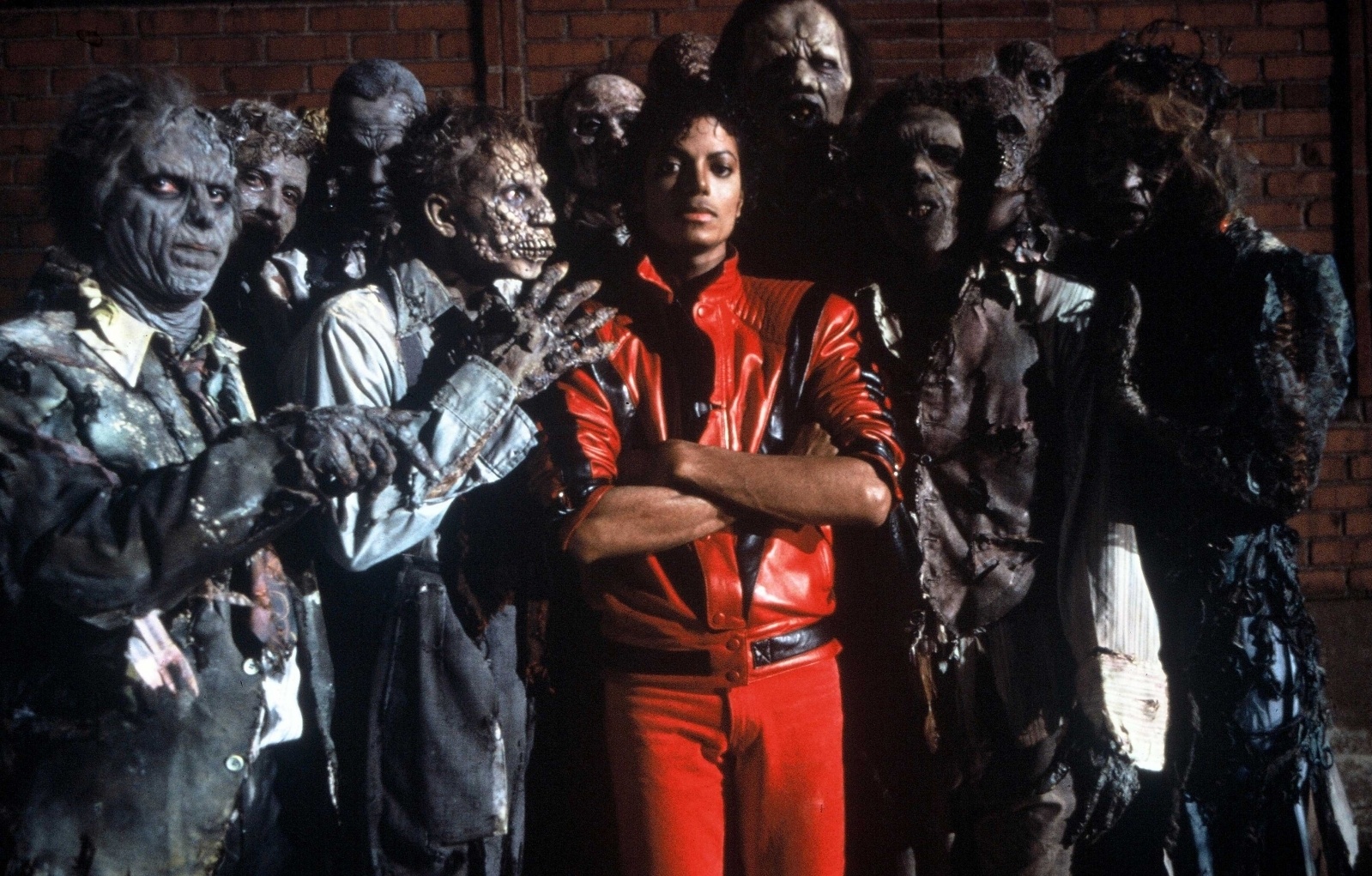
The Plot: Michael (Michael Jackson) and his girlfriend (Ola Ray) walk home from seeing a scary movie (starring themselves?). As they pass a graveyard with its own fog machine, Vincent Price reads some scary narration as zombies rise from the graves. The couple tries to escape, but it’s too late; Michael is a zombie, and boy can he dance.

Why It Matters: The NFR calls it “the most famous of music videos” and acknowledges the film’s production values as far more elaborate than the standard for music videos of the time.

But Does It Really?: Well, if you’re going to put one music video on the Registry, this is the one. Here’s how big the impact of “Thriller” is; I have never actually seen the film in its entirety until now, but I somehow already knew the entire choreography. We’re still not too far removed from Jackson’s…let’s say interesting time on Earth, but where it counts, Jackson knew how to entertain, and “Thriller” is the perfect embodiment of an artist in peak form.

Shout Outs: A “House of Wax” poster appears in the movie theater lobby.

Everybody Gets One: Ola Ray is possibly the only Playboy Playmate to make it on the Registry.

Wow, That’s Dated: I mean, if you want to know what 1983 looked and sounded like, this video is a good place to start.

Seriously, Oscars?: To qualify for the 1983 Oscars, “Thriller” played a short run in a Westwood, Los Angeles theater. It didn’t help. The film did, however, win a Grammy and three MTV Awards.

Other notes

  • The film that “Thriller” played before to qualify for the Oscars? A re-release of “Fantasia”. Now THAT’S a double feature!
  • I try not to pick the viewing order for this blog too far out in advance – or with any rhyme or reason – but I was not expecting John Landis to be my first repeat director on the list. Take that, Hitchcock.
  • Speaking of Landis, I hear you, guy who says, “See You Next Wednesday”.
  • Does MJ turn into a muskrat at the beginning?
  • Shout-out to makeup legend Rick Baker for his work on this film. Gotta love a tangible monster effect without a single frame of CG.
  • How did the zombies sneak up on Michael and Ola? I feel like the undead make their presence known far in advance.
  • Vincent Price is listed in the end credits as performing the ‘Rap’. Now I know I’m as white as they come, but that ain’t rap.
  • This has got to be the only film whose “Making Of” special is longer than the film itself.

Legacy

  • Well, every music video with a story since then, but let’s focus on the one where Michael Jackson turns into a car.

https://www.youtube.com/watch?v=p2AgUudfcQA

  • Captain EO

https://www.youtube.com/watch?v=KQADoOeaDxQ

  • This video from a Philippines prison.

https://www.youtube.com/watch?v=hMnk7lh9M3o

  • From the film “Donga”, “Golimar” aka “Indian Thriller” aka “Girly Man”

https://www.youtube.com/watch?v=x81iip6psks

  • Werewolf Bar Mitzvah

https://www.youtube.com/watch?v=Zxk_P3PNuZU

  • Jackson’s jacket in this video is so damn iconic it has its own Wikipedia page.

Listen to This: The entire Thriller album was inducted into the National Recording Registry in 2007. Want more? The NRR includes an essay by MJ historian Joseph Vogel. Still craving? How about their interview with “Thriller” producer Quincy Jones? At long last will that make you happy?

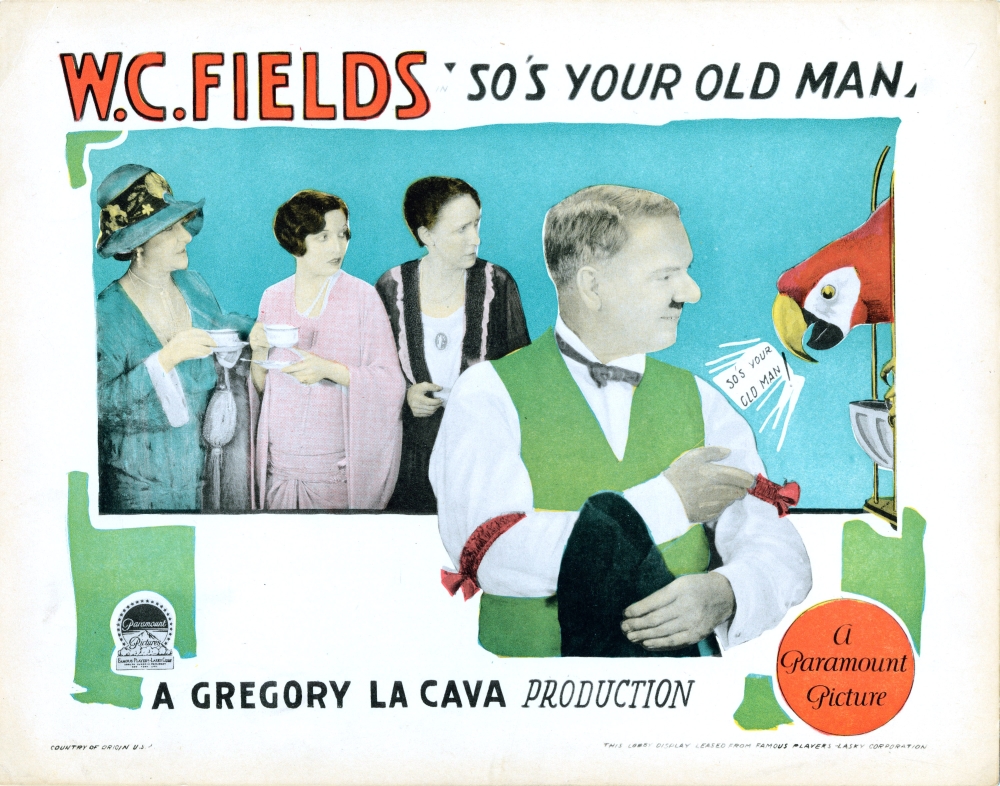
#20) So’s Your Old Man (1926)

MCDSOYO EC008#20) So’s Your Old Man (1926)

OR “Never Give a Silent an Even Break”

Directed by Gregory La Cava

Written by J. Clarkson Miller. Adaptation by Howard Emmett Rogers. Based on the story “Mr. Bisbee’s Princess” by Julian Street.

Class of 2008

Here’s the whole thing!

The Plot: Sam Bisbee (W.C. Fields) is an unsuccessful inventor with a long-suffering wife (Marcia Harris) and a daughter (Kittens Reichert) who is trying to marry into high society. After a failed demonstration of his unbreakable windshield, he contemplates suicide on the train ride home. He thinks better of it and befriends a suicidal woman (Alice Joyce) who turns out to be a runaway princess. Bisbee’s small town is turned upside down when the Princess Lescaboura arrives and tries to help Sam out.

Why It Matters: The NFR points out that while Fields’ verbal talents were better suited for sound films, his training as a juggler and the direction by La Cava help make “So’s Your Old Man” Fields’ most memorable silent film. An essay by silent film expert Steve Massa is mostly a Fields biography.

But Does It Really?: While I agree with the NFR that Mr. Fields’ best work was in the sound era, I don’t agree that this film belongs on the Registry. We have two W.C. Fields sound pictures coming up on this list – “It’s a Gift” and “The Bank Dick” – and I think that’s all we need from Mr. Fields. My favorite parts of “So’s Your Old Man” are the verbal jokes, but who wants to read a funny movie? Sorry William Claude, but this spot could have gone to someone else.

Everybody Gets One: Unfortunately W.C. Fields is pretty much the only actor in this film who survived the transition from silent pictures to talkies. Special mention to William “Shorty” Blanche, Fields’ vaudeville partner who reprises his role as the caddy for the film’s golf routine.

Wow, That’s Dated: Kenneth is described as being in “the ukulele stage of calf love”, which may be the most ‘20s thing I’ve ever heard. Also dated are cars that were built to take multiple rams into a tree, and references to veterans of the Spanish-American War. Also, the title.

Take a Shot: The phrase “So’s your old man” is said three times in the film; twice via title card, and once mouthed by Bisbee.

Other notes

  • Maybe it’s Fields’ strength as a writer, but this film has a lot of title cards.
  • What part of any of this requires Bisbee to not wear a shirt?
  • Geez, these silent films really love suicide as a comic device.
  • Why the contraction of princess to “pr’ncess”? You’re not saving any time with that one.
  • Bisbee’s golf game is a recreation of one of Fields’ best-known vaudeville routine. It’s funny, but it takes longer than an Art Carney bit.
  • When all is said and done, the final chase scene is under-cranked to perfection. Take note, Benny Hill.
  • While I’m researching W.C. Fields, does anyone know if he actually said “Never work with animals or children”? He struggles with a mare in this film, and I wonder if this is where he came up with the phrase.

Legacy/Further Viewing

  • W. C. Fields starred in a sound remake of “So’s Your Old Man” eight years later called “You’re Telling Me!”

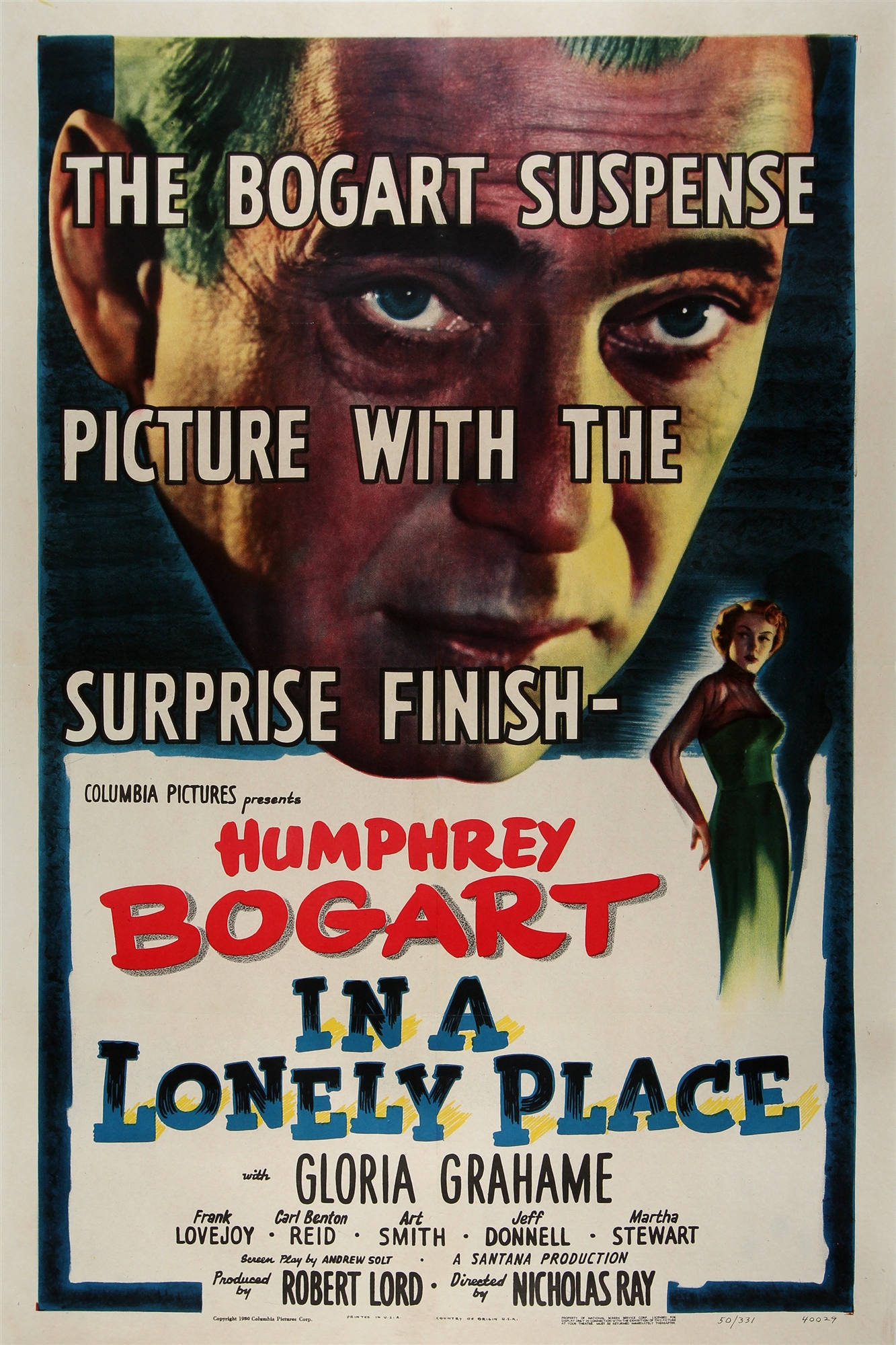
#19) In a Lonely Place (1950)

onesheet1199-2#19) In a Lonely Place (1950)

OR “Dix Chix Fix Pix”

Directed by Nicholas Ray

Written by Andrew Solt. Adaptation by Edmund H. North. Based on the story by Dorothy B. Hughes.

Class of 2007

Before we begin, special thanks to Kevin at the public library; who spoke to me about his appreciation for underrated Bogart films when I checked out this DVD from him. Thank you for sharing.

The Plot: Humphrey Bogart is Dixon Steele, an over-the-hill Hollywood screenwriter with a bit of an anger issue. Hired to adapt a bad novel into a movie, he brings home a hat-check girl named Mildred (Martha Stewart – not that one) to tell him the plot. The next morning Dixon awakes to learn that after Mildred left his place she was murdered, and he’s a prime suspect. While the cops try to solve the case, Dixon gets involved with his neighbor Laurel (Gloria Grahame), an aspiring actress who supported his alibi. Their relationship becomes very intense as Laurel begins to see Dixon’s darker side.

Why It Matters: The NFR praises Bogart’s performance, as well as a script that “marries film-noir themes with doomed romance”. And if you want to learn about the film’s 2002 restoration by Sony Pictures, too bad: it’s a dead link. You had one job, Sony.

But Does It Really?: Oh yes. There’s a lot of cliché in film-noir, but you won’t find any of them here. Like many underrated gems of the era, this film has a lot going on beneath the surface, and Bogart and Grahame play that subtext beautifully. The biggest mystery of this film isn’t the murder that brought these two together, but rather the mystery of whether or not you can trust either lead character.

Shout Outs: Mel mentions trying to talk Selznick out of making “Gone With the Wind”. For those of you keeping score, that’s the second 1950 Hollywood noir film I’ve covered that features a character Forrest Gump-ing their way around “Gone With the Wind”.

Everybody Gets One: Most of the supporting cast members were familiar film and TV actors. Like his character, Robert Warwick (Charlie) was an ex-silent film star. Frank Lovejoy (Det. Nicolai) was no stranger to film-noir, even starring in a TV remake of “Double Indemnity”. Art Smith (Mel) was a long-time stage and film star before unfortunately being victimized by the Hollywood Blacklist. And special mention to Martha Stewart as Mildred, aka “The vic”. Ironically, she is the last surviving member of the credited cast.

Wow, That’s Dated: Taxi stands, looking up actors in a physical directory, references to Emily Post, the phrase “sex murder”.

Take a Shot: Amazingly, no one says the phrase “In a lonely place” in this film.

Seriously, Oscars?: Not a single nomination – from the Oscars or from anyone. Perhaps the major studios felt threatened that an actor’s production company could make a good film.

Other notes

  • While the film follows the main plot of the original story, there are enough differences, particularly with the character of Dix, to call this a loose adaptation.
  • This is one of the few films produced by Humphrey Bogart’s production company, Santana Productions. Santana was the name of his yacht.
  • You know this has got to be a work of fiction within the first minute. He’s a tough-guy screenwriter? And an actress recognizes him on sight? Please.
  • I think we shall have to make the Horse’s Neck the official drink of The Horse’s Head (Please drink responsibly).
  • If CliffsNotes had existed back in the ‘50s this whole film would never have happened.
  • They establish Dix as an army man, but they don’t mention his time with the navy.
  • I really like Gloria Grahame/Laurel in this film. The performance is even more layered when you learn that her marriage to director Nicholas Ray was falling apart during filming. You can learn more in a very good episode of the “You Must Remember This” podcast (I’m sure I’ll reference this podcast again for this blog).
  • The only problem with naming your character Dixon and then having everyone call him Dix is that it makes me giggle like a moron when the characters say things like “I love Dix” and “There is something strange about Dix”.
  • I love that even when she is in the passenger seat of a speeding car being driven by a man prone to rage, Laurel still has time for a cigarette.
  • This film contains one of my favorite old movie tropes; a character tossing in bed while superimposed images of the other characters hover above them and say lines from the film.

Legacy

  • Director Curtis Hanson loved this film and shows up on many of the film’s DVD extras. Hanson also cited “In a Lonely Place” as one of the main influences behind his 1997 film (and future NFR entry) “L.A. Confidential”.
  • “In a Lonely Place” gives us a line many associate with film noir; “I was born when she kissed me. I died when she left me. I lived a few weeks while she loved me.”
  • A brief clip of Bogie’s performance is one of many spliced into the Steve Martin spoof “Dead Men Don’t Wear Plaid”.
  • Bogie and Grahame also show up via archival footage in Michael Jackson’s “This Is It”.