#52) Dirty Harry (1971)

dirty_harry

#52) Dirty Harry (1971)

OR “The Creeps of San Francisco”

Directed by Don Siegel

Written by Harry Julian Fink & R.M. Fink and Dean Riesner. Story by Harry Julian Fink & R.M. Fink.

Class of 2012

The Plot: Clint Eastwood stars as “Dirty” Harry Callahan, Homicide Inspector for the SFPD who doesn’t play by the rules, and can never remember how many shots he fired. Earning his nickname by taking any dirty assignment that comes his way, Harry is chosen to track down a serial killer who calls himself “Scorpio” (Andy Robinson). Their cat-and-mouse game unfolds amongst the gritty San Francisco of the early ‘70s.

Why It Matters: In the wake of the Escobedo and Miranda rulings of the ‘60s that gave rights to the accused, “Dirty Harry” was a tip of the hat to the old school cops who didn’t play nice but always got results. The NFR also praises the work of Eastwood and Siegel, and includes an essay by “award-winning screenwriter” Matt Lohr (though I have yet to find the awards he’s won, or even the screenplays).

But Does It Really?: The “cop who doesn’t play but the rules” is cliché now, but “Dirty Harry” still feels fresh, which makes for an entertaining ride. Eastwood’s easy-going performance, plus some great San Francisco location shots, help add dimension to what could otherwise have been a pretty straightforward “cops and robbers” film. The era’s political and historical background (plus the film’s ongoing impact on the genre) help solidify a place on the Registry for “Dirty Harry”.

Everybody Gets One: Special mention to Andy Robinson in his film debut as “Scorpio”. He would go on to play Garak on “Star Trek: Deep Space Nine” before giving up acting in the mid-2000s. Also worth noting is Harry Guardino as Bressler, especially the scene where he sings.

Wow, That’s Dated: A long, unfiltered look at San Francisco in a simpler time, before the hipsters and tech-bros took over and turned one of the most unique cities in the world into their own personal playground, leading to the eviction of long-time citizens and effectively removing everything San Franciscan about San Francisco.

Also at one point Harry uses a pay phone.

Take a Shot: The name “Dirty Harry” first shows up 19 minutes in and is said a few times throughout (always preceded by, “I see why they call you…”).

Seriously, Oscars?: Probably because of how polarizing the film was for some on its initial release, and probably because 1971 Oscar voters preferred that other detective movie, “Dirty Harry” received zero Academy Award nominations.

Other notes

  • For you San Francisco serial killer buffs out there, “Scorpio” is based on the very real and then very current “Zodiac Killer”.
  • Thanks to the many panoramic skyline shots, I can confidently say “I can see my house from here.”
  • I always forget about the character of Chico, and that for a hot second “Dirty Harry” is a buddy cop film.
  • Only in the ‘70s could Clint Eastwood dress as essentially a used-car salesman and still be a sex symbol.
  • Ladies and Gentlemen, Hot Mary.
  • It sounds like half of this film is dubbed later in ADR. Was it because of all the location shooting? Or is this par-for-the-course on a Clint Eastwood film?
  • My favorite piece of background graffiti is the tag at Forrest Hill that simply reads “KYLE”.
  • “Scorpio” seems to me like a proto-Crispin Glover we tried out in the ‘70s.
  • For those of you who don’t want to make a drinking game out of “Dirty Harry”, there are plenty of rounds of Punch Buggy to be had here.
  • Note that three years after the release of “Bullitt”(also a detective drama set in San Francisco), “Dirty Harry” has no major car chase.

Legacy

  • Four sequels, but you really only need five words from the third one.
  • As previously stated, every renegade cop film and TV series.
  • This scene in “The Naked Gun”.
  • The one Clint did with the monkey.
  • MacGarnicle
  • And of course, everyone, and I mean everyone, who asks the question, “Do you feel lucky, punk?”
#51) Fake Fruit Factory (1986)

2011-nfr-fake-fruit-factory-1986-image-normal

#51) Fake Fruit Factory (1986)

OR “I’m Ready for My Extreme Close-Up, Ms. Strand”

Directed by Chick Strand

Class of 2011

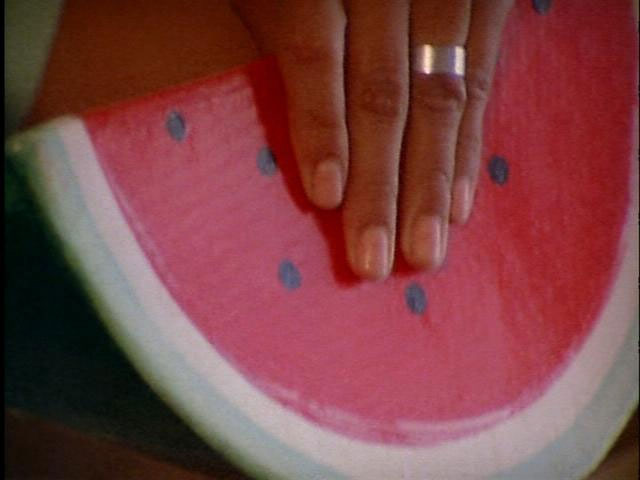
The Plot: Filmed in Mexico in the early ‘80s, “Fake Fruit Factory” is a documentary short about a group of women who make papier-mâché fruit for sale. Through overlapping audio and with the camera’s zoom function set to the max, the film covers snippets of the women’s conversations, mainly about sex and their American boss.

Why It Matters: The NFR praises Strand for her “unique style that deftly blends documentary, avant-garde and ethnographic techniques.” The description goes on to drop the word “ethnographic” a second time. We’re all very impressed, college boy.

But Does It Really?: At long last, that rare type of NFR entry that defies description. I’m not quite sure what I saw, or what exactly, if anything, it was trying to say. But ultimately I dig it and give it a pass. Thanks for the ride, Chick Strand.

Everybody Gets One: Born Mildred D. Totman, her father gave her the nickname “Chick”, while Strand was her first husband’s last name. During her happenings in 1960s Berkeley, Chick helped fellow future-NFR filmmaker Bruce Baillie create the indie film distributor Canyon Cinema. Chick’s work was similar to the avant-garde type on display in “Fake Fruit Factory”, and much of it has been preserved over the years by such institutions as the Academy Film Archive and the American Film Institute.

Wow, That’s Dated: That soundtrack could only have come from the early ‘80s.

Seriously, Oscars?: No Best Documentary Short nomination for “Fake Fruit Factory”. Instead they opted for a film about female anti-nuclear activists (probably shot at a regular non-zoomed-in angle. Cowards.) Despite 20 films over the course of 30 years, Chick Strand never received an Oscar nomination.

Other notes

  • About that extreme zoom: it definitely sets this film apart from others on the Registry. For me, that’s definitely a plus. It forces you to focus on what’s being said and gives the whole film a sense of mystery, since you (literally) don’t get the whole picture. Plus towards the end it gives the film an invasive, almost voyeuristic feel. I felt like I needed to apologize to these women after my viewing.
  • I’m not going to pretend I understand everything that happened, but the one thing that I really didn’t understand was the 98 second shot (yes I counted) of a rear-view mirror as the employees travel to their picnic. What in God’s name was that about, Chick?

Legacy

  • While Canyon Cinema no longer exists as a film distribution company, it lives on as a nonprofit film organization, specializing as always in the avant-garde. Visit their website here.

#50) The Front Page (1931) [Original 2017 Post]

the-front-page-poster

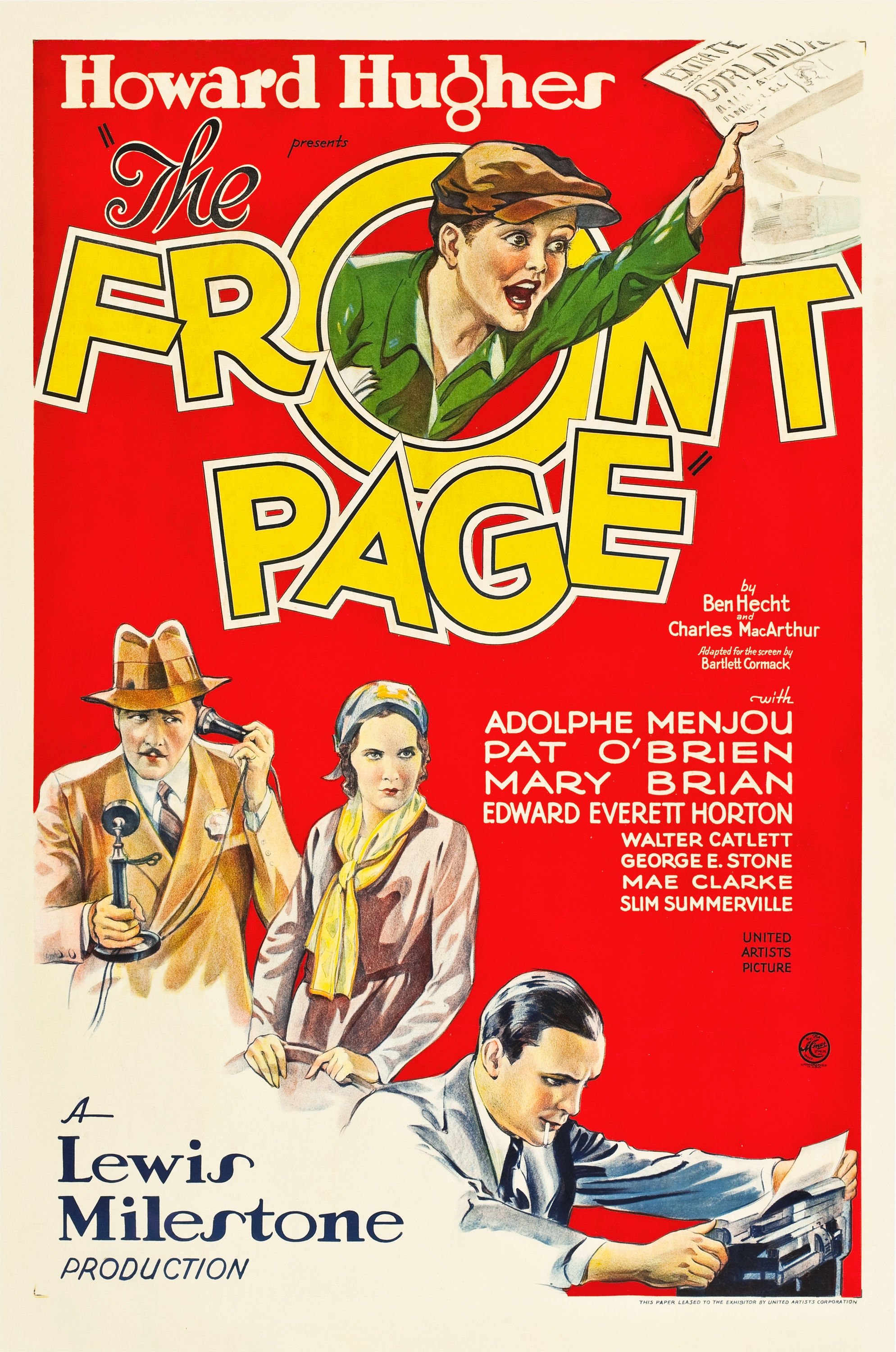
#50) The Front Page (1931)

OR “Same News, Different Editions”

Directed by Lewis Milestone

Written by Bartlett Cormack. Additional dialogue by Charles Lederer. Based on the play by Ben Hecht and Charles MacArthur.

Class of 2010

This is my original post on “The Front Page”; you can read the revised and expanded version here.

NOTE: There are at least two versions of “The Front Page” out there; the “British” print which is the most commonly seen, and the higher quality “domestic” version that was recently restored by the Academy of Motion Picture Arts and Sciences. I was able to track down both versions for this post. The “domestic” print is vastly superior to the “British” print in sound and picture quality, and is comprised of almost entirely different takes. Check them both out below.

The “Domestic” Print

The “British” Print

The Plot: On the eve of the hanging of political prisoner Earl Williams (George E. Stone), Chicago newspaper reporter Hildy Johnson (Pat O’Brien) announces to his editor Walter Burns (Adolphe Menjou) that he’s leaving the business to get married. When Williams escapes the jail and takes refuge in the Criminal Courts press room, Hildy knows a scoop when he sees one and is torn between his love and his career. Also it’s a ‘30s movie so everyone’s wearing suits and hats and talks lots of slang real fast, see?

Why It Matters: The NFR highlights this film as an example of the rapid technological advances in film following the creation of sound pictures. The entire cast is praised, as is the screenplay. There’s also mention of the film’s recent Academy restoration.

But Does It Really?: Well, as an example of a talkie it’s just okay. If only there wasn’t a superior remake already on the Registry (See “Other notes” and “Legacy” below). If you only have room for one version, hands down go with the restored “domestic” print. But even then, I was more interested in the differences between the two prints than I was with the film itself.

Wow, That’s Dated: The usual ‘30s phrases like “in your hat” and “nerts”. Plus, shout outs to Mussolini and Clarence Darrow back when they were, ya know, alive.

Seriously, Oscars?: At the 4th Annual Academy Awards, “The Front Page” garnered three nominations; Picture, Director, and Actor for Adolphe Menjou. It lost all three awards to, respectively, “Cimarron”, “Skippy”, and “A Free Soul”. Ever heard of any of those films? No, no you haven’t. Are any of them on the Registry? No, no they are not.

Other notes

  • The infamous Howard Hughes produced this film. He put his stamp on this one sometime between “Hell’s Angels” and the original “Scarface”.
  • If Bensinger sounds familiar to you, I guess you also watched “Fractured Fairy Tales” as a kid. And if Murphy sounds familiar too, imagine he’s a talking fox con artist in a Disney classic.
  • And yes, Walter spends most of the film being addressed as “Mr. Burns.”
  • I know it was the beginning of the sound era, but would it have killed anyone to throw in a few musical cues?
  • The cinematography in this film is very inventive, though at times distracting. It’s almost as if they were too worried about this film being stage-bound. Regardless, my salutations to Glen MacWilliams, with potential uncredited assistance by Tony Gaudio and Hal Mohr.
  • Anyone know any of the songs the reporters sing when Hartman shows up?
  • Say what you will about the inferiority of the “British” print, but it’s the version where reporter Kruger flips off the mayor. God save the Queen!
  • And then Burns and Johnson reunite on screen and they have a contest to see who can talk faster.
  • Both this film and “His Girl Friday” tell the same story, but “Friday” does it clearer and faster, and therefore funnier. Perhaps “Front Page” could have benefited from more sexual tension between O’Brien and Menjou.
  • Speaking of, “The Front Page” includes Burns’ line “Get back in there, you Mock Turtle!” which I always assumed was a Cary Grant ad-lib for “His Girl Friday”. Oh, Hollywood lore.
  • And then there’s the famous censoring of “That son-of-a-bitch stole my watch”. The diegetic bleep comes across cleaner in the restored version, but it’s still kinda weird.
  • Is this the type of film that really warrants a “The End?”

Legacy

  • Nine years later Howard Hawks remade this film, but decided to make Hildy a woman and called it “His Girl Friday”. The result is everything “The Front Page” just falls short of.
  • Billy Wilder adapted and directed another remake of “The Front Page” in 1974 with Jack Lemmon and Walter Matthau. It’s…fine.
  • “The Front Page” was also a 1949 TV series that didn’t even make it a full season.
  • As for the play itself, it comes back to Broadway every couple of decades, most recently as a limited-run event starring Nathan Lane and John Slattery.

Further Viewing: A brief comparison between the common “British” print and the newfound “domestic” print. I guess the narrator gets caught up in the spirit of the film, because boy does he talk fast.

#49) Once Upon a Time in the West (1968)

once-upon-a-time-in-the-west-68-poster

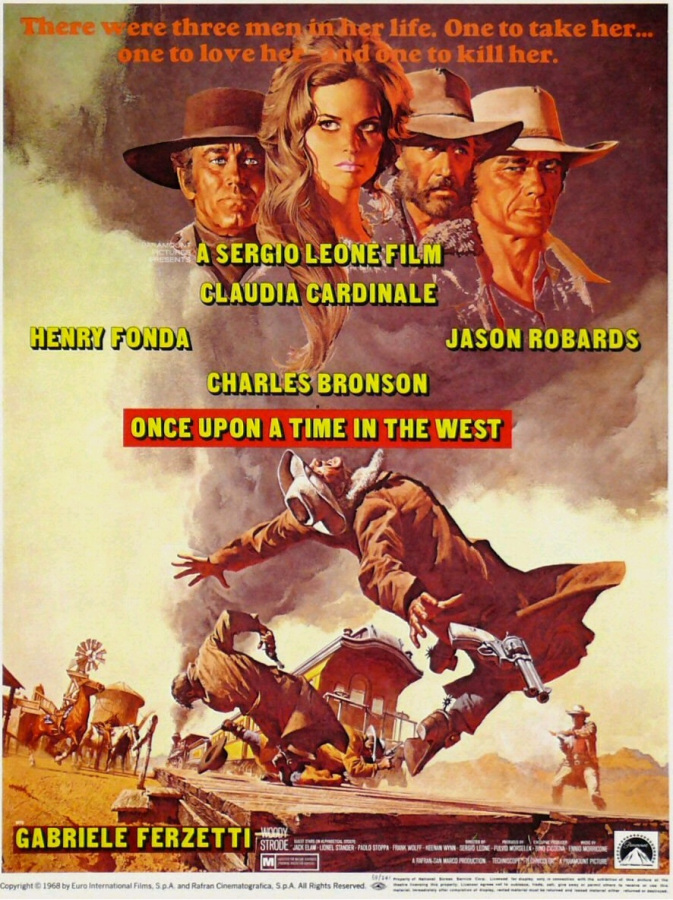
#49) Once Upon a Time in the West (1968)

OR “The Finest McBain Movie”

Directed by Sergio Leone

Written by Leone & Sergio Donati. Story by Leone, Dario Argento & Bernardo Bertolucci.

Class of 2009

The Plot: A tale of vengeance in the Old West with the interconnecting stories of a widow (Claudia Cardinale) determined to develop her dead husband’s land, the gunslinger (Henry Fonda) who murdered her husband, a fugitive bandit (Jason Robards) framed for the murder, and a man with a harmonica (Charles Bronson) who has his own agenda.

Why It Matters: The NFR calls this film “among the greatest achievements of the Western movie genre” and salutes the work of Leone and composer Ennio Morricone. An essay by Professor Chelsea Wessels focuses on the film’s use of iconic Western imagery to tell the story.

But Does It Really?: Yes, given that this was your only option. Leone’s earlier (and arguably more famous) westerns were pure Italian productions, and therefore not eligible for NFR inclusion. Since Paramount paid Leone a large sum to shoot one last Western, this film qualifies. Not that I’m knocking the film or its impact, Leone’s contributions to the genre deserve to be preserved by anyone who can stake a legitimate claim. The film can drag a bit (though, as Paramount learned, cutting it does more harm) but “Once Upon a Time in the West” is proof that with the right filmmakers, even the oldest film genres can be reinvigorated. Plus Fonda’s the bad guy! Come on! That’s worth it right there!

Shout Outs: Leone et al worked several American Western homages into the film, including NFR entries “My Darling Clementine”, “High Noon”, “Shane” and “Johnny Guitar”, among others.

Everybody Gets One: For obvious reasons this is Sergio Leone’s only film on the list. Also noteworthy are screenwriter (and future director) Bernardo Bertolucci, actor Lionel “Max” Stander, and pretty much the entire crew.

Wow, That’s Dated: Ah, the completely dubbed soundtrack of 1960s Italian cinema. Also the sexism. Let’s not forget the constant sexism shown towards the one female character in this film. I guess it wasn’t Leone’s idea to have one of the leads be female…and it shows.

Seriously, Oscars?: Due to its flop status upon initial release, “Once Upon a Time in the West” missed out at the 1969 Oscars. But why should this film be any different? None of Sergio Leone’s seven films received any Oscar nominations in any category. They didn’t even give him a lifetime achievement award!

Other notes

  • This film brings up an interesting question; what qualities constitute a film’s nationality? Obviously the creative team was Italian, and the film was shot mainly in Rome, but Paramount was a major financier and three of the film’s four leads were American. I dunno, seems like a stretch by NFR standards. We’ll see this issue come up again for “Lawrence of Arabia” and the works of Stanley Kubrick.
  • Claudia Cardinale really got a raw deal on this film. Everything’s set up at the beginning to make her story the backbone, but then she’s pretty much sidelined for the whole film. She spends a lot of time getting abuse from the other characters and [Spoilers] doesn’t get to exact revenge on Frank herself. If you’re going to get top billing over Henry freakin’ Fonda I expect more from your character.
  • Early on Mr. McBain slaps his son and the sound effect is obviously a punch. Did they really think no one would notice?
  • Nationality debate aside, is this the first American film in which a character says “bullshit”? I’ll go ahead and say that Jason Robards is the first actor to say “turds” in an American film.
  • In perhaps the greatest against-type casting in film history, Henry Fonda is not fucking around as cold-blooded Frank and it is just the greatest.
  • I love that each of the main characters has their own musical theme. This film is a gritty, cinematically violent “Peter and the Wolf”.
  • Speaking of, never has the sound of an off-screen harmonica been so effective. Well done, Morricone (and, to an extent, Pavlov).
  • Best line in the film; “How can you trust a man that wears both a belt and suspenders? Man can’t even trust his own pants.”
  • Shout-out to cinematographer Tonino Delli Colli. The framing of each and every shot? Forget about it, it’s beautiful.
  • When you do as much on-location shooting as this film does, the few uses of rear projection really stick out.
  • For the dirty Wild West, everyone sure has the whitest teeth.
  • That…was a long pre-title sequence.

Legacy

  • This is the first film in Leone’s unofficial second trilogy; it was followed by the spiritual sequels “Duck, You Sucker” (aka “A Fistful of Dynamite”) and “Once Upon a Time in America”.
  • This is also the reason films started having “Once Upon a Time in…” in their titles.
  • David Letterman has said on numerous occasions that this is one of his favorite films.
  • Can’t you just picture little Quentin Tarantino watching this film frame-by-frame, dreaming of one day making his own Spaghetti Westerns, working/possibly sparring with Ennio Morricone?

Further Viewing: Any and all of Sergio Leone’s other “Spaghetti Westerns”.