
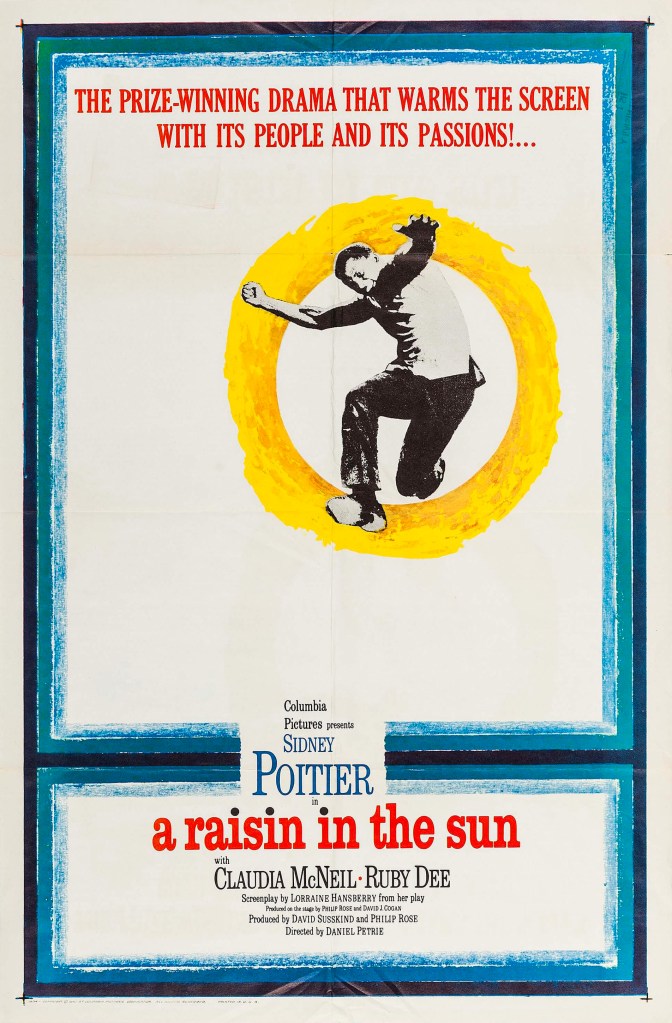
#795) A Raisin in the Sun (1961)
OR “The Youngers and the Restless”
Directed by Daniel Petrie
Written by Lorraine Hansberry. Based on her play.
Class of 2005
The Plot: The Youngers are three generations of an African-American family living in a cramped apartment in Chicago and expecting a $10,000 life insurance check following the death of patriarch Walter Lee Sr. His son Walter Jr. (Sidney Poitier) wants to use the money to open and run a neighborhood liquor store, allowing him to better provide for his wife Ruth and son Travis (Ruby Dee and Stephen Perry). Walter’s outspoken sister Beneatha (Diana Sands) wants to use the money to go to school and become a doctor, but is aware that their mother Lena (Claudia McNeil) is the only person who can decide where the money goes. When the check finally arrives, Lena uses the money to buy a house in the White neighborhood of Clybourne Park. What follows is an exploration of racism and discrimination in America, and a contemplation on who in this country is truly entitled to follow their dreams.
Why It Matters: The NFR write-up on “A Raisin in the Sun” is two very brief sentences; the first calls the film a “[m]odel film adaptation”, and the second describes the cast as “a veritable who’s who of the civil rights era”. Compared to the lengthy paragraphs other 2005 NFR entries received, the “Raisin” write-up is disappointing, if not downright insulting.
But Does It Really?: It’s a miracle the film version of “A Raisin in the Sun” got made at all, especially in 1961 with almost all of its stage creatives intact and minimal Hollywood meddling. 65 years later, I’m happy to report that the film still works, packing the same dramatic punch as it always has (though it’s also disappointing how little of the film feels dated in regards to systemic racism in America). “Raisin” isn’t the most incredible film adaptation of a play, but continues to be an important film due to the strength and ongoing relevance of its source material, aided by some top-notch performances. “A Raisin in the Sun” is certainly worthy of recognition and preservation, if for nothing else the preservation of Lorraine Hansberry and her work.
Shout Outs: Beneatha and Ruth briefly mention both Mrs. Miniver and Scarlett O’Hara while teasing Lena about her new gardening hat.
Everybody Gets One: Lorraine Hansberry’s writing career began in 1951 when she moved to New York and joined the staff of Freedom, a progressive Black newspaper whose writing team included Paul Robeson and Alice Childress. Hansberry was able to become a full-time writer when her then-husband Robert Nemiroff co-wrote the hit song “Cindy, Oh Cindy”. “A Raisin in the Sun” was based on Hansberry’s childhood in Chicago, including her father’s legal battle against a racist White neighborhood, culminating in the 1940 Supreme Court case Hansberry v. Lee (which paved the way for later cases that deemed restrictive covenants unconstitutional). “Raisin” premiered in New York in March 1959, making Lorraine Hansberry the first female African-American playwright on Broadway.
Wow, That’s Dated: The $10,000 check would be worth over $100,000 in today’s money. Other than that, not a hell of a lot.
Title Track: The title, of course, comes from a line in Langston Hughes’ 1951 poem “Harlem”: “What happens to a dream deferred?/Does it dry up/like a raisin in the sun?”
Seriously, Oscars?: Although the film received a number of precursor awards and nominations (and won a special prize at the 1961 Cannes Film Festival), “A Raisin in the Sun” failed to be nominated in any category at the Oscars. Columbia’s major contender that year was the far less controversial WWII movie “The Guns of Navarone”.
Other notes
- While the original Broadway production received mixed reviews, “A Raisin in the Sun” was an immediate hit with audiences, and was optioned by Columbia Pictures for a film adaptation just a few weeks after opening night. In a surprise move, Columbia paid an additional $50,000 to Lorraine Hansberry to adapt her own work for the movie, making her the rare (if not only) Black woman at the time to write a Hollywood screenplay.
- This is Daniel Petrie’s second film as a director following 1960’s “The Bramble Bush”. While I have no evidence to support this, I assume Petrie was hired because a) there were no Black directors Columbia Pictures would have let helm this big a project and b) his extensive TV background would ensure the film’s production stayed on schedule and under budget. It should be noted that the director of the original Broadway production – Lloyd Richards – was Black.
- The film adaptation of “Raisin” definitely feels like a filmed play, but that’s not necessarily the fault of the filmmakers. Hansberry’s original screenplay (which has subsequently been published) included additional scenes of the Youngers outside of their apartment, including more scenes of Walter and Lena at their respective jobs and facing casual racism from their employers and other White characters. As best I can tell these scenes were filmed, but when the first cut clocked in at over 2 1/2 hours, these scenes were the first to go, making the final film seem more claustrophobic. According to UC Berkeley Professor Margaret B. Wilkerson, these additional scenes were most likely deleted to make the film more palatable for a White audience.
- With a few minor exceptions, the original Broadway cast reprised their roles for the film version. If nothing else, it’s great seeing their original performances and dynamics preserved on film, and everyone does a good job of reigning in their work from stage to screen.
- I like when Sidney Poitier plays a flawed character. So many of his iconic film roles are stoic, infallible men bravely fighting the racism around them, but Walter isn’t any of those things (at least not at first): he’s a weak, resentful powder keg ready to explode at any moment, fiercely protecting any shred of dignity he has left. Poitier’s work is nicely balanced out by the grounded fortitude of Claudia McNeil’s Lena. The story goes that Poitier and McNeil were a bit antagonistic towards each other throughout the play’s run and this film’s production due to an ongoing debate over which of their characters was the true lead (Hansberry herself wasn’t quite sure, but seemed to favor Lena in the long run).
- This is definitely one of the few NFR movies to consistently pass the Bechdel test. Yes, Lena, Ruth, and Beneatha spend a lot of time talking about race relations and that check, but at least it’s not all about Walter.
- Like Lorraine Hansberry, Diana Sands was a remarkable talent who died far too young. Beneatha is as close to a stand-in for Hansberry as we get, with her vocal activism and atheist beliefs, the latter leading to Lena’s very powerful line “In my mother’s house, there is still God.” Fun Fact: Diana Sands and I share a birthday!
- Rounding out the lead quartet is the always great Ruby Dee. Ruth isn’t as flashy as the other characters, but she ties everything together. And when Ruth finally smiles at the prospect of a new house, it’s one of the most uplifting moments in this or any movie. It’s still unfathomable how Dee or anyone else in the cast didn’t get an Oscar nomination. For the record, Ruby Dee would get her first and only Oscar nomination 46 years later for slapping Denzel Washington in “American Gangster”.
- I recently re-read the original play, and when it got to Ruth discovering she’s pregnant and putting a down payment on an abortion, I assumed this was all cut for the movie. To my shock, it’s all still there. Nobody directly says the word “abortion”, but it is made very clear what is going on. As far as I can tell the Hays Code only objected to the film’s depictions of racism, and the abortion storyline slipped under their radar. Another instance of the Hays Code being chipped away at in its final years.
- Sorta shoutout to veteran cinematographer Charles Lawton Jr. While most of the cinematography fares well within the confines of a cramped apartment, there are a few obvious moments where no one could figure out the best place to put the camera, with actors awkwardly upstaging each other or not in full view of the camera. Still, there are decent compositions throughout, plus creative blocking that moves the characters around organically.
- Both of Beneatha’s suitors are played by actors on their way to bigger and better things. Her Nigerian boyfriend Joseph Asagai is played by Ivan Dixon, who went on to star in future NFR entry “Nothing But a Man” and direct “The Spook Who Sat by the Door” (he was also Kinch on “Hogan’s Heroes”, but who cares about that?). The more straight-laced George Murchison is played by future Oscar winner Louis Gossett Jr. in his film debut!
- One of the handful of “opened-up” scenes that remains in the final film is a sequence of the Youngers visiting their new house before they move in. In a depressing case of life imitating art, while filming these scenes in a Chicago suburb, a White neighbor contacted the homeowner of the house being filmed at, afraid they were selling their house to a Black family. This is just one example of the constant racism faced by the cast and crew during this film’s production, including the cast’s difficulty finding housing when filming moved to Los Angeles.
- Showing up near the end as token White character Mark Lindner is John Fiedler, aka the voice of Piglet, aka Juror #2. It is so weird hearing Piglet nervously navigating a misguided conversation about race relations. Oh d-d-dear indeed.
- My one major complaint about the movie is the score by Laurence Rosenthal, particularly in the scene where Bobo tells Walter about what happened to Willie Harris. In what is already the most intense scene in the film, the score unnecessarily ramps things up, becoming too intrusive and oversaturating the moment.
- Despite everything that’s happened, the film manages to end on a hopeful note, or at least leaves it up to your interpretation. Despite all their hardships, I believe the Youngers…oh man I just got it! Lena’s plant is a metaphor! It’s growing and flourishing despite its stifling environment. It all makes sense now!
Legacy
- “A Raisin in the Sun” opened in New York in March 1961, and while it received positive reviews and decent box office, it just barely missed the break-even point, earning $1.3 million against a $1.5 million budget. While Lorraine Hansberry had some private reservations about the cuts made to her screenplay, she championed the picture and Petrie’s direction in public.
- Following the release of “Raisin”, Lorraine Hansberry continued writing, as well as being an activist for the Civil Rights movement, until her tragic death in 1965 from pancreatic cancer at age 34. Several of her writings would be published posthumously, including the autobiographical “To Be Young, Gifted and Black”, which is where the Nina Simone song gets its name from.
- “A Raisin in the Sun” has continued being performed on stage throughout the last nearly 70 years, and has returned to Broadway twice (three times if you count the 1973 musical “Raisin”). The play’s first revival in 2004 starred Phylicia Rashad, Audra McDonald, Sanaa Lathan, and…I forget who played Walter. The second revival in 2014 starred Denzel Washington, Sophie Okonedo, Anika Noni Rose, and LaTayna Richardson Jackson impressively serving as a last-minute replacement for Diahann Carroll.
- “Raisin” has been filmed for television twice. A 1989 taping for “American Playhouse” starred Danny Glover, Esther Rolle, and Starletta DuPois, with John Fiedler reprising his role from the original Broadway production and film 30 years later! A 2008 TV movie saw almost the entire cast of the 2004 Broadway production reprising their roles, plus John Stamos for some reason. They even got Morgan Freeman to narrate!


One thought on “#795) A Raisin in the Sun (1961)”