#83) Drácula (1931)

f4dd7689d0b13d3760510dcb4208c155

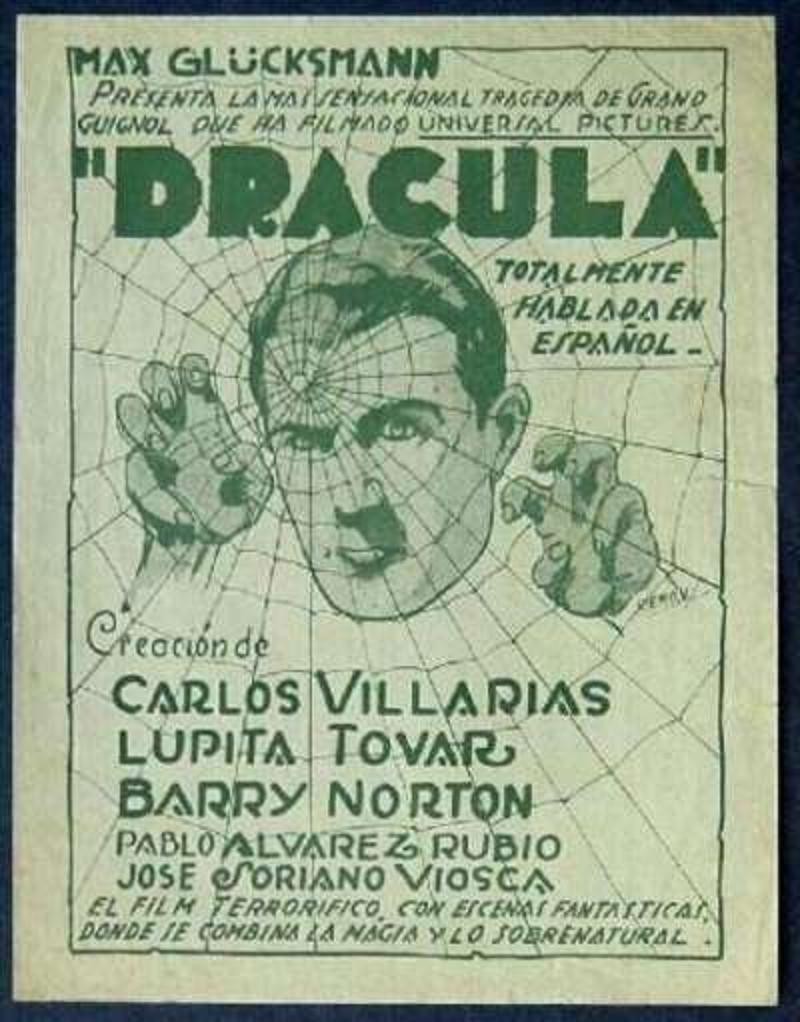
#83) Drácula (1931)

O “El Hombre Que Muerde”

Dirigido por George Melford

Escrito por Baltasar Fernández Cué. Based on the novel by Bram Stoker and the play by Hamilton Deane and John L. Balderston.

Class of 2015

Read my take on the English-language version here.

No trailer, but here’s a little background on this version of Dracula.

Trama de la Pelicula: Carlos Villarías es el Conde Drácula, un vampiro de Transilvania que debe beber la sangre de los vivos. Asistido por su criado Renfield (Pablo Álvarez Rubio), viajan a Londres para arreglar el arriendo en una abadía al lado del sanatorio local. El conde se enamora de la hija Eva del médico (Lupita Tovar) y los planes para hacerla su novia siguiente. Pero el doctor Van Helsing (Eduardo Arozamena) sospecha los hábitos de vampiro de Drácula mientras estudia las misteriosas muertes que han ocurrido desde que Drácula llegó.

Por Qué Importa: Both the NFR description and the essay by Film History and Hispanic Studies professor András Lénárt discuss the history of multiple-language version films (or MLV for short) and debate which “Dracula” is the superior one.

Pero Realmente?: As a representation of MLV films, “Drácula” is tough to beat. Of the early sound films known to have an MLV, “Drácula” is the best known, and has enough key differences to warrant side-by-side viewing and comparisons. I’ll cover some of these in the “Other Notes” section, suffice it to say that both films have their pros and cons that prevent me from declaring one to be the obvious “better” one. Regardless, this “Drácula” belongs on the list.

Todo el Mundo Tiene Uno: Like many foreign actors in Hollywood, Carlos Villarías’ career consisted mostly of MLV films, as well as minor roles in “A” pictures and supporting roles in “B” pictures. Lupita Tovar continued making films in Hollywood and Mexico before finally settling down with “Drácula” producer Paul Kohner and raising two children, among them future actress Susan Kohner. Ms. Tovar lived to be 106 years old!

Wow, Eso Es Anticuado: Unlike the English-language “Dracula”, this one firmly establishes its present day setting. So let’s go with sanatoriums, as well as people who wear their cape and gloves to the symphony.

Toma un Trago: Dicen mucho el nombre del Conde. No hagas esto un juego de beber.

Seriamente, Oscars?: Like its English counterpart, “Drácula” did not receive any Oscar nominations. Of course I doubt MLV films were even eligible to begin with.

Otras Notas

  • This film’s director, George Melford, oversaw production on several foreign-language films at Universal in the late ‘20s and early ‘30s. Weirdly enough, he didn’t speak Spanish and had to rely on an interpreter pretty much the entire time.
  • Among the many differences, Melford’s direction involves more close-ups and feels a little more cinematic. Browning’s version feels a little bit more like the stage version.
  • While Browning’s violence is implied rather than shown, this version shows us actual bite marks! Plus you see Dracula actually get out of his coffin!
  • This Renfield has more of a Gene Wilder in “Young Frankenstein” quality to him.
  • Yeah, the attack on the ship is way better in this one. Less cheesy.
  • Don’t think I didn’t catch that, reused long shots of Bela Lugosi.
  • Oh man, the Martín in this version is also a great comic relief. It’s an embarrassment of riches!
  • How did I go the entire English-language “Dracula” without making a “Werewolves of London” reference?
  • The “Van Helsing Mirror” scene is a very different but equally chilling take.
  • Well there’s no use prolonging it: I have to compare Draculas. No offense to Carlos Villarías, but Lugosi wins hands down. Lugosi has a stillness to his Count that helps the overall creepiness of the film. Even when Villarías is standing still he does just enough movement to take me out of it. Plus he blinks. That’s no good either.
  • Eva in lingerie. No wonder everyone thinks this version is better.
  • That being said, Lupita Tovar’s take on Eva is much livelier than Helen Chandler’s. Their Jonathan Harkers, however, are the same amount of cipher no matter what the language.
  • Yes, the Spanish version is about 29 minutes longer than the English version, but it didn’t feel bloated by comparison. If anything, it gives everything just a little bit more breathing room. Plus, the Spanish version provides additional dialogue and character details that, while not completely necessary, do add some extra dimension to the film.
  • En caso de que se haya olvidado, ¡es una Pelicula de la Universal!

Legado

  • MLV films continued throughout the ‘30s, but since so many of these films were collaborations with Europe, World War II put an end to them. By the time the war ended, dubbing had become more commonplace.
  • Thankfully, this version of “Dracula” is starting to get more recognition alongside the English version. Which one is better? Watch them both and find out for yourself.
  • Once again, Blacula!

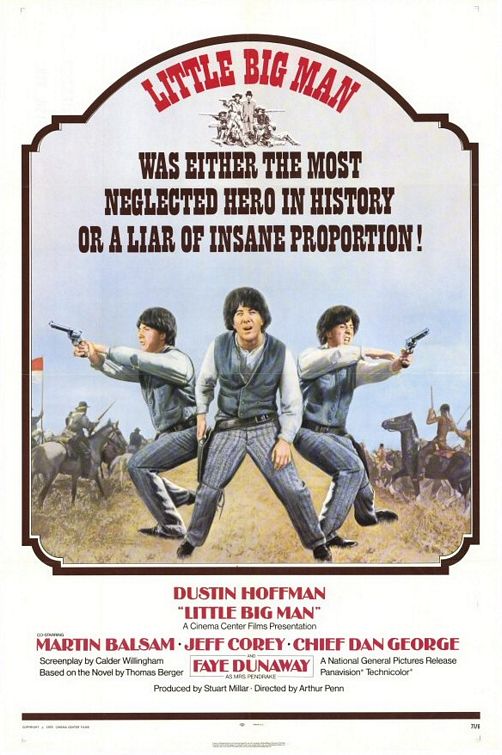
#82) Little Big Man (1970)

little_big_man

#82) Little Big Man (1970)

OR “Crabb’s People”

Directed by Arthur Penn

Written by Calder Willingham. Based on the novel by Thomas Berger.

Class of 2014

The Plot: 121-year-old Jack Crabb (Dustin Hoffman) recounts his early years in the old west; from being raised by Cheyenne leader Old Lodge Skins (Chief Dan George) after his parents were killed, to his brief Christian upbringing with repressed Louise Pendrake (Faye Dunaway), to his turn as a gunslinger alongside Wild Bill Hickok (Jeff Corey). Along the way Jack sees the Cheyenne culture and the white culture for all their pros and cons, never remaining loyal to or truly understanding either of them. His unique perspective on the American west is put to the test when he finds himself in the middle of General Custer (Richard Mulligan) and the Battle of Little Bighorn.

Why It Matters: The NFR praises the film for being “the Western reimagined for a post-1960s audience” and salutes Hoffman, Penn, Willingham, and makeup artist Dick Smith. There’s also an essay by Kimberly Lindbergs, freelance film writer and fellow WordPress film blogger.

But Does It Really?: I chalk this one up as a minor classic. Everyone involved has been in more famous films, but “Little Big Man” is important due to its unique views of the western genre, particularly with how it depicts Native Americans. “Little Big Man” was one of the first mainstream films to show that the West wasn’t won, it was stolen, and that the brave pioneers and cavalrymen we made our heroes may have actually been the villains.

Shout Outs: Some have suggested that Faye Dunaway’s seduction scene is an homage to “The Graduate”, but who knows if this was intentional or not.

Everybody Gets One: Many of the featured cast members, most notably future TV star Richard Mulligan.

Wow, That’s Dated: While many of the actors playing Native Americans were actually Native American (or in Chief Dan George’s case, First Nations), Cal Bellini (Younger Bear) was Malay and Aimee Eccles (Sunshine) was Chinese.

Take a Shot: “Little Big Man” is Jack’s Cheyenne name and is only uttered a handful of time during scenes with the Cheyenne.

Seriously, Oscars?: “Little Big Man” received only one Oscar nomination; Best Supporting Actor for Chief Dan George, making him one of the very few indigenous peoples to receive an Oscar nomination. He lost to British actor John Mills’ performance as a mentally impaired mute in “Ryan’s Daughter”, because Oscars.

Other notes

  • There was a real life Little Big Man, but there are few, if any, similarities between him and Dustin Hoffman’s character.
  • That’s William Hickey at the beginning as I’m assuming the reporter for “The Framing Device Weekly”.
  • What can I say about Hoffman’s old age makeup except Dick Smith you brilliant bastard. I can’t believe the Oscars wouldn’t have a make-up category for another 11 years (Smith finally won in 1984 for “Amadeus”).
  • A lot of slams on the Pawnee in this film. The Cheyenne must be from Eagleton.
  • I gotta say this is one of Faye Dunaway’s most underrated performances. It’s short, but very impactful and surprisingly funny. A nice departure from the roles I typically associate Ms. Dunaway with.
  • Okay, someone’s having fun with the forced perspective between Jack and Wild Bill Hickok.
  • Jack’s sort of a Zelig of the Old West.
  • Just when you think this film is done showing you how diverse the Cheyenne were, along comes Little Horse, the tribe hwame.
  • Ah yes, quick cuts and sudden spurts of violence. Truly this film is from the man who brought you “Bonnie and Clyde”.
  • The music that accompanies Custer and his men sounds a lot like the “Patton” theme. They came out in the same year, so who copied whom?
  • Ladies and Gentlemen, Dustin Hoffman’s ass!
  • Technically this film intersects with the first season of “Deadwood”. I’d love to see that c********** crossover.
  • Nope, just ignore Martin Balsam’s real leg sitting on top of his peg leg.
  • Do you think Dustin Hoffman went full “Revenant” when Jack becomes a trapper?
  • For those of you who know Richard Mulligan from “Empty Nest” and “Soap”, this is probably his most restrained performance. Fun Fact: His older brother is “To Kill a Mockingbird” director Robert Mulligan. Thanksgiving must have been fun at that house.

Legacy

  • While the film never got a sequel, Thomas Berger wrote one for the original book in 1999 called “The Return of Little Big Man”. The book showcased Jack Forrest Gump-ing his way through such other historical Wild West moments as the Gunfight at the OK Corral.
  • Old Lodge Skins’ line “Today is a good day to die” has been adopted by another culture, the Klingons.

Further Viewing: An excerpt from “The Many Faces of Dustin Hoffman” shows Dick Smith helping Dustin Hoffman age 88 years.

#81) The Hole (1962)

The-Hole-1962-film-images-18415109-384d-4544-b39a-d2253d3b377

#81) The Hole (1962)

OR “An Animated Discussion”

Directed by John Hubley

Written by John & Faith Hubley

Class of 2013

The Plot: An “observation” on the nuclear arms race while it was still happening; two construction workers (voices of Dizzy Gillespie and George Matthews) debate the plausibility and outcome of nuclear fallout.

Why It Matters: The NFR calls the film a “chilling…meditation”. An essay by New York Magazine editor Greg Cwik is a history and appreciation of John & Faith Hubley.

But Does It Really?: I give it a pass for the work of the Hubleys, and as a conversational approach to the prospect of nuclear annihilation without resorting to propaganda and fear-mongering.

Everybody Gets One: While not their only work on the list, this is the only representation of John & Faith Hubley’s animated collaborations. In their 22 years of marriage they made 30 animated projects, as well as four live-action children. Actor George Matthews appeared in every western ever, and Dizzy Gillespie was a jazz musician of some kind.

Wow, That’s Dated: Reading newspapers and the threat of nuclear war. Wait, maybe not that last one.

Seriously, Oscars?: “The Hole” won the Oscar for Best Animated Short Film in 1962. Among those the Hubleys beat out were animation legend Chuck Jones and John’s former boss, Walt Disney.

Other notes

  • John Hubley was an animator for Disney until their famous animator strike of 1941. He then worked for bizarro-Disney studio UPA until he was blacklisted. Storyboard Studios was a way for John to create his own work during the blacklist years. Among Faith Hubley’s odd jobs while animating was as script supervisor for the film “12 Angry Men”.
  • Dizzy Gillespie’s real name is John. He earned his famous nickname in his early 20s due to his unpredictable behavior.
  • Since when do average Joe construction workers admit to knowing regular ballroom dancing?
  • George’s claim that they found Venus de Milo’s arms is a bit misleading. They did find broken arms nearby the discovery of the statue in 1820, but the arms in question could not conclusively be named hers. Of course, George could just be joking and this Google search was a complete waste of my time.
  • Is Dizzy nude at the end of this?

Legacy/Further Viewing: John & Faith continued making great animation together until John’s death in 1977. Among those was another Oscar winner – “A Herb Alpert and the Tijuana Brass Double Feature”.

John & Faith’s daughter Emily is a successful animator in her own right, most notably as the producer and designer of the “Origins of Love” sequence from “Hedwig and the Angry Inch”.

Listen to This: Dizzy Gillespie’s big band sound and Latin jazz influence can be heard in all its splendor in the 1947 recording “Manteca”, added to the NRR in 2004.

#80) A League of Their Own (1992)

league_of_their_own_ver2

#80) A League of Their Own (1992)

OR “[Insert Uninspired Baseball Metaphor Here]”

Directed by Penny Marshall

Written by Lowell Ganz & Babaloo Mandel. Story by Kim Wilson & Kelly Candaele.

Class of 2012

The Plot: “A League of Their Own” is a fictional account of the real-life All-American Girls Professional Baseball League, an alternative to Major League Baseball while most of their players were fighting in World War II. Oregon farmer Dottie (Geena Davis) is offered to join the league and reluctantly accepts, if she can bring along her sister Kit (Lori Petty). Led by washed up former slugger Jimmy Dugan (Tom Hanks), the league eventually become a success, but the complicated sibling rivalry between Dottie and Kit becomes a sticking point leading up to the World Series.

Why It Matters: The NFR praises the work of Marshall, Davis and Hanks, and calls the film “an enjoyably nostalgic film about women’s choices and solidarity during World War II that was both funny and feminist.”

But Does It Really?: Oh of course. This film is just wonderful. Marshall takes an almost-forgotten piece of Americana and creates a funny and touching story that doesn’t veer into any genre clichés. The film succeeds not by standing on a soapbox and telling you that women can do anything that men can do, but rather by just unapologetically showing you. It’s also a great reminder that at one point in time a major studio released a film by a female director with a cast primarily of women, and no one sparked a childish boycott or Twitter war. Can we start doing that again please?

Shout Outs: Dugan singles out Miss Cuthbert’s performance in “The Wizard of Oz”.

Everybody Gets One: Director Penny Marshall (as well as her brother Garry), writers Ganz & Mandel, and most of the cast, notably Jon Lovitz, Madonna, Rosie O’Donnell, Lori Petty, and Bill Pullman.

Wow, That’s Dated: Six words – “This Used to Be My Playground”. Speaking of, this film is from that brief time when we let Madonna be in movies.

Seriously, Oscars?: “A League of Their Own” received zero Oscar nominations. You could say it “struck out”, but you wouldn’t because you’re better than that.

Other notes

  • Despite “A League of Their Own” breaking through several glass ceilings for women in film, Tom Hanks gets top billing.
  • Is there any more time-honored exposition dump in a film than an old newsreel? Also, hi Harry Shearer!
  • Jon Lovitz is hilarious in this film, and nothing makes me laugh harder than his reading of “Will you SHUT UP!?” I love it so much I’m just going to leave it here for future reference.
  • Who’d have thought that Rosie O’Donnell and Madonna would have such great on-screen chemistry?
  • Blink and you’ll miss Téa Leoni as one of the Racine Belles.
  • This film was made during that brief point in history when Tom Hanks and Michael Keaton were essentially the same person.
  • After the first game, everyone just assumes that despite all the hard work done by the women, it was the man who was responsible. Good thing that never happens anymore.
  • Ah, ‘40s swing dancing; essentially just tossing your female partner around as hard as you can.
  • Penny Marshall casts two of her former “Laverne & Shirley” co-stars in the film. Mae’s dance partner at the roadhouse is Eddie Mekka, aka Carmine Ragusa, and one of the baseball announcers throughout the film is David Lander, aka Squiggy (or possibly Lenny).
  • “There’s no crying in baseball!” What can I say? That scene is pretty damn perfect.
  • I gotta give kudos to Geena Davis. Dottie is one of the more dimensional female leads in a movie. Davis underplays it so perfectly it’s easy not to notice just how emotionally complex her character really is.
  • It also needs to be mentioned that both Geena Davis and her on-screen husband Bill Pullman have played the President of the United States; Davis on the short-lived series “Commander in Chief” and Pullman in some alien movie.
  • Even back then baseball had scalpers.
  • That’s Mark Holton as Older Stilwell at the end. I remember him best as Francis in “Pee-wee’s Big Adventure”, and for having one of the best one-liners in “The Naked Gun”. Any way you slice it, he is far too young to be playing this character.
  • I have to admit I have mixed feelings about the ending. I’ve spent two hours caring about these characters, and at the end they’re all played by different actors. It robs the film of its emotional punch just a little. Of course, they could have pulled a Harry Potter and put everyone in old age make-up to potentially disastrous results. There’s really no clear way to pull this off. This all being said, I appreciate seeing this many older actresses on screen without any of them being humorously vulgar or robbing a bank or some other crap.
  • “Exclusive cast and crew merchandise available on QVC” may be my favorite credit in any film ever.

Legacy

  • Despite the success of this film – as well as her previous endeavors “Big” and “Awakenings”, Penny Marshall’s directing career never reached these same heights again. I blame “Renaissance Man”.
  • CBS cashed in on the film’s success with a very short-lived TV series in 1993. Despite the participation of many of the film’s creatives (including Marshall, Ganz & Mandel, and Hanks directing an episode), only 5 episodes aired before getting the axe.
  • I fondly recall the times Rosie O’Donnell and Penny Marshall would reunite for appearances on Rosie’s ‘90s daytime talk show and/or to plug Kmart.
  • But of course, the real legacy is everyone who has said “There’s no crying in baseball!”

#79) Twentieth Century (1934)

MV5BMWFlMjNkZGQtZDAxNS00Nzg1LTkyYmYtZDUwNDdkMTIxMzFhXkEyXkFqcGdeQXVyMjUxODE0MDY@._V1_

#79) Twentieth Century (1934)

OR “Hawks Goes Off the Rails”

Directed by Howard Hawks

Written by Ben Hecht and Charles MacArthur. Based on their play, as well as the unproduced play “Napoleon of Broadway” by Charles Bruce Millholland. [With possible uncredited contributions by Gene Fowler and Preston Sturges]

Class of 2011

Sadly, no trailer for this one. Please enjoy this brief clip of Carole Lombard.

The Plot: Theatrical impresario Oscar Jaffe (John Barrymore) takes young untalented lingerie model Mildred Plotka (Carole Lombard) and turns her into Broadway star Lily Garland. They have several hit plays and a passionate affair over the next few years, but when things turn sour professionally and personally, Lily heads to Hollywood to become an even bigger star. After a string of flops, Oscar makes one last Hail Mary (no, the other one) when both he and Lily end up onboard the Twentieth Century limited from Chicago to New York. There’s slamming doors, mistaken identity, and no piece of scenery left unchewed.

Why It Matters: The NFR calls it a “sophisticated farce” and credits the film with being the breakout for director Hawks and actor Lombard, as well as Barrymore’s final victory lap as a screen actor. An essay by Michael Schlesinger is a love-letter to the film and its status as the first true “screwball comedy”.

But Does It Really?: Historically yes. It may not be the best screwball comedy, but it’s definitely the first with the genre’s staples. As entertainment, it creaks a little bit, and the source material definitely plays better on stage (Barrymore in particular is playing to a back of the house that isn’t there). “Twentieth Century” gets a pass if just for its place in screwball comedy history, and a star-making turn by Lombard.

Wow, That’s Dated: All kinds of ‘30s phrases and references in this one, plus an incredibly unhealthy dosage of ethnic slurs that wouldn’t fly today. Let’s just say “Uncle Remus” gets more than one shout-out.

Seriously, Oscars?: No nominations of any kind for “Twentieth Century”. I guess Colombia was putting all their eggs in the “It Happened One Night” basket that year.

Other notes

  • If they waited a year, “Twentieth Century” could have been produced by 20th Century Fox.
  • Why the artificial zoom when O’Malley is on the phone with Oscar? Was one of the background players doing something they shouldn’t?
  • Genii? As in plural of genie? You don’t hear that one every day.
  • I do love that chalk gag. Though at one point they complain about not being able to find more chalk in New York at midnight. I feel like there’s an app for that nowadays.
  • There are some shots where John Barrymore looks a bit like Christopher Plummer. This bodes well.
  • Special mention to Walter Connolly and Roscoe Karns as Oscar’s sidekicks Webb & O’Malley. They are both perfectly screwball ‘30s.
  • And yes, throughout the film Oscar’s cohorts call him simply “OJ”.
  • There are a handful of process shots while aboard the train, and one of them is geographically impossible. It appears that the train is riding perpendicular to the track!
  • Does anyone else notice the occasional flies buzzing around the set? It is especially noticeable once we board the Twentieth Century.
  • At one point Oscar is compared to Svengali. And he ought to know.
  • Towards the end they mention calling up Ringling. I guess that’s a “Wow, That’s Dated” now.
  • The great thing about Carole Lombard, and the reason why she’s still remembered today, is that she is still one of the handful of Hollywood leading ladies who was allowed to be sexy and funny at the same time. To this day, Hollywood typically will only let its female stars be one or the other.

Legacy

  • This film gave us the beginning of the Howard Hawks’ run of screwball comedies as we know it, as well as the short but legendary career of Carole Lombard. We’ll see more of both later on in the Registry.
  • The play of “Twentieth Century” has been revived on Broadway from time to time, most recently in 2004 with Alec Baldwin and Anne Heche.
  • The play was also turned into the operetta-style Broadway musical “On the Twentieth Century” in 1978, starring John Cullum, Madeline Kahn Judy Kaye, and a young Kevin Kline. The show was revived in 2015 as a vehicle for Kristin Chenoweth.