#101) The Music Man (1962)

Music_Man_(1962)

#101) The Music Man (1962)

OR “The Grift of Song”

Directed by Morton DaCosta

Written by Marion Hargrove. Based on the stage musical by Meredith Willson, in collaboration with Franklin Lacey.

Gold Medal, Class of aught-five

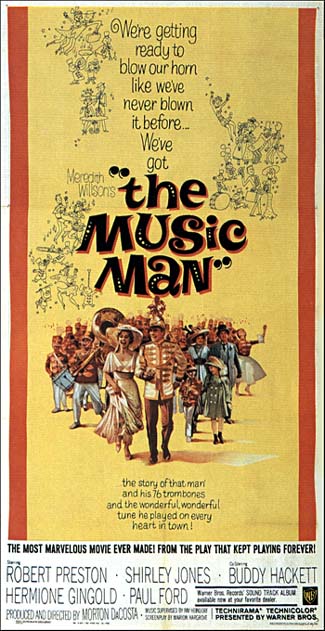
The Plot: Con artist “Harold Hill” (Robert Preston) arrives in 1912 River City, Iowa with a plan to trick its citizens into financing a boys’ marching band. Aided by his old friend Marcellus (Buddy Hackett), all goes smoothly until Harold starts to fall for Marian the town librarian (Shirley Jones). And this causes Trouble with a capital T, and that rhymes with P, which stands for…Perfectly Enjoyable.

Why It Matters: The NFR calls the film “Americana at its finest” and wonders how Robert Preston didn’t get an Oscar nomination for his performance. We’ll talk about that later, NFR.

But Does It Really?: If you aren’t tapping your toes and singing along by the end of this movie, you have a problem. It’s not as bold as “West Side Story” or as epic as “The Sound of Music”, but “The Music Man” is just as entertaining as many of the other great Broadway musicals-turned-films of the era. Though I can’t help but wonder if this spot on the Registry could have gone to Warner Brothers’ other Broadway musical adaptation with a non-singing lead; 1964’s “My Fair Lady”. Regardless, “The Music Man” is a feel-good film that represents the end of the movie musical’s reign in Hollywood.

Everybody Gets One: Director of both stage and film version Morton DaCosta, original cast member Pert Kelton, choreographer Onna White, and of course Leonard Hacker, aka Buddy Hackett.

Wow, That’s Dated: This has got to be one of the last movies where Technicolor gets a big mention in the opening credits. Also the idea of a big budget movie musical that isn’t, ya know, awful.

Seriously, Oscars?: A commercial and critical success in the summer of 1962, “The Music Man” was nominated for six Academy Awards, including Best Picture. It lost in most of its categories to “Lawrence of Arabia”, but did win the Oscar for Adapted Score. And yes, Robert Preston (along with the rest of the cast) went unnominated. But when Best Actor has the likes of Peter O’Toole, Jack Lemmon, and Gregory Peck (in “To Kill a Mockingbird”, no less), what chance do you really have?

Other notes

  • Can “Babes in Toyland” sue these guys for the stop-motion wooden soldiers opening credits?
  • All copies of this film should come with a 1910s Phraseology Reference Guide. Mainly just because I want to incorporate more of it into my own vocabulary.
  • “Iowa Stubborn” goes a long way for that “American Gothic” joke. Too bad the painting won’t be a thing for another 18 years.
  • Robert Preston is just so damn charismatic in this film. I’d buy what he’s selling too. As for Shirley Jones, it’s unfair to compare her to the late great Barbara Cook, but she more than holds her own against Preston, who had been playing the role for five years at this point.
  • Everyone in this movie is lip-synching for their life. But the important distinction is that, to the best of my knowledge, all of the principals did their own (pre-recorded) singing. No need for Marni Nixon here.
  • There’s a 20 year age gap between Shirley Jones and her on-screen brother Ronny Howard. Did Mrs. Paroo have another dozen kids we never see?
  • I always forget about the scene where Eulailie and the other ladies dress in Indian regalia. Yeesh.
  • What’s with the blackouts that have a single spotlight on the principals? A little too theatrical if you ask me.
  • Surprise cameo by the banjo kid from “Deliverance”.
  • Yes movie, we get it, a bunch of women together is like a brood of hens. Very insightful. Move on.
  • You want to talk about not getting an Oscar nomination, how about Hermione Gingold’s delivery of “Balzac”?
  • Should they be singing “Sadder But Wiser Girl” in front of Amaryllis?
  • As I did during my first viewing of this film, I burst into applause at the end of “Marian the Librarian”. Easily one of the most underrated dance scenes in a film.
  • This film is the best commercial Wells Fargo ever got.
  • There are two things musically that I am a sucker for: barbershop quartets and good counterpoint. So naturally “Lida Rose” is my favorite song in this score, hands down.
  • Speaking of “Lida Rose”, what’s with the camera set-up? Am I supposed to be watching through a knotted fence?
  • Just a reminder that Winthrop is directing the new Han Solo movie. Keep this in mind as you watch him lisp his way through this film.
  • The finale gives me chills every time.

Legacy

  • The stage version of “The Music Man” has come back to Broadway a few times, and was remade for television in 2003 with Matthew Broderick and Kristin Chenoweth. It’s the film that made us notice that Matthew Broderick was really starting to phone it in as an actor.
  • Conan O’Brien loves “The Music Man” and has referenced it throughout his career, most memorably in his “Simpsons” episode “Marge vs. the Monorail”. He also did his own rendition of “Trouble” at the 2006 Emmys.
  • Seth MacFarlane also cites “The Music Man” as a favorite. Watch him croon a classic, and then turn another song into a “Family Guy” gag.
  • The Beatles covered “Till There Was You” on their second album, and is the reason Meredith Willson’s estate never has to worry about running out of money.
  • The “con artist starts a con and then has a change of heart” trope has been used again and again, perhaps no more entertainingly than here and “School of Rock”.

Listen to This: You want your Sousa, I got your Sousa.
#100) Unforgiven (1992)

unforgiven_ver2

#100) Unforgiven (1992)

OR “Old West Action”

Directed by Clint Eastwood

Written by David Webb Peoples

Class of 2004

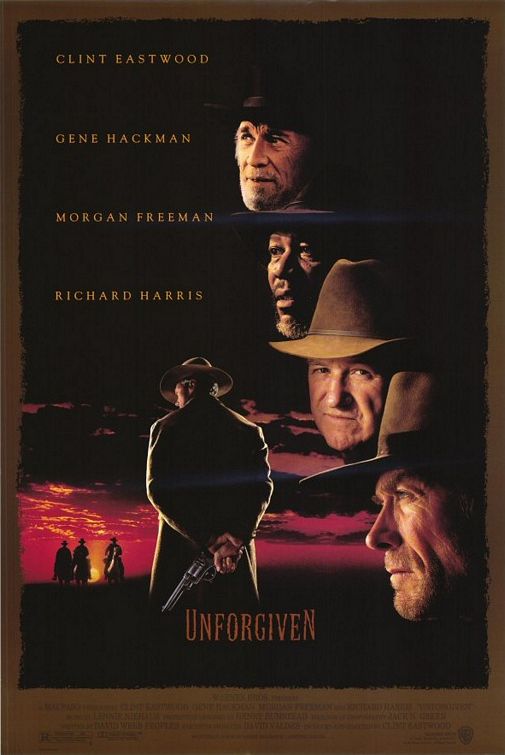
The Plot: Two cowboys cut up a prostitute in the small town of Big Whiskey, Wyoming. When the town’s seemingly reformed Sheriff Bill Daggett (Gene Hackman) lets them off easy, the prostitutes place a bounty for any man who will kill the cowboys. Hearing of this, the Schofield Kid (Jaimz Woolvett) attempts to recruit William Munny (Clint Eastwood), a former gunslinger who is now a widowed farmer and father. Munny finally agrees to do “one last job” and enlists the help of his former partner Ned Logan (Morgan Freeman). Oh, and Richard Harris shows up as someone named English Bob.

Why It Matters: The NFR’s listing for “Unforgiven” is two sentences; the first is the plot of the film, the second a rundown of the supporting cast. No essay, no additional information, no commentary on why the film has been included in the NFR.

But Does It Really?: Well if the NFR can’t come up with anything to say, what can I possibly add? It’s a little too early to call this film a classic, but “Unforgiven” is a well crafted Western and worth at least one viewing. The film’s meditative view on gun violence and its consequences will help it age better than others of the genre. Eastwood directs with a confident hand, and Clint the director lets Clint the actor show colors otherwise unseen in his other performances. Clint went on the record saying this was going to be his last western, and a quarter of a century later he is still going and true to his word.

Shout Outs: Several westerns are referenced throughout, notably Eastwood’s own “The Outlaw Josey Wales”. Screenwriter David Webb Peoples cited “Taxi Driver” as a major influence on his screenplay.

Everybody Gets One: Most of the crew, as well as actors Frances Fisher** and, most surprisingly, Richard Harris.

Wow, That’s Dated: This film actually avoids any major ‘90s filmmaking tropes. You win this round, Clint.

Take a Shot: No one says “unforgiven” at any point in this film.

Seriously, Oscars?: After giving up on winning an Oscar anytime in his career, Clint walked away with both Best Picture and Best Director at the 1992 Oscars. Along for the ride were Gene Hackman for Supporting Actor and Joel Cox for Film Editing. Eastwood directed himself to a Best Actor nomination, but lost to Al Pacino’s overdue turn in “Scent of a Woman”. After waiting 15 years for his screenplay to become a film, David Webb Peoples lost Best Original Screenplay to “The Crying Game”.

Other notes

  • “Prostitute cutting” may be the weirdest MacGuffin in film history.
  • Ladies and Gentlemen, Quick Mike.
  • Gene Hackman’s good in anything.
  • There is something very upsetting about watching Clint not being able to shoot a gun or ride a horse.
  • This film was made before California State Law required that Morgan Freeman narrate all films that he appears in.
  • I have been to the train station used in the film. It’s in Sonora, California and looks pretty much the same as it does here.
  • At one point William and Ned talk about former gang member Quincy, who left to enter the world of forensic medicine.
  • There are a few shots where English Bob looks a bit like The First Doctor. He also looks a bit like The First Dumbledore, but that’s another story.
  • W. W. Beauchamp is played here by Saul Rubinek, who I always remember best as Daphne’s one-time fiancé Donny on “Frasier”.
  • The Schofield Kid beats the Elliot Page record for most questions asked by a film character.
  • In true film tradition, when a gang confronts one person, everyone in the gang attacks one at a time, rather than all at once. How unrealistically polite of everyone.
  • A treat for MST3K fans, the boom operator for this film was Kelly Zombor of “The Final Sacrifice” infamy.
  • “Unforgiven” is dedicated to two of Clint’s previous collaborators and mentors: spaghetti western master Sergio Leone and “Dirty Harry” director Don Siegel.

Legacy

  • While not the first Clint Eastwood directed film by a long-shot, “Unforgiven” was the first Clint film to receive major Oscar attention, and the one that made all his future films instant Oscar bait. Clint would repeat his “Unforgiven” Oscar wins 12 years later with “Million Dollar Baby”.
  • “Unforgiven” was remade in 2013 by Lee Sang-il. In a move I’m calling the “Reverse ‘Magnificent Seven’” the story was relocated to Japan’s own frontier period around the 1860s and stars Ken Watanabe in the Clint Eastwood role. It looks remarkably faithful.
  • Surprising no one, the anti-violent “Unforgiven” is referenced in the ultra-violent “Kill Bill: Vol. 1”.
  • Bonus Clip: This is as good a place as any to reference #FakeBaby.

Thanks for making it to my 100th film with me! (Despite the fact that you are most likely reading this in the future and out of order) On to the next 100!

**2017 Update: Frances Fisher now has “Titanic” on the list as well.

#99) One Froggy Evening (1955)

one-froggy-evening-c2a9-warner-brothers

#99) One Froggy Evening (1955)

OR “Frog In His Throat, Song In His Heart”

Directed by Chuck Jones

Written by Michael Maltese

Class of 2003

The full short is tough to track down online (almost like it’s copyrighted or something), but here’s the clip you’re really here for.

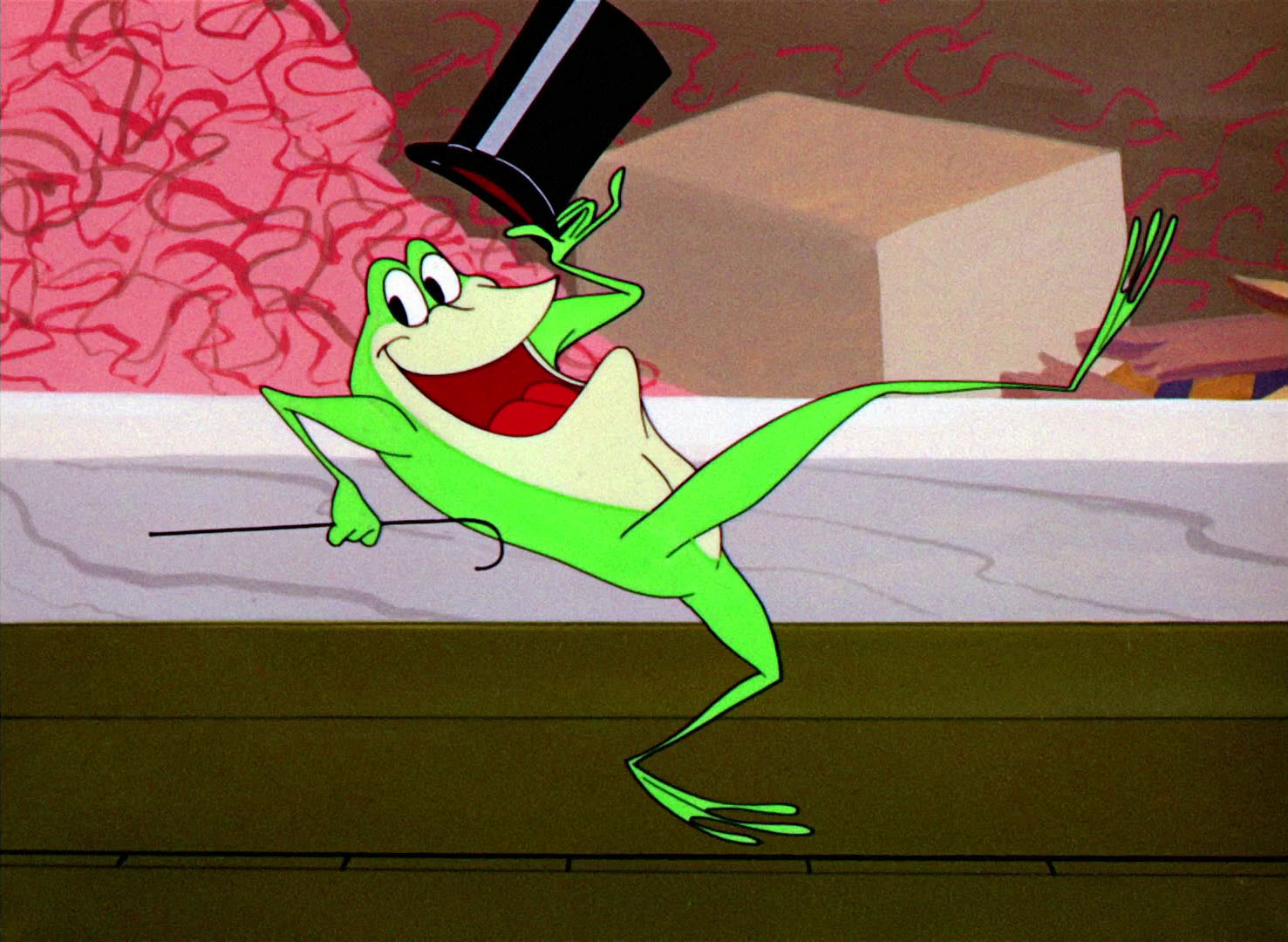
The Plot: While demolishing an old building, a construction worker finds a frog (voiced by William Roberts) who can dance and sing ragtime. The man tries to exploit the frog’s talents, but learns that the frog will only sing and dance when no one else is around.

Why It Matters: The NFR cites the film as being “on every short list of the greatest animation”.

But Does It Really?: It’s still really funny with solid animation and storytelling throughout. Who am I to say no?

Everybody Gets One: Though his identity was unknown for years, famous L.A. baritone William Roberts was the voice of Michigan J. Frog. Roberts’ singing career didn’t transition to the movies, where he only appeared in bit parts throughout the ‘40s. “One Froggy Evening” is his last film appearance.

Wow, That’s Dated: Three words: Tin Pan Alley!

Seriously, Oscars?: No nomination for “One Froggy Evening”. The Looney Tunes choice that year was “Speedy Gonzales”. Only one of these two shorts can still be shown on TV.

Other notes

  • Everybody remembers “Hello! Ma Baby”, but that is just one of many songs Michigan sings throughout the short. Among the others are “I’m Just Wild About Harry” and cartoon staple “Largo al factotum”.
  • Interestingly, “The Michigan Rag” was an original song written for this short by Michael Maltese, and was the reason the frog was eventually named Michigan.
  • A quick question about the year 2056; Why is he wearing a space helmet? What happens to Earth’s oxygen in less than 40 years?

Legacy

  • Michigan & Chuck Jones returned to the big screen 40 years later in “Another Froggy Evening”. Despite the fact that it treads almost exactly the same water as the original short, it’s still very entertaining. Plus that’s the original Officer Lockstock as Michigan!
  • For those who remember a time before the CW, Michigan J. Frog was the mascot for the short-lived WB network.
  • “One Froggy Evening” has been spoofed many times over the years, but will any of them top “Spaceballs”?

https://www.youtube.com/watch?v=RrxlbLVcpqI

#98) The Black Stallion (1979)

black_stallion

#98) The Black Stallion (1979)

OR “The Dark Horse” (Come on, it’s right there!)

Directed by Carroll Ballard

Written by Melissa Mathison & Jeanne Rosenberg and William D. Wittliff. Based on the novel by Walter Farley.

Class of 2002

Thanks, Holly

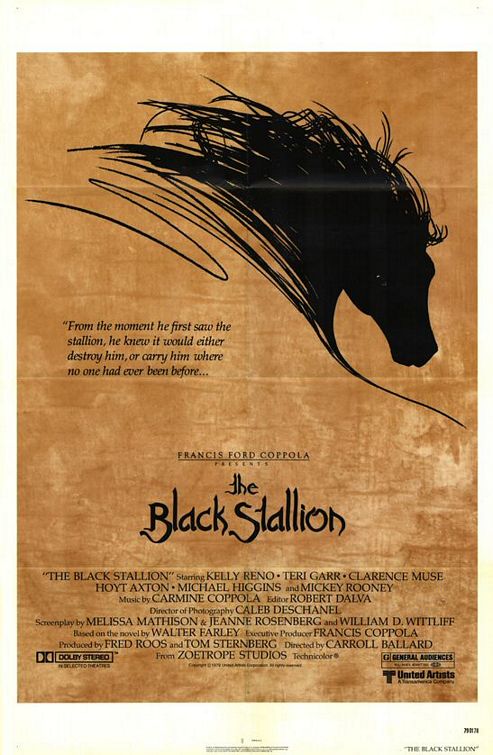
The Plot: While traveling by ship along the coast of North Africa, Alec Ramsey (Kelly Reno) meets and befriends an Arabian Stallion named Black (Cass Ole). After the ship sinks, Alec and Black wash ashore on a deserted island and form a bond that helps them survive. Once rescued, Alec returns home to his mother (Teri Garr) with Black in tow. Too wild for their small town, Black finds refuge on the farm of Henry Dailey (Mickey Rooney) a former jockey who is motivated to come out of retirement to train Black as a racehorse. Things look promising, but can Alec tame Black in time for the big race?

Why It Matters: The NFR mentions the film’s eventual release thanks to Francis Ford Coppola stepping in, as well as its Oscar nominations. There’s also a very sweet essay by writer Keith Phipps, who praises the film’s beauty while also managing to make a “C.H.O.M.P.S.” reference.

But Does It Really?: If nothing else, “The Black Stallion” set the template for kids-and-animal films for the next two decades. Everyone else tries to be this movie, but there’s only one “Black Stallion”. It doesn’t talk down to kids or try to give the animal some magical quality. The film shows that children and animals have their own natural way of living, and by listening to each other they can not only coexist, but also give Mickey Rooney a much-needed comeback vehicle.

Shout Outs: A photograph of Henry in his jockey days is actually young Mickey Rooney from “National Velvet”.

Everybody Gets One: Director Carroll Ballard, lead actor Kelly Reno, and almost the entire supporting cast, most notably folk singer Hoyt “Mitchell” Axton.

Wow, That’s Dated: Actually, this film fares okay in the dated department. The only giveaway that this is a ‘70s film is its quiet, art film style. You don’t see any kid movies doing that nowadays I’ll tell you that.

Title Track: Snoe mentions a “black stallion” once about halfway through the film.

Seriously, Oscars?: “The Black Stallion” received only two nominations, but did receive an honorary Oscar for Alan Splet’s sound editing (while the category of Best Sound Editing did exist back in 1979, there weren’t enough eligible films that year, so “Black Stallion” won an Honorary Award instead). Robert Dalva’s editing lost to the flashier work of “All That Jazz”, and Mickey Rooney’s sentimental Supporting Actor nomination lost to the even more sentimental Melvyn Douglas for “Being There”. “The Black Stallion” was not nominated for Best Picture, nor for Carmine Coppola’s score or Caleb Deschanel’s cinematography.

Other notes

  • Speaking of Caleb Deschanel: In addition to being a (still very active) five-time Oscar nominated cinematographer, Caleb is the father of actors Emily & Zooey Deschanel. Now that’s one creative family.
  • Man, between Kelly Reno, Justin Henry and Ricky Schroder, 1979 was the year of the child actor.
  • A fun game to play while watching this film; Connect-the-Dots with Kelly Reno’s Freckles!
  • I didn’t realize the first half of this film is basically “Cast Away”. The scene where Tom Hanks tries to ride Wilson just doesn’t pack the same punch.
  • Jesus, that cobra is booking it. Damn nature, you scary!
  • Nope, didn’t see the plate of glass between Alec and the cobra.
  • The montage of Alec riding Black along the beach is just awe-inspiring. But if he’s not careful they’re going to run into those “Chariots of Fire” guys coming the other way.
  • I bet when Alec came back to school, his “How I Spent My Summer Vacation” essay was the best.
  • Mom seems sort of nonplussed by all of this. Dad’s dead, my kid vanished and now there’s an untamed horse in the backyard. Cool, cool.
  • Clarence Muse, seen here as Snoe, was one of the first black stars of the sound era. This film was released just four days after his death.
  • Snoe’s horse Napoleon also played Niedermeyer’s horse Trooper in “Animal House”. That’s right, one of the horses in this film has more NFR credits than the director.
  • This is Mickey Rooney in what I call his “Lampie” era. It’s also telling when the best child actor in your film is 59 years old.
  • Cass Ole gives the best side-eye. But then again, that’s all a horse can really give you I suppose.
  • Why is Alec dressed like a Mexican wrestler for the race?
  • Stick around during the end credits for a rare double rainbow. What does it mean!?
  • No AHA disclaimer in the credits, but by all accounts those horses were not harmed during filming.

Legacy

  • Despite the original book having 900 sequels, “The Black Stallion” only had one follow-up film; 1983’s “The Black Stallion Returns”, which follows its source novel pretty faithfully.
  • Early ‘90s Family Channel viewers may recall “The Adventures of the Black Stallion” a TV series with Mickey Rooney reprising his role of Henry. Although it’s never explained why it’s the ‘90s all of a sudden. Is Henry immortal?
  • “The Black Stallion” joined the early ‘00s prequel craze with “The Young Black Stallion”, which featured Black finding mystic artifacts and bumping into historical figures, I guess.
  • Director Carroll Ballard has only directed a handful of films, but almost all of them are about the bond between humans and animals, most notably “Never Cry Wolf” and “Fly Away Home”.
  • In a misguided attempt to keep two film franchises alive, The Black Stallion fought Rocky “The Italian Stallion” Balboa in “Rocky V”. Cass Ole called being in that film “one of my deepest regrets”.

#97) Miss Lulu Bett (1921)

Miss_Lulu_Bett_1921_lobby_card

#97) Miss Lulu Bett (1921)

OR “Spinster Act”

Directed by William C. deMille

Written by Clara Beranger. Based on the novel and play by Zona Gale.

Class of 2001

https://www.youtube.com/watch?v=sb9ROkl8cC0

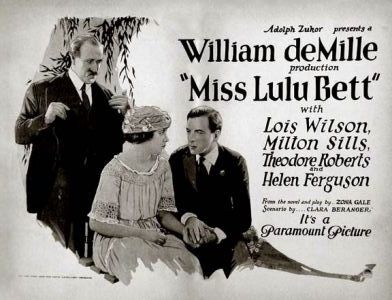
The Plot: Lulu Bett (Lois Wilson) is unmarried and unhappily living as a housekeeper with her sister Ina (Mabel Van Buren) and her family. When Ina’s brother-in-law Ninian (Clarence Burton) returns home after 20 years, he takes a liking to Lulu and jokes about them getting married. When they accidentally say wedding vows in front of Ina’s husband/Justice of the Peace Dwight (Theodore Roberts), they become legally married. This complicates life for everyone, especially as Lulu starts to fall for local schoolteacher Neil Cornish (Milton Sills).

Why It Matters: The NFR praises Wilson’s “quiet and restrained performance” as well as William C. deMille’s “deceptively simple visual storytelling style”.

But Does It Really?: Maybe it’s just because the story itself hasn’t aged well, but this film just kinda lays there for me. Interestingly, this film suffers from the same problem as more recent films based on plays; it’s not opened up enough. Most of “Lulu” takes place in the same house and nothing is done stylistically with the camera or the editing to make it anything other than a filmed play. At almost 100 years old, this film neither wows nor bores in its presentation. Like many of the silent era, “Lulu” is on the NFR list because it survived. An accomplishment to be sure, but not enough for me to recommend it.

Everybody Gets One: While never a major movie star, Lois Wilson had a successful career in silent films and managed to make the transition to “talkies”. In addition to being a matinée idol, Milton Sills was a founding member of both Actors’ Equity and the Academy of Motion Picture Arts and Sciences.

Wow, That’s Dated: Mainly the way we ostracized “spinsters” from our society. In addition, this film features cars that you had to crank, and cigarette girls!

Other notes

  • This is a film with a screenplay by a woman based on work by another woman. You’ve done it before you can do it again, Hollywood!
  • The stage version of “Miss Lulu Bett” won the Pulitzer Prize for Drama in 1921, making Zona Gale the first woman to win the prize.
  • If the name of the director sounds familiar it’s because William C. deMille is the older brother of Cecil and the father of Agnes. And at one point he was married to screenwriter Clara Beranger. Another exciting family to spend Thanksgiving with.
  • It’s only 70 minutes, but this film sure takes its time getting started. We get a virtual realtor walk-through of the house, followed by very slow introductions of the characters and the actors playing them. Very “Robin Hood”.
  • Lulu asks Ninian if he’s “a Miss Mister or a Mrs. Mister?” As long as he’s not Mr. Mister we’re all fine.
  • Did Ina just cop a feel on her mom?
  • Oh yeah, the patriarchy is in full swing in this film. Dwight and Ninian are the least fleshed-out characters, but everything revolves around what they want.
  • Speaking of, when did the name Ninian go out of fashion? He is a saint after all.
  • This film utilizes the lesser-used second definition of “making love”; in this case to be amorously attentive to someone.
  • Again, the whole reason this film doesn’t hold up is that we have accepted as a society that life is not over for unmarried women in their late-20s. That’s right, she’s 27, and they’ve already cast her off on the metaphorical ice floe (which, like this movie, hasn’t been a thing for a long time).

Legacy

  • Oh, the things you learn while researching a film blog. Turns out that my grandfather was named after Milton Sills. He was my great-grandmother’s favorite actor when Milton was born.
  • Like Sills, William C. deMille was a founding member of AMPAS and hosted the first two Oscar ceremonies. That’s right, the director of this film has hosted the Oscars more times than Seth MacFarlane or James Franco ever will.
  • But seriously, has anyone seen or heard from “Miss Lulu Bett” in any of its incarnations since 1921?