
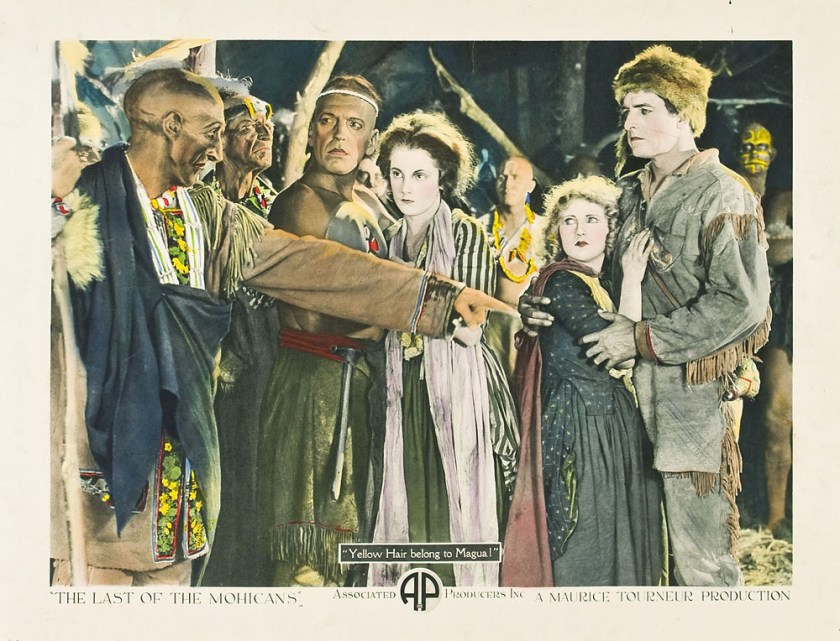
#91) The Last of the Mohicans (1920)

Last-mohicans-1920

#91) The Last of the Mohicans (1920)

OR “Seven Years’ Bore”

Directed by Maurice Tourneur and Clarence Brown

Written by Robert A. Dillon. Based on the novel by James Fenimore Cooper.

Class of 1995

The Plot: In the midst of the French and Indian War, title character Uncas (Alan Roscoe) and a white man raised by the Mohicans named Hawkeye (Harry Lorraine) are sent by the English to escort Cora and Alice Munro (Barbara Bedford & Lillian Hall) to their father (James Gordon) at Fort William Henry. They are thwarted along the way by Cora’s jilted suitor Captain Randolph (George Hackathorne) and Huron Indian Chief Magua (Wallace Beery), an ally of the French Army. In the middle of all of this, Cora starts to fall for Uncas.

Why It Matters: The NFR says that the film “astutely balanced the romantic angle with plenty of action sequences, albeit often stereotypical and brutal.” Their description also mistakenly identifies director Maurice Tourneur as his son (and fellow film director) Jacques Tourneur. Whoops.

But Does It Really?: Many (including Cooper himself in his later years) called the novel unreadable, and this film adaptation, while not unwatchable, is a real slog. I can’t tell if it’s just the limitations of the silent film medium, or if the film as a whole just hasn’t aged well. Regardless, I really can’t find a compelling argument to preserve this film. There are other film versions of this novel (see “Legacy” below) and other opportunities to preserve the works of this cast and crew. I suspect it’s on here due to a restoration of the film in 1993, two years prior to its induction, which was probably only initiated because of the success of the 1992 film version. Who knows?

Everybody Gets One: Barbara Bedford and Alan Roscoe were married not too long after working together on this film. They divorced, but re-married two years later and stayed together until Roscoe’s death in 1933.

Wow, That’s Dated: You mean besides having all of the Native Americans played by white people in redface? I feel like we should just focus on that one.

Other notes

  • Director Maurice Tourneur also directed the fantasy film (and fellow NFR entry) “The Blue Bird”. An injury on the set of this film led to his assistant Clarence Brown taking over the picture, and a 32-year directing career began.
  • Barbara Bedford has a face for silent movies. She may be the only actor in this film aware that the audience has to be able to see your face.
  • Why would you invite along someone who admits he is just going to sing psalms the whole time?
  • The action scenes help pick things up a little bit, but they are few and far between. And how many of these scenes are going to end with two people rolling down a hill?
  • As with a lot of silent films based on novels, this film really doesn’t know how to adapt to a different medium. So much of the visual translation is muddled, and so little of the pertinent text from the book is displayed as title cards.

Legacy

  • The novel has been remade several times over the years, most notably a 1936 version starring Randolph Scott as Hawkeye, and the 1992 version with Daniel Day-Lewis in the role.
  • This prequel

Screen Shot 2017-08-06 at 11.49.12 PM

  • Bonus Clip: Perhaps the best line reading in film history.
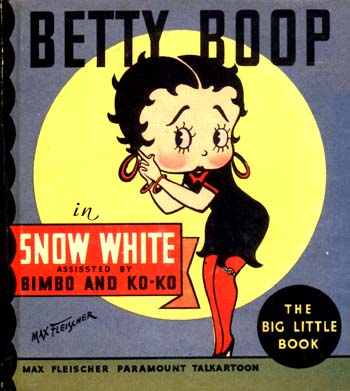
#90) Snow-White (1933)

bettyboopcvr

#90) Snow-White (1933)

OR “Brothers Grimm Via Brothers Fleischer”

Directed by Dave Fleischer

Class of 1994

The Plot: Very, very loosely based on the fairy tale, Betty Boop (voice of Mae Questel) is Snow White, the “fairest in the land” much to the chagrin of her evil stepmother the Queen (possibly also voiced by Questel). Snow White is sentenced to death, but is rescued by Koko the Klown & Bimbo the Dog (voices of Cab Calloway & Billy Murray, respectively) as well as seven indistinguishable dwarfs.

Why It Matters: Despite being the only “Betty Boop” cartoon on the Registry, the NFR listing includes no specific reasons why this short was chosen.

But Does It Really?: Hey kids, wanna see the weirdest cartoon ever? I guess I’ve never really seen a lot of Betty Boop cartoons, because this one took me by surprise. Apparently adult-oriented surreal animation and Cab Calloway music were staples of the series? Regardless, a Betty Boop cartoon should be included on the Registry, and I guess this one will do. But be warned, there are no amount of recreational drugs that can prepare you for this animation.

Everybody Gets One: The real star of this film is animator Roland Crandall. The story goes that the Fleischer Brothers gave Crandall carte blanche on this short’s animation as thanks for all his hard work on previous shorts. He did not disappoint.

Wow, That’s Dated: Fleischer Studios’ hallmark of rotoscoping performers (in this case Cab Calloway) for Koko’s dance movements.

Seriously, Oscars?: Despite being eligible in the relatively new “Best Short Subjects, Cartoon” category, “Snow-White” was snubbed in favor of more sophisticated, less racy fare like “The Three Little Pigs”. No Betty Boop cartoon ever received an Oscar nomination.

Other notes

  • But seriously, are we sure Salvador Dalí didn’t have a hand in animating this?
  • The Queen in this version is not too far removed from Mae Questel’s other great Fleischer character: Olive Oyl.
  • Both Koko and Bimbo were stars of their own cartoon series in the ‘20s. Their waning popularity mixed with Betty’s rising star led to them becoming supporting characters in her series.
  • The film diverges from the fairy tale in a lot of places, but I’ll take a Cab Calloway number over “Love’s First Kiss” any day of the week.

Legacy

  • This short was released just before the Hays Code went into effect, ending the risqué version of Betty as we know it. Attempts to keep Betty going in a more conservative fashion ended poorly.
  • Work’s been kind of slow for Betty since cartoons went to color. But she’s still got it, Eddie!
  • Four years later, Walt Disney would try his hand at telling the Snow White fairy tale in animation. Folly, I tell you!

https://www.youtube.com/watch?v=5kWr9e4JN5I

#89) An American in Paris (1951)

american_in_paris_xlg

#89) An American in Paris (1951)

OR “Song & France”

Directed by Vincente Minnelli

Written by Alan Jay Lerner

Class of 1993

The Plot: Jerry Mulligan (Gene Kelly) is a former GI now living in Paris as a struggling painter. He falls for lovely young French woman Lise (Leslie Caron) who it turns out is dating his mutual friend, performer Henri Baurel (Georges Guétary). At the same time heiress Milo Roberts (Nina Foch) takes interest in Jerry’s art, and possibly a whole lot more. But all of this is just the wall from which to hang some classic Gershwin tunes and some of the best dance numbers captured on film.

Why It Matters: I get the feeling whoever had to do the “American in Paris” NFR write-up didn’t like the film. They call the plot “thinnish”, point out that George Guétary didn’t become the film’s break-out star, and highlight the two numbers that Gene Kelly isn’t in. Was no one else in the office that day?

But Does It Really?: By comparison my thoughts are practically gushing. It may fall apart under scrutiny, but “An American in Paris” is one of the most romantic, feel-good musicals ever made. I dare you to not grin from ear to ear while watching it. This is the film in which Gene Kelly finally broke through as a true artist, and everything around him from the songs to the set help amplify that artistry. If forced to choose I’d still say “Singin’ in the Rain” is the quintessential Gene Kelly film, but “An American in Paris” is a worthy close second.

Everybody Gets One: Of the credited cast, Georges Guétary is the only actor with one film on the Registry. Among the uncredited masses is Noel “Lois Lane” Neill**.

Wow, That’s Dated: A quick shout-out to Hopalong Cassidy, plus some very obvious Chroma key outlining during any scene in a car.

Seriously, Oscars?: “An American in Paris” won six Oscars, including a surprise win for Best Picture (most people were backing either “A Streetcar Named Desire” or “A Place in the Sun”). Despite not being nominated for Best Actor, Gene Kelly did take home an honorary Oscar for his contributions as a choreographer. It was Kelly’s only Oscar during his 50-year showbiz career.

Other notes

  • This was Leslie Caron’s first film. Like her character, Leslie was 19 when she filmed this. Gene Kelly was literally twice her age during filming.
  • Hope you enjoyed those establishing shots, because that’s all you’re seeing of the real Paris for the next two hours!
  • Five minutes in and we get three different narrators, a device we never see or hear again. What gives?
  • A bed that hangs from the ceiling. That’s what I need!
  • Yes, modern girls were definitely still doing The Charleston in 1951.
  • Among the great things about this film is that many of the scenes (musical or otherwise) are presented in just a handful of continuous takes. It gives the whole film a wonderful energy about it.
  • By many accounts he was a taskmaster and not the nicest person, but on screen Gene Kelly is effortlessly charming. And he’s great with kids, that’s always a plus.
  • Having never seen this film before, I was not expecting it to be so funny. Kudos to Alan Jay Lerner, and special kudos to actor Oscar Levant, who hits most of those lines out of the park.
  • Always great to see Dr. Bellows in a movie.
  • Oh I really like Nina Foch in this film. It’s a character we don’t get in a musical too often and she nails it. I wish she could’ve gotten an Oscar nomination.
  • Ah yes, that classic movie romance where he’s aggressive and a borderline stalker but she’s okay with it because it’s…charming?
  • How come the only thing Adam can compose are Gershwin songs?
  • Nice split-screen work during Adam’s dream number. Very “Parent Trap”.
  • Ooh, a joke about Hitler only six years after the war. Quite ballsy.
  • The lead-up to “’S Wonderful” is brilliant. There are three different narratives happening in the same shot, and two of them continue into the song. Perfect.
  • So if my math is right, Lise was 8 to 13 years old when she stayed with Henri during the war. And now they’re engaged. …Okay then.
  • Seeing Gene Kelly in those tight pants I suddenly understand why every woman I’ve ever met wants to climb him like a tree.
  • That ending ballet is great and all, but isn’t it just a rip-off of the ending of “La La Land”?

Legacy

  • Boy, when Gene Kelly does an encore…
  • Many of the artists involved in “An American in Paris” would continue their collaboration throughout the ‘50s musicals that comprise MGM’s “Freed Unit”. This era hit its peak with 1958’s similarly veined “Gigi”.
  • “Love Is Here To Stay” went from second-tier Gershwin to American standard thanks to this film.
  • We get a “new” Gershwin musical every decade or so, so it was only a matter of time before “An American in Paris” made its way to Broadway. Thankfully, it’s a perfect match.

Listen to This: The best Gershwin composition not in this film, George’s “Rhapsody in Blue” was first recorded in 1924. George played piano with Paul Whiteman as conductor. The recording was among the first 50 in the NRR’s inaugural class of 2002.

** 2017 Update: Speaking of, Ms. Neill has a cameo in new NFR entry “Superman”.