Second Screening: E.T. the Extra-Terrestrial (2002 Special Edition)

A70-13550

“Second Screening” is devoted to watching alternate versions of NFR entries and determining which version is most worthy of preservation. Today we look at the 20th anniversary special edition of “E.T. the Extra-Terrestrial”. You can read my thoughts on the original film here.

Full Disclosure: I actually saw the 20th anniversary in the theater (alone, for some reason), and I own the original DVD release that includes both versions of the film.


What’s Different?: Spielberg’s intention with this version was to tweak some shots that always bothered him, either due to the technical limitations of 1982 or changing tastes over the previous 20 years. Most notable are some cleaned up special effects shots, particularly involving E.T. itself. The alien’s facial expressions have been enhanced, and scenes of E.T. moving now show that it uses its arms to propel itself. Two scenes have been added; one involving Elliott trying to give E.T. a bath on his sick day, and another in which Mary finds Michael and Gertie on Halloween.

But perhaps the most controversial alterations are the ones deemed too politically correct. Mary’s objection to Michael dressing as a “terrorist” for Halloween is changed to “hippie”. And during the final chase scene, the guns wielded by government agents have been changed to walkie-talkies. This change was expertly lampooned on the “South Park” episode “Free Hat”.


Does It Help?: Not really. I understand the logic behind changing the guns, but it still looks clunky. The only takeaway from the reinstated scenes is that Elliott learns of E.T.’s neck stretching abilities a few scenes earlier. Really the most insulting change is all the cosmetic updates to E.T.’s performance. The original team of puppeteers did a fine job creating E.T.’s character, conveying everything you need to know about E.T. and its thought process. Adding digital facial expressions and movements just spells out everything, leaving less to the viewer’s imagination. Overall, I can’t say any of these changes improve upon the original film.

The Verdict: Even Spielberg says to stick with the original 1982 version. They should take all copies of the Special Edition and bury them next to the E.T. Atari game.


#118) E.T. the Extra-Terrestrial (1982)

et--the-extra-terrestrial-movie-poster-1982-1020141470

#118) E.T. the Extra-Terrestrial (1982)

OR “Fly Me Near the Moon”

Directed by Steven Spielberg

Written by Melissa Mathison

Class of 1994

The Plot: An alien (voiced by Pat Welsh) is stranded on Earth after government agents discover its species’ ship. The alien flees the scene and finds itself in the backyard of a suburban home. A boy named Elliott (Henry Thomas) befriends the alien and they form a special bond. With the help of his siblings (Robert MacNaughton and Drew Barrymore), Elliott helps the alien (dubbed “E.T.”) with its mission to “phone home”.

Why It Matters: The NFR praises the film’s “masterful blending of hopeful innocence with excitement and humor”. There’s also a very loving essay by David Gibson, whose work for the Library of Congress includes preserving film as well as video games. This naturally leads to a shout-out to the infamous E.T. Atari game.

But Does It Really?: What am I, made of stone? “E.T.” is still as warm and as exciting a film as it was when it came out. Melissa Mathison’s screenplay is flawless, and Spielberg keeps the direction simple but powerful. “E.T.” works on every level and leaves you with hope every single time. I won’t try to break it down any further (Christian allegories be damned), but “E.T.” is about as perfect as filmmaking gets.

Shout Outs: Elliott shows E.T. his “Star Wars” action figures, Yoda is one of the Halloween costumes, and there is an extended tribute to “The Quiet Man”.

Everybody Gets One: Pretty much everyone involved except Spielberg and John Williams. Most notable are Drew Barrymore and ‘80s staple C. Thomas Howell.

Wow, That’s Dated: Polaroid cameras, ‘80s computers the size of a washer/dryer unit, casual references to terrorists, and of course, the classic Speak & Spell.

Take a Shot: No one says the full title, but as always the real drinking game with a Spielberg film is “Shots of People Looking Meaningfully at Something Off-Camera”.

Seriously, Oscars?: While “E.T.” did win four technical Oscars (Sound Mixing, Sound Editing, Original Score, and Visual Effects), it lost Best Picture, Director, and Original Screenplay to “Gandhi”, a slight that was even acknowledged by “Gandhi” director Richard Attenborough. Spielberg held no grudges; casting Attenborough in “Jurassic Park” and “Gandhi” lead Ben Kingsley in “Schindler’s List”.

Other notes

  • While I was not alive for the original release of “E.T.”, my parents saw it at a drive-in with my newborn brother. Dad fell asleep during it, a tradition he continued every time he tried to watch the film.
  • That alien ship is easily a cousin of the “Close Encounters” ship.
  • Hmmm, ‘80s kids playing D&D? Oh my god, don’t go through the woods!
  • I’m convinced that Elliott lives in the same neighborhood as the “Poltergeist” family. Don’t forget to move the bodies.
  • Ah yes, the film that brought us the great insult “penis breath”.
  • Aliens, absent fathers, a score by John Williams, the aforementioned looking off-camera…hey I just won Spielberg Bingo!
  • E.T. runs like a ‘40s cartoon character; quickly and with doors swinging in its wake.
  • That puppet work on E.T. is amazing. Shout-out to the whole team. No amount of CG can improve upon that.
  • Elliott doesn’t seem to have any of the major “Star Wars” action figures. Did he never turn in his Kenner Early Bird certificate?
  • One of the great things about this film is that the kids are allowed to be kids. They’re not adults trapped in kids bodies, they talk like kids talk. It keeps everything fresh.
  • Hey, don’t throw your gender constructs on E.T., Elliott!
  • Okay, Spielberg, enough with the “Vertigo” zoom effect. It’s giving me a headache.
  • Between “The Quiet Man” and “This Island Earth”, is every channel TCM? (Side Note: This is the closest Tom & Jerry have gotten to being on the NFR so far.)
  • Bonus Clip: Melissa Mathison’s then-husband Harrison Ford filmed a scene as Elliott’s principal that was eventually cut. It was made available only on the film’s laserdisc release.
  • Oh Drew Barrymore, you are adorable. And to think one day you’ll grow up to briefly marry Tom Green.
  • Good for E.T.; English is a tough second language to learn.
  • At one point Mary reads “Peter Pan” to Gertie. Now don’t you get any ideas, Spielberg.
  • Halloween in the movies: where no one goes as a copyrighted character unless it’s somewhere in the conglomerate (or you’re friends with George Lucas).
  • That bike flying scene gave me all of the chills.
  • Elliott is supposed to be dressed as a hunchback? That does not come across.
  • It needs to be said that when government vans start showing up, your Neighborhood Watch program has failed you big time.
  • Shout-out to Peter Coyote as “Keys”. He could have been the bad guy, but Coyote (as well as Mathison) make him human. And props to Dee Wallace as Mom. She adds a lot to a character that has surprisingly little to do.
  • You’d think the aliens would invent a better ramp system. It takes E.T. a while to get up to the ship.

Legacy

  • “E.T.” was the hit of the year and spawned countless merchandise and pop culture opportunities. To name just a few:
  • The short-lived knock-off craze of films where a kid befriends an alien. The go-to examples are “Los Nuevos Extraterrestres” (aka “Pod People”) and the incredibly awful “Mac and Me”.
  • Reese’s Pieces saw their stock go up thanks to an appearance in this film, leading to many more product placements in film.
  • The aforementioned Atari game that is so awful they buried unsold copies in a New Mexico landfill.
  • A ride at Universal Studios, which is the closest we’re ever getting to a sequel.
  • The logo for Spielberg’s production company Amblin.
  • The long running TV spin-off
  • And perhaps most interestingly, Neil Diamond was inspired by this film to write the song “Heartlight”. Try listening to these lyrics without thinking of E.T.

Further Viewing To Avoid At All Costs: I have some thoughts on the 20th anniversary version of “E.T.” You can read them here.

The Class of 2017: My Ballot

National_Film_Registry_logo_vector.svg

The great thing about the National Film Registry is that anyone can nominate a film for consideration. I figured since I’m devoting an entire blog to this list, I might as well throw in my two cents. Back in March I submitted a list of 50 films (the maximum amount permitted) that I feel should be added to the National Film Registry. Now that the deadline for 2017 submissions has passed, I’d like to share with you some of my selections. This is not the full list of my 50, but rather a sample of the kind of films I was looking at. This was a long process dwindling this list down to only 50, but I finally made my choices. And for the ones that didn’t make it, there’s always next year.

Movies I Can’t Believe Aren’t On The List Yet: A Clockwork Orange (1971), The Great Escape (1963), Jurassic Park (1993), Rebecca (1940), The Seven Year Itch (1955), The Shining (1980), Spartacus (1960), Titanic (1997)


Minor Classics/Movies I’d Give a Pass To: Guess Who’s Coming to Dinner (1967), Lady and the Tramp (1955), Rope (1948), Sophie’s Choice (1982), To Have and Have Not (1944)


Probably Not Making It, But I Like Them Anyway: Big (1988), The Birdcage (1996), It’s a Mad, Mad, Mad, Mad World (1963), Mrs. Doubtfire (1993), The Nightmare Before Christmas (1993), The Odd Couple (1968), Plan 9 from Outer Space (1959), The Truman Show (1998)


The Movie I Can’t Stand But Also Can’t Deny Its Cultural Impact: Grease (1978)


The Movie I Wouldn’t Be Surprised Finally Gets Included Because of This Whole “Feud” Thing: What Ever Happened to Baby Jane? (1962)


A Few Shorts For Your Consideration: Der Feuhrer’s Face (1942), Exploratorium (1974), Red Hot Riding Hood (1943)


Fairly Recent Films That Might Make It One Day: Aliens (1986), Beetlejuice (1988), Dead Poets Society (1989), Die Hard (1988), Fatal Attraction (1987), The Sixth Sense (1999), Terminator 2: Judgment Day (1991), The Usual Suspects (1995), When Harry Met Sally… (1989)


Because They Need to Pick A Narrative Feature From This Century Sometime: Finding Nemo (2003), No Country for Old Men (2007), There Will Be Blood (2007)


And as soon as we get the list of 25 in December, I’ll be back at it submitting for 2018. As always, you too can submit to the list on this page. Check this page for the list of eligible films.

#117) Point of Order (1964)

#117) Point of Order (1964)

OR “The Schine-ing”

Directed by Emile de Antonio

Class of 1993

The Plot: Senator Joseph McCarthy, best known for his strong anti-Communist stance in the early 1950s, found himself in hot water in 1954 when the U.S. Army accused him of using his influence on the army in exchange for privileges for his former staff member, Pvt. G. David Schine. McCarthy claimed that the threat of Communism had subverted the U.S. Army, while Chief Counsel Joseph N. Welch questioned the Senator’s sense of decency. This film takes almost 200 hours of television footage of the landmark investigation hearings and condenses it to a lean representation of what went down.

Why It Matters: The NFR gives a brief overview of the film, and then throws out the word “obfuscation” like it’s the flippin’ SATs.

But Does It Really?: A major historical yes on this one, though I will admit the legacy is the original footage more than the film itself. This footage is important as a reminder that politics have always been infuriating and that just because someone’s loud doesn’t mean they are right. I am surprised (but also grateful) that the NFR didn’t include the entire televised hearings in their archives in lieu of this film. Not to give anyone any ideas. I still have to sit through “Greed” and “Empire”.

Everybody Gets One: Director Emile de Antonio was originally in the art world alongside the likes of Andy Warhol. It was during an attempt to distribute “Pull My Daisy” that he discovered filmmaking. Like “Point of Order” most of his films focus on American politics, except, of course, for “Painters Painting”.

Wow, That’s Dated: Phrases like “crackpot”, kinescope television, indoor pipe smoking, and flashbulbs. Perhaps most dated, the hearings were originally aired on the DuMont Network!

Take a Shot: This one actually makes a fun drinking game. This being a senate hearing and all, the phrase “point of order” comes up quite a bit.

Seriously, Oscars?: I’m not sure if this film ever got an L.A. release, but regardless, “Point of Order” didn’t get a Best Documentary nomination. Even if it had, that year’s winner “Jacques-Yves Cousteau’s World Without Sun” gives you a hint that the Academy wasn’t ready to revisit McCarthyism.

Other notes

  • The original poster calls this film “Point of Order!”, but the title in the film itself has no punctuation of any kind. What gives?
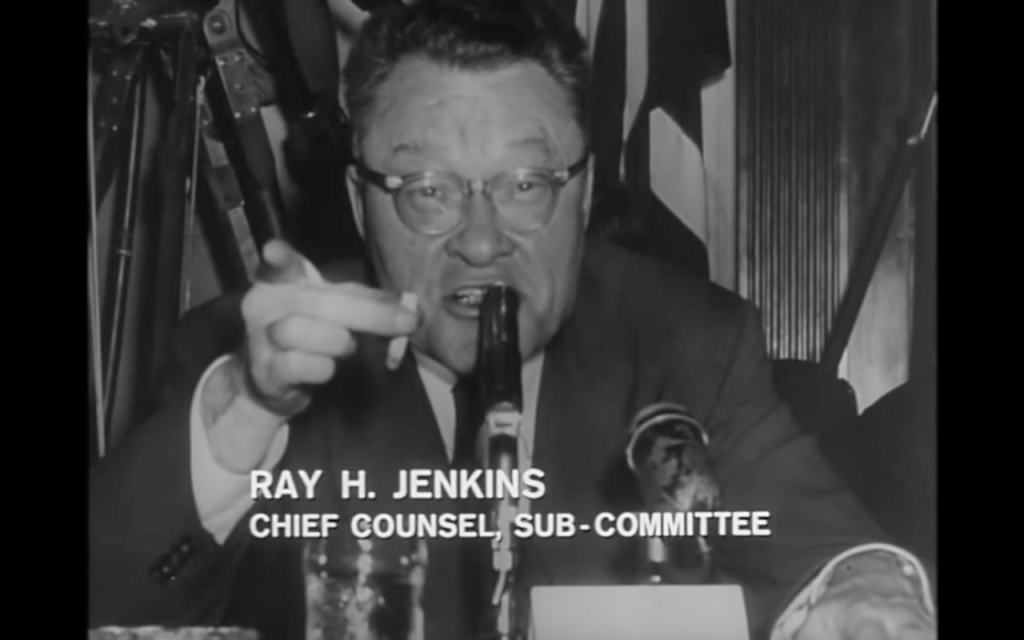
  • The photo used for special counsel Ray Jenkins is that of a man who does not want his picture taken.
Screen Shot 2017-09-19 at 10.14.31 PM
  • I’ve said it before and I’ll say it again; Joe McCarthy looks like Broderick Crawford and sounds like a Muppet.
  • Look closely for Robert Kennedy in the background. Turns out Joseph Kennedy was a friend of McCarthy. This is where the bad blood between Robert and Roy Cohn started.
  • Oh, what social media would have done to McCarthy and this entire hearing had it existed back then. But of course, that could have backfired and helped make McCarthy president for all I know.
  • Wow, infiltration of homosexuals in our Air Force and Navy. Was not expecting that to come up back now. If only they had created “Don’t Ask, Don’t Tell”.
  • Why does McCarthy keep saying he represents the Army? Am I missing something?
  • Wow, McCarthy’s jokes just aren’t landing with this crowd. Read the room, Senator.
  • Will someone please invent Photoshop so Welch doesn’t have to keep coming up with synonyms for “altered”?
  • All I kept thinking throughout the film was “those poor stenographers”.
  • The debate between McCarthy and Welch over the definition of the word “pixie” has more gay subtext than all of “Rope”.
  • This is the second movie I’ve covered where Eisenhower is mentioned but never seen.
  • Man, if you lived in Wisconsin in 1946 and you voted for this guy, you’ve got to be kicking yourself right about now.
  • Did we ever figure out who gave McCarthy the fake J. Edgar Hoover letter? Or did McCarthy’s team just forge it themselves?
  • Unsurprisingly, they changed the ending of the film. In real life, Senator Symington’s walkout on McCarthy happened about halfway through the hearings. The hearings concluded with McCarthy being cleared of any wrongdoing (not that it helped), but did declare some shenanigans from both McCarthy’s chief counsel Roy Cohn and the U.S. Army.

Legacy

  • Nine words; “At long last, have you no sense of decency?”
  • McCarthy was eventually censured at the end of 1954. Not an impeachment, but not great either. McCarthy kept fighting Communism on the Senate floor, but his alcoholism cut his life short in 1957.
  • Joseph Welch died not too long after the hearings, but did manage to play a judge in Otto Preminger’s “Anatomy of a Murder”.
  • G. David Schine went on to be the executive producer on “The French Connection”. I’m not kidding, that actually happened.
  • Roy Cohn’s legal career took off after this, but he is perhaps best remembered for his fictional portrayal in “Angels in America: A Gay Fantasia on National Themes”.
  • As for the film itself, “Point of Order” was re-edited for television in the ‘70s. A new introduction by Paul Newman was filmed, and the movie was retitled “McCarthy: Death of a Witch Hunter”.

Further Viewing: The 1977 TV movie “Tail Gunner Joe” covers all of McCarthy’s highs and lows, and also recreates several key moments from the Army-McCarthy hearings. Peter Boyle plays McCarthy here, and Welch is played by Burgess Meredith who, coincidentally (or maybe not), was blacklisted during McCarthy’s Communist witch-hunt of the early ‘50s. Emilio de Antonio did not speak highly of this film.

#116) Paths of Glory (1957)

paths-of-glory-movie-poster-1957-1020529123

#116) Paths of Glory (1957)

OR “The Dawn of Stan”

Directed by Stanley Kubrick

Written by Kubrick & Calder Willingham and Jim Thompson. Based on the novel by Humphrey Cobb.

Class of 1992

The Plot: During World War I, a group of French soldiers are ordered by General Mireau (George Macready) to attack the German army at “The Anthill”. Knowing this is a suicide mission, and facing heavy fire near the trenches, the soldiers refuse to fight. After consulting with General Broulard (Adolphe Menjou), Mireau has three of the soldiers randomly arrested and tried in a court-martial for cowardice. The unit’s leader Colonel Dax (Kirk Douglas) is on hand to defend the soldiers and question why the army would make such a command in the first place. And somewhere behind the camera is a young director whose love of slick camera movements and distrust of authority is already on display.

Why It Matters: The NFR praises Douglas’ performance, as well as the screenplay, and calls “Paths of Glory” the film that “established Stanley Kubrick as an influential director.”

But Does It Really?: This film has “minor classic” written all over it, but it’s fun to see where Stanley Kubrick got his “start” (this was his fourth film, but his first to meet any sort of success). “Paths of Glory” has elements that would continue to permeate through Kubrick’s work, most notably the dark humor we’ll see in “Dr. Strangelove”. The film’s message isn’t so much “war is hell” as it is “hell is other people”. “Paths of Glory” isn’t the first Stanley Kubrick film that comes to mind, but it is definitely worth a watch. Plus it’s less than 90 minutes! How many war movies can say that?

Title Track: No one says “paths of glory” in this film, but it’s worth noting that the title comes from the Thomas Gray poem “Elegy Written in a Country Churchyard”; “The paths of glory lead but to the grave.” Good stuff.

Seriously, Oscars?: A critical success but commercial failure, “Paths of Glory” received zero Oscar nominations. The only major stateside nomination it got was the Writers Guild Award for Best Written Drama, which it lost to “12 Angry Men”. The film did better overseas, earning a BAFTA nomination for Best Picture, losing to “The Bridge on the River Kwai”.

Other notes

  • Before being a film, “Paths of Glory” was adapted into a play in 1935. It closed on Broadway after only 23 performances.
  • You can definitely see Kubrick’s flair for cinematography all over this film. He may have had the vision, but shout-out to credited cinematographer Georg Krause, a native of Germany when “Paths of Glory” came to film there. Krause would later be the cinematographer for, and I swear I am not making this up, “Horrors of Spider Island”.
  • I think we can all agree that Kirk Douglas has the definitive cleft chin of 20th century cinema. And at 100 years old he still does!
  • Kubrick loves blocking scenes so it’s just the actors walking in big circles around the room talking. Keep in mind he was 29 when he directed this film; maybe he just felt that long dialogue scenes needed to be punched-up visually.
  • Roget does the classic “dramatic turn towards the camera after someone leaves the room” maneuver.
  • That is actor George Macready’s actual scar on his right cheek. He received it from a car accident in his college days, and this film makes no effort to hide it.
  • Pretty amazing that in a film with a cast of predominantly French characters not a single one of them has an accent. The closest we get is Adolphe Menjou’s name.
  • Hey Mireau, if you’re going to threaten a subordinate, maybe don’t do it in a room that’s essentially an echo chamber.
  • The three convicted soldiers are lucky Patton isn’t around to slap them silly.
  • The court-martial president (and narrator) is played by Peter Capell. You know him best as the tinker in “Willy Wonka & the Chocolate Factory” (“Up the airy mountain, down the rushy glen…”)
  • Richard Anderson is great as Major Saint-Auban, the prosecuting attorney. He’s just so smarmy. Anderson would gain fame in the ‘70s for his work on both “The Six Million Dollar Man” and “The Bionic Woman”.
  • At one point Dax objects that there is no stenographic record of the court-martial. Dude, there’s cameras.
  • We will see that “camera glide through a ballroom” shot again in “The Shining”.
  • Hang in there until almost the very end for Kirk Douglas to have one of his classic clenched teeth outbursts. It’s worth it.
  • The German woman at the end of the film is Christiane Harlan (credited as Susanne Christian). She and Stanley Kubrick met on the set, married a year later, had two daughters, and stayed together for the rest of Stanley’s life.

Legacy

  • Remembering their collaboration on this film, Kirk Douglas hired Kubrick to direct “Spartacus” after the unceremonious firing of original director Anthony Mann. Kubrick hated not having complete creative control of the film, and disliked when Douglas would put on his producer hat to outrank him in arguments. Kubrick and Douglas never worked together again.
  • Kirk Douglas got a chance to play a similarly conflicted WWI officer in the “Tales from the Crypt” episode “Yellow”. I can’t believe the Crypt Keeper didn’t introduce this episode as “Paths of Gory”. It’s right there!
  • David Simon cited this film as an influence on “The Wire”. And if I haven’t gotten around to watching that show at this point, I never will.
  • Kubrick would revisit some of the same warfare politics 30 years later with “Full Metal Jacket”.
  • Are we ever getting that Napoleon movie? I’m looking at you, Spielberg.