#137) King of Jazz (1930)

kingofjazzad1

#137) King of Jazz (1930)

OR “Whiteman Can’t Jump”

Directed by John Murray Anderson

Written by Harry Ruskin

Class of 2013

The Plot: Plot? What plot? “King of Jazz” is a revue showcasing Paul Whiteman and his orchestra. Featured along the way are musical numbers, comedy sketches, and even a cartoon! Plus, be on the lookout for a young Bing Crosby.

Why It Matters: The NFR calls the film “[a] sparkling example of a musical in the earliest days of two-color Technicolor.” There’s also a pretty by-the-numbers essay by Swedish film historian Jonas Nordin.

But Does It Really?: Well it gets by on “Belloq film” status, and the new restoration looks great, but man is this thing tough to get through. “King of Jazz” is very much filmed vaudeville, with little if any attempt to make it cinematic. Audiences didn’t care for it in 1930, why should I care now? I can’t believe the deleted “Magnificent Ambersons” footage is gone forever, but this thing lives on.

Shout Outs: One of the sketches is inspired by “All Quiet on the Western Front”, which premiered the same week as this film!

Everybody Gets One: Paul Whiteman was one of the most popular bandleaders of the ‘20s and ‘30s. He helped introduce jazz to a white audience (though it was really orchestral jazz, and white people definitely didn’t invent that). Among his career highlights: He was the first to conduct Gershwin’s “Rhapsody in Blue”. It was his version that made the National Recording Registry in 2002.

Wow, That’s Dated: References to jazz as “new music”, as well as one character remembering Prohibition. But the main takeaway is the final “Melting Pot” number with some of the whitest dancer I’ve ever seen. I’ll just take this time upfront to apologize to every nationality.

Title Track: Paul Whiteman’s nickname “the King of Jazz” is said only twice at the very beginning of the film. The cartoon by Walter Lang is about how he got the moniker.

Seriously, Oscars?: “King of Jazz” was nominated for and won the Oscar in one category: Best Art Direction. Truly this is Hollywood’s way of saying “At least the sets looked nice.”

Other notes

  • The cartoon sequence is notable for being the first animation in two-color Technicolor. And for a cartoon set in the jungles of Africa, they really don’t utilize that much color.
  • Surprise guest appearance by Oswald the Lucky Rabbit.
  • While introducing the band, the pianist plays a few bars of “Nola”. It’s been done.
  • When I think of chorus girls I think of them sitting down and only moving their hands. Could none of them actually dance?
  • All female reporters in the first sketch. How progressive.
  • And to think one of the Rhythm Boys would one day win an Oscar and sing a Christmas duet with David Bowie.
  • Where’s the giant vaudeville hook when you need it?
  • Oooh, overhead dancing shots that predate Busby Berkeley. How do like that?
  • One of the blackout sketches is referred to as “Another Quickie”. Ahem.
  • “Rhapsody in Blue” is entertaining, but “Fantasia 2000” did it better.
  • Between the rag doll number and the finale, I guarantee at least one on-set injury occurred.
  • “So help me Bob”? Who’s Bob?
  • That’s future three-time Oscar winner Walter Brennan as the front of a horse.
  • Listen closely to the father in the proposal sketch. Sound familiar? That’s Otis Harlan, the voice of Happy (of the Seven Dwarfs).
  • At one point my notes simply read “WHAT IS HAPPENING?”

Legacy

  • “King of Jazz” pretty much killed the film musical until “42nd Street”.
  • The film’s only real legacy is giving Bing Crosby the exposure he needed to become a star.
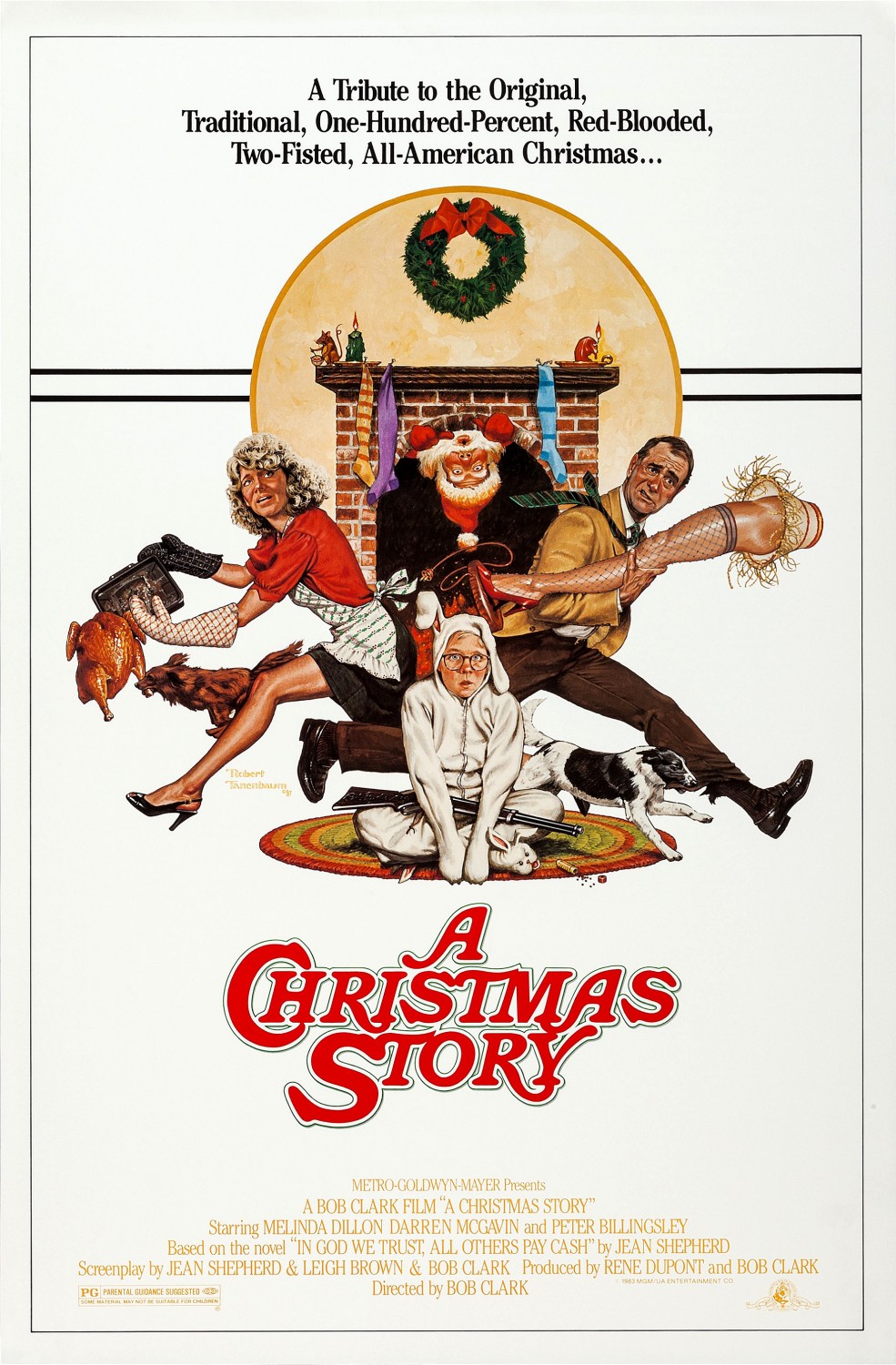
#136) A Christmas Story (1983)

christmas_story_xlg

#136) A Christmas Story (1983)

OR “When You Comin’ Back, Red Ryder?”

Directed by Bob Clark

Written by Clark & Jean Shepherd & Leigh Brown. Based on Shepherd’s novel “In God We Trust: All Others Pay Cash” and other short stories.

Class of 2012

The Plot: Based on Jean Shepherd’s childhood in Indiana (or not), “A Christmas Story” is about Ralphie Parker (Peter Billingsley, older version voiced by Jean Shepherd) and his quest to get a Red Ryder BB Gun for Christmas. Mom (Melinda Dillon) is concerned he’ll shoot his eye out, while the Old Man (Darren McGavin) is more fixated on a “major award” leg lamp. Throw in the neighbor’s dogs, a malfunctioning furnace, and all the fake swearing a PG movie can handle, and you got a holiday classic.

Why It Matters: The NFR highlights Bob Clark’s love for the material, and that the film’s “expertly realized moments reflect an astute understanding of human nature.” Wow, they didn’t say anything this nice about “The Graduate”, that’s for sure.

But Does It Really?: Full disclosure: I didn’t see this film until I was an adult. Everyone’s got that classic film they somehow missed growing up, and this is mine. I enjoyed it, but we’ve already covered my personal favorite Christmas movie. The journey “A Christmas Story” made from cult film to holiday standard is admirable, and the film has more reasons for preservation than others on this list. I liked “A Christmas Story”, but I don’t need to see it every year. And if that upsets you well…go fudge yourself.

Shout Outs: Several “Wizard of Oz” references, plus fleeting shout-outs to “Snow White and the Seven Dwarfs” and “Frankenstein”. Special bonus reference: The end credits list actors playing the roles of Flash Gordon and Ming the Merciless, despite neither of them making the final cut.

Everybody Gets One: Jean Shepherd was a radio personality who specialized in improvised monologues about his childhood. Encouraged by his friend, author Shel Silverstein, he used these stories as the basis for his novel “In God We Trust: All Others Pay Cash”. This film is also the only NFR appearance for director Bob “Porky’s” Clark, actors Darren “Kolchak” McGavin and Peter “Ralphie from ‘A Christmas Story’” Billingsley.

Wow, That’s Dated: The casual racism towards Arabs and the Chinese. Also, Melinda Dillon’s hair, but mostly the casual racism.

Seriously, Oscars?: Despite this film doing very well at Canada’s Genie Awards (the bulk of the film was shot in Ontario), “A Christmas Story” only received one major American nomination: a Writers Guild nod for Best Adapted Comedy. The film lost to… “Terms of Endearment”? I mean, it’s kind of funny, but how can a movie with a kid in a bunny costume be less funny than Debra Winger dying of cancer?

Other notes

  • I’ll just reiterate that Bob Clark also directed raunchy teen comedy “Porky’s”. Though to be fair, it was the success of that film (and several horror films) that led to Clark being able to make this movie.
  • Mom gets top billing because she’s a two-time Oscar nominee and the original Honey, goddammit!
  • Ralphie sweetie, I know you’re an adorable kid, but you need to articulate.
  • Even in a child’s fantasy, the black character is the first one to get shot.
  • I am pretty confident that the Red Ryder theme is from the Grand Canyon diorama at Disneyland.
  • Darren McGavin kinda looks like Jim Backus.
  • And then Flick gets his tongue stuck to a flagpole and I start to warm up to this film.
  • That has got to be the easiest unboxing of a crate that big ever.
  • Fantasy Miss Shields gives an F for misuse of a semicolon. I would not do well in her class.
  • I guess my main turn-off with this film is that there’s so much screaming. The kids scream, Mom screams, and there’s no ice cream to be had. This film is periodically very unpleasant to listen to.
  • Someone’s having fun with those scene transitions.
  • I laughed hardest at Randy’s line, “Dad’s gonna kill Ralphie.” The whole run of Randy hiding in the cabinet is hilarious.
  • Jean Shepherd’s description of Santa borders on Rex Kramer territory.
  • A quick anachronism: That Mickey Mouse costume is definitely the ‘70s version. The ‘40s Mickey Mouse costume was a bit more grotesque.
  • Anything you need to know about shopping mall Santas you can learn from David Sedaris.
  • No extended family? Now this is my kind of Christmas.

Legacy

  • “A Christmas Story” wasn’t a huge success when it first premiered, but home video and cable showings helped give the film a cult status. By the late ‘90s TBS and/or TNT aired 24-hour marathons of “A Christmas Story” during the holidays, a tradition that continues to this day.
  • Bob Clark and Jean Shepherd reteamed in the ‘90s to make “My Summer Story” (aka “It Runs in the Family”), based on additional work by Shepherd. Because it had been 11 years between films, the entire Parker family had to be recast. Same goes for the PBS adaptations throughout the ‘90s.
  • Oh dear god, I forgot they made a sequel. To no one’s surprise, the direct-to-video “A Christmas Story 2” takes no inspiration from Jean Shepherd’s stories.
  • Peter Billingsley grew up and shifted his show business career towards producing. He still occasionally acts, most notably in another holiday classic: “Elf”.
  • Like many a classic film whose franchise days are over, “A Christmas Story” was turned into a Broadway musical in 2012. The show did well in its limited engagement, and managed a Best Musical nomination at the 2013 Tony Awards.
  • The musical version will be getting the live TV treatment, because that’s a thing that’s still happening.
  • They brought back Red Ryders because of this film.
  • And finally, I’ll blame “A Christmas Story” for “The Wonder Years”, “The Goldbergs” and every other show where a narrator looks nostalgically at their childhood.

#135) A Computer Animated Hand (1972)

128975797_1280x720

#135) A Computer Animated Hand (1972)

OR “Digital Digits”

Directed by Edwin Catmull & Fred Parke

Class of 2011

The Plot: A demonstration for a graduate project at the University of Utah, Edwin Catmull and Fred Parke show the step-by-step process of digitizing a real hand (Edwin’s left, to be exact) and rendering it as three-dimensional computer animation. Remember, this is the early ‘70s; they didn’t even have “Pong” yet. This is revolutionary.

Why It Matters: Both the NFR write-up and the supplemental essay by Andrew Utterson discuss the film’s place as “the foundation for computer graphics that followed.”

But Does It Really?: From a technical viewpoint, absolutely. This is the “Gertie the Dinosaur” of computer animation. I can only imagine what it must have been like to see this in the early ‘70s. Plus it’s only a minute long. What are you, too busy to watch?

Everybody Gets One: Edwin Catmull wanted to be a Disney animator, but realized early on that he didn’t have the drawing skills required. While at the University of Utah he studied computer graphics, and hoped of one day marrying the new field with traditional animation. Not a lot of details are known about Fred Parke, but he currently teaches at Texas A&M. Anybody know his office hours?

Wow, That’s Dated: Early ‘70s computer graphics: you gotta love them.

Other notes

  • Does anyone know what grade these two got on this project? I hope their professor wrote something incredibly shortsighted like, “Well you’ll never see this in the Library of Congress.”
  • Nice jazz score, fellas.
  • What’s up with Edwin’s pinky? It’s a little out of whack. Sports injury?
  • If they had shaded that hand differently they could have called this film “A Computer Animated Turkey”.
  • I don’t care what anyone says: this is Thing’s finest performance.
  • Be sure to watch the full version, which also includes a computer-rendered heart valve and a computer-animated face (Fred Parke’s wife).

Legacy

  • Footage from “A Computer Animated Hand” was recycled into the 1976 “Westworld” sequel “Futureworld”. But if it’s not gratuitous nudity or Anthony Hopkins saying the name “Arnold” I don’t care.
  • Edwin Catmull went on to found the Computer Graphics Lab, renamed Pixar in 1986. He eventually became the president of Pixar and Disney Animation Studios, and finally got to realize his passion project: “Cars 2”.
  • While Catmull stayed with animation, Fred Parke continued to work on computer graphics outside the limelight. He is currently a professor in the Visualization Department at Texas A&M University.
  • And of course, this film is responsible for all of the computer animation that has followed in the last 45 years. But the main takeaway from all of this is the dancing baby on “Ally McBeal”.

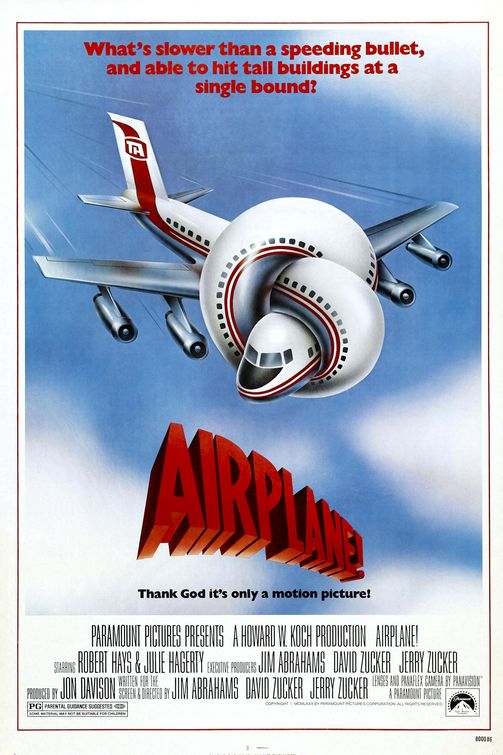
#134) Airplane! (1980)

airplane

#134) Airplane! (1980)

OR “With a Name Like Zucker’s, It Has To Be Good”

Directed & Written by Jim Abrahams & David Zucker & Jerry Zucker. Based on the film “Zero Hour!”, screenplay by Arthur Hailey & Hall Bartlett & John Champion.

Class of 2010

The Plot: In a mashup of “Zero Hour!” and “Airport 1975”, a commercial flight is thrown into chaos when both pilots (Peter Graves & Kareem Abdul-Jabbar) fall ill. The only man who can land the plane is Ted Striker (Robert Hays) an ex-fighter pilot traumatized by flying in the war. With the aid of his estranged lover Elaine (Julie Hagerty), his former commander Rex Kramer (Robert Stack), control tower supervisor Steve McCroskey (Lloyd Bridges), straight-faced Dr. Rumack (Leslie Nielsen) and an inflatable automatic pilot (Otto), Striker will either land the plane, or the shit’s gonna hit the fan.

Why It Matters: The NFR’s description says the film “skewered Hollywood’s tendency to push successful formulaic movie conventions beyond the point of logic.” Geez, way to over-analyze everything. An essay by NFR go-to Michael Schlesinger puts the film in the context of other ‘70s comedies and disaster films.

But Does It Really?: This is the gold standard by which all parody films should be measured. “Airplane!” takes the disaster genre (a genre that’s already pretty ridiculous) and takes it to the next level. All of the jokes are individually stupid (and some a bit too crude for my tastes), but when they come at this relentless a pace, you are at the mercy of unstoppable laughter. “Airplane!” is one of the rare film comedies where everyone is in on the joke. From its rapid-fire pace to its pitch-perfect casting, “Airplane!” holds up better than most other comedies from that era, and even better than the films it’s satirizing.

Shout Outs: Among the films parodied are NFR entries “The Wizard of Oz”, “Knute Rockne, All American”, “Pinocchio”, “From Here to Eternity”, “Jaws”, and “Saturday Night Fever”.

Everybody Gets One: Practically everyone, most notably the ZAZ team, Robert Hays, Julie Hagerty, Kareem Abdul-Jabbar, and of course, Otto.

Wow, That’s Dated: Despite the film’s timeless humor, there are a lot of references to the late ‘70s. Among them; Hare Krishnas at airports, pre-9/11 flight procedures, a parody of this Yuban Coffee commercial, an extended disco sequence, and a slam on Anita Bryant.

Take a Shot: Amazingly, the word “airplane” is said only twice in the entire film: once by McCroskey and once by Striker.

Seriously, Oscars?: No Oscar nominations, but “Airplane!” did receive a Golden Globe nomination for Best Comedy or Musical (losing to the hilarious “Coal Miner’s Daughter”). The ZAZ team won the WGA Award for Best Adapted Comedy, beating out… “The Empire Strikes Back”? Does anyone in Hollywood know what a comedy is?

Other notes

  • The third credit in the opening titles (after Hays and Hagerty) is for costume designer Rosanna Norton. She must have a great agent.
  • Exhibit A for “This Film Couldn’t Be Made Today”: an abortion joke three minutes in.
  • Among the many, many bit players in this film are Jimmie Walker, future “Breaking Bad” star Jonathan Banks, future “24” president Gregory Itzin, ‘70s game show staple Joyce Bulifant, and ultimate TV Mom Barbara Billingsley. Special Bonus: Dr. Brody of the Mayo Clinic? He was the original voice of Boba Fett. I’m not kidding, look it up.
  • I can’t say enough about Robert Hays and Julie Hagerty. They may not get the funniest lines, but they really are the glue that holds this film together.
  • Peter Graves’ running joke with Joey is creepy as hell, but I’ll be damned, Graves sells it.
  • Shout-out to Lt. Hurwitz. This is the last movie I’d expect Stephen Sondheim and Jule Styne to get royalties from.
  • Quick jab at the expense of then-presidential candidate Ronald Reagan.
  • In today’s money $113.30 isn’t too bad for a cab fare.
  • I love this movie, but I’ve never quite gotten the spear/watermelon gag. The directors have said it never got the laugh they wanted it to.
  • As previously mentioned, everyone’s in on the joke, but Robert Stack especially gets it. That performance is flawless.
  • Speaking of great performances: Stephen Stucker as Johnny. It’s not exactly PC, but in a film where everyone plays it straight, Stucker’s the only cast-member who gets away with being over-the-top.
  • I have too many favorite lines, so here’s just a few:

“Joey, have you ever been in a…in a Turkish prison?”

“You can’t take a guess for another two hours?”

“Keep them at 24,000. No, feet.”

“Pinch hitting for Pedro Borbón, Manny Mota…Mota…Mota…”

“Me John Big Tree!”

“He’s all over the place. 900 feet up to 1300 feet. What an asshole.”

“Municipal bonds, Ted. I’m talking double A rating. The best investment in America.”

Legacy

  • Following the success of “Airplane!”, Paramount wanted a sequel, and team ZAZ definitely did not. The result: “Airplane II: The Sequel”, written and directed by Canadian comedy writer Ken Finkleman, is a beat-for-beat remake of the first film.
  • Leslie Nielsen reteamed with ZAZ to make the TV show “Police Squad!”. Critically hailed but roundly ignored, the show was cancelled after six episodes. It did, however, spawn the successful “Naked Gun” film series.
  • ZAZ is also responsible for “Top Secret!” and one of my favorite jokes in any movie ever.
  • Nielsen wasn’t the only one who got a career revival from “Airplane!”. Robert Stack, Lloyd Bridges, and Peter Graves all got second acts playing straight-faced characters saying ridiculous things.
  • My friend Travis and I tried our hand at adapting “Airplane!” into a “39 Steps”-esque stage production. It is currently a lovely Word document on my computer, but if anyone with the rights to “Airplane!” wants to talk, we are listening.
  • And of course:

Further Viewing: “Zero Hour!” Duh.

Further Further Viewing: While promoting “Police Squad!” on an early episode of “Late Night”, ZAZ presented David Letterman’s screen test for the role of Ted Striker. Yeah, good call for everyone involved.

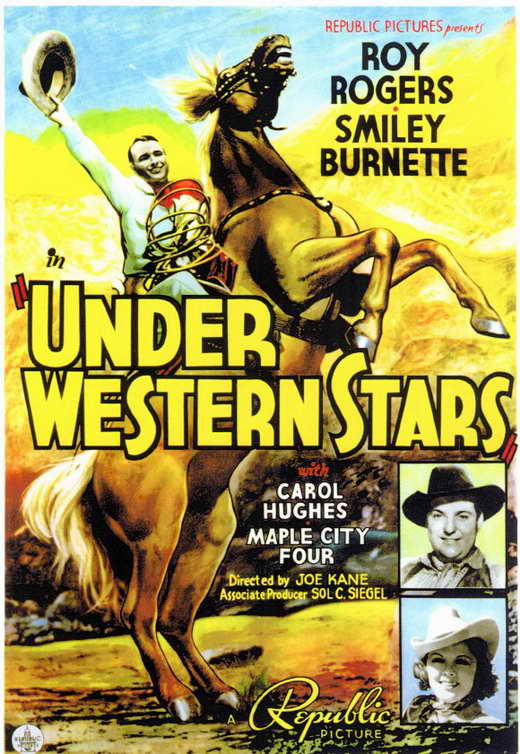
#133) Under Western Stars (1938)

under-western-stars-movie-poster-1938-1020143527

#133) Under Western Stars (1938)

OR “The Roy Rogers Follies”

Directed by Joe Kane

Written by Dorrel McGowan and Stuart McGowan and Betty Burbridge. Original Story by the McGowan Brothers.

Class of 2009

Republic Pictures folded in the ‘50s, long live Public Domain Theater!

The Plot: At the height of the dust bowl, ranchers lose their water rights when the local water company builds a dam near their ranches. With a congressional election coming up, the ranchers endorse Roy Rogers (Roy Rogers) to help take their case to Washington. Roy tries to win over the Washington elite with strong moral values and far more songs than the average member of congress.

Why It Matters: The NFR cites “Under Western Stars” as the film that “turned Roy Rogers into a movie star”. There’s also a detailed essay by Roy Rogers experts Howard Kazanjian and Chris Enss. Fun Fact: Kazanjian produced “Raiders of the Lost Ark” and “Return of the Jedi”!

But Does It Really?: Historically, sure. It’s cheap and a bit contrived, but you can see Roy Rogers’ screen appeal on display. Plus, like most B-movies, it’s short. Roy Rogers should be on this list somewhere, and this film might as well be it.

Everybody Gets One: Before he was Roy Rogers, the King of the Cowboys was a singer named Leonard Slye. A founding member of Sons of the Pioneers (still going, by the way), Leonard was groomed by Republic Pictures to replace their other singing cowboy Gene Autry during a contract dispute. Slye received his new surname as homage to the late Will Rogers.

Wow, That’s Dated: Besides the film’s obvious dust bowl roots, “Under Western Stars” features candlestick phones, steel guitars as a western instrument, and joking references to spousal abuse. Yeah, definitely want to preserve that.

Title Track: Not only does no one say (or sing) the phrase “under western stars” in this film, but most of the film doesn’t even take place at night. What gives?

Seriously, Oscars?: “Under Western Stars” is one of the rare B-movies to receive an Oscar nomination: an Original Song nod for the stirring and timely “Dust”. Due to the aforementioned legal issues with co-writer Gene Autry, only Johnny Marvin got the credit and, subsequently, the nomination. No matter: the song lost to “Thanks for the Memory” from “The Big Broadcast of 1938”.

Other notes

  • This is also the only NFR appearance for Roy Rogers’ faithful horse Trigger. In all honesty, Trigger doesn’t do anything in this film to warrant his moniker of “The Smartest Horse in the Movies”. Maybe he just tests well?
  • Among the countless B-movies helmed by Joe Kane is the serial “Undersea Kingdom”. And now I have that song stuck in my head.
  • Like many a low-budget western, “Stars” was filmed in Lone Pine, California. That’s weird; I thought it was called Twin Pines, California.
  • Ladies and Gentlemen, Frog Milhouse! Frog is played by Lester “Smiley” Burnette, because I guess Andy Devine and Pat Buttram were unavailable.
  • Flying headlines are an acceptable alternative to spinning headlines.
  • Pit stains. I feel you, Smiley.
  • I don’t care who you are; it’s always impressive to watch someone leap onto (and off of) a horse.
  • I miss aggressive winking.
  • “Vote for Rogers” is a fun precursor to “I Like Ike”. Also, no lip-synching here, go on about your business.
  • Roy is giving me Cal Worthington flashbacks.
  • Is fox hunting still a thing?
  • What a downer “Dust” must have been when they performed it at the Oscars.
  • “Evidently you still believe in motion pictures”. How meta.
  • Despite the film’s low-budget, they picked a lovely day-for-night to shoot.
  • I hope Roy uses his political power to help the Joads out.

Legacy

  • Roy met his future third-wife Dale Evans during filming of 1944’s “Cowboy and the Senorita” (Yes, she was the senorita. Different times.) What followed were a 50-year marriage, a successful radio and TV program, and the reason you inexplicably know the words to “Happy Trails”.