
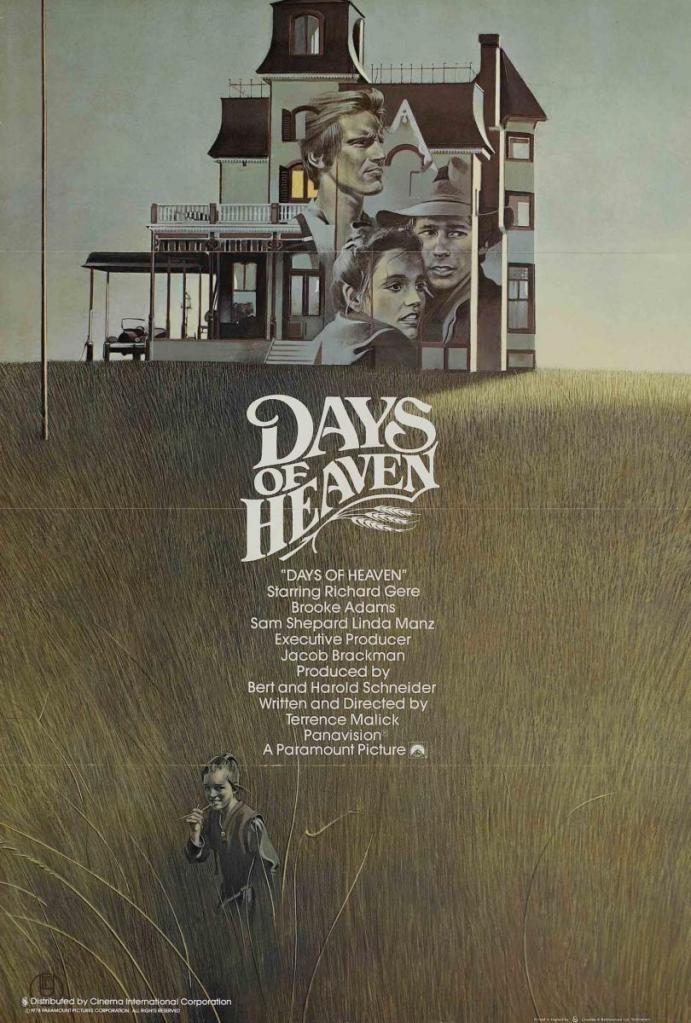
#808) Days of Heaven (1978)
OR “Fields of Vision”
Directed & Written by Terrence Malick
Class of 2007
The Plot: Around 1916, steelworker Bill (Richard Gere) flees Chicago with his girlfriend Abby (Brooke Adams) and younger sister Linda (Linda Manz) following an altercation at work. The trio end up in the Texas panhandle working as grain shockers for a wealthy farmer (Sam Shepard). To avoid gossip among the other hired hands, Bill and Abby pose as siblings, though rumors persist. When Bill learns that the Farmer is dying of an unknown disease, he convinces Abby to marry the Farmer so that they can inherit his fortune. From here we get a complicated love triangle, set against some of the most beautiful visuals ever committed to film.
Why It Matters: The NFR calls the film “an impressionist painting for the screen”, praising Néstor Almendros’ “sublime” cinematography and Ennio Morricone’s “elegiac” musical score.
But Does It Really?: This is another NFR entry I would partially preserve. That cinematography? Print out each frame and hang it in a museum. That score? Have it playing on a loop in the same museum. Everything else about this movie? It’s fine. Ultimately, “Days of Heaven” is remembered for specific elements that are so good they help make up for the less successful story beats, plus compared to Malick’s other NFR entry “Badlands”, “Days” is more in line with what we think of as a “Terrence Malick movie”. I understand the NFR induction of “Days of Heaven” (it is beloved and respected enough that its absence would be too conspicuous), but personally it’s not my thing.
Shout Outs: Abby, Linda, and the Farmer briefly watch a scene from Charlie Chaplin’s “The Immigrant”.
Title Track: The film’s working title was “Stay Hungry”, which co-producer Harold Schneider used for his 1976 bodybuilding movie starring Arnold Schwarzenegger. The title “Days of Heaven” was taken from a Bible passage; something about the land being heaven on earth. Deuteronomy: Look it up.
Seriously, Oscars?: “Days of Heaven” received four Oscar nominations, winning one for Néstor Almendros’ cinematography. To date, this is the sole Oscar win for a Terrence Malick film. Even more surprising, Ennio Morricone’s nod for Original Score was his first Oscar nomination ever, and it would be another 28 years and four nominations before they finally gave him a lifetime achievement Oscar (he would also win a competitive Oscar for 2015’s “The Hateful Eight”).
Other notes
- When we last saw Terrence Malick on this blog, he had achieved critical success with “Badlands”. While on vacation in Cuba in 1975, Malick talked with Bert (brother of the aforementioned Harold) Schneider about possible story ideas for his next movie, which led to what would become “Days of Heaven”. Schneider was able to use his recent clout from “Hearts and Minds” to get this unorthodox project set up at Paramount.
- Production took a full year from 1976 to 1977 in Alberta, Canada. Two weeks into shooting, Malick, unhappy with the results, threw the script out and began shooting as much footage as possible, hoping to fix everything in post, which took nearly two years!
- The opening credits feature one of my favorite pieces of music: “Aquarium” from Camille Saint-Saëns’ “Carnival of the Animals”. I always associate it with this Criterion commercial, and therefore classic movies in general.
- Richard Gere is giving a very different performance than his later work, but then again it’s a very different movie from his later work, too. Malick originally wanted John Travolta for Bill, but Travolta couldn’t make it work with his “Welcome Back, Kotter” schedule. “Days” was one of Gere’s first movies, though he filmed his breakout performances in “Looking for Mr. Goodbar” and “Bloodbrothers” during the “Days” lengthy post-production.
- At first I thought that the Farmer’s house was the Benedict estate from “Giant”, but it turns out it was made specifically for this film by production designer Jack Fisk.
- It’s time to praise the many beautiful compositions of Néstor Almendros. What helps make this movie’s cinematography stick out is the reliance on natural light, giving the film a more earthy, modern quality. It also helps that much of the film is shot during “magic hour”. Everything looks better with a sunset sky as your backdrop. Bonus shoutout to Haskell Wexler, credited here as “additional photography”. Turns out Almendros had to leave production halfway through, and Wexler came in to complete the project, filming by his estimation more than half of the finished film. While Wexler was initially pissed about not receiving a co-cinematographer credit, he eventually came to accept that he was ultimately carrying out Almendros’ vision for the film rather than his own.
- I always used to get this movie mixed up with “Heaven’s Gate”, Michael Cimino’s epic period piece from around the same time that killed the New Hollywood movement once and for all. There’s a little bit of overlap between the two movies (both are profiled in Peter Biskind’s “Easy Riders, Raging Bulls”) but watching “Days” made me see that they are very different films.
- One of the ways Malick “fixed it in post” was scrapping most of the film’s dialogue and filling any gaps with improvised narration/commentary from Linda Manz as Bill’s little sister. I’m not quite sure it works, especially given her thick Chicagoan accent.
- On a related note, I appreciate the film’s spare usage of dialogue, but it means everything is conveyed through subtle glances and camera compositions. I had to stay on my toes during this viewing.
- This is a good point to reiterate that the film is an original screenplay and not, as I assumed based on the film’s epic yet meandering tone, an adaptation from a novel.
- Much like Gere’s performance, it’s hard to judge Brooke Adams’ work because the movie she made during production is not the same movie that got released. But I think she’s doing okay as the object of everyone’s affection. Fun Fact; Brooke Adams is married to Tony Shalhoub!
- The brother/sister thing is a weird plot point to have. Just…why? I guess the idea of two adults not being married was just too much for people in 1916.
- The locust invasion is probably the film’s highlight, and contains the most repeated bit of trivia about this movie: The shot of the locusts flying out of the field was filmed by dropping peanut shells onto the field and then playing the footage in reverse. To everyone’s credit, I didn’t notice any of the trickery involved. Well done, Malick.
- I love seeing which random people get mentioned in a movie’s Special Thanks section of the credits, and “Days of Heaven” has a doozy: Redd Foxx! Apparently a punchline from Foxx’s stand-up act is used in the film, which required Foxx’s permission. Definitely missed that.
Legacy
- “Days of Heaven” was released in September 1978, and while it didn’t make its money back, it went over okay with critics, who loved the cinematography, if not the story. In the ensuing decades, the film received a reevaluation from critics and historians, and its reception in recent years has been much more positive.
- In addition to its Oscar win, “Days of Heaven” played at the 1979 Cannes Film Festival, where Terrence Malick won their Best Director prize, one of the rare Americans to do so.
- Following “Days of Heaven”, Terrence Malick began work on his next film “Q”, which ultimately fell through. In the early ‘80s, Malick moved to Paris, and although he continued writing screenplays, none of them were produced. Malick spent nearly a decade trying to make a film adaptation of “The Thin Red Line”, which was finally released in 1998, a full 20 years after “Days of Heaven”.


2 thoughts on “#808) Days of Heaven (1978)”