#205) The Band Wagon (1953)

the_band_wagon-669013880-large

#205) The Band Wagon (1953)

OR “Cyd and Fancy”

Directed by Vincente Minnelli

Written by Betty Comden & Adolph Green. Score by Arthur Schwartz & Howard Dietz.

Class of 1995

The Plot: Musical movie star Tony Hunter (Fred Astaire) has hit a dry spell and heads to New York to make his return to Broadway. His composer friends Lily & Lester Marton (Nanette Fabray & Oscar Levant) create a fun musical revue for him to star in, but director Jeffrey Cordova (Jack Buchanan) turns it into an extravagant Faustian spectacle. Tony also takes issue with his leading lady, ballet dancer Gabrielle Gerard (Cyd Charisse), but it’s a ‘50s MGM musical so I think you see where they’re going with this.

Why It Matters: The NFR calls it a “sophisticated backstage toe-tapper” and “one of the greatest movie musicals of all time”.

But Does It Really?: This one gets a “minor classic” designation from me. It’s not the best Fred Astaire movie, nor the best MGM “Freed Unit” musical, but it is still very entertaining. The film seems to be going for a balance between character development and solid production numbers, and partially succeeds on both fronts. Some numbers are more memorable than others, as are some characters. But this is the film that gave us “That’s Entertainment!” so who am I to say no?

Shout Outs: Quick allusions to Fred’s earlier films “Top Hat” and “Swing Time”, plus be on the lookout for a poster for “The Proud Land”, the film featured in “The Bad and the Beautiful” directed by…Vincente Minnelli!

Everybody Gets One: Arthur Schwartz & Howard Dietz don’t have a lot of songs on their resume that are remembered today, but the one they wrote specifically for this film is the one that counts: “That’s Entertainment!” Also along for the ride in this film are supporting players Nanette Fabray and Jack Buchanan.

Wow, That’s Dated: “The New Tony Hunter 1953!” is your first clue. This film is also from that time when a musical revue could succeed on Broadway.

Title Track: No one says the title, but “The Band Wagon” is the name of the show within the film.

Seriously, Oscars?: Not as popular as the other MGM musicals of the era, “The Band Wagon” still managed three Oscar nominations: Scoring of a Musical Picture, Costume Design, and Screenplay for Comden & Green. The film lost to, respectively, “Call Me Madam”, “The Robe” and “Titanic” (no, not that one). For those of you keeping score, “That’s Entertainment!” did not receive a Best Song nomination.

Other notes

  • Despite the title, this is not a movie about my friends who became huge Golden State Warriors fans overnight.
  • Quick side note: This film is related to the 1931 stage version of “The Band Wagon” in name only. The only other holdovers are some of the songs, and Fred Astaire.
  • Surprise Guest Star Ava Gardner! She is doing what appears to be the ‘50s version of the “Weird Al’s on the plane” joke from “Naked Gun”.
  • Lily & Lester Marton are based on the film’s screenwriters: Betty Comden & Adolph Green (who in real life were not a married couple). Jeffrey Cordova appears to be based on actor-director-producer Jose Ferrer who, in the spring of 1952, did have four shows running on Broadway at the same time.
  • I was introduced to “Shine on My Shoes” by its appearance in “That’s Dancing!”. I’ve always found it a delightfully infectious number.
  • There’s some lovely, subtle cinematography happening throughout the film by Harry Jackson. Coincidentally, he was the DP for “Dancing in the Dark”, the other film based on “The Band Wagon”.
  • Hans Conried must have been pissed that he wasn’t cast as Cordova. This seems right up his alley.
  • My favorite part of “That’s Entertainment!” is when Oscar Levant simply walks off-screen as the others start to tap dance. He knows his limitations.
  • Fred has a lovely low-key charm about him throughout this film, but it’s easy for him to get overshadowed by the more, well, theatrical characters he’s surrounded by.
  • Fun Fact: Cyd Charisse was coincidentally married to a guy named Tony during all of this: singer Tony Martin.
  • For a brief moment the production montage turns into the opening of “All That Jazz”.
  • You gotta love a time when people got dressed up for a rehearsal. Not a single pair of sweatpants in sight.
  • The scene of Tony trashing his hotel room is notable for breaking all kinds of records. Thank you!
  • The best line in the film: “Leave it to the horse.”
  • “Dancing in the Dark”. What can I say? It’s damn beautiful.
  • So many production setbacks. “Band Wagon” was the “Spider-Man: Turn Off the Dark” of its day.
  • This is pretty much how most theater parties go down.
  • Today on the Michael Douglas Scale: Fred Astaire is 23 years older than Cyd Charisse.
  • And now the “Best of the Rest” montage for all the Schwartz/Dietz songs they couldn’t shoehorn into the plot.
  • Is Louisiana known for its hayrides?
  • “Triplets” is by far the weirdest number. There’s even the super-meta lyric “MGM has got a Leo”.
  • Shoutout to The Vampire by Rudyard Kipling.
  • I stand corrected: This is one of two appearances on the NFR for Julie Newmar. She’s one of the dancers in the “Girl Hunt” ballet. Next stop, “Seven Brides”!
  • Unless I missed something, the Martons never patch up their quarrel. So much for happy endings.

Legacy

  • Two words: “That’s Entertainment!”
  • Fred Astaire and Cyd Charrise reunited for 1957’s “Silk Stockings”, aka “Ninotchka: The Musical!”
  • The original stage version of “The Band Wagon” is only tangentially connected to this film, but a more faithful stage adaptation of the film played New York in 2014.
  • Michael Jackson referenced this film in a few of his music videos, most notably “Smooth Criminal”.
  • The film’s best homage/spoof came in 1978 when Steve Martin and Gilda Radner did their own rendition of “Dancing in the Dark” on “Saturday Night Live”.

#204) A Corner in Wheat (1909)

image-w1280

#204) A Corner in Wheat (1909)

OR “Ain’t No Lie, Baby, Buy, Buy, Buy”

Directed by D.W. Griffith

Written by Griffith and Frank E. Woods. Based on the short stories “The Pit” and “A Deal in Wheat” by Frank Norris.

Class of 1994

The Plot: One of (and this is true) over 140 films Griffith directed in 1909 alone, “A Corner in Wheat” is the story of the self-proclaimed “Wheat King” (Frank Powell) a tycoon whose quest is to corner the market on wheat. He succeeds and makes millions overnight, but a brand new cinema technique called intercutting shows us the negative effects raising the price of wheat has on the average Joe, including a wheat farmer (James Kirkwood) and his family.

Why It Matters: The NFR praises Griffith and cinematographer G.W. Bitzer, saying they achieve “a surprising sense of movement from a single stationary camera”. Griffith’s revolutionary use of intercutting is also highlighted. An essay by film historian Daniel Eagan helps put the film in a proper context.

But Does It Really?: Well I liked this a lot more than “The Musketeers of Pig Alley” that’s for sure. The story is simple, but it’s easy to follow and holds your interest. It’s an easy-enough takedown on what we now call the one-percenters, and it’s vague enough that you can still apply its message today. And as always, I’ll give a pass to anything that’s short/doesn’t overstay its welcome. You win this round, Griffith.

Everybody Gets One: James Kirkwood was a successful actor and director during the silent era, perhaps most famously being passed over for “The Sheik” in favor some upstart named Rudolph Valentino. Kirkwood’s son – James Jr. – wrote the book for the musical “A Chorus Line”. Linda Arvidson, seen here as the farmer’s wife, was in fact D.W. Griffith’s wife at the time. They had been married for three years at this point, and would separate a few years later before finally divorcing in 1936.

Wow, That’s Dated: A loaf of bread goes up from 5 cents to 10 cents! Highway robbery I tell ya!

Other notes

  • Griffith took Norris’ stories and distilled them down to their core elements. No one in the original story is as one-dimensional as the characters here, but it’s easier to convey general ideas in silent film than complex gray areas.
  • Man, Biograph Studios is a major player in a lot of these silent shorts on the list. Another case of a business going into decline because Thomas Edison is a dick.
  • After the long shots on the farm, I feel eminently qualified to be a wheat farmer.
  • The intercutting is rudimentary, but it gets the point across. Well played, David Wark and editor Jimmy Smith.
  • This film’s ending would have been completely different if someone had invented the guardrail.
  • Slowest. Fade Out. Ever.

Legacy

  • As pointed out in Eagan’s essay, the success of this film led to Griffith painting other groups in broad strokes while condemning them. He started off with the rich elite, and…well then “Birth of a Nation” happened.
  • The next time you watch “WALL-E”, pay close attention: a clip from “A Corner in Wheat” is the first thing to pop up when the captain asks the Axiom computer to “define Earth”.
  • Until “Wall Street” came along, this was the stock market movie.
  • Wheat is still going strong worldwide, but so is greed, so this film’s legacy is on both sides of the coin.

#203) Badlands (1973)

MPW-106681

#203) Badlands (1973)

OR “Thank You, a-Sissy and a-Marty”

Directed & Written by Terrence Malick

Class of 1993

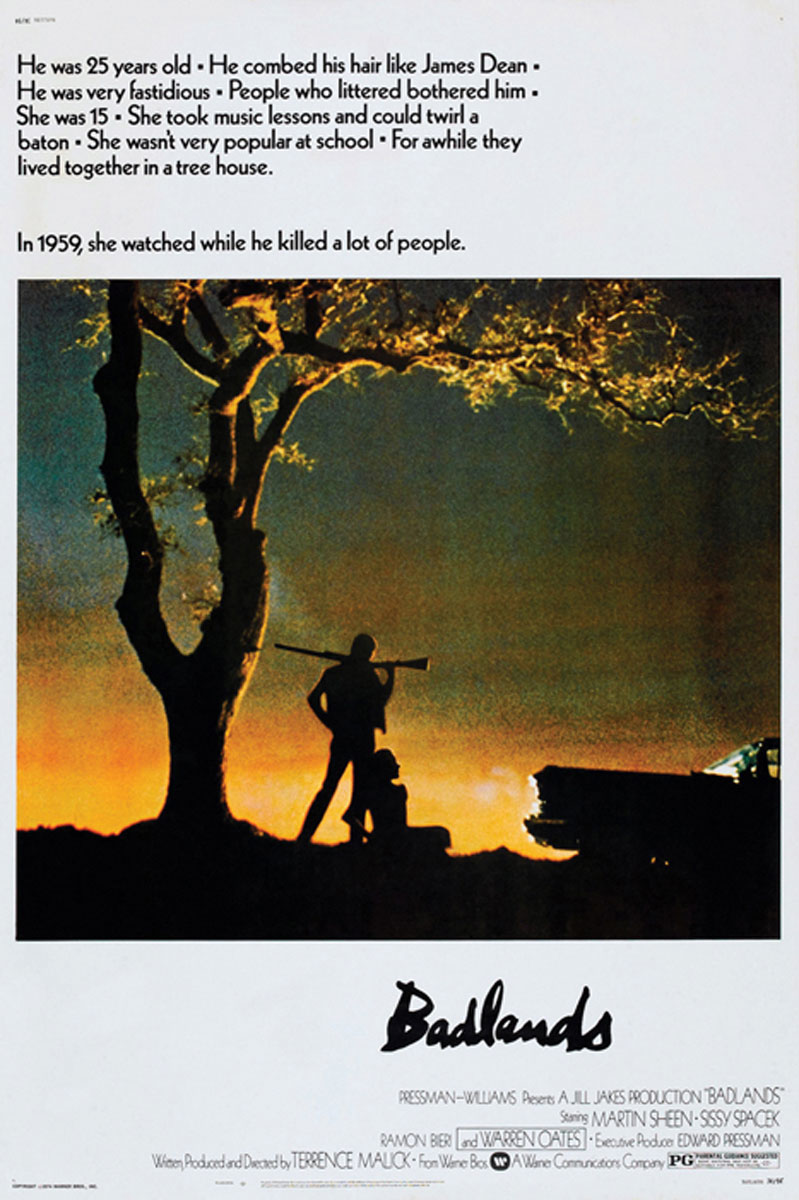
The Plot: Loosely based on the 1958 Nebraska killing spree of Charles Starkweather & Caril Ann Fugate, “Badlands” tells the tale of Kit & Holly (Martin Sheen & Sissy Spacek) in 1959 South Dakota (See? Totally different). Kit is an aimless 25-year-old James Dean lookalike with a penchant for gun violence, and Holly is an impressionable 15-year-old with an overprotective father (Warren Oates). When Father finally confronts Kit about his unhealthy attraction to his daughter, Kit shoots him, fakes his and Holly’s suicide by burning the house down, and drives off with Holly for the badlands of Montana. There’s an unlikely mix of character study and mass shootings in their future.

Why It Matters: The NFR praises Malick, calling this film “one of the most impressive of directorial debuts” and calls Sheen’s performance “forceful and properly weird”. As mom always says, if you’re going to be weird, at least be proper.

But Does It Really?: The degree of difficulty is high on this one, but Malick pulls off a film that is surprisingly understanding of these two incredibly fucked-up kids. In the hands of a lesser director, this film would have been louder and way more violent. But Malick gets you to understand these two, and Sheen and Spacek make them two people you want to spend time with. I have my doubts it could be made today, but “Badlands” is a fine representation of the new cinema of the ‘70s and a wonderful introduction to the works of Terrence Malick.

Everybody Gets One: How is this Sissy Spacek’s only NFR entry? Where the hell is “Carrie” or “JFK” or “Trading Mom”? [2019 UPDATE: “Coal Miner’s Daughter“; I was close.]

Wow, That’s Dated: Mainly the idea that you could make a movie that sympathizes with a loner white man who takes out his frustrations by shooting a bunch of people. Those days are over.

Title Track: Holly says the title once in the pre-opening credits scene. Malick’s restraint in his first feature is commendable.

Seriously, Oscars?: No Oscar love for “Badlands”, but Malick’s movies (whenever he makes them) would become Oscar contenders soon enough. This film’s only awards attention was at the 1974 San Sebastian International Film Festival, and a BAFTA nomination for Sissy Spacek as Most Promising Newcomer. She lost to the very British Georgina Hale.

Other notes

  • 25-15 is one hell of an age-gap. There was a 5-year gap between Starkweather and Fugate, but Kit’s age was upped to 25 because Sheen could not convincingly play 20.
  • Sissy Spacek does teenage awkwardness so well.
  • Among the moments this film preserves is Martin Sheen’s jacket maneuver of putting it on over his head. This is due to Sheen’s limited lateral movement due to a birth defect. You can also spot the move in many episodes of “The West Wing”.
  • See those two kids sitting on the street corner that Kit watches? Those are Charlie Sheen and Emilio Estevez. For the better part of two decades this was their only Registry appearance.
  • The confrontation between Sheen and Oates ain’t exactly “Meet the Parents”, is it? Also, how did no one in that neighborhood hear multiple gunshots?
  • What the hell is a Voice-O-Graph?
  • I’m enjoying the film’s abrupt transitions from steady cam to shaky cam. Kudos to whoever was the cinematographer on those days.
  • That is the most impressive treehouse I’ve ever seen. It’s “Swiss Family Robinson” meets “Home Alone”, with a little bit of “The Ewok Adventure” thrown in for fun.
  • Love Is Strange”. A little on the nose, don’t you think Malick?
  • That’s Terrence Malick himself as the architect who tries to visit the rich man. And who says he’s a recluse?
  • So..Sissy Spacek has never aged. We can all agree on that, right? Are freckles the secret to eternal youth?
  • I applaud people who drove pre-GPS. Relying on a map on the dashboard sounds like a nightmare. I don’t know how anyone did it.
  • Holly says that if they don’t come back for their buried stuff, someone 1000 years from now will find it. Be sure to include Barney Google.
  • Given how many gunshots and car chases there are, this is a surprisingly quiet film. You can definitely see the Arthur Penn influence.
  • The film’s stunt driver Gary Littlejohn also appears onscreen as the Sheriff towards the end. Because when it’s your first movie, you have to save money wherever you can.
  • “Badlands” didn’t do so well during its first release, primarily because Warner Bros. put it on a double feature with, and this is true, “Blazing Saddles”. Luckily both films survived this immense head-scratcher.

Legacy

  • Terrence Malick followed this up with another NFR entry: 1978’s “Days of Heaven”. After that, 20 years of radio silence.
  • Everyone at some point has done a fictional version of the Starkweather-Fugate murder spree. See “Natural Born Killers” and “The Sadist” for such examples.
  • “True Romance” takes it up a notch by not only emulating the movie, but also emulating its score!
  • This Bruce Springsteen song;
  • Sissy Spacek met art director Jack Fisk on the set of this film. They married in 1974, and they’re still going!
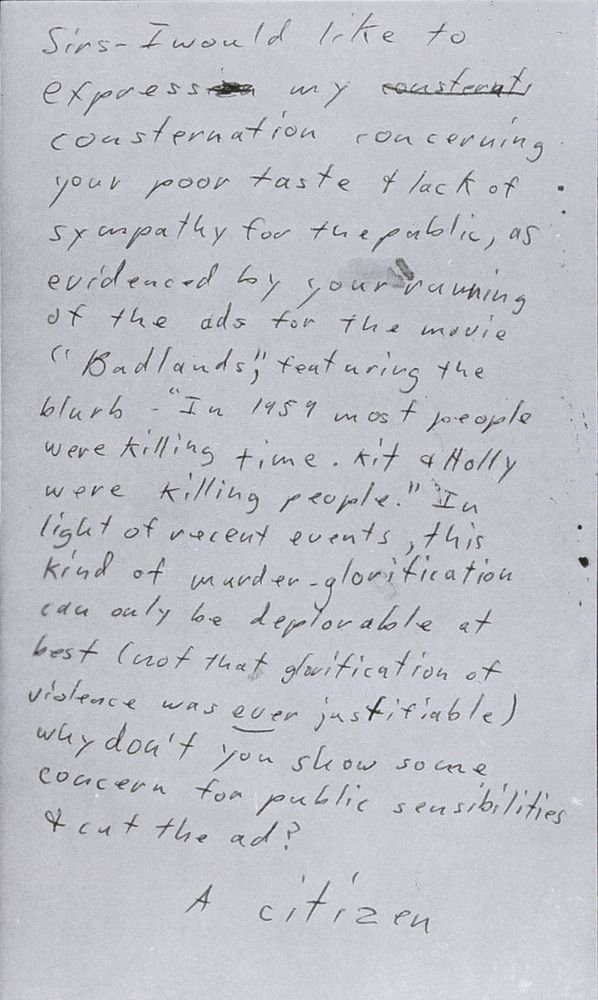
  • The Zodiac Killer wrote a letter to the San Francisco Chronicle to complain about an ad they ran for a screening of “Badlands”. He felt that the film’s tagline was too casual about the characters’ killing spree and that this kind of advertisement was “murder-glorification”. …wait, what?
17_a_-_San_Francisco_Chronicle_Badlands_card_May_8_1974