
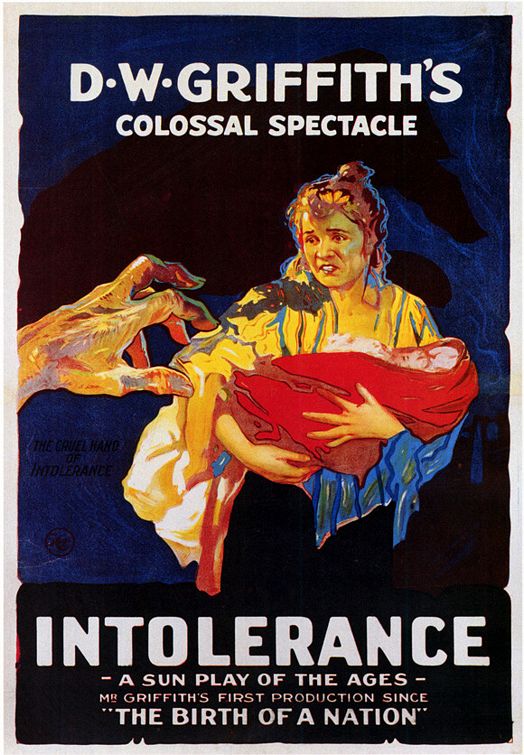
#257) Intolerance: Love’s Struggle Throughout the Ages (1916)
OR “Four of a Kind”
Directed by D.W. Griffith
Written by Everybody, all of them uncredited
The Plot: As Eternal Motherhood (Lillian Gish) rocks the cradle of each passing generation, four stories of intolerance play out over four different historical eras. The religious conflict between Prince Belshazzar and Cyrus the Great (Alfred Paget and George Siegmann) leads to the fall of Babylon. The compassionate teachings of Christ (Howard Gaye) are ignored by the people of ancient Judea, and the man is crucified. Another religious battle leads to the St. Bartholomew’s Day Massacre of 1572, led by Queen-mother Catherine de Medici (Josephine Cromwell) to wipe out the Huguenots from Catholic France. And a modern (1916) story of a poor young woman (Mae Marsh) and her hardworking husband (Robert Harron) whose lives are oppressed by a group of social elites promoting upright values. All this, plus the kind of epic filmmaking that only D.W. Griffith could provide.
Why It Matters: The NFR calls the film no less than “one of the masterpieces of the silent era” and praises Griffith’s technological breakthroughs. In addition, there’s an essay by Benjamin Schrom, who is referred to as “an avid film fan and product manager for Google Education.” Come on! Every other movie gets a film scholar but this one gets some guy from Google? Hell, by that standard I’m more qualified to write one of these things (and I wouldn’t say no, NFR).
But Does It Really?: I’m gonna chalk this one up to historical significance. “Intolerance” is definitely worthy of early inclusion on this list, if just for its monumental undertaking and effective juxtaposition between its four storylines. Entertainment-wise it’s…fine. I found myself in awe of the production value and not necessarily involved in the stories. Griffith’s grandiose technical side always outshined his oversimplified storylines. “Intolerance” is worth a watch for all you serious film buffs, but once is enough.
Wow, That’s Dated: The “modern” story deals with pre-union American labor, the stigma of fatherless children, and the common punishment of hanging criminals. Plus there’s a reference to the relatively current song “In the Good Old Summer Time”.
Other notes
- The films alternate subtitle is “A Sun-Play of the Ages”. Does anyone know what a Sun-Play is? The internet says it’s an online swimming pool supply warehouse, but I have my doubts that was Griffith’s intention.
- Pretty ballsy to make “The Birth of a Nation” and then immediately follow up with a movie called “Intolerance”. The story goes that Griffith made this film in response to those who were critical of “Birth of a Nation”. Yeah, people who disapprove of a movie that glorifies the Klan are so intolerant. Are we sure Griffith doesn’t have a Twitter account?
- Lillian Gish plays the Eternal Mother, in what must have been her easiest paycheck ever: sit there, rock a cradle, and enter film immortality. Side note: The title cards in these sequences have lines lifted from “Out of the Cradle Endlessly Rocking” by…Walt Whitman! Look at that handsome undercover Mark Twain.

- The intertitles have footnotes! Griffith shows off his historical accuracy with information dispersed throughout the film. This may be the only movie on the list with an appendix.
- Griffith clearly blew the budget on the Babylon set, and he makes sure to include plenty of shots showing it off.
- I was following everything just fine up until the 1572 scenes. Someone get me a flow chart!
- Nice touch having different backdrops for each era’s intertitles.
- Thanks to the headbands, everyone in the Babylon scenes looks like an ‘80s rocker.
- To this day, most labor disputes are still settled using cannons. I’m just glad my union has health care.
- Mae Marsh is the Sandy Dennis of the silent era: so many tics.
- Shoutout to assinu, the androgynous servants of Ishtar.
- Not only does actor Howard Gaye portray Jesus in this film, but he was also Robert E. Lee in “Birth of a Nation”. How many actors can say that?
- We need to bring back the adjective “Christly”. “Everyone applauded Jane for her Christly charity work.”
- “Intolerance” isn’t so much four stories as it is two with special guest appearances. Griffith clearly favored the Babylon and modern stories, with the Christ plotline being used mostly as a linchpin. The St. Bartholomew scenes feel like an afterthought; they are to this movie what “The Watch” is to “Pulp Fiction”.
- Wow, the fall of Babylon is epic. This alone is worth the price of admission. Blink and you’ll miss a man get decapitated!
- In another moment of keen cinematic foresight, you can see Griffith futzing with aspect ratio. Certain shots would fit on today’s widescreen TVs, and a few others look like they were filmed portrait style on someone’s phone.
- The modern scenes feel a lot like “Musketeers of Pig Alley: Part 2”. For those of you who remember that post, that’s not necessarily a compliment.
- Yeah, Griffith definitely had issues with women. In every era of this movie the women are either victims, property, or unjustifiably evil.
- The intercutting between the four stories at the climax must have been an intense viewing experience 100 years ago. It’s pretty much the same template intercutting has followed ever since.
- Eternal Mother’s been rocking that cradle for three hours. Is that kid ever going to sleep?
Legacy
- “Intolerance” was not the box office bomb some have labeled it as. The film made a lot of money, but since Griffith backed most of the movie he suffered financially for the rest of his life, even with hits like “Broken Blossoms” and “Way Down East”.
- Griffith knew he had enough footage on his hands for more than one movie, and in 1919 he used that material to create two new films: “The Fall of Babylon” and “The Mother and the Law” (the latter being the working title for “Intolerance”). Griffith’s one mistake: he used the original negative for “Intolerance”, making future restorations nearly impossible.
- Buster Keaton spoofed the film’s overall concept with 1923’s “Three Ages”.
- The elephants on the Babylon set were recreated for the Hollywood and Highland Center, and the former Hollywood Pictures Backlot at Disney’s California Adventure.
- I’m gonna blame this film for every movie that covers a central theme over different eras; such notable examples being “The Hours”, “If These Walls Could Talk”, and…uh…. “If These Walls Could Talk 2”?

 The Horse's Head