#416) Little Miss Marker (1934)

MV5BNzFjZjZhZjYtY2MwZC00OTQ0LTgwNDMtYzExNGFiOGMyOWEzXkEyXkFqcGdeQXVyMDI2NDg0NQ@@._V1_SY1000_CR0,0,1290,1000_AL_

#416) Little Miss Marker (1934)

OR “Luck Be a Little Lady”

Directed by Alexander Hall

Written by William R. Lipman and Sam Hellman and Gladys Lehman. Based on the short story by Damon Runyon.

Class of 1998

No trailer. In fact, the only footage I could embed was one of those YouTube tribute videos. 

The Plot: Bookie Sorrowful Jones (Adolphe Menjou) reluctantly agrees to take collateral (a “marker”) for a horse race when one of the betters (Edward Earle) places a $20 marker on his daughter Marthy (Shirley Temple). When the man loses the bet, he runs out and commits suicide, and Sorrowful and his gang take in Marthy, nicknaming her “Marky”. The gangsters become an extended family to Marky, with Sorrowful as her put-upon new father and nightclub singer Bangles Carson (Dorothy Dell) as a more agreeable surrogate mother. There are a few songs and loads of sweetness in one of Hollywood’s first attempts at a “Shirley Temple picture”.

Why It Matters: The NFR gives a quick rundown of Shirley Temple, calling her “[o]ne of the most popular stars of the 1930s” and “the biggest child star the world had ever seen”. There’s also an essay by film professor/Shirley Temple expert John F. Kasson.

But Does It Really?: It’s clear the NFR inducted “Little Miss Marker” as representation of Shirley Temple’s career, but when I think Shirley Temple, this is not the movie that comes to mind. Mention Shirley Temple to any film buff and they’ll picture her dancing up the stairway with Bill Robinson, or singing the likes of “Animal Crackers” and “Good Ship Lollipop”. Those moments are from three different movies, and none of them are “Little Miss Marker”. On its own, “Marker” is a quick, enjoyable, harmless movie, but compared to the other films that could represent Miss Temple on the list, it is found wanting.

Everybody Gets One: Shirley Temple started making movies when she was three years old! After being spotted by a casting director in her dance class, Temple signed a contract with Educational Pictures and starred in “Baby Burlesks”, a series of shorts that spoofed modern movies. Her success in those shorts led to a featured role in the Fox film “Baby, Take a Bow”, and later a Fox contract with a seven-year option. Temple quickly became a nationwide sensation, and her films the epitome of Depression-era escapism. “Little Miss Marker” was her only non-Fox film of the era, on loan to Paramount.

Wow, That’s Dated: Besides the obvious ‘30s slang, “Little Miss Marker” resorts to some of the negative African-American and Asian-American stereotypes of the day. The most visible example is Willie Best, who spent the bulk of his career playing a stereotypically lazy, slow black man, to the point where in some films he is credited as “Sleep ‘n’ Eat”. Yikes.

Seriously, Oscars?: No Oscar love for “Little Miss Marker”, but the Academy recognized Shirley Temple with the first ever Juvenile Oscar. Temple starred in six films in 1934, and this body of work earned her an honorary statuette. At six years old, Shirley Temple is still the youngest person to ever receive an Oscar.

Other notes

  • Right from the start, this thing is pure Damon Runyon: lowlifes with names like Sorrowful Jones and Benny the Gouge putting all their money on a horse race. I keep expecting Stubby Kaye to walk by.
  • It’s always hard to accurately judge a child’s acting ability, but what Shirley Temple lacks in polish, she more than makes up for in star quality. From her first moment on screen you know that she will melt the heart of every gangster in this movie.
  • Adjusted for inflation, the $20 marker on Marky would be about $380 today.
  • Adolphe Menjou is one of those actors who was not on my radar until this blog, and it’s a shame he’s not as well remembered today. From his lead comic turn in “The Front Page” to his later dramatic work in “Paths of Glory”, Menjou has quite the range, and provides a good foil for Shirley Temple here.
  • This film is also the only NFR representation of singer/actress Dorothy Dell. Sadly, “Little Miss Marker” was one of Ms. Dell’s final films; she was killed in a car accident at age 19 one week after this film’s premiere. Shirley Temple formed a close bond with Dell during filming, and her death devastated the young actor.
  • Finally, Shirley gets to sing! “Laugh You Son of a Gun” is a brief duet between Markie and Bangles, and it definitely leaves you wanting more.
  • Watching this ‘30s movie about an adorable orphan makes me suspect that “Annie” (the musical and subsequent films) has replaced “Little Miss Marker” in our cultural heritage. They are just similar enough properties, but “Annie” has all those songs!
  • Best exchange in the movie: “Wanna kiss me?” “Well, I ain’t runnin’ for mayor.”
  • Not only does the movie take a sudden dramatic turn at the end, but then Charles Bickford’s Big Steve returns and…he’s the hero? What a weird movie.

Legacy

  • After the success of “Little Miss Marker”, Paramount tried to buy out Shirley Temple’s contract with Fox, but she returned to her home studio and started making her best-known films. Temple’s star diminished in the 1940s, and she retired from acting at age 22. Ms. Temple had a successful second career as a diplomat, eventually becoming the US Ambassador to Ghana and Czechoslovakia.
  • “Little Miss Marker” has been remade for film three times: 1949’s “Sorrowful Jones” with Bob Hope and Lucille Ball, 1962’s modern update “40 Pounds of Trouble” with Tony Curtis, and 1980’s “Little Miss Marker” with Walter Matthau, Julie Andrews, and a poster that definitely rips off “The Sting”.
  • Ginger ale, a splash of grenadine, and a maraschino cherry is all you need to make the non-alcoholic drink named after Ms. Temple. Ironically, in her adult years Shirley admitted to hating the drink.

Further Viewing: I’m currently obsessed with the short-lived ‘80s TV show “Mad Movies”, in which Los Angeles improv group LA Connection overdubs public domain films. One episode turns Shirley Temple’s 1939 vehicle “The Little Princess” into an “Exorcist” parody. It’s a bit dumb and slightly dated, but it tickles me just right.

Listen to This: In 1950, Damon Runyon’s short stories “The Idyll of Miss Sarah Brown” and “Blood Pressure” were combined to become the book for the Broadway musical “Guys and Dolls” by Frank Loesser. The original cast album made the National Recording Registry in 2004.
#415) Wings (1927)

MV5BYTI1YjgzZmMtZmIyYy00YTkwLTgyOWEtOTVlNTFkZmMzNTk3XkEyXkFqcGdeQXVyMDI2NDg0NQ@@._V1_SY1000_SX660_AL_

#415) Wings (1927)

OR “1917: The Multi-Take Version”

Directed by William A. Wellman

Written by Hope Loring and Louis D. Lighton. Story by John Monk Saunders.

Class of 1997

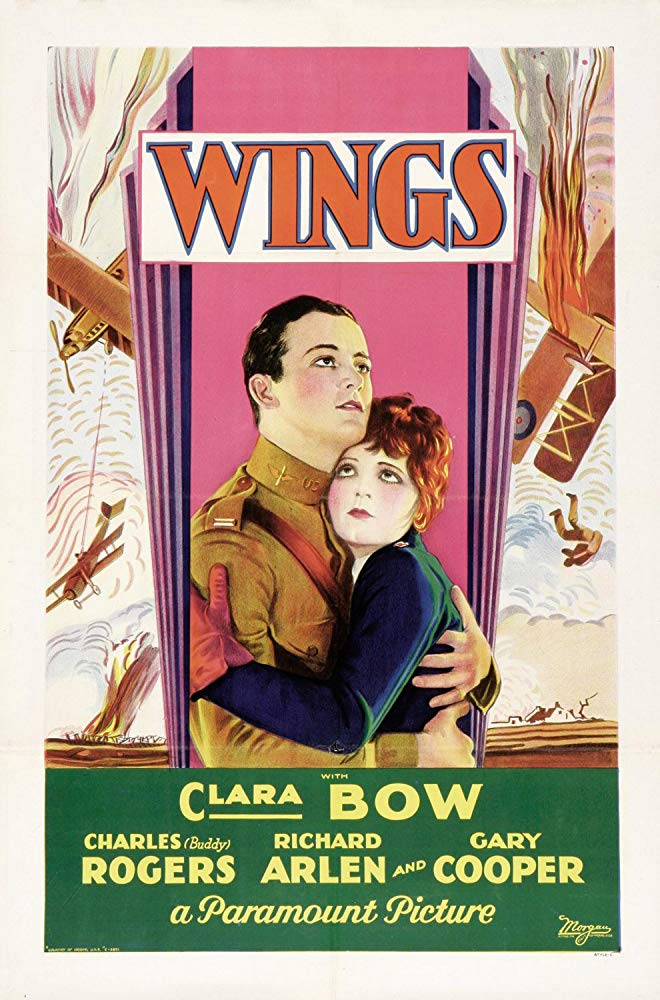
The Plot: After the outbreak of World War I, small town boys-next-door Jack Powell (Charles “Buddy” Rogers) and David Armstrong (Richard Arlen) enlist in the United States Air Service. David leaves behind the beautiful Sylvia Lewis (Jobyna Ralston), but Jack also vies for her affection, completely unaware that Mary Preston (Clara Bow) is in love with him. After basic training, Jack and David fly several missions, while Mary enlists as an ambulance driver. There’s plenty of love triangle complications to be had here, as well as some of the most amazing aerial footage ever preserved on film.

Why It Matters: While the NFR admits that “Wings” is “[s]hort on story but long on action”, their write-up is a tribute to the film’s “[d]azzling aerobatic dogfights”. An essay by film historian/curator Dino Everett also praises the film’s technical accomplishments.

But Does It Really?: The cultural significance of “Wings” has always seemed trivial to me: it’s the first Best Picture Oscar winner. But after viewing “Wings”, I can say that the film has a lot more going for it. The plot’s a bit thin, but the action-packed aerial sequences more than make up for any shortcomings. “Wings” was a technical innovation in its day, and those effects (as well as the film in general) hold up remarkably well 90 years later. “Wings” deserves a second look, as well as its place in the NFR.

Everybody Gets One: Of the main cast, Richard Arlen actually served as a pilot in Canada’s Royal Flying Corps during WWI, though he did not see combat. Arlen met Jobyna Ralston on the set of “Wings”, and the two married shortly after production wrapped.

Seriously, Oscars?: “Wings” premiered in August 1927 and was second only to “The Jazz Singer” at the box office. In February 1929, the newly formed Academy of Motion Picture Arts and Sciences voted “Wings” the winner for their Academy Award. The first ceremony was held that May, where “Wings” won Outstanding Picture and Best Engineering Effects. Still fine-tuning their new award, AMPAS eliminated Engineering Effects the following year, and merged Outstanding Picture with Best Unique and Artistic Picture (won by “Sunrise”) to create the Best Picture category. “Wings” was retroactively declared the first Best Picture winner, cementing its legacy in Hollywood history.

Other notes

  • First of all, shoutout to the team behind the 2012 restoration. In addition to an incredible picture restoration, this print rerecorded the original J.S. Zamecnik score, and recreated the Handschiegl color process, used here to colorize the flames when a plane is shot down. This restoration helps a modern viewer appreciate the epic scale of the original release.
  • Clara Bow’s part was essentially shoehorned into Wings, as Paramount insisted on their biggest star being in their most expensive film. As Bow herself put it, “I’m just the whipped cream on top of the pie.” It helps that Clara Bow has that certain…quality about her. I don’t know how to describe…that quality.
  • I get the everyman appeal of Charles “Buddy” Rogers, promoted at the time as “America’s Boy Friend”. To badly paraphrase, he doesn’t need dialogue, he has faces.
  • The film’s comic relief comes in the form of vaudeville performer El Brendel as Herman Schwimpf, the German-American recruit who constantly has to prove his loyalty to America because of his name. Good thing we don’t do that anymore…
  • And here comes Gary Cooper in his breakout film role as Cadet White. I can’t wait to see young Gary’s star power in full….and he’s dead. What a waste.
  • What can I say except that the dogfight scenes in this movie are amazing. Director William Wellman was hired for the film thanks to his flying experience in WWI, and his expertise really shines through. He even revolutionized filmmaking when he had cameras mounted onto the plane to capture closeups of the pilots mid-flight!
  • The film’s action sequences were filmed at Kelly Field in San Antonio, Texas with assistance from the War Department. Wellman insisted on perfect weather conditions for shooting, leading to production delays. At a time when most movies were shot in a month, principal photography for “Wings” lasted seven months.
  • For the record, a Fokker is an aircraft manufacturer that began in Germany just before WWI. Nothing else.
  • “Wings” has two moments of pre-Code nudity! Blink and you’ll miss some male rear ends as Jack enlists in the Air Service, but the film’s most famous example is a brief shot of a topless Clara Bow as Mary is caught changing back into her uniform. No wonder this movie won Best Picture.
  • The random doughboy who cheers on Jack during the climactic battle isn’t so random after all: it’s director William Wellman. Wellman’s wife Margery Chapin and daughter Gloria appear as the mother and child whose house is crashed into.
  • In addition to all its other claims to fame, “Wings” also contains what is purported to be the first on-screen kiss between two men. It’s definitely not in a homosexual context, but it’s still there.
  • The film’s stance on war is a bit muddled. Ultimately, the French soldier says it best: “C’est la guerre”. War isn’t hell, it’s just war. A bit down the middle, but the more extreme stance of “All Quiet on the Western Front” was still three years away.

Legacy

  • “Wings” was considered a lost film, until a print was discovered by a Paris archive in 1992. This, however, conflicts with a recorded screening of the film that occurred at the Mary Pickford Theater in 1987. Any leads on this one?
  • “Wings” still gets its share of references, primarily every year at the Oscars when previous Best Picture winners get their shout out.
  • Here’s a weird one: Buddy Rogers and Richard Arlen appeared as themselves in connection to “Wings” on two separate sitcoms in the late 1960s. A 1967 episode of “The Lucy Show” features the two in a musical revue about pilots with Lucy and guest star Carol Burnett, while a 1968 “Petticoat Junction” has them attend the Junction’s premiere of “Wings” 40 years after the fact. The latter episode includes footage from the film.
  • Hmmm, do I go for the Paul McCartney reference or the NBC sitcom reference? “Maybe I’m Amazed” is great, but I’m opting to end this post with some vintage Tony Shalhoub!