#485) Cool Hand Luke (1967)

#485) Cool Hand Luke (1967)

OR “I Am a Christ Allegory from a Chain Gang”

Directed by Stuart Rosenberg

Written by Donn Pearce and Frank Pierson. Based on the novel by Pearce.

Class of 2005

Spoilers Ahead!

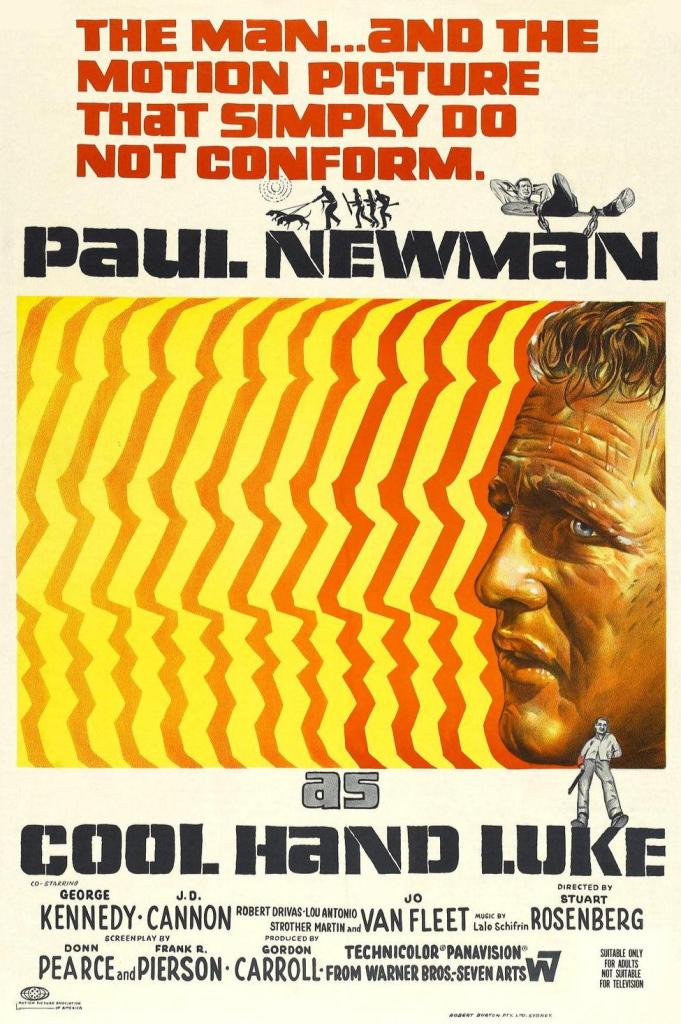
The Plot: A 1950s prison camp gets some “new meat” for their chain gang, including Luke Jackson (Paul Newman), a veteran doing time for cutting off parking meter heads. Luke immediately establishes his nonconformity by mouthing off to both his warden The Captain (Strother Martin) and lead prisoner Dragline (George Kennedy). Despite this initial “failure to communicate”, Luke’s perseverance and refusal to let the camp get him down prove an inspiration to his fellow prisoners. Let’s see, a young radical who doesn’t know his real father, always sticks to his morals in the face of hardship, and has a following of about 12 guys. Something very familiar about all this…

Why It Matters: The NFR praises Newman’s performance as a “classic antihero”, mentions the film’s Oscar nods, and quotes Strother Martin’s famous line.

But Does It Really?: In a film year that gave us “In the Heat of the Night“, “The Graduate” and “Bonnie and Clyde“, “Cool Hand Luke” can easily get lost in the shuffle of 1967’s movie lineup. But the film endures thanks to its bountiful iconic moments, a never-better Paul Newman, and some stunning imagery from cinematographer Conrad L. Hall. The film’s inspirational take on the anti-establishment stance of the ’60s gives the film a timeless quality, which has helped “Cool Hand Luke” remain a classic over 50 years later.

Everybody Gets One: “Cool Hand Luke” was the first major studio film for director Stuart Rosenberg, who spent most of the ’60s directing episodic television, as well as the independent film “Question 7”. Also making their sole NFR appearance is most of the supporting cast, including George Kennedy, Wayne Rogers, Joe Don Baker, and Morgan Woodward as “the man with no eyes”.

Wow, That’s Dated: As I mentioned in my “I Am a Fugitive…” post, chain gangs were more or less phased out of the American criminal reform system by the mid-‘50s, though some states continued the practice well into the ’70s, and Arizona briefly revived it in the mid ’90s.

Seriously, Oscars?: A critical and commercial success, “Cool Hand Luke” received four Oscar nominations, and George Kennedy took home the prize for Supporting Actor (Kennedy invested $5000 of his own money into his campaign). Newman’s Best Actor nod was his 4th failed bid in nine years. Perhaps most embarrassing, “Luke” missed out on a Best Picture nomination, because “Doctor Dolittle” you guys!

Other notes 

  • I have a few personal connections with “Cool Hand Luke”. For starters, it was one of my Dad’s favorite movies, and subsequently I saw this film when I was a tad too young for it. “Cool Hand Luke” was also primarily filmed in my hometown of Stockton, California. Much of the seemingly endless stretches of road in the film are from Stockton’s outskirts, and look remarkably similar today. And yes, it’s always that hot.
  • Donn Pearce based his novel “Cool Hand Luke” on his own experience in a Florida chain gang. Warner Bros. bought the film rights and commissioned Pearce to adapt the screenplay. Pearce’s screenwriting inexperience led to Frank Pierson being brought in. Depending on which story you read, it was either Pierson or director Rosenberg who layered on the Christ metaphors.
  • Shoutout to Lalo Schifrin’s superb score. I could listen to that main theme all day.
  • Dragline goes through a lot of trouble trying to give Luke a good nickname. Why not stick with “Fast Eddie“?
  • Some of the most iconic lines from this movie are the ones that get repeated a lot. Keep an ear out for the frequent instances of lines like “Takin’ it off here, boss” and “Shakin’ the bushes, boss”. Anyone not noticing these moments spends a night in the box.
  • Goddamit, there’s that “Enter the Dragoncollapse/oof sound again! Damn you to hell, Warners Sound Department!
  • Oh god, it’s the “Lucille” scene. Everyone stop ogling that woman. That means you too, Conrad L. Hall!
  • “Sometimes, nothing can be a real cool hand [to play].” Can it? This movie has the same questionable moral as “Parasite“.
  • Jo Van Fleet IS Geraldine Page. Like her Oscar-winning turn in “East of Eden“, Van Fleet nails her cameo here as Luke’s mother.
  • Shoutout to Harry Dean Stanton. This is one of four NFR entries with Stanton, and while his characters never get much to do, he spent a 60+ year career being reliably perfect in whatever role he was given. And at least in “Luke” he gets to sing!
  • This is yet another classic movie that I always forget Dennis Hopper is in. Speaking of, how did his character get the nickname “Babalugats”? And what does that even mean?
  • The 50 egg challenge is still nauseating to watch. Between this and “Rocky“, eggs don’t come across as too appetizing in classic films. Oh, and afterwards, Luke is lying on the table in his underwear with his arms stretched out. Real subtle, everyone.
  • Paul Newman sings too! And plays the banjo! What can’t he do?
  • “What we’ve got here is failure to communicate.” Strother Martin spent most of his career in westerns (playing characters he referred to as “prairie scum”), and “Luke” was a chance to play a more sophisticated, yet more sadistic variation. Fun Fact: Due to their physical and vocal similarities, Martin was occasionally cast as Tennessee Williams-esque characters.
  • Luke’s tactics for escaping and evading the police are quite ingenious. Did Christ use chili powder when he was a fugitive?
  • We’re at the tail end of the Hays era, so the movie gently pushes a few boundaries. Profanity is sprinkled in for effect (“son-of-a-bitch” is the favorite), and there’s even some rear nudity! And Luke’s butt is not a double: that is Newman’s Own!
  • I can see how George Kennedy got the Oscar. Dragline gets a nice character arc, going from the intimidating heavy to a helpless follower, and Kennedy makes that change subtly and effectively. Plus he gets to be the Judas!
  • The film ends with a supercut of every time Luke/Paul Newman smiles in the movie (a late addition to the film), and a wide pan out to a crossroad. A crossroad. Get it? GET IT?

Legacy 

  • “Luke” was an instant hit, and was just as instantly inundated with parodies. Everyone at some point in pop culture has commented on “a failure to communicate”. It helps that this line is repeated multiple times in the original trailer.
  • The name “Cool Hand Luke” served as the inspiration for both the Christian band and the steakhouse.
  • Lalo Schifrin’s composition for the “Tar Sequence” was used by ABC for their Eyewitness News programs throughout the ’70s (it has that rapid staccato associated with typewriters). The music is so ubiquitous with Eyewitness News, people thought Schifrin lifted the music from the show for “Cool Hand Luke”! That being said, Schifrin is on the record saying that he “laughed all the way to the bank”.
  • The MTV show “Jackass” actually recreated the 50 egg challenge. Mercifully, I could not find a clip. Or maybe I just didn’t want to.
  • Luke Jackson paved the way for such future Christ metaphors in film as E.T. and Neo. And just when you think Hollywood has killed this trope, it just keeps getting…revived? Is that the word I’m thinking of?

#484) There It Is (1928)

#484) There It Is (1928)

OR “Great Scot!”

Directed by Harold L. Muller

Written by Muller and Charles R. Bowers

Class of 2004

The Plot: The Frisbie Family (Melbourne MacDowell and Kathryn McGuire) is experiencing some unusual phenomena in their house, all thanks to the appearance of the mysterious Fuzz-Faced Phantom (Buster Brodie). The family calls Scotland Yard, who send the kilt-clad, bagpipe-playing Charley MacNeesha (Charley Bowers) to investigate. Aided by his assistant, a stop motion bug named MacGregor (you read that right), Charley arrives and falls victim to the Phantom’s absurdist antics, as well as some really groundbreaking effects animation.

Why It Matters: The NFR calls Bowers “increasingly famous” and singles out the “adorable” MacGregor. An informative essay by silent film expert Steve Massa gives a brief overview of Charley Bowers’ career.

But Does It Really?: Oh sure. While most silent films are forgotten today, it doesn’t mean there were any less popular or important in their time. Bowers’ surreal style of silent comedy is quite unique (especially for the era), and deserves a spot alongside Chaplin, Keaton, and Lloyd for its inventiveness. Hopefully the NFR inclusion will lead to more film lovers discovering Bowers and “There It Is”.

Everybody Gets One: Charley Bowers got his start as a newspaper cartoonist for “The Chicago Star” and “The Chicago Tribune”. A move to New York found Bowers animating the Mutt & Jeff cartoon shorts, and experimenting with puppets and stop motion in his free time. His early films included the Bowers Process, a type of stop motion animation which only Bowers knew the secret to. These films caught the attention of Educational Pictures, and Bowers headed out to Hollywood. “There It Is” was the first of six shorts Bowers did under contract with Educational.

Other notes 

  • Right out the gate this movie captured my attention with its revolutionary effects. A stop motion egg turns into a live chicken, and a pair of pants seem to dance on their own. I presume the latter was the result of Substitutiary Locomotion.
  • I know this won’t matter to most of you, but the Fuzz-Faced Phantom looks remarkably like a former manager of mine. And that guy wishes he were as interesting or funny as the Phantom.
  • The only thing I can compare Bowers’ brand of innovative filmmaking to is the kind of experiments Ernie Kovacs would present on his TV show 30 years later.
  • The rising cab fare from $4 to $5 would be about $60 to $75 today. Nowadays that’s how much it costs to just get in the cab.
  • Best line in the short: the butler, upon seeing only Charley’s kilt and legs, “It’s a girl!”
  • MacGregor is so cute. Where’s his spinoff?
  • This whole film is an impressive undertaking. “There It Is” features the kind of inspired lunacy that can easily be made for animation, but becomes a logistical nightmare when translated to live action. Kudos to the team’s endless imagination and spirited execution.
  • “There It Is” may be one of the rare movies with a Previous Owners Ex Machina. The stigmatized property revelation might as well be Craig T. Nelson shouting at everyone for not moving the bodies.

Legacy 

  • Bowers’ films with Educational Pictures were well-received, but his output slowed down with the advent of sound. Bowers shifted his focus more towards puppetry and illustrations for children’s books before severe arthritis ended his career. Bowers died in 1946 at the age of 57.
  • The films of Charley Bowers were considered lost or destroyed for decades (some were victims of the Fox Vault Fire of 1937), but prints started showing up in the 1980s. In addition to its NFR designation, Bowers’ work has been included in the American Film Archives and released on both DVD and BluRay.

#483) Film Portrait (1972)

#483) Film Portrait (1972)

OR “A Movie-able Feast”

Directed & Written by Jerome Hill

Class of 2003 

The Plot: After a lifetime of documentary and experimental films, Jerome Hill turns the camera on himself to examine his life in the aptly titled “Film Portrait”. Hill covers his childhood in Minnesota, his early films in Europe, and his later, more renowned documentaries, as well as the techniques he learned for and applied to all of them. Hill’s meditation on his past and present (as well as hypothetical futures) came at just the right time, as Hill passed away shortly after completing “Film Portrait”.

Why It Matters: The NFR gives a brief rundown on the film, and a link to the Jerome Foundation, which features “Film Portrait” (and Jerome’s other works) in its entirety. It should be pointed out, however, that the NFR erroneously lists the film’s release year as 1970.

But Does It Really?: Jerome Hill isn’t well-known to modern audiences, but his films are an important link between the experimental filmmakers that inspired him, and the ones whom Hill inspired. “Film Portrait” is a thoughtful, entertaining memoir, never becoming too reverential or self-important, and is filled with the kind of experimentation Hill was known for. “Film Portrait” earns its spot on the NFR as representation of Jerome Hill’s artistry.

Shout Outs: I’m pretty sure “Intolerance” is among the silent films featured in Hill’s montage about the early days of cinema.

Everybody Gets One: A plethora of biographical information on Jerome Hill can be found within this film (obviously), as well as in this authorized essay by Mary Ann Caws. To summarize: Hill was born in Saint Paul, Minnesota, and was an avid film lover from day one. Before becoming a filmmaker, he studied music at Yale, and painting at the British Academy in Rome (both of these disciplines would find their way into his films). He started making experimental films in the 1930s, and even got a few of them distributed by Warner Bros. After serving in various Army film units during WWII, Hill made a documentary short about painter Grandma Moses, earning his first Oscar nomination. Hill’s filmography was supplemented by his musical compositions, paintings, and photography.

Wow, That’s Dated: Mainly the art of making films with actual film. The final sequence of Jerome editing “Film Portrait” on an old-school flatbed looks like a complex nightmare. Then again, watching him examine his past on Final Cut Pro wouldn’t pack the same punch.

Seriously, Oscars?: Although “Film Portrait” played Cannes (and other festivals) in 1972, it appears that the film didn’t have an Oscar eligible run until 1973. No posthumous nomination for Jerome Hill, but “Film Portrait” does feature footage of Hill’s 1957 Oscar win for “Albert Schweitzer”. For the record: 1973’s Best Documentary winner was Kieth Merrill’s “The Great American Cowboy”.

Other notes 

  • Right out the gate, Hill’s passing is causing problems for this movie. Much of the first 10 minutes is Hill theorizing how he will die, played out in various comic scenarios, including a ski accident and being eaten by a giant fish. It’d be more fun without the foresight.
  • Hill grew up in the 1900s-1910s, so every photo in this movie looks like the ending of “The Shining“.
  • The first section of the film is Hill looking back fondly on where his fascination with movies comes from. His father was a photographer, and the Hill’s were among the first families to own a movie camera. Surprisingly for the 1910s, the Hill family is well documented in what could be considered the earliest known home movies.
  • Many of Hill’s recreations of his childhood include one of his favorite experimental tricks: painting directly onto the film negative. The amazing part is that, in order to get the colors right, Hill had to paint the complimentary colors on the negative. For example: painting red on the negative would make the color appear green on the positive print.
  • I appreciate Hill’s use of footage by Georges Méliès and the Lumière Brothers. Since these important filmmakers were French (and based in France), their monumental work is ineligible for the NFR, so including them here is a nice workaround.
  • So much cutting and manipulating of family photos; if only Photoshop had been a thing in the ’70s.
  • The bulk of the movie is Jerome discussing and showcasing the experimental movies he and his friends made in Europe in the late ’20s and early ’30s, utilizing such then-revolutionary techniques as film reversal. All good stuff, but there’s a point where it feels like padding. Almost like Jerome’s goal was to include as much of this footage as possible.
  • Hill’s 1932 film “La Cartomancienne”[roughly translated: “The Fortune Teller”] briefly turns into yet another “staring at water” movie. I’m beginning to see why the NFR picked “Film Portrait”.
  • Shoutout to legendary “Nanook of the North” filmmaker Robert J. Flaherty, whose films inspired Jerome to start making documentaries.
  • One of Hill’s later in life attempts at a narrative film includes the dark comedy “Open the Door and See All the People”. After an hour of avant-garde footage, I was not expecting this movie to have a pie fight.
  • My main takeaway from this movie is a quote from Jerome towards the end: “Through cinema, time in annihilated”. Hill recognizes film as a form of time travel, where the past is always the present. This is visualized in the final shot; a modern (c. 1970) recreation of the Lumière Brothers’ “Arrival of a Train at La Ciotat”, filmed at the same station from the same angle.
  • Ultimately, I don’t know enough about Jerome’s timeline to conclusively determine whether or not he knew he was dying while making “Film Portrait”. I suspect he did, as the final film is an in-depth assessment of his work. And if he didn’t, Hill was 67 when he made the movie, making a thorough self-reflection unsurprising.

Legacy 

  • Jerome Hill died of cancer in November 1972, just four weeks after attending a screening of “Film Portrait” at the Museum of Modern Art.
  • In 1964, Hill founded the Avon Foundation, with a mission to support young artists in both New York and his native Minnesota. After Hill’s passing, the foundation was renamed the Jerome Foundation, and is still going strong, providing a wealth of information on Hill, including his papers and films.
  • Among the filmmakers inspired by Jerome Hill’s experimental work were future NFR inductees Stan Brakhage and Jonas Mekas. Mekas was also responsible for finishing Hill’s uncompleted documentary on Carl Jung, which became the 1991 short “Carl G. Jung or Lapis Philosophorum”.

#482) Melody Ranch (1940)

#482) Melody Ranch (1940)

OR “Local Cowboy Makes Good”

Directed by Joseph Stanley

Written by Jack Moffitt & F. Hugh Hebert & Bradford Ropes & Betty Burbridge

Class of 2002 

No trailer, but here’s a clip.

Shoutout to streaming service Tubi, which thanks to a partnership with Gene Autry Entertainment, offered this elusive film online for free.

The Plot: Gene Autry plays a successful country music radio and recording star not unlike himself. When his hometown of Torpedo invites him to return for their Frontier Days Celebration, Autry accepts and takes his radio show with him, including sidekick Corny Courtney (Jimmy Durante) and new leading lady Julie Shelton (Ann Miller). Once in Torpedo, Autry runs into trouble with the Wildhack Brothers (Barton MacLane, Joe Sawyer, and Horace McMahon), who threaten to wreck havoc on the town. There’s action, romance, comedy, and plenty of songs in this offering from America’s Singing Cowboy.

Why It Matters: The NFR gives a rundown of the film and Gene Autry, attributing his success to his “playful humility and popular Western-tinged songs”.

But Does It Really?: While Gene Autry is (as he was then) primarily associated with his songs rather than his movies, having one of his films on the list is a testament to his popularity, and “Melody Ranch” is a perfect encapsulation of the all-in-good-fun type of movies Autry specialized in. It’s nowhere near an untouchable classic, but “Melody Ranch” has a welcomed spot in the NFR.

Shout Outs: Corny, upon being held at gunpoint: “What is this, ‘The Great Train Robbery‘?”

Everybody Gets One: Orvon “Gene” Autry got his start singing and playing guitar at local dances in southern Oklahoma. In 1929, he signed with Columbia Records, and after spending most of the ’30s as a mildly successful radio and recording star, had his breakthrough in 1939 with his re-written rendition of Ray Whitley’s “Back in the Saddle Again“. The song was a hit, and became Autry’s signature song for the rest of his career.

Wow, That’s Dated: Your first clue is that Autry is presented here as a radio star. Other than that, it’s smooth sailing…until the scene where Gene and Julie play Brave and Squaw. It’s brief, but incredibly cringe-inducing.

Title Track: In addition to being the name of Gene Autry’s real life radio program (which premiered the same year as the movie), the song “(Stake Your Claim on) Melody Ranch” bookends the film.

Seriously, Oscars?: No nominations for “Melody Ranch”, though Gene Autry would receive an Oscar nod the next year for composing (along with Fred Rose) the song “Be Honest with Me” in his film “Ridin’ on a Rainbow”.

Other notes 

  • Autry had already made dozens of films for Republic Pictures by 1940, but “Melody Ranch” was given a bigger budget in an attempt to make Autry a bigger movie star.
  • This is also the only NFR appearance for film and TV comedian Jimmy Durante (but not if I have anything to say about it). By 1940, Durante had been a star of vaudeville and radio, and was just starting to get decent parts in the movies. Aided by his raspy delivery and trademark schnozzola, Durante is still laugh-out-loud funny in this movie.
  • This is one of seven films George “Gabby” Hayes made with Gene Autry, and he is everything the later impressions of him would claim to be. The “Blazing Saddles” team did their homework.
  • Gene Autry is not the best actor, but he never claims to be and is clearly not taking himself seriously, which adds to this film’s overall fun. Be on the lookout for moments where Gene almost breaks while genuinely amused by his co-stars’ comic antics, just like Jerry on “Seinfeld”.
  • “Melody Ranch” would make a good double feature with fellow NFR entry “Under Western Stars” starring Autry’s movie cowboy rival Roy Rogers. Both films have our stars essentially playing themselves and applying their homespun personas to local politics.
  • During this viewing I realized that both Durante and Autry are associated with Christmas standards: Durante has “Frosty the Snowman“, and Autry has “Here Comes Santa Claus” (which he wrote!).
  • We hired Ann Miller and damn it, we’re gonna make her show off her legs and tap dance! I don’t think the number comes across on radio, but it’s fun to watch.
  • After beating up Gene, the Wildhack Brothers sing their own version of “Back in the Saddle” called “Go Back to the City”. Very meta, though if you’re not familiar with the original song the scene can be confusing.
  • Wow, Gene Autry was doing training montages 35 years before “Rocky“. How I long for a bluegrass cover of “Gonna Fly Now”.
  • Yes, the romantic subplot between Gene and Julie is by-the-numbers and a bit dull, but the “Call of the Canyon” sequence gave me an opportunity to stretch a bit without missing anything. Thanks, movie!
  • Shoutout to Barbara Jo Allen as local school teacher Veronica Whipple. Here, Allen plays a variation of her radio character, the perpetually oblivious Vera Vague (she’s even parenthetically credited as Vera in the opening credits). Everyone’s good in this movie, but Allen steals the show. Fun Fact: Allen would go on to voice Fauna (the green fairy) in Disney’s “Sleeping Beauty”.
  • A celebrity running for public office? What a ridiculous notion…
  • That being said, the political subplot really takes over during the third act. Wasn’t Ann Miller in this movie?
  • The action scene on the trolly loses something whenever we switch to the wide-shots with an obvious model. It made me start humming the “Neighborhood of Make Believe” music.
  • Even back in the ’40s there was voter oppression? Man, we really suck at keeping that under control. Quick, someone get Richard Kiley!

Legacy 

  • Although “Melody Ranch” did not elevate Gene Autry’s movie star status, he continued to make popular western musicals throughout the 1940s. In fact, Autry was successful in practically every showbiz endeavor he attempted: movies, records, radio, television, live performance, to say nothing of his shrewd investments in real estate and TV/radio affiliates.
  • Further proof of his success: Gene Autry is the only person to receive five stars on the Hollywood Walk of Fame, one for each of the five eligible categories.
  • As his film career was winding down in the early ’50s, Gene Autry purchased the Monogram Movie Ranch, renaming it Melody Ranch after this movie. The ranch has been a go-to filming spot for many a TV and movie western, and most recently doubled for the infamous Spahn Ranch in “Once Upon a Time in Hollywood”.

Listen to This: There’s NO Gene Autry on the National Recording Registry? That’s it, I’m filling out the form…

#481) Abbott and Costello Meet Frankenstein (1948)

#481) Abbott and Costello Meet Frankenstein (1948)

OR “Monster Mashup”

Directed by Charles T. Barton

Written by Robert Lees & Frederic I. Rinaldo & John Grant

Class of 2001

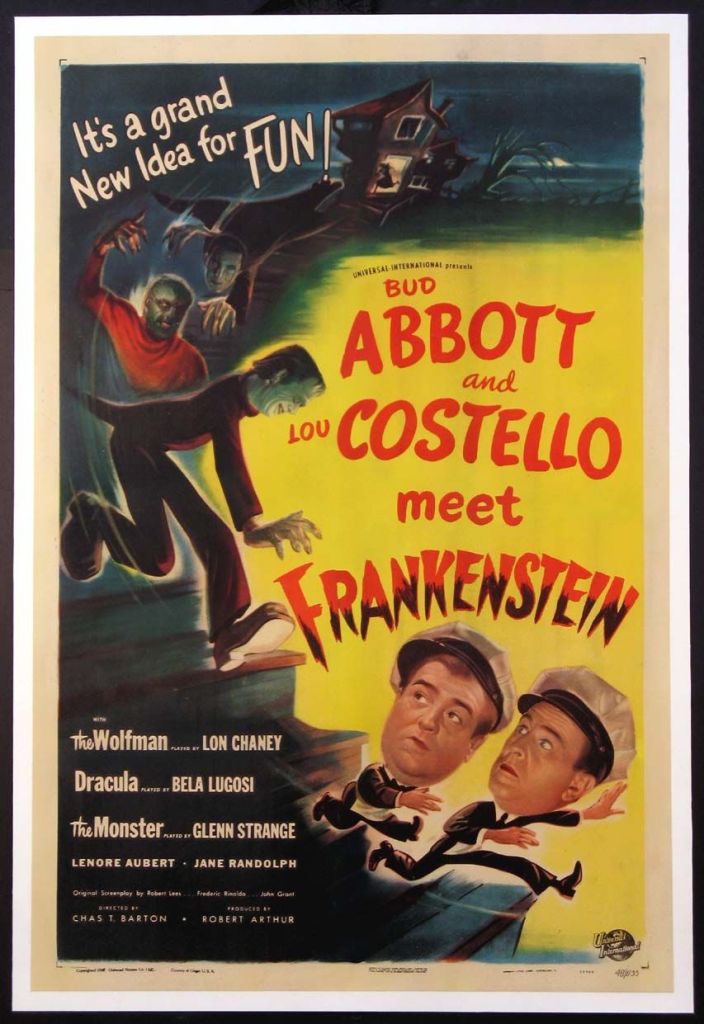
The Plot: Baggage clerks Chick Young and Wilbur Grey (Bud Abbott & Lou Costello) are assigned to deliver two large crates to “McDougal’s House of Horrors”. They soon discover that the crates include the bodies of Count Dracula and Frankenstein’s Monster (Bela Lugosi & Glenn Strange), with the Count planning to revive the monster by putting Wilbur’s brain into its body. The boys are aided by Wilbur’s girlfriend Sandra (Lenore Aubert), insurance investigator Joan (Jane Randolph), and Lawrence Talbot (Lon Chaney Jr.), who turns into the Wolf Man whenever there’s a full moon. But all this is just a backdrop to watch a legendary comedy duo mug their way through some of Universal’s most iconic franchises.

Why It Matters: The NFR gives a plot recap, and states that Lugosi, Chaney and Strange “all play their roles perfectly straight” as foils for Abbott and Costello. There’s a more appreciative essay by Abbott & Costello expert Ron Palumbo.

But Does It Really?: While not in the same league as movie comedy teams The Marx Brothers and Laurel & Hardy, Abbott & Costello’s iconic filmography and pitch-perfect timing are more than deserving of NFR recognition. I suspect the appearance of the Universal monsters gives this A&C outing the edge over their other well-known films “Buck Privates” and “The Naughty Nineties”. “Nineties” has their “Who’s on First” routine, but “Meet Frankenstein” is the overall better film, and is a welcome addition to the NFR.

Shout Outs: Well, obviously “Frankenstein” and “Dracula“, though it should be noted that this film takes its depiction of these monsters from 1944’s “The House of Frankenstein”, not the original classics.

Everybody Gets One: In 1935, vaudeville performer Lou Costello needed a last minute replacement when his comedy partner fell ill. William “Bud” Abbott filled in, and the two officially became a comedy duo the next year. In 1938, Abbott & Costello made their radio debut on “The Kate Smith Hour”, and their successful appearance led to more radio, stage, and eventually film work. Under contract with Universal, the pair became two of the most successful movie stars of the 1940s. By the time “Meet Frankenstein” came about, the duo’s star power was fading, and the team had endured a few personal rifts between them. Pairing the boys with the declining Universal Monsters characters was a last ditch cash grab for Universal, and was one of their cheapest productions that year.

Wow, That’s Dated: In addition to the massive cultural appropriation happening at the masquerade ball, we get the lost attraction of wax museums, and a shoutout to the Lucky Strike slogan.

Title Track: The film was originally titled “The Brain of Frankenstein”, but Abbott and Costello’s names were added to prevent people from expecting another horror film. It should also be noted that this film always refers to the creature as “Frankenstein’s Monster“, meaning the Frankenstein of the title is presumably the doctor, who does not appear at any point in this film.

Other notes 

  • If this is your first viewing of Abbott & Costello, their dynamic might seem a little off-putting; Abbott’s exasperated straight man constantly berating Costello’s energetic man-child. The team had made 21 movies together prior to this, their stage personas firmly established over the previous decade. Like “Road to Morocco“, this NFR entry assumes you know who these two are and what their deal is.
  • Although he played many vampires throughout his career, this was Bela Lugosi’s only official film appearance as Count Dracula following the 1931 original. This was also Lugosi’s last major studio film before resorting to television and the films of Ed Wood.
  • Here’s a weird one: Boris Karloff refused to reprise his role of Frankenstein’s Monster for this movie, but agreed to do publicity for it as long as he didn’t have to see the final film. The role ultimately went to Universal’s other Frankenstein Monster Glenn Strange, and publicity photos of Karloff promoting the film still exist.
  • Lon Chaney Jr. had played Lawrence Talbot, aka The Wolf Man, in four previous Universal films. He is…not much of an actor without that makeup.
  • [Insert Mandatory “Werewolves of London” Reference Here]
  • Shoutout to the Universal effects team for their impressive work transforming Dracula into a bat. Bela Lugosi fades into animation of Dracula turning into a bat, which fades to a live-action model bat on strings. A relic by modern standards, but still cool to watch.
  • Chick and Wilbur live together? Chick is Wilbur’s boss, how does that make any sense?
  • Costello gets to chew the scenery (and excels at it), but Abbott also scores with the handful of punch lines he gets throughout the film.
  • Ah yes, the exhilarating life of an insurance investigator. Romance! Intrigue! Danger!
  • Everyone in this movie follows the Comedy Rule of Peripheral Vision: You can only see things when it’s funny.
  • I am willing to forgive this movie’s “Full Moon” rule about werewolves if they would acknowledge it also works during the moon’s Gibbous phases. Speaking of, The Wolf Man kinda looks like Tim Allen, complete with grunting noises!
  • Why does everyone keep calling Wilbur a “kid”: He’s 42!
  • While pleading with Frankenstein’s Monster, Wilbur repeatedly calls him “Frankie”. That’s what we should be calling the monster!
  • Frankie throws one of the leading ladies through a glass window? You wouldn’t see Karloff do that.
  • The finale ramps up the funny, and I found myself laughing out loud quite a bit. No spoilers, but the movie ends with a big laugh from a surprise cameo. Take that, Nick Fury!

Legacy 

  • “Abbott and Costello Meet Frankenstein” was a surprise smash for Universal, and rejuvenated the comedy team’s sagging career. Universal had the duo “Meet” several of their other properties, including “The Mummy”, “The Invisible Man”, and at last, “The Killer, Boris Karloff”.
  • In addition to their films, Abbott & Costello found continued success in radio, as well as the new medium of television. The duo ended their partnership in 1957, with several factors contributing (overexposure, Lou’s ongoing health issues, the rise of Lewis & Martin). After Costello’s death in 1959, Abbott attempted to revive the act with Candy Candido, but as Abbott later put it, “No one could ever live up to Lou.”

Listen to This: Abbott & Costello had been honing their “Who’s on First?” routine since their vaudeville days, and the bit became their most famous sketch. The earliest surviving recording of “Who’s on First?” comes from a 1938 radio appearance, which made the National Recording Registry’s inaugural class of 2002. A&C expert Ron Palumbo is back with a detailed essay on the history of the routine.