#510) Duck Amuck (1953)

#510) Duck Amuck (1953)

OR “Keeping Up with the Joneses”

Directed by Chuck Jones

Written by Michael Maltese

Class of 1999


The Plot: Daffy Duck (voiced by Mel Blanc) stars as a swashbuckling musketeer in this Merrie Melodies…at least at first. A few seconds in, Daffy meets his match in an omnipotent animator who keeps erasing and redrawing the duck’s surroundings. Daffy’s patience wears out quickly when this mysterious artist changes everything about him, from his voice to his appearance. With a limitless supply of clever cartooning, “Duck Amuck” asks the question, “Fourth wall? What fourth wall?”

Why It Matters: The NFR calls it “[o]ne of the defining examples of Chuck Jones’ irreverent creativity”, praising Mel Blanc’s vocal performance and the film’s inventive fourth-wall breaking. Also on hand is the Craig Kausen essay that covers all three of Chuck Jones’ NFR entries.

But Does It Really?: While not the most iconic Daffy Duck short of all time, “Duck Amuck” is a fine example not only of Daffy’s character, but also of Chuck Jones’ imaginative animation and respect for his animated stars. Plus, it’s funny and short, two big points in its favor. A pass for “Duck Amuck”.

Wow, That’s Dated: Like everyone else in the ’50s, Daffy Duck appropriates Hawaiian culture by donning a grass skirt and playing “Aloha ‘Oe” on the ukulele.

Seriously, Oscars?: “Duck Amuck” did not receive an Oscar nomination for Best Animated Short. 1953’s winner was Disney’s “Toot, Whistle, Plunk and Boom“, and Warner Bros.’ sole nomination was for “From A to Z-Z-Z-Z“, featuring none of the recognizable Looney Tunes characters. 

Other notes

  • Daffy Duck made his film debut as a bit player in 1937’s “Porky’s Duck Hunt“. His standout appearance led to larger parts, eventually playing the zany foil to the straightlaced Porky Pig. By the time “Duck Amuck” rolled around, Daffy’s… well, daffiness had toned down a bit, replaced with, as film critic Steve Schneider would later call it, “unleashed id”. For the first 52 years of his existence, Daffy was voiced by the legendary Mel Blanc, who felt that the duck’s “extended mandible would hinder his speech”, thus creating Daffy’s lateral lisp.
  • According to Chuck Jones, the general idea behind “Duck Amuck” was to highlight how animation can create characters with distinct personalities. As he put it “Who is Daffy Duck anyway? Would you recognize him if I did this to him?…What if he had no voice? No face? What if he wasn’t even a duck anymore?” The fact that Daffy survives all of these changes throughout the short is a testament to the character.
  • Also dated: Daffy, exasperated from the umpteenth alteration, “What a way to run a railroad.”
  • I’m a bit disappointed that at no point during this short does Daffy utter his catchphrase “You’re deth-spicable!” Surely this animator gave him plenty of reasons to say it.
  • Originally, Chuck Jones was to appear as himself in live-action as the mystery animator. This was later changed to Bugs Bunny, as he was the only Looney Tunes character with any sort of antagonism towards Daffy (their “Duck Season/Rabbit Season” feud began a few years earlier).

Legacy

  • Chuck Jones would revisit this short’s premise two years later in “Rabbit Rampage”, only this time with Bugs being tormented by an animator revealed to be Elmer Fudd (“I finawwy got even with that scwewy wabbit!”).

  • Daffy would exact his own revenge in two later shorts: the “Baby Looney Tunes” episode “Duck Reflucks”, and the New Looney Tunes short “One Carroter in Search of an Artist”.
  • Daffy Duck appears in one other NFR entry: a cameo alongside fellow cartoon duck Donald in “Who Framed Roger Rabbit“. 
#509) The Last Picture Show (1971)

#509) The Last Picture Show (1971)

OR “Texan Graffiti”

Directed by Peter Bogdanovich

Written by Bogdanovich and Larry McMurtry. Based on the novel by McMurtry.

Class of 1998

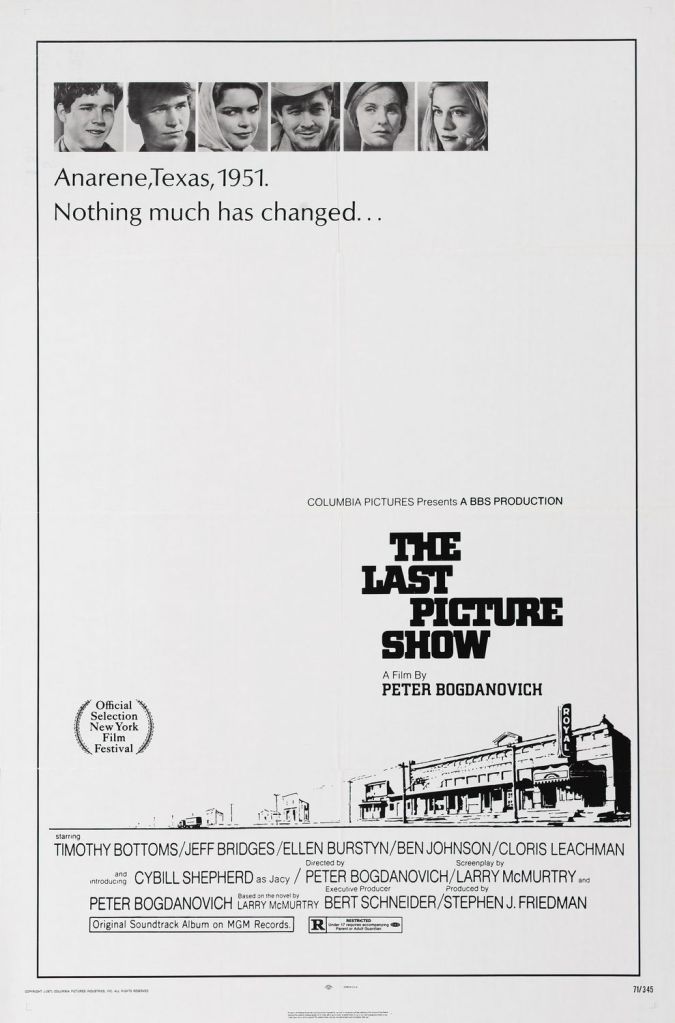
The Plot: “The Last Picture Show” is a coming of age story about high-school seniors Sonny and Duane (Timothy Bottoms and Jeff Bridges) in 1951 Anarene, Texas. The boys spend most of their days playing pool, going to the local movie house, and trying to lose their virginity. Duane is dating Jacy (Cybill Shepherd), despite the objections of her mother Lois (Ellen Burstyn), and Sonny is having an affair with Ruth (Cloris Leachman), the repressed wife of Sonny’s gym coach (Bill Thurman). Watching all of this unfold is pool house/movie theater proprietor Sam “The Lion” (Ben Johnson), who reflects on how much Anarene has changed in his lifetime. Depressed yet?

Why It Matters: The NFR highlights Robert Surtees’ black and white cinematography, and the cast of stars-to-be, especially the “subtly moving performances” of Leachman and Johnson.

But Does It Really?: I had never seen “The Last Picture Show” prior to this viewing, and I have to admit the film is…fine. Maybe I wasn’t in the right mood, but while I enjoyed “Picture Show”, it didn’t grab me the way its status as a classic suggested it would. The film is several great performances by a cast on the brink of stardom, mixed with two hours of bleak existence for everyone. But hey, if that’s what Bogdanovich et al were going for, mission accomplished. Despite my less-than-stellar viewing experience, “The Last Picture Show” has held firm for 50 years thanks to its cast and aesthetic, and is deserving of its NFR standing.

Shout Outs: The titular last picture show is Howard Hawks’ “Red River“. And keep an eye out for the movie posters of “White Heat” and “Winchester ’73“.

Everybody Gets One: Peter Bogdanovich was a movie buff from an early age, seeing literally hundreds of movies a year, and eventually becoming a film programmer at New York’s MoMA. Inspired by critics-turned-directors like Jean-Luc Godard, Bogdanovich moved to Los Angeles to pursue directing. After a few early films with Roger Corman, Bogdanovich spied a copy of Larry McMurtry’s “The Last Picture Show” in a drug store…and put it back after losing interest. Coincidentally, Bogdanovich’s friend Sal Mineo gave him a copy of the book a few weeks later, telling him he just had to make the movie.

Seriously, Oscars?: “The Last Picture Show” was well received by critics, and tied for most Oscar nominations of the year (8) with “Fiddler on the Roof” and “The French Connection“. “French” ended up taking home the big prizes, but “Last Picture” won the two supporting prizes for Ben Johnson and Cloris Leachman.

Other notes 

  • Special mention goes to Polly Platt: Peter Bogdanovich’s then-wife and collaborator. Credited as the film’s production and costume designer, Platt has been called by many involved with “Last Picture Show” the glue that held the film together. The podcast “You Must Remember This” devotes an entire season to the unsung influence Polly Platt had on everything from “Last Picture Show” to “The Simpsons”.
  • The roster of talent assembled for this movie is incredible, but what’s even more impressive is how no one upstages anyone, nor are there any distracting signs of future stardom. No traces of Cybill Shepherd’s run as a ’70s sex symbol or Jeff Bridges’ future as The Dude; just a bunch of well-cast young actors doing exactly what their roles call for.
  • During filming in Archer City, Texas, Sam Bottoms came to visit his brother Timothy, and Bogdanovich cast him on the spot as Billy, the developmentally disabled boy. This may explain why to this day I still can’t tell you which one is Timothy and which one is Sam.
  • Eileen Brennan doesn’t get a lot to do as diner waitress Genevieve, but it’s a nice 180 from her later, more comedic work.
  • It’s no secret that Peter Bogdanovich and Cybill Shepherd began a romantic relationship during production of “Last Picture Show”. From Jacy’s first introduction in a glossy close-up, you know that Jacy/Cybill is getting the star treatment.
  • The student that Coach Popper slaps on the behind is played by Frank Marshall, the film’s assistant production manager and future producer of “Raiders of the Lost Ark” and “Back to the Future“.
  • At first I cried foul at the idea of Ellen Burstyn playing Cybill Shepherd’s mom, but it turns out Burstyn has 18 years on Shepherd, so it’s appropriate for the characters. Also, as previously mentioned on this blog, I have a thing for Ellen Burstyn, so her performance here is flawless as far as I’m concerned.
  • It’s around the pool party scene (and its bevy of full-frontal nudity) that I realized how, as the kids say nowadays, “thirsty” everyone in this town is. Sex and sexuality is the undercurrent of practically every scene in this movie, and the sex that does eventually take place is awkward and uncomfortable. I feel like the only satisfying ending would be if Rodney Dangerfield shouted “Hey everybody, we’re all gonna get laid!
  • Ben Johnson was hesitant to play Sam the Lion because of the script’s wordiness, but Johnson’s longtime friend John Ford convinced him to take the role. Any trepidation Johnson had over the script is nowhere to be found in his monologue at the fish tank, where Sam the Lion recounts bringing a young lady to the tank 20 years earlier. No flashy theatrics, just a straightforward performance from Johnson as the camera zooms in. It’s definitely a highlight.
  • Things get a lot drearier in the film’s second act, including the unexpected deaths of a few characters, and a brief subplot in which one of the townspeople is accused of pedophilia. I know they’re going for dreary, but they are piling it on. After this, maybe I’ll watch an Ingmar Bergman movie to cheer myself up…
  • I have no interest in slut-shaming Jacy as she sleeps with the various male characters, but I will shame the men (both on and off-camera) who keep objectifying her.
  • Cloris Leachman is so well-known for her pitch-perfect comic acting, it’s easy to forget about her pitch-perfect dramatic acting. Ruth Popper doesn’t get a lot of screentime, but Cloris says so much about the character without speaking a word. When Ruth finally vents her frustrations at Sonny, it doesn’t feel like Oscar-bait theatrics, but rather a justified burst of emotion. I’d give Cloris an Oscar too after that scene.
  • “Last Picture Show” can trace some of its influence to Bogdanovich’s mentor Orson Welles and “Citizen Kane“. In addition to the black-and-white cinematography, both movies have nearly identical openings (static title shot in silence, no credits) and closings (credits with footage of the cast and curiously upbeat music). Unsurprisingly, reviews of “Picture Show” made the same kind of wunderkind comparisons to Bogdanovich that had been made of Welles 30 years earlier.

Legacy 

  • While Peter Bogdanovich would follow up “Last Picture Show” with “What’s Up, Doc?” and “Paper Moon”, his next few films were poorly received (he even publicly apologized for “At Long Last Love”), and his directing career stalled. Luckily, Bogdanovich is still around, and an active advocate for classic films.
  • Once again, “The Last Picture Show” is responsible for some of the biggest movie and TV stars of the last 50 years, including Jeff Bridges, Cybill Shepherd, Timothy Bottoms, Randy Quaid, and Ellen Burstyn.
  • In 1987, Larry McMurtry wrote “Texasville”, a sequel that chronicles the lives of the main characters 30 years after “The Last Picture Show”. In 1990, the novel became a movie that reunited Bogdanovich and most of the original cast. The film received decent reviews, but permanently resides in the shadow of its predecessor. And at no point does anyone explain when exactly Anarene, Texas switched from black and white to color.

#508) Grass: A Nation’s Battle for Life (1925)

#508) Grass: A Nation’s Battle for Life (1925)

OR “The Iranian Trail”

Directed by Merian C. Cooper & Ernest B. Schoedsack

Written by Richard P. Carver & Terry Ramsaye

Class of 1997 

Here’s a modern trailer for the film

The Plot: Eight years before they gave us filmdom’s quintessential stop-motion ape, Merian Cooper & Ernest Schoedsack – along with adventurous socialite Marguerite Harrison- gave us a real-life story of the Middle East, and one of the first documentary features in American film. “Grass” chronicles the Bakhtiari (often referenced here as “The Forgotten People”) of Persia as they migrate from the arid summer heat to literally greener pastures. Led by Haidar Khan, the tribe spends 48 days migrating with thousands of people and animals. Cooper, Schoedsack and Harrison document all the tribulations, including the crossing of the Karun River, and the scaling of Zard Kuh, one of the highest peaks in the Middle East.

Why It Matters: The NFR gives a brief run-down, calling the film “[o]ne of the earliest ethnographic documentaries”. A more detailed appreciation for “Grass” comes from the accompanying essay by Denis Doros, co-founder of Milestone Films, which currently owns the rights to “Grass”.

But Does It Really?: While not on anyone’s shortlist of greatest documentaries, “Grass” stands on a unique piece of ground in what it’s presenting and how it’s being presented. While I don’t care for the film’s constant exoticizing of Persian (now Iranian) culture, this is definitely a story worth telling. The adventure Cooper, Schoedsack and Harrison had to get this movie made is just as exciting as the adventure they’re recording. A yes for “Grass” and its NFR induction.

Shout Out?: Some sources state that Cooper and Schoedsack were inspired to make the film after seeing “Nanook of the North“, while other sources say the two were unaware of the film’s existence until after they returned from filming in Persia. 

Everybody Gets One: Marguerite Harrison was born into Maryland’s social elite, but as an adult defied convention by marrying a man without money. After her husband’s sudden death, Harrison became a reporter for the Baltimore Sun. During the first World War, women were not allowed to be war correspondents, so Harrison used a connection in the War Department to enlist as a spy, even serving 10 months in a Russian prison! During the war, Harrison met Merian C. Cooper, then a fighter pilot for the U.S. Air Force, and years later helped fund and produce “Grass”.

Wow, That’s Dated: Mainly the geography. Angora (where they start their journey) is now Ankara, Turkey, and the Bakhtiari land in Persia is now the Chaharmahal and Bakhtiari Province of Iran.

Other notes 

  • “Grass” came about when Schoedsack and Cooper were looking for a project to work on that would give them the kind of adventure they had during the war. With Marguerite Harrison, the trio traveled to Turkey with the intention of filming the Kurdish people of then-Upper Mesopotamia . When that footage was deemed unsatisfactory, Harrison had her friend, the archaeologist Gertude Bell, introduce them to the Bakhtiari tribe. After months of negotiations and trust-gaining, the Bakhtiari agreed to let Cooper, Schoedsack and Harrison join and film their journey, making them the first non-Bakhtiari to make the trek.
  • Historian Terry Ramsaye was brought in to write the intertitles, and is clearly having fun giving the trip an epic, poetic description. For the record, Marguerite Harrison hated these intertitles, calling them “old-fashioned and hokey”.
  • Right out the gate I got problems with this movie’s emphasis on colonization. The opening title cards state that “the way of the world is west” and specifically mentions Aryans. Uh-oh.
  • The first part of the film is the journey from Angora to the Bakhtiari, which involves its own set of hurdles, including a sandstorm. All in all, this film isn’t so much a documentary as it is a travelogue. It’s like someone found the dramatic core of your vacation slides.
  • Once again, the key to a good movie is always include a puppy, even if it’s just for a second.
  • Easily the most impressive segment of the film is the Karun River crossing. Watching these people travel down the river with only the supplies on their backs is simply incredible. My one question: How are they filming this? If I find out that Cooper and Schoedsack had a motorboat this whole time…
  • Speaking of, it turns out Schoedsack’s trip was a bit more harrowing than Cooper’s or Harrison’s. At the end of each day, Schoedsack would travel ahead of the migration and plan out the next day’s shoot, meaning that he typically faced each of these hardships before everyone else.
  • Someone is clearly having fun with these intertitles. Shots of the sheep being prepared to cross the Karun are accompanied by several animated “Baa!” intertitles. The actual crossing by the sheep features the commentary “Every where that Mary went…”
  • If this film were made today it would be a NatGeo documentary narrated by…I’m gonna say Shohreh Aghdashloo.
  • The film’s finale is an almost vertical climb by the Bakhtiari up and over Zard-Kuh to their final destination. Once again, the intertitles emphasize the extreme conditions: “Barefoot! Barefoot through the snow!” This intertitle sounds like it was written by my grandparents.
  • The group’s arrival to the titular grass is worth the wait, especially that wide shot with the entire migration in a long, winding line that stretches seemingly forever.
  • I can’t get over that this migration took 48 days! And they did this every year! The river crossing alone took three days!

Legacy 

  • Upon completion, “Grass” played the lecture circuit, with Cooper providing live narration. A presentation at a private dinner party caught the eye of Paramount executive Jesse Lasky, who bought the distribution rights. “Grass” became one of the few non-fiction films of the era with a studio-backed wide distribution.
  • In additon to “King Kong”, Merian Cooper and Ernest Schoedsack would go on to give us future NFR entry “This Is Cinerama”. What I wouldn’t give to see the Bahktiari make their journey in color, sound, and a curved widescreen.
  • While Marguerite Harrison never made another film, she went on to found both the Society of Women Geographers and the Children’s Hospital of Baltimore.
  • The Bahktiari still exist, though like so much of Iranian culture, much of their practices were upturned following the Iranian Revolution of 1979.  While a small population of Bakhtiari still make this annual migration, trucks are used to transport the livestock.
  • According to his son Lufta, Haidar Khan died of yellow fever one year after the events of “Grass”.
  • There have been a few other films that attempted to document the Bakhtiari trek, including 1973’s “The Ascent of Man” and 1976’s “People of the Wind”.

#507) The Life and Times of Rosie the Riveter (1980)

#507) The Life and Times of Rosie the Riveter (1980)

OR “I’m With Her”

Directed by Connie Field

Class of 1996 

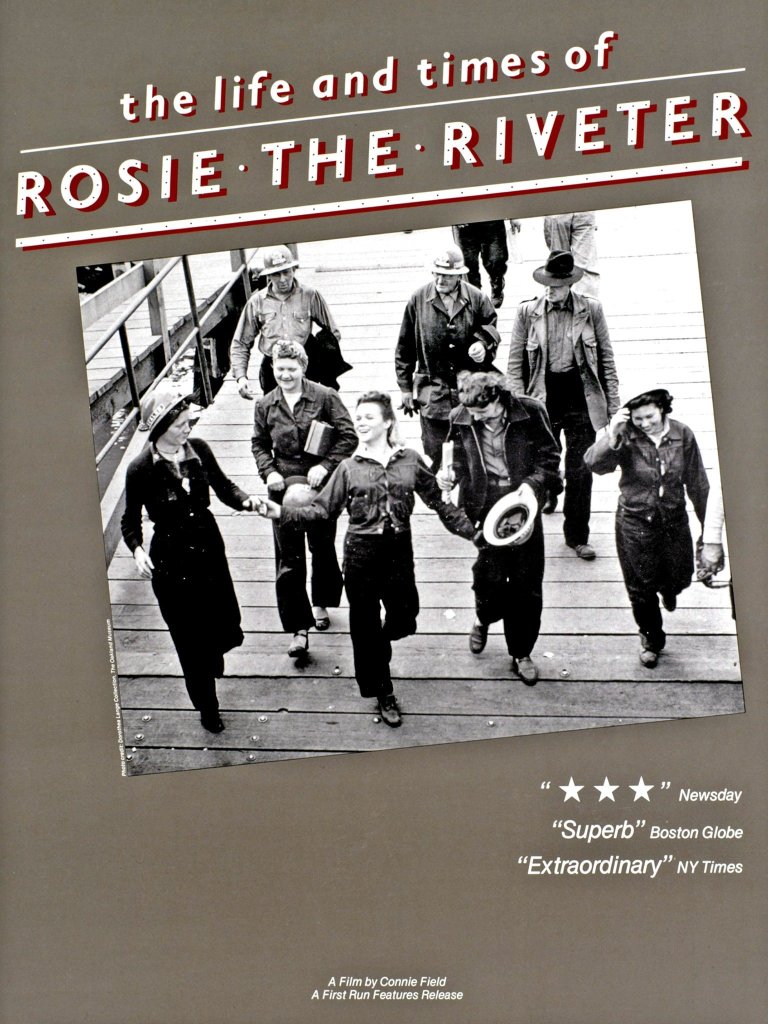
The Plot: During WWII, as men were sent overseas to fight for our country, 19 million American women were called upon to take over the men’s work at shipyards and factories, helping to make wartime munitions and other supplies. These women were often typified as “Rosie the Riveter“, a fictional ideal of the hardworking American woman. After the war, the soldiers returned home, and these women more or less resumed their lives as housewives. In 1980, filmmaker Connie Field interviewed five real-life Rosies (Wanita Allen, Gladys Belcher, Lyn Childs, Lola Weixel, and Margaret Wright) to get their side of the story. What follows is a tale of discrimination and sexism, contrasted with wartime government propaganda hailing these women as heroes.

Why It Matters: The NFR gives a synopsis of the documentary, and…that’s it. No superlatives, no essay: just a rundown of the movie.

But Does It Really?: “Rosie the Riveter” is a compelling examination of an underrepresented era of women; lost between the first two waves of feminism, and reappraised through the lens of the second wave. By zeroing in on the stories of five women, Connie Field highlights an engaging cross-section of the millions of Rosies across the country. At a brisk 65 minutes, “Rosie” is one of the rare NFR entries that I wish was longer; but at any length, “Rosie” is an important historical document, and has earned its place on the Registry.

Everybody Gets One: During the late 1960s, Connie Field was an organizer for both the feminist and anti-Vietnam War movements. Her experience working for the independent distribution company Newsreel got her interested in filmmaking. In 1974, while working for Cine Manifest in San Francisco, Field learned about a Rosie the Riveter reunion that had taken place in Oakland, and thought the subject would make a good documentary. Field recognized that the issues the Rosies faced in the ‘40s were similar to the feminist issues of the ‘70s. In her own words, “It had a very strong current day relevance – plus it was fun and campy.”

Title Track: Though obviously not written for this film, Rosie the Riveter had her own song. Sure, it’s wartime propaganda, but it’s so catchy! I’ve been humming it for days!

Seriously, Oscars?: Despite a slew of critics awards for Best Documentary, “Rosie the Riveter” failed to receive an Oscar nomination. Connie Field would receive her first (and so far only) Oscar nod for her 1994 film “Freedom on My Mind“, a look at voter oppression in 1960s Mississippi.

Other notes 

  • Before we go any further, it should be stressed that Rosie the Riveter is not, I repeat, NOT the woman in the “We Can Do It!” poster. That poster was commissioned by Westinghouse to motivate their workers during the war, and would eventually be conflated with the Rosie mythology when the poster resurfaced 40 years later. There was an official painting of Rosie the Riveter by Norman Rockwell in 1943, but that doesn’t appear as often due to copyright concerns from the Rockwell estate.
  • No one can conclusively determine who was the original inspiration for Rosie the Riveter; suffice it to say that any woman named Rose or Rosie who worked during the war has a legitimate claim to it.
  • The women interviewed for this film are just five of the over 700 Connie Field interviewed as part of her research. Field selected the five based on their diversity, as well as their camera-friendly personalities.
  • There’s a lot to unpack about the history of sexism in this country, but my main takeaway from this film is that it took a World War for us to recognize women as integral, contributing members of society (women played a similar role in the first World War, but there’s not as much surviving material). Adding insult to injury, the Rosies were often referred to in propaganda as “The Hidden Army”. Men are the worst.
  • This film’s main attribute is its ironic usage of ’40s newsreels. In almost every instance, the newsreels’ message of women helping with the war effort is contrasted with contemporary recollections from the Rosies about the difficult working conditions. Speaking of…
  • As unfortunately expected, there is a lot of screentime devoted to the endless sexism and racism the Rosies had to endure while working. They encounter everything from being paid less than their male/white counterparts, to one company closing off the workroom showers rather than integrating them. Most of this is discussed by the women with a bit of nervous laughter and a sort of off-handed “that was then” mentality. I wish I could say it got better.
  • It was only a matter of time before the Rosies started unionizing, which makes this the fourth NFR movie regarding unions that I’ve covered in the last three months. Still don’t know what to make of that.
  • “Rosie” makes effective use of period songs to emphasize points during the film. A section about the women having their own income (some for the first time) is punctuated with Benny Goodman’s “Minnie’s in the Money”. Good use of the song, but it’s giving me some terrible “The Gang’s All Here” flashbacks. Make it stop!
  • It’s interesting to watch the discussion of wartime racism towards African-Americans with the added knowledge that the Civil Rights Movement was less than a decade away. While the early seeds of that movement were planted during Reconstruction, WWII was the final precursor, bringing up the point that we still segregated our African-American citizens, yet expected them to fight for this country alongside the white population.
  • This may be the first NFR film I’ve covered with the oft-used stock footage of sailors returning from the war and kissing every woman in sight. I guess consent hadn’t been invented yet.
  • The last third of the film covers the immediate aftermath of the war, with millions of women being fired or laid off to make way for the returning men. Most women went back to being housewives, others continued to look for work, usually ending up as secretaries or assistants. Among those urging women to return to their previous lives was Dr. Marynia Farnham, who wrote an entire book about women in post-war America, even calling the feminist movement “a deep illness”. You can cut the irony with a knife.
  • Lola Weixel gets the final word in the film, saying that despite all the hardships she and her fellow Rosies endured, she felt that America had a lot of love for women during the war years. “I hope for that feeling in this country again, but not for a war.”

Legacy 

  • Connie Field is still making documentaries that shine a spotlight on underrepresented social issues. In 2018 she gave us two films: “Oliver Tambo: Have You Heard From Johannesburg” and “The Whistleblower of My Lai”.
  • Not a lot of information about what happened to these five women after the war, but most of them engaged in some form of social activism, or spoke on their wartime work at screenings of the film. Margaret Wright gained some notoriety in 1976 when, and this is absolutely true, she ran for President with Dr. Benjamin Spock as her running mate.
  • There are still a few real-life Rosies with us as of this writing. One, 94 year-old Mae Krier, is even helping make COVID masks!

#506) 7th Heaven (1927)

#506) 7th Heaven (1927)

OR “The One Without Jessica Biel”

Directed by Frank Borzage

Written by Benjamin Glazer and Katherine Hilliker & H.H. Caldwell. Based on the play by Austin Strong.

Class of 1995

The Plot: In the streets of Paris 1914, down on his luck sewer worker Chico (Charles Farrell) has a chance meeting with Diane (Janet Gaynor), a prostitute running from her abusive sister Nana (Gladys Brockwell). When the police try to arrest Diane, Chico intervenes, claiming she is his wife. To keep up the facade, Diane moves into Chico’s apartment, a seventh story loft closer to the stars than the streets (we almost have a title!). What starts as a temporary arrangement becomes more permanent when Chico and Diane begin to fall for each other. But with the outbreak of the Great War, their newfound love is put to the test.

Why It Matters: The NFR write-up offers no superlatives, but does give a rundown of the film’s historical significance. An essay by Fox expert Aubrey Solomon is much more supportive of the film’s artistic triumphs.

But Does It Really?: This is another “minor classic” for the NFR: “7th Heaven” isn’t the most iconic silent film (it’s not even Janet Gaynor’s best known film from that year), but it holds up well, and gets enough mention among film buffs to get eventual NFR recognition. No argument here for the inclusion of “7th Heaven”, but I’m not singing its praises either.

Seriously, Oscars?: “7th Heaven” was released in 1927, therefore making it eleigible for the very first Academy Awards. When the nominations were announced, “7th Heaven” received a record-breaking five nominations, and went on to win three: Director, Screenplay, and Actress for Janet Gaynor (along with her performance in “Street Angel” and “Sunrise”). Recalling the event years later, Gaynor admitted that while she was thrilled to receive the first Best Actress prize, the Oscars didn’t have the pedigree it does now, and she was more excited to meet Academy president Douglas Fairbanks than to win the award.

Other notes 

  • There’s a bit of confusion with the exact spelling of the title. The original 1922 play spells out “Seventh Heaven”, but the film uses the number “7th Heaven”. Various write-ups over the years use either spelling interchangeably.
  • “7th Heaven” was initially released in May 1927 as a silent film, but when synchronized sound started to become popular, Fox re-released the film in September with a new score and sound effects. This version hit theaters in September 1927, one month before “The Jazz Singer“.
  • The new soundtrack includes the song “Diane”, written Erno Rapee and Lew Pollack, which becomes a leitmotif throughout the movie. The song is performed by opera singer Zari Elmassian, making her quite possibly the first woman to be heard in a sound picture.
  • “7th Heaven” was a gamble for Fox Films. In addition to being an expensive film based on a highly-sought after stage property (Mary Pickford attempted to by the rights as well), both of the leads were virtual unknowns. Charles Farrell only had a few credits in small parts prior to being cast as Chico, and while Janet Gaynor had already filmed “Sunrise”, it hadn’t been released yet, so Fox was banking on her untested box office appeal.
  • I feel like we lost some artistry when silent pictures started talking. With the silent films I’ve covered on this list, the ones made at the end of the era take the most artistic leaps, resulting in them being more visually appealing and therefore more likely to age well. Once synchronized sound arrived, movies focused on dialogue and music (naturally), and the camera became static. There’s always a few exceptions, but I feel like movies spent most of the ’30s being products, with the artistry taking a backseat.
  • The meet-cute of Chico and Diane is important, but is also very reliant on intertitles to preserve much of the play’s dialogue. It’s hard to monologue in a silent film. Also: Chico must have read my notes on repeating your catchphrase throughout your movie, because he keeps referring to himself as “a very remarkable fellow”. Not exactly “Do you feel lucky, punk?
  • Wow, Chico is all over the place. First he has the impulsive idea to pass off Diane as his wife, then makes her feel bad for his decision, then Diane has the idea of staying at his place, and Chico worries that she’ll “take advantage” of him. Pick a lane, Chico!
  • Shoutout to cinematographers Ernest Palmer and Joseph A. Valentine (as well as Art Director Harry Oliver) for the impressive shot of the camera following Chico and Diane up the seven flights of stairs to get to his apartment. In a movie that retains too much dialogue, this shot is a visually stunning change of pace.
  • I love that the only French any of these Parisians seem to know is “Bon Dieu”.
  • Much like Borzage’s previous film “Humoresque“, “7th Heaven” is an unapologetic melodrama that takes a second act turn and becomes a war movie. The man had a niche.
  • Keep in mind that “7th Heaven” was released only nine years after the end of World War I, so it was still very fresh in people’s minds. It was definitely on Hollywood’s mind; we get this movie the same year as “Wings“, and we’re only a few years away from “All Quiet on the Western Front“. The Great War may have been the first surefire Oscar trope.
  • Diane and Chico communicate to each other via film dissolves every day at 11am. It looks like Darth Vader trying to contact Luke at the end of “Empire Strikes Back“.
  • [Spoilers] Chico died as he lived: spouting his stupid catchphrase.
  • [Actual Spoiler] Turns out this movie has a death fake-out worthy of J.J. Abrams. Chico doesn’t die, but returns home blinded from the war. Ironically, it’s only after the blinding that the self-professed atheist sees the light.

Legacy 

  • “7th Heaven” was a huge success, and helped put Fox Film on the map. Shortly after the stock market crash of 1929, the studio received new management, and shortly thereafter merged with Twentieth-Century Pictures to become…a future Disney property.
  • Fox continued to pair Janet Gaynor and Charles Farrell together in 11 more movies over the next seven years, including a remake of Mary Pickford’s “Tess of the Storm Country”.
  • The song “Diane” became a standard that has been covered many times over the years.
  • “7th Heaven” received a sound remake in 1937 starring Simone Simon and James Stewart. But if you want to talk about remakes, look no further than this 1951 episode of Lux Radio Theatre that reunites Janet Gaynor and Charles Farrell!