
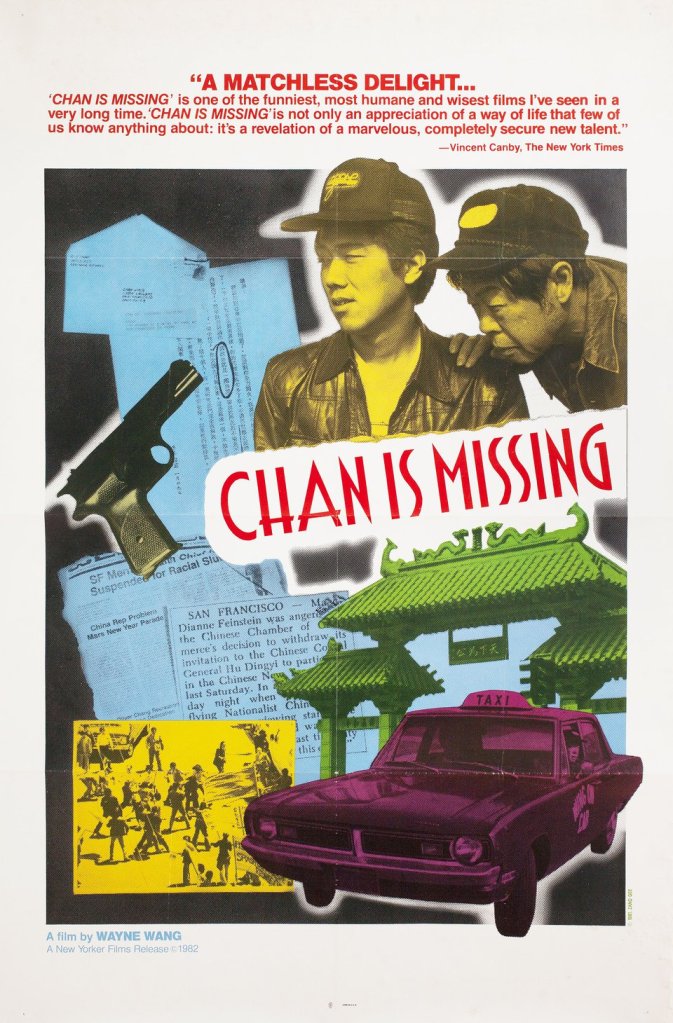
#538) Chan Is Missing (1982)

#538) Chan Is Missing (1982)

OR “Forget It Wayne, It’s Chinatown”

Directed by Wayne Wang

Written by Wang, Isaac Cronin and Terrel Seltzer.

Class of 1995

The Plot: In San Francisco’s Chinatown district, aging taxi driver Jo (Wood Moy) is applying for his cab license with his nephew Steve (Marc Hayashi). Their friend Chan Hung has been assisting them in the process, and one day seemingly disappears with the $4,000 Jo and Steve gave him. The two try to track down Chan, a search that leads them throughout Chinatown, where many of the residents have contradicting viewpoints of Chan. “Chan Is Missing” uses its mystery and backdrop to examine the struggles faced by the Chinese American community, including identity issues and tensions between mainland China and Taiwan.

Why It Matters: The NFR calls it “a seminal work of Asian-America cinema” and “a heart-felt travelogue of San Francisco’s Chinatown”.

But Does It Really?: “Chan Is Missing” is referred to in various film essays as a “quiet gamechanger”, and I think I know what they mean. “Chan” might not get mentioned among the groundbreaking classics of filmdom, but its diverse depiction of Chinese Americans was one of the first in American film, and continues to inspire more varied depictions of Asians throughout our popular culture. The film’s more cerebral approach takes some getting used to, but behind its complex outer shell is a dissection of Chinese culture with a film noir coating. A “yes” for the NFR inclusion/continuing impact of “Chan Is Missing”.

Shout Outs: Supporting character Henry is always seen wearing his “Samurai Night Fever” shirt.

Everybody Gets One: Wayne Wang inherited his love of movies from his father, who named him after his favorite actor, John Wayne. Born and raised in Hong Kong, Wang moved to California to study medicine, but the political atmosphere of 1960s Berkeley led him to study film and television at Oakland’s California College of the Arts. Wang was inspired to make “Chan” while working with immigrants and hearing their stories of struggle and assimilation. “Chan” was made with grants from both the AFI and NEA that totaled just under $22,000.

Wow, That’s Dated: “Chan” is a nice little encapsulation of 1980s Chinatown, including shoutouts to such political figures as then-mayor of San Francisco Dianne Feinstein. Plus, as with many a mystery movie on this list, this case would be a lot easier to solve if everyone had smart phones and the internet.

Title Track: “Chan Is Missing” refers to not only the missing character of Chan Hung, but also the fictional detective Charlie Chan. While popular throughout the ’30s and ’40s in various novels, films, and radio programs, Charlie Chan came to represent many negative Asian stereotypes (adding insult to injury, he was always played in films by White actors in yellowface). This film’s more dimensional depictions of the Chinese (mixed with the mystery elements) prove that (Charlie) Chan is indeed missing.

Seriously, Oscars?: No Oscar love for this little movie, but “Chan Is Missing” did receive a special award from the Los Angeles Film Critics Association. Despite being filmed (and premiering) in San Francisco and utilizing local talent, “Chan” received zero San Francisco critics awards, and was rejected by the San Francisco Film Festival. Seriously, SF?

Other notes 

  • First off, my namesake is St. Anthony, patron saint of lost people. Chan is missing? I’ll get Tony on it.
  • One of Wayne Wang’s inspirations while making “Chan” was the Chinese philosophy that “what is not there is just as important as what is there.” While Wang felt the final result was “too intellectual” for film, he has stood by this creative choice in recent years, stating how important it is for young filmmakers to take these kinds of risks.
  • The majority of “Chan Is Missing” was filmed on weekends, as everyone involved had day jobs and/or school. For example, Wayne Wang was simultaneously writing bilingual science curricula for SFSU while making “Chan”. With apologies to the late James Brown, Wang may in fact be the hardest working man in show business.
  • This is the third movie on the NFR list that opens with “Rock Around the Clock”, albeit a cover of the song in Chinese, thus highlighting the film’s theme of cultural identity immediately.
  • Both Wood Moy and Marc Hayashi were members of San Francisco’s Asian American Theater Company before being cast in “Chan”. The two have a nice rapport between them, and their inherent dichotomy gives the film a nice balance: Jo with his more mature, grounded approach to the mystery, Steve with a more youthful, unpolished confidence. And when was the last time you saw a movie where one of the leads was a Chinese man in his mid ’60s?
  • Wang’s theory of filmmaking: when in doubt, cut to the old guy. Moy’s reaction shots cover up a lot of edits, presumably to stitch together two separate takes of improvised dialogue.
  • One of Wayne Wang’s best directorial decisions: the multiple POV shots throughout the film. These shots allow the viewer to feel that they are a participant in this depiction of Chinatown, and not just an observer.
  • Identity in film is a fine line to walk, but thankfully Wang et al never make their discussion about the subject sound preachy, or like a plea for racial tolerance. Each character in “Chan” is so well defined the dialogue comes across as hearing different perspectives from real people, rather than characters that serve as a mouthpiece for the writers.
  • This movie’s drinking game: take a shot every time a passerby realizes they are on camera. Guerrilla filmmaking at its finest.
  • “Chan Is Missing” rarely strays from Chinatown, but one of the last scenes occurs at Fort Point, not too far from where Kim Novak jumps into the bay in “Vertigo“. Hey, I was just there!
  • The final montage is set to the song “Grant Avenue” from “Flower Drum Song“, offering one final contrast between a White perception of Chinatown and its authentic reality.

Legacy 

  • After being rejected by multiple film festivals, “Chan Is Missing” was selected by New York’s MoMA to play as part of its New Directors/New Films series. Shortly after this, “Chan” was picked up for distribution by New Yorker films and had a surprisingly successful run in a handful of independent theaters. Wayne Wang often recalls seeing lines at its original New York engagement that stretched around the block.
  • Despite the warm reception “Chan” has received over the years, Wayne Wang has expressed disappointment that his film didn’t lead to more change in the opportunities and representation of Chinese and Chinese-Americans within American film.
  • After making a series of movies that dissected the Chinese-American experience (among them future NFR entry “The Joy Luck Club”), Wayne Wang branched out with movies tackling more diverse subject matters and cultures, in an effort to avoid being pigeonholed as an “Asian” director. And you can’t get any more different from “Chan Is Missing” than with 2002’s “Maid in Manhattan”. Not a great movie, but hey, if it pays the bills…
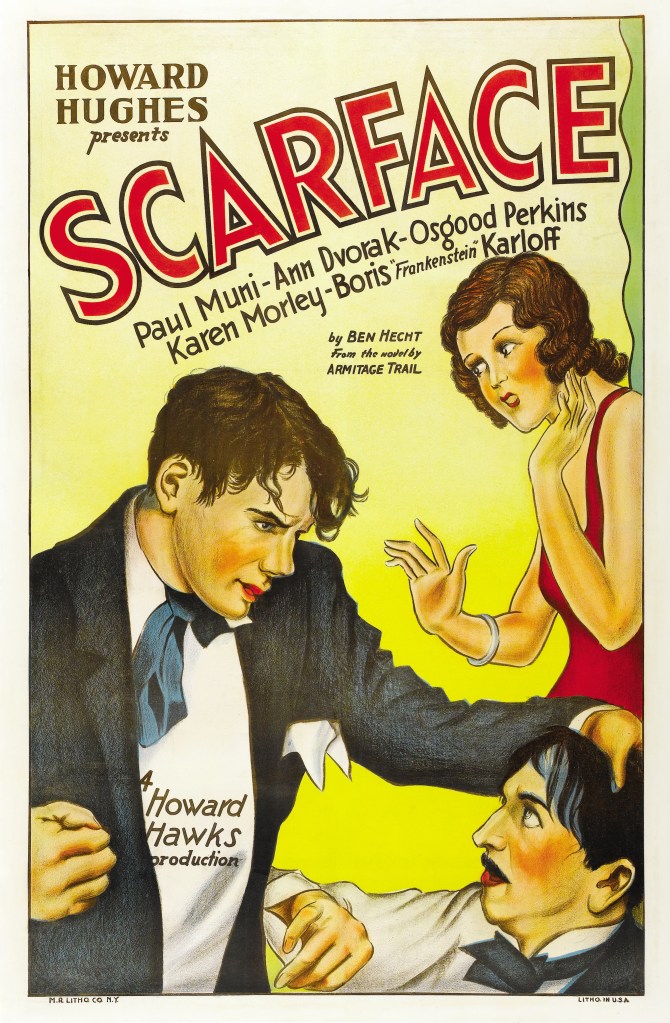
#537) Scarface (1932)

#537) Scarface (1932)

OR “Say Hello to My Older Friend”

Directed by Howard Hawks

Written by Ben Hecht. Dialogue by Seton I. Miller, John Lee Mahin, and W.R. Burnett. Based on the novel by Armitage Trail.

Class of 1994

This trailer appears to be from a re-release in the late ’70s.

The Plot: In 1930s Chicago this town, Italian mobster Al Capone Tony Camonte (Paul Muni), shoots down a crime boss so that mafioso Johnny Torrio Johnny Lovo (Osgood Perkins) can control the South Side of…this Anytown U.S.A. Acting as Lovo’s second-in-command, Tony sells booze to speakeasies across their new territory. Soon Tony’s ambition gets in the way, and he begins selling beer to the North Side, starting a turf war with the Irish mob. Tony also starts aiming to replace Lovo as the crime boss, even stealing his best gal Poppy (Karen Morley). It’s a tale of gangsters hot with power that is in no way related to…what did you say his name was? Al Ca-pone? I’ll have to look him up.

Why It Matters: The NFR calls “Scarface” no short of a “masterpiece”, praising Paul Muni for giving “his best performance”.

But Does It Really?: Hey, why not? While not the quintessential ’30s gangster picture, “Scarface” is worthy of NFR recognition thanks to its top-notch talent, its behind-the-scenes struggles with the censors, and for spawning an equally memorable remake. No argument here for “Scarface” on the NFR.

Wow, That’s Dated: Italian stereotypes, pay phones, tommy guns, yada yada yada, you know the drill with this segment.

Title Track: As part of the Hays Office’s many attempts to water down the film’s glorification of the crime world, some prints of “Scarface” include the subtitle “The Shame of the Nation”. The subtitle has often been used in recent years to help differentiate this film from its better-known remake. Also, weirdly enough, in order to further avoid any connections to Al Capone (who was also nicknamed Scarface), no one says “Scarface” at any point in this movie.

Seriously, Oscars?: Perhaps due to the film’s controversies with censorship or its poor box office receipts, “Scarface” received zero Oscar nominations. The film was, however, named one of the top 10 films of 1932 by the National Board of Review.

Other notes 

  • Producer Howard Hughes (yes, that Howard Hughes) was interested in doing a gangster picture based on Al Capone (still in his bootlegging prime in 1931), and bought the film rights to the novel “Scarface”, based in part on Capone. Hughes hired screenwriter Ben Hecht (writer of previous Hughes film “The Front Page“) and director Howard Hawks to mold Tony Camonte to a figure more align with the Borgia Family. Interesting side note: Hawks was in the process of suing Hughes for plagiarism on another movie when approached to direct! Helming “Scarface” was part of the agreement to drop the case.
  • Due to its central themes of crime and corruption, “Scarface” ran afoul of the Hays Office throughout its production. In order for the film to be approved for release, a text prologue was added calling the picture “an indictment of gang rule in America”, and several new scenes were shot of journalists and government officials serving as a Greek chorus condemning Tony and his actions. In addition, any elements that were specific to Capone were toned down or eliminated.
  • Tony gets a nice reveal: his first scene is played out in shadow, and you finally see his face during his second scene at the barbershop when the towels are being removed from his face.
  • There’s something quite interesting about Paul Muni’s performance. In a movie swarming with the Italian stereotypes of the day (there’s an organ grinder for crissakes!), Muni approaches Tony organically. Still plenty of clichés in his performance, but he’s building the character from the inside out. It’s the kind of “method stereotyping” that Eli Wallach would perfect in the ’50s.
  • A quick reminder that stage legend Osgood Perkins is the father of Anthony Perkins.
  • George Raft was hired to play Tony’s confidante Guino Rinaldo thanks in part to his real life connections to various gangsters (he was childhood friends with Bugsy Siegel). As Guino, Raft spends most of this movie flipping a coin. Where’d he pick up that cheap trick?
  • This movie may have the greatest time-lapse scene in cinema history. The passage of time as Tony starts to take over is visualized as pages rapidly falling off a calendar, synchronized with the rat-a-tat of a machine gun. It’s perfection.
  • So that’s what Boris Karloff actually looks like! As Irish gang leader Tom Gaffney, Karloff is either using his native English accent or has the worst Irish accent since Sean Connery. Either way, Karloff has more dialogue here than he did in two whole “Frankenstein” movies.
  • Between the free spirited, opinionated female characters, the rapid fire dialogue, and the comic relief of Tony’s secretary Angelo, are we sure Hawks didn’t think he was directing one of his screwball comedies?
  • Like oranges in “The Godfather“, “Scarface” uses the X motif to symbolize when a character is about to be killed. Typically this is represented by perpendicular architecture or convenient shadows, but there’s also the creative workaround when a character is killed in a bowling alley immediately after scoring a strike. Even Tony’s scar is an X!
  • Apparently the filmmakers fought to retain the original novel’s implications of incest between Tony and his sister Cesca. If any remnants of that are in the final film, I definitely missed them. Of course, that’s not something I inherently look for while I’m watching a movie.
  • In addition to the overall neutering of violence and story elements “Scarface” endured from various censor boards, a new ending was filmed in which Tony turns himself in to the police and is hanged in the gallows, rather than being shot in a blaze of glory. Richard Rosson directed this new ending when Hawks refused, and a double filled in for Paul Muni, who was starring in a Broadway play at the time. Current releases of “Scarface” include the original ending, with the mandated alternate ending appearing as a supplemental feature.

Legacy 

  • It was the long-fought censorship battles movies like “Scarface” encountered that led to the eventual installment of the Production Code. While this move negated the need for each state to have its own censor board, it created an over-protective code of conduct the movies would be straightjacketed with for the next 35 years.
  • While there were critics and moviegoers alike who praised “Scarface” from the beginning (even Capone liked it), the public backlash over the film’s subject matter led to “Scarface” underperforming at the box office. Disappointed with the film’s initial lack of success, Howard Hughes removed all prints of “Scarface” from circulation and turned down all offers to sell or re-release the film during his lifetime.
  • Following Hughes’ death in 1976, “Scarface” returned to the public eye for a reappraisal. Among those who saw the film was Al Pacino, who started planning a remake with producer Martin Bregman. Originally attached director Sidney Lumet came up with the idea of transplanting the story to the Cuban Mariel boatlift of 1980, and in the hands of new director Brian de Palma, 1983’s “Scarface” is more iconic than its predecessor. And yet, still no NFR recognition.

Bonus Clip: While we’re waiting for the ’83 “Scarface” to make the NFR, please enjoy this montage of Universal’s attempt to clean up Pacino’s F-bombs for network TV. Because this town is like a great big chicken just waiting to get plucked.

#535) Carmen Jones (1954)

#535) Carmen Jones (1954)

OR “Let’s Get Bizet”

Directed by Otto Preminger

Written by Harry Kleiner. Based on the musical by Oscar Hammerstein II, the opera “Carmen” by Georges Bizet, and the novella “Carmen” by Prosper Mérimée.

Class of 1992 

The Plot: “Carmen Jones” updates the opera “Carmen” from 1820s Spain to 1940s North Carolina with an all African-American cast. Carmen Jones (Dorothy Dandridge) is a free-spirit and relentless flirt working in a parachute factory during the war. When she is arrested for fighting with a co-worker, Corporal Joe (Harry Belafonte) is assigned to escort her to the authorities. Carmen works her charm on Joe and the two begin an affair. Things are complicated by Carmen’s desire to not be held back by anyone, Joe’s engagement to Cindy Lou (Olga James), and the arrival of champion boxer Husky Miller (Joe Adams). An impulsive trip to Chicago leads to more complications, and follows its source material to its tragic conclusion.

Why It Matters: The NFR write-up calls the film “[e]xceptionally liberal in its time”, gives some historical background, and weirdly highlights that “Otto Preminger’s realist sensibility often seems contradictory to the whimsical nature of a musical”.

But Does It Really?: “Carmen Jones” tends to be forgotten in terms of classic Hollywood musicals, but it earns its NFR status thanks to its progressive subject matter and a star-making turn by Dorothy Dandridge. The film’s social commentary may have been eclipsed by later progressions in the Civil Rights movement, but “Carmen Jones” can still be viewed today without any major cringing, and is a testament to the career of Dorothy Dandridge. No argument here for NFR inclusion.

Wow, That’s Dated: Like “Porgy and Bess” before it, “Carmen Jones” is a musical about Black characters written by White men. Sure, phrasing like “You is” and “Dey is” might be accurate to this specific regional subculture (emphasis on might), but at the end of the day, this show is White composers approximating a Black experience.

Seriously, Oscars?: Well received in its time, “Carmen Jones” won the Golden Globe for Best Comedy or Musical, and received two Oscar nominations. Although Dorothy Dandridge lost Best Actress to Grace Kelly, she made history by being the first African-American woman nominated in that category. The film’s other nod was for its Musical Scoring, which it lost to “Seven Brides for Seven Brothers“.

Other notes 

  • How do you think Rodgers felt when Hammerstein told him he wanted to collaborate with a dead guy?
  • Like many a classic opera, “Carmen” features music that you’ve heard a thousand times before, but couldn’t say where it’s from. “March of the Toreadors” shows up in a lot of commercials, as does “The Toreador Song“, but most people would recognize “Habanera” out of all these numbers.
  • Another historical highlight: “Carmen Jones” features Saul Bass’ first opening credits sequence! Bass debuts with a simple yet powerful image of flames over a stylistic rose. This symbol was put to more provocative use in international versions of the film’s poster.
  • By the early 1950s, Dorothy Dandridge was known primarily as a nightclub singer, with a handful of bit parts in films. A starring role as a reserved teacher in “Bright Road” almost cost her “Carmen Jones”, when Otto Preminger felt she was too demure for the part. After an in-person meeting with Preminger where she “dressed the part”, Dandridge won the role, and started a four-year affair with her director.
  • I don’t know how Preminger almost messed this up: Dorothy Dandridge has star quality coming out of every pore. You can’t take your eyes off of her (well, at least I couldn’t).
  • Despite both Dorothy Dandridge and Harry Belafonte being known for their singing abilities, neither had a voice deemed up to the demands of the score, and the two were dubbed by, respectively, Marilyn Horne and LeVern Hutcherson. That being said, Horne does a remarkably good job matching Dandridge’s vocal inflections.
  • Shoutout to cinematographer Sam Leavitt. Like his other 1954 musical “A Star Is Born“, Leavitt knows how to fill the CinemaScope frame without the characters becoming eclipsed by spectacle. Though there are a few shots that must have been a real bummer to watch in pan-and-scan.
  • “There’s a Café on the Corner” features a fun performance by Dandridge/Horne, but Carmen’s doing a lot of moving about in an open-top car. Someone please invent the seat belt.
  • Things start to pick up once we arrive at the café. In addition to the always entertaining Pearl Bailey (the only lead performer who does their own singing), you get Diahann Carroll in her film debut! She was 19!
  • The “Whizzin’ Away Along de Track” number is a fine example of this musical’s focus on character rather than the spectacle of its contemporaries. The song is primarily one shot of the five singers (all fitted comfortably in the widescreen), but there’s enough character development and back-and-forth between them to hold your interest without resorting to cuts. Well done.
  • Just a reminder that Harry Belafonte is still alive and thriving at age 93, with a performing career that is second only to his outstanding humanitarian accomplishments.
  • Dorothy Dandridge strips down to her bra and panties! It’s 1954, how did any of this get past the censors? Preminger, you’ve done it again!
  • The only thing Cindy Lou has done wrong this whole movie was not be a star of the same stature as Belafonte or Dandridge. At least her subplot ends with an inner monologue song about how she can do better than Joe.
  • When he picks a fight with Husky Miller, Joe learns the hard way never to bring a knife to a fistfight. …wait, what?
  • [Spoilers] Given its opera lineage, I should have seen this movie’s ending coming. It’s a real downer, but at least Preminger only films Carmen’s dead body from the shoulders up. I always get distracted watching corpses breathe in movies.

Legacy 

  • “Carmen Jones” was a hit and made Dorothy Dandridge a star. Dandridge followed the career advice from her paramour Otto Preminger, which she ultimately regretted taking when it limited her casting options and stalled her rising star. After a decade of various financial and professional setbacks, Dorothy Dandridge died unexpectedly in 1965 at age 42.
  • Preminger would reunite with Dandridge and Pearl Bailey for another NFR musical entry: 1959’s “Porgy and Bess”.
  • The making of “Carmen Jones” is touched upon in the 1999 HBO movie “Introducing Dorothy Dandridge”, starring Halle Berry as Dandridge and Klaus Maria Brandauer as Preminger.
  • Following its original Broadway run in the ’40s, the stage version of “Carmen Jones” has only had a handful of revivals. “Carmen Jones” would eventually return to New York in 2018 in an Off-Broadway production starring Anika Noni Rose.
  • The original “Carmen” opera is still performed with some regularity, with a few filmed versions over the years, including a hip-hopera starring Beyoncé. You know, for the kids.

Listen to This: Despite showing up in two movies on the NFR, Harry Belafonte doesn’t sing a note in either of them. Fortunately the National Recording Registry came through in 2017 by inducting his 1956 album “Calypso”. The NRR write-up includes an essay by Belafonte expert Judith E. Smith, as well as an interview with the man himself. Day-O!