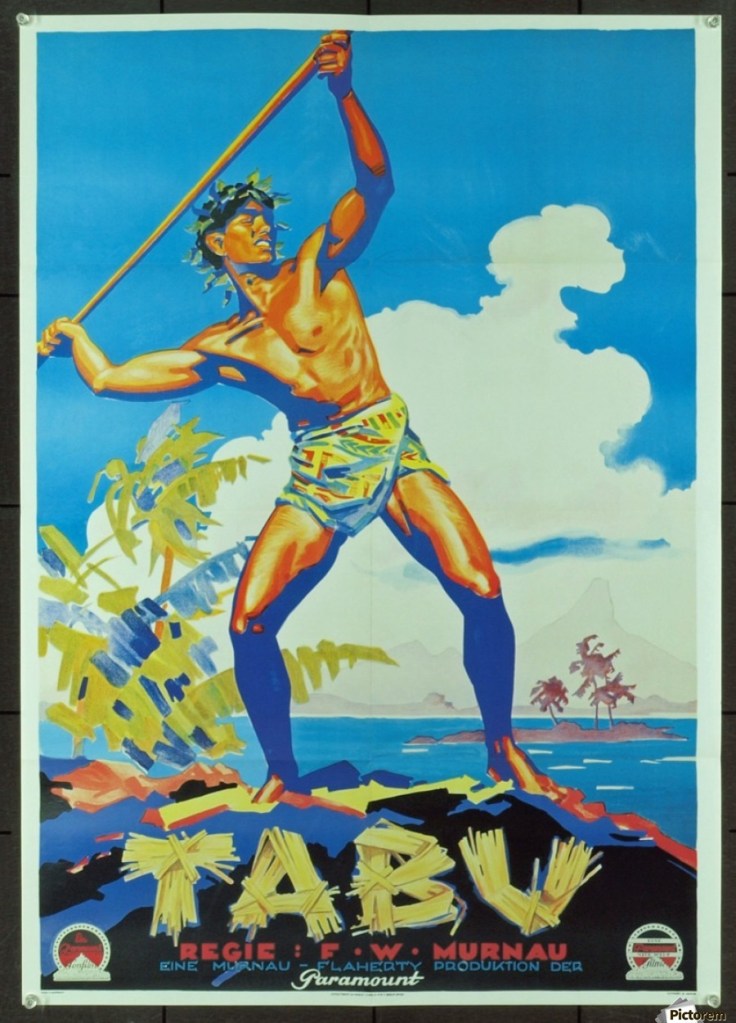
#602) Tabu: A Story of the South Seas (1931)

#602) Tabu: A Story of the South Seas (1931)

OR “How are Things in Bora Bora?”

Directed by F.W. Murnau

Written by Murnau and Robert J. Flaherty

Class of 1994

The Plot: The South Pacific island of Bora Bora is met with the arrival of Hitu (actor unknown), an emissary from another island with a message from their Chief. With the death of their sacred virgin, the title has now been placed on young native Reri (Anne Chevalier), who is officially declared “tabu”: she cannot be touched or desired by any man under penalty of death. This news does not sit well with Reri or with her beau Matahi (actor unknown), and the two flee the island, taking refuge in a colonized city in French Polynesia. Reri and Matahi are happy in their new life, but Hitu and the curse of Tabu loom over the couple. Will these two keep their newfound happiness, or become the next victims of Tabu?

Why It Matters: The NFR praises the film’s “lush” cinematography and quotes the New York Times review that described “Tabu” as a “picture poem”.

But Does It Really?: “Tabu” is on the list because of its impressive cinematography and for being F. W. Murnau’s last film. That’s it. Unsurprising for a Murnau film, “Tabu” is beautifully shot, and it’s impressive to watch a story told almost exclusively through the visuals, but the film suffers from the kind of exoticizing of other cultures prominent throughout most films of this era, which makes for a difficult modern viewing. Still, “Tabu” is a unique movie thanks to the melding of Murnau’s expressionism and Robert Flaherty’s docudrama technique, and holds up well enough today to warrant a pass for its NFR designation.

Everybody Gets One: Raised in Tahiti by a Polynesian mother and French father, Anne Chevalier was discovered by F.W. Murnau at age 16 and cast as Reri. Chevalier traveled to the United States and Europe to promote the film and even performed her dance routines in nightclubs and cabarets (plus a stint in the Ziegfeld Follies). Anne Chevalier was the only “Tabu” cast member to appear in other movies, starring in two more (“Black Pearl” and “The Hurricane”) before returning to Tahiti for the rest of her life. And for the record, Anne is of no relation to Maurice Chevalier.

Wow, That’s Dated: The opening credits state that while the film is cast with “native-born South Sea Islanders”, there are a few “half-castes”, a derogatory term for people of mixed European and Indian heritage.

Title Track: Tabu is the Polynesian concept denoting something as sacred and prohibited (it’s the word that the English “taboo” is derived from). While spelled “Tabu” at the time of the film’s release, the Tongan language now spells it “Tapu”.

Seriously, Oscars?: While not very successful upon its initial release, “Tabu” was nominated for – and won – a single Oscar for Floyd Crosby’s cinematography. “Tabu” was the last silent film to win Best Cinematography, and at age 31 Crosby is still the category’s youngest recipient. 

Other notes

  • F.W. Murnau and Robert Flaherty were introduced through Flaherty’s brother David and hit it off immediately. The two agreed to collaborate on a film set in Tahiti; Murnau had always wanted to make a film there, and Flaherty had previous experience filming in the South Seas. The original film was titled “Turia”, but when financing fell through (possibly due to the 1929 stock market crash), Murnau funded the film himself and rewrote the entire script to avoid a potential legal dispute with the original production company.
  • “Tabu” was filmed in Tahiti over eight months. Production went south immediately as Murnau and Flaherty’s relationship started to sour. Flaherty did not like Murnau’s new script, and the little he contributed to the rewrite was deemed unusable by Murnau. Unsatisfied with Flaherty’s footage of the opening sequence, Murnau hired Floyd Crosby to serve as cinematographer, with Flaherty returning to America to develop the arriving film stock. Flaherty’s initial co-director credit was removed, and his ultimate contributions to the final film are debatable. Flaherty’s involvement was further diminished when after production, broke and desperate for money, he sold his share of the film back to Murnau for $25,000.
  • It’s 1931 and we’re thousands of miles away from the nearest Hollywood studio, so you know what that means: Pre-Code nudity! The opening bathing scene is tasteful and shows great restraint. I wonder if any of these women ever suspected this footage would be readily available for viewing over 90 years later.
  • Shoutout to Floyd Crosby; the cinematography is genuinely impressive. The shots aboard the outriggers are the best: the rowers and their boat are stable in the foreground while the ocean bounces wildly in the background. Fun Fact: Crosby was the only professional cameraman on the shoot, the rest of the cameras were helmed by native Bora-Borans. 
  • The ship from Papeete is named “Moana”. This is, of course, the Tahitian word for “ocean”, but now I have the songs from that Disney movie stuck in my head. Damn you Lin-Manuel Miranda and your worthy succession of Alan Menken!
  • The inherent issues with women being treated as property aside, my big question regarding Reri’s new Tabu status: What happened to the last virgin? They gloss over that little detail quickly.
  • Matahi and the other natives participate in a ritualistic dance celebrating Reri, and boy I hope it’s culturally accurate. Things take a turn when Matahi dances a little too close to Reri. I didn’t realize this movie was the original “Dirty Dancing”. Nobody puts Reri in a corner.
  • Anne Chevalier has the “head down in sadness” look down pat. Every time she walks I keep waiting for them to play “Christmas Time Is Here“.
  • Oh come on, the message says that Reri was “stolen”? She’s a person, not property. Somehow the term “kidnapped” is less demoralizing in this scenario.
  • As one of the last truly silent films (soundtrack aside), “Tabu” features no intertitle dialogue, with the only expository text coming from letters and journal entries within the film. It’s commendable, but that being said the filmmakers increasingly rely on this technique as the film goes along.
  • You gotta love any movie where a plot point involves a shark. Obviously, it’s a model shark (you can more or less sense the hand holding it up in some shots), but it works for a movie on a shoestring budget. And like “Jaws” some 40 years later, Murnau knows to only show the shark sparingly for maximum effect.
  • Between this and “La Perla“, the NFR really wants to warn me about the dangers of pearl diving. 
  • Is it just me, or does the score keep almost turning into “Love Is a Many-Splendored Thing“?
  • Ah yes, there’s your Murnau expressionism at work. The camera gets in close to Matahi’s face as he struggles to sleep, with the image of the man he owes money to superimposed over him. This composition should feel out of place, but given this movie’s somewhat heightened reality, it works.
  • Wow, what a downer ending. I guess the moral is “keep it in your pants”?

Legacy

  • Upon his return to Hollywood, F.W. Murnau sold the distribution rights of “Tabu” to Paramount, who added a score by Hugo Riesenfeld to the otherwise silent film. Murnau was in talks with Paramount to make several films in Tahiti, the next one planned was an adaptation of Herman Melville’s novel “Typee”. Sadly, one week before the premiere of “Tabu”, F.W. Murnau was in a car accident and died the following day from sustained head injuries. He was 42, and “Tabu” was his final film.
  • After the lackluster box office performance of “Tabu”, the film’s distribution rights reverted to Murnau’s mother Ottilie Plumpe. In the 1940s, she sold the film to screenwriters/directors Rowland and Samuel Brown, who re-released it in 1948 (albeit with Code-mandated cuts). Murnau’s nieces eventually bought the film back in the 1960s, and in the ’70s Floyd Crosby funded a restoration of the original uncut film by UCLA.
  • Floyd Crosby would go on to serve as cinematographer for such NFR entries as “The River” and “High Noon“. I don’t think I’ve mentioned this yet on the blog, but Floyd Crosby is the father of singer David Crosby. Do with that piece of trivia what you will.
  • “Tabu” is one of many films of the era that romanticized the South Pacific for American (re: White) moviegoers. Among the other films, Best Picture winner “Mutiny on the Bounty” and Anne Chevalier’s final film “The Hurricane”.

Further Viewing: “Tabu” is typically remembered today in conjunction with the rest of Murnau’s filmography. Easily the most iconic of his earlier, NFR ineligible films is 1922’s “Nosferatu”. Check that out and, if there’s time, take a peek at 2000’s “Shadow of the Vampire” with John Malkovich as Murnau!
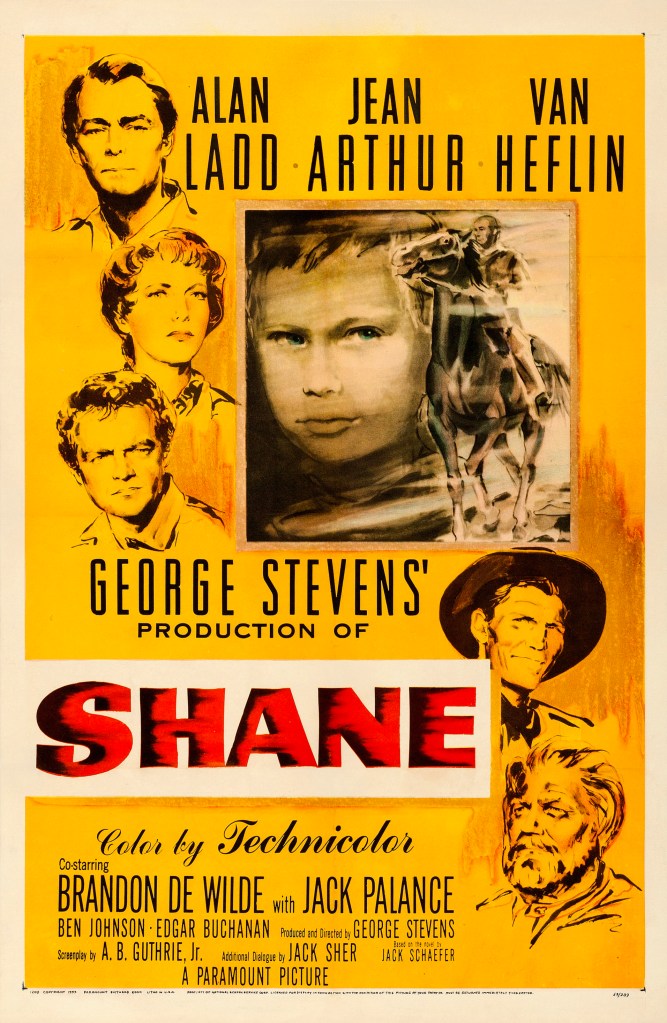
#601) Shane (1953)

#601) Shane (1953)

OR “Sorrowful Ladd”

Directed by George Stevens

Written by A.B. Guthrie Jr. and Jack Sher. Based on the novel by Jack Schaefer.

Class of 1993

The Plot: In the Wyoming Territory of the 1880s, a mysterious gunfighter known only as Shane (Alan Ladd) arrives at the homestead of ranchers Joe & Marian Starrett (Van Heflin & Jean Arthur). Shane takes work as their farmhand, easily impressing the Starrett’s eight-year-old son Joey (Brandon deWilde) with his gunmanship. Soon Shane learns of an ongoing turf war between settlers like the Starretts and the cattle rustler Rufus Ryker (Emile Meyer), who hires gunfighters to scare settlers off their land. When Ryker hires the notorious Jack Wilson (Jack Palance), Shane agrees to help the Starretts win this fight, even if it means using his moralistic present to justify his criminal past. It’s a meditative take on a west that was becoming a little less wild, in a movie that meditates on the evolving status of the western film genre.

Why It Matters: The NFR praises the film’s impressive scale, cinematography, and performances by Ladd and Palance. It also points out that “Shane” features “some of the longest dissolves in American cinema”. What an odd thing to find noteworthy about one of the most famous films ever made. It’s like if a film made the NFR for having the longest credits or the best on-set catering.

But Does It Really?:  I think this is another case of a film’s reputation (and preordained “classic” status) overhyping my viewing experience. Don’t get me wrong, “Shane” is a step up from most of the westerns on this list, and like the NFR write-up I appreciated the performances and cinematography, but overall “Shane” never fires on all cylinders like its reputation would suggest. “Shane” is by no means undeserving of its NFR status, but like our hero’s inability to stay put in an ever-changing landscape, I wouldn’t be surprised if “Shane” moves on from its status as an untouchable film classic.

Everybody Gets One: A.B. Guthrie Jr. was a novelist, having won the Pulitzer Prize for Fiction in 1950 for his book “The Way West”. While Howard Hawks was producing the film adaptation of Guthrie’s “The Big Sky”, he recommended Guthrie to George Stevens to adapt “Shane” for the screen, even though Guthrie had never written a screenplay before. “Shane” is one of only two movies for which Guthrie is credited as a screenwriter (the other is 1955’s “The Kentuckian”). Co-writer Jack Sher was also new to moviemaking when he helped pen “Shane”. His subsequent writing career included 14 more movies, and three episodes of “Bewitched”!

Wow, That’s Dated: As with many a movie from this era, there are plenty of day-for-night shots that always look weird. If the sky ever turns that shade of blue in real life, we’re doomed.

Seriously, Oscars?: One of the biggest hits of 1953 (and one of the most successful westerns of the decade), “Shane” received six Oscar nominations, including Best Picture and Best Director. “Shane” lost five of its six nods to “From Here to Eternity“, but still managed a win for Loyal Griggs’ color cinematography (thank god “Eternity” was in black & white).

Other notes

  • The novel of “Shane” was published in 1949, and Paramount purchased the film rights immediately. It’s unclear when George Stevens became involved, but apparently his son George Jr. read “Shane” while in college and suggested to his father that it would make a good film. “Shane” was filmed on location in Jackson Hole, Wyoming in the summer and fall of 1951, though the film would not be released until the spring of 1953 due to George Stevens’ extensive editing process. 
  • I’m about thirty seconds into this movie and I already love the cinematography. One of the last films shot in the original Technicolor process, “Shane” has the lush, vibrant colors we associate with classic movies: the natural beauty of the Wyoming mountain range (including Grand Teton) juxtaposed with the drab earth tones of the land and the cabins. In addition, there are plenty of lovely visual compositions during the dialogue scenes that help tell the story and develop character.
  • This was my introduction to Alan Ladd, who doesn’t have a lot of classics on his resume (his only other NFR appearance is a brief turn as a reporter in “Citizen Kane“). He’s stoic, I give him that, but maybe his Shane is a little too passive? I guess I don’t have any other Ladd performances to base this one off of. There’s also a Robert Mitchum quality about Ladd’s voice, so that’s not helping.
  • After being genuinely delighted by her work in “Mr. Smith Goes to Washington”, I was a bit let down by Jean Arthur in “Shane”. She’s a little too old for the part (Ms. Arthur was 50 during production), and it doesn’t help that Marian is sidelined for most of the movie, given no plot responsibility whatsoever, other than to say “Joey, stop it” every few minutes. There’s also a lot of glancing going on between Marian and Shane. Was there a “forbidden romance” subplot cut from the novel?
  • Also showing up in this is Ben Johnson, still 18 years away from his Oscar-winning turn in “The Last Picture Show“. I didn’t realize he was so young.
  • Yes, there is a moment with the familiar-sounding exchange “You speaking to me?”  “I don’t see nobody else standing there.” Whether or not “Taxi Driver” is referencing this directly is anyone’s guess.
  • Wow, that is one hell of a punch. Ben flew across the room like a cartoon character. I guess Shane remembered to eat his spinach that day.
  • “Shane” is not without its faults, but you can’t entirely hate a movie with a good ol’ fashioned barroom brawl. 
  • Hey, that’s Elisha Cook Jr. from “Maltese Falcon“! I recognized him immediately this time!
  • What did George Stevens see in Brandon deWilde? Apparently the eight-year-old deWilde was cast based on his breakout performance in the play “The Member of the Wedding” with Julie Harris and Ethel Waters. Maybe he was dynamite on stage, but in this film he seems like any other run-of-the-mill child actor. And an Oscar nomination to boot? Were there only five eligible performances that year? Hopefully he’s better in “Hud”.
  • Ah, Jack Palance. I’m used to seeing Jack in his later, “I crap bigger than you” days, so it’s refreshing seeing him as the young heavy he used to play all the time. With his slow gait and impossibly angular features, Palance makes a memorable screen villain. I’ll also argue that in another universe, Jack would have made a great Joker (and not just Carl Grissom).
  • While we’re on the subject, Jack pronounced his last name PAL-ance, not pa-LANCE. It was an anglicization of his Ukrainian last name Palahniuk, and Jack hated when people emphasized the second syllable.
  • “A gun is as good or as bad as the man using it.” I mean, he’s not wrong, but it’s so much more complicated than that. 
  • I appreciate that in a film about land claimers, they at least acknowledge the Indigenous people that lived on the land first. Granted, it’s only one line and we don’t actually see any Indigenous people on screen (nor do they mention the specific tribes), but still, it’s better than having them run around like John Ford savages.
  • The only funny exchange in the movie: Fred Lewis (watching his cabin burn): “I built it with my own hands.” Mrs. Lewis: “Not the girls’ room.” Fred: “I was gettin’ ’round to it!” George Stevens could never truly escape his beginnings in film comedy.
  • The finale is…fine. I wasn’t necessarily engaged with “Shane” at this point, but ultimately I was curious to see how they wrapped things up. The final shootout has some good tension (aided by the sound design that helps condone the minimal violence we see), and of course, if you know one line from this movie, it’s Joey’s saddened cry: “Shane! Shane! Come back!”
  • Man, I really wanted to like this movie, and I still can’t exactly figure out why I didn’t. I’ve never been a big western fan to begin with, so maybe it’s just genre bias? Ah well, maybe next time.

Legacy

  • “Shane” was the end of an era for most of its creatives. George Stevens made a handful of movies (including 1956’s “Giant“) before retiring. Jean Arthur would also retire from the movies shortly thereafter, and “Shane” was her last film. Sadly, within 18 years of this film’s release, we lost Alan Ladd, Van Heflin, and Brandon de Wilde in three separate tragic occurrences.
  • A TV adaptation of “Shane” starring David Carradine came and went in the fall of 1966. Hmmm….a TV show where David Carradine plays a man with a mysterious past, traveling the Old West and fighting for justice. It could work…
  • While there have been no direct remakes of “Shane”, Clint Eastwood’s 1985 film “Pale Rider” borrows several elements from the film, as does 2017’s “Logan”.
  • There are still occasional references made to “Shane” in pop culture (almost always the final lines), but hands-down the most random is Cliff Robertson as Shame, the Conniving Cowboy of Crime, on the ’60s “Batman” TV series. Hey, that’s two Batman references in one post!
  • Perhaps the film’s longest legacy: among the many who saw “Shane” when it was first released was a young Billy Crystal (with his babysitter Billie Holiday – but that’s another story). Almost 40 years later, when it came time to cast the trail boss Curly in “City Slickers”, Crystal’s first and only choice was Jack Palance, based on his performance in “Shane”. Palance took the part and won an Oscar (as well as my vote for Best Oscar Speech).

#600) Footlight Parade (1933)

#600) Footlight Parade (1933)

OR “A Number of Issues”

Directed by Lloyd Bacon. Musical numbers by Busby Berkeley.

Written by Manuel Seff and James Seymour. Songs by Harry Warren & Al Dubin and Sammy Fain & Irving Kahal.

Class of 1992

The Plot: With the advent of talking pictures, Broadway musical director Chester Kent (James Cagney) fears his career is over. After being persuaded to see one of these “talkies”, he witnesses a prologue, a dance number performed live on stage before the movie, and decides to pivot his career to directing these mini-musicals. With support from his devoted, wise-cracking secretary Nan (Joan Blondell), Chester assembles his dancers into “units” for various prologues to be performed across the country. Among his dancers is juvenile lead Scotty Blair (Dick Powell) who may be falling for secretary turned dancer Bea Thorn (Ruby Keeler). When Chester learns that his prologues might get a deal with a major theater chain, he has to stage three lavish prologues, performed at three different theaters on the same night! There’s a lot of plot before you get to the exciting Busby Berkeley numbers these films are known for.

Why It Matters: The NFR calls it “one of the best of the Warner Brothers showbiz musicals”, praising Cagney’s “dynamite” performance and Busby Berkeley’s numbers. A loving essay by early film expert Randy Skretvedt calls the film “pure enjoyable escapism” compared to the darker tones of fellow NFR entries “42nd Street” and “Gold Diggers of 1933“.

But Does It Really?: “Footlight Parade” is the third of the ’30s Busby Berkeley backstage musicals on this list, and I’m tempted to rank it as third best. Collectively, these three represent a genre synonymous with Depression-era escapism, but individually none of them hold up as an undisputed classic. “Footlight” in particular suffers from too much backstage/not enough musical, and is bogged down by some very dated concepts. I get why “Footlight Parade” is on the list, but perhaps the NFR should have just selected the “That’s Entertainment!” film series, preserving the Busby Berkeley numbers from these three films and trimming the fat.

Wow, That’s Dated: Oh man, we have a lot to cover this time. First of all, prologues, but I’ll get to those a little later. There are the usual Depression-era sensibilities and obscure references (Lydia Pinkham, anyone?), but mainly we have to acknowledge the massive racial insensitivity throughout, particularly the copious Yellowface in the “Shanghai Lil” finale. Oh, and in one rehearsal scene, there’s a guy sitting in the background wearing Blackface AND THEY NEVER ACKNOWLEDGE HIM!

Seriously, Oscars?: No Oscar nominations for “Footlight Parade”, the only one of Warner Bros.’ three backstage musicals of the year to not be recognized by the Academy.

Other notes

  • A quick word about prologues. Turns out they were real, and more or less how they are depicted here: specialty acts and dance numbers that preceded your feature presentation, typically themed around the movie. The brother-sister team of Fanchon & Marco Wolff were the top prologue producers of the day, and their studio in Hollywood served as the basis for Kent’s studio in this film. While prologues were popular in their ’30s heyday, they were slowly phased out over the decade in favor of cheaper B-pictures and shorts. New York’s Radio City Music Hall was the last of the classic movie houses to feature prologues, ending the tradition in 1979 when it stopped showing movies altogether.
  • 1933 was the year of the backstage musical. “42nd Street” was released in March and was an instant hit. “Gold Diggers of 1933” was already in production, but more numbers were added following the success of “42nd Street”, and the film hit theaters in May. “Footlight Parade” was filmed in the summer of ’33 and released that October, which explains why “Footlight” has more in common with “42nd Street” than “Gold Diggers” does.
  • James Cagney got his start in show business as a hoofer before pivoting to acting. Even in his early film roles he was already pigeonholed as a gangster (“The Public Enemy” came out in 1931), and Cagney lobbied for the role of Chester Kent to avoid typecasting. Cagney’s performance is one of the things keeping this movie afloat; he plays his role with such conviction it really does hold together some of the more disjointed parts of the film.
  • I’m appreciating all the scene wipes this movie has. “Footlight Parade” may rival the entire “Star Wars” franchise for sheer quantity of wipes.
  • This movie gets my standard note of confusion: “What is happening?” Part of that is everyone’s talking at breakneck speed, and part of that is the long-forgotten world of prologues, which a modern audience may have difficulty understanding (I sure did, and I actually study this stuff!).
  • Among the plethora of Warner Bros. character actors in the film is Hugh Herbert as a censor (a not-so-subtle dig at the burgeoning Production Code). Side note: Herbert is one of many ’30s actors caricatured in the Disney cartoon “Mother Goose Goes Hollywood” (his joviality lends itself well to Old King Cole). Also making an appearance is Frank McHugh as the exasperated choreographer. If he keeps stressing out and chomping on those cigars he’s gonna pull a Joe Gideon.
  • Yes, Dick Powell and Ruby Keeler play the same juvenile romantic leads they played in “42nd Street”, but this was long before you could watch these movies on a loop in your own home, so reprising these character types in film after film was the next best thing.
  • “Footlight Parade” was one of the last major movies to be released before the Production Code went into full force in 1934. Joan Blondell in particular gets the bulk of the risqué dialogue, most of it directed at her on-screen rival Vivian Rich. Highlights include Nan introducing her as “Miss Bi- uh, Rich”, and her later remark that “As long as they’ve got sidewalks, you’ve got a job.” Whoa.
  • I’ve said it before and I’ll say it again: tap dancing in heels is one of the most impressive things I’ll ever witness. Get it, Ruby Keeler!
  • It takes 41 minutes before we finally get our first big production number: “Sitting on a Backyard Fence”, performed by the entire ensemble dressed as cats. It’s…very unsettling, not unlike another attempt to put dancing cats on the big screen.
  • Once again, these backstage movies have way too much plot for something that should just be an escapist spectacle. I only have enough bandwidth to follow one of these plot lines, I don’t need eight of them vying for my limited attention.
  • This movie gives us three different finale musical numbers: It’s like an all-dancing version of “Clue”! Finale #1, “Honeymoon Hotel”, is easily the weakest. It’s the only one not directed by Busby Berkeley (He was called back to his home studio of MGM), and with all due respect to dance director Larry Ceballos, it’s pretty obvious this one is missing Berkeley’s genius. In addition to its static staging, it relies on old tropes like adulterous couples registering as “Mr. & Mrs. Smith”, and the ever-watchful hotel detectives. Bonus weirdness: there’s eight-year-old Billy Barty running around, with a joke implying that he slept with one of the adult brides. What is happening?
  • “By a Waterfall” (Finale #2) is the best one. There are plenty of aquatic configurations as Busby’s overhead camera captures beautiful women in stunning formations. Sure, none of this would actually fit onto a stage, but who cares, it looks great. “By a Waterfall” is definitely the reason this movie is on the NFR, it’s just a shame you have to sit through the rest of this movie to get to it.
  • And then we arrive at “Shanghai Lil” (Finale #3). Yes, it’s the number where we finally see Cagney strut his stuff (more than holding his own against Ruby Keeler), but this is also the number that features Ruby Keeler in Yellowface, spouting broken English and exhibiting other harmful Asian stereotypes. Again, it’s a technically impressive number (complete with patriotic card stunt), but the racial insensitivity is too much to stomach. One of my notes simply read “Oh no oh no oh no”. 

Legacy

  • Like its predecessors, “Footlight Parade” was a hit upon release, and Warner Bros. kept cranking out backstage musicals for the rest of the ’30s. Busby Berkeley continued directing and choreographing for the movies for the next two decades (though his early work with MGM and Warner Bros. was his creative peak). 
  • As reiterated in the Skretvedt essay, “Footlight Parade” showed off Cagney’s dance moves for the first time on the screen, paving the way for his Oscar-winning turn in “Yankee Doodle Dandy“. Similarly, Esther Williams owes her career to Berkeley’s swimming number here. 
  • Footage from “Footlight Parade” shows up in another NFR entry from 1933: William Wellman’s vastly underrated “Wild Boys of the Road“.
  • But of course, if you’re a theme park nerd like me, you know what this film’s main legacy is. The opening sequence of Disney MGM Studios’ “The Great Movie Ride” was a recreation of this movie’s “By the Waterfall” sequence, complete with rotating platforms of (animatronic) women and active water jets! Maintenance, however, was always a problem as the platforms would constantly break down and the water jets would occasionally flood the track. For most of this ride’s 28-year existence, the big opening number sat motionless behind a scrim.

Wow, 600 movies, which means I am almost 75% of the way through this list! My sincerest gratitude to all of you who keep checking in and supporting my never-ending film festival. Stay tuned for more posts.

Happy viewing,

Tony

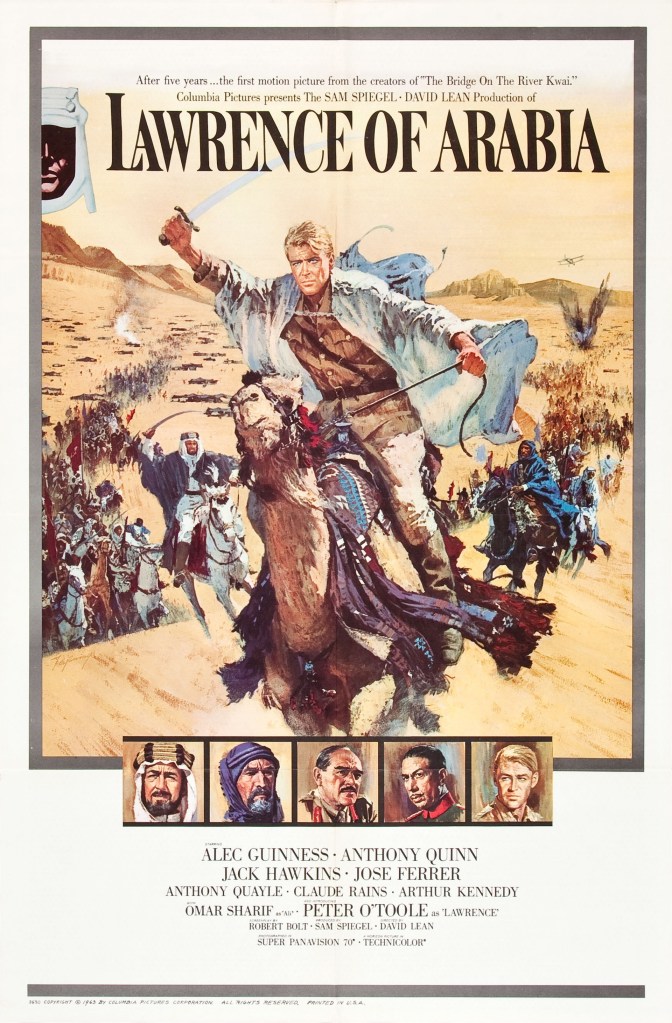
#599) Lawrence of Arabia (1962)

#599) Lawrence of Arabia (1962)

OR “[Citation Needed]: The Motion Picture”

Directed by David Lean

Written by Robert Bolt and Michael Wilson. Based on the book “Seven Pillars of Wisdom” by T.E. Lawrence.

Class of 1991 

The Plot: While stationed in Cairo during World War I, British lieutenant T.E. Lawrence (Peter O’Toole) is sent to the Arabian desert to locate Prince Faisal (Alec Guinness) and assess his revolt against the Turkish Empire for Arab independence. Upon arrival, Lawrence defies Colonel Brighton (Anthony Quayle) and begins helping the Arabs, proposing a surprise attack on the Turks in Aqaba, Jordan. Lawrence enlists the help of two tribes – the Harith led by Sherif Ali iben el Kharish (Omar Sharif) and the Howeitat led by Auda Abu Tayi (Anthony Quinn) – and leads them across the desert, ultimately earning their respect as a natural leader. When the raid on Aqaba is successful, Lawrence is promoted to Major and is encouraged by General Allenby (Jack Hawkins) to continue his guerrilla war, unaware that the British have plans to control Arabia once the war is over. But all this history and political drama takes a backseat to the cinematic grandeur of the Hollywood epic.

Why It Matters: The NFR praises the film for its “remarkable beauty”, “sweeping wide shots”, and for Maurice Jarre’s “memorably rousing” score. The write-up does, however, point out that the film (as well as O’Toole’s performance) portray Lawrence with “marginal historical accuracy”. An essay by film critic Michael Wilmington is a detailed recap of the film and its production.

But Does It Really?: Even if you don’t like this movie, you have to admit you are in the presence of greatness. “Lawrence of Arabia” is David Lean at the height of his power, and the movie succeeds on every creative front (The editing! The cinematography! That score!). Yes, the movie plays fast and loose with some of the facts, but this movie clearly isn’t going for reportage. This is a film about an extraordinary man, played by an extraordinary actor giving one of the best film performances of all time, aided by an accomplished supporting cast. “Lawrence of Arabia” is classic filmmaking at its finest; the kind that can never be duplicated, only revered.

Everybody Gets One: Born in England to an Irish father and a Scottish mother, Peter O’Toole joined the Royal Academy of Dramatic Art in 1952, and quickly found work in theatre and television. In 1959, O’Toole reached the West End playing a rebellious WWII private in the play “The Long and the Short and the Tall”. His performance here got him a few film roles, including the 1960 heist caper “The Day They Robbed the Bank of England”, which got him a screen test for “Lawrence” with David Lean. O’Toole won the role of T.E. Lawrence after Marlon Brando and Albert Finney turned it down. “Lawrence” was O’Toole’s fourth movie and first starring role.

Wow, That’s Dated: BROWNFACE WARNING: While “Lawrence” makes very progressive strides casting actual Middle-Eastern actors in several prominent roles, the film still casts British actor Alec Guinness as the Arabian Prince Faisal. I don’t care if Guinness does kinda look like the real-life Faisal, it’s still whitewashing!

Seriously, Oscars?: A hit upon release, “Lawrence of Arabia” received the most nominations at the 1963 Oscars (10) as well as the most wins (7). Among its wins: Best Picture, Director, Cinematography, Editing, and Score. Peter O’Toole lost Best Actor to Gregory Peck in “To Kill a Mockingbird“, the first of an eventual eight losses O’Toole endured over the next 44 years (though he did win an Honorary Oscar in 2003).

Other notes 

  • Several film adaptations of T.E. Lawrence’s time in Arabia had been attempted since his death in 1935, with such names as Leslie Howard and Laurence Olivier attached at various times. Following their successful collaboration on “The Bridge on the River Kwai“, director David Lean and producer Sam Spiegel considered making a film on the life of Gandhi before ultimately deciding on Lawrence. The rights to Lawrence’s life and work were owned by his younger brother Arnold Lawrence, who reluctantly sold Spiegel the film rights to “Seven Pillars of Wisdom”, Lawrence’s memoir about his years in Arabia. The initial screenplay by blacklisted writer Michael Wilson was deemed too political, and playwright Robert Bolt (“A Man For All Seasons”) was brought in to make the film more a character study of Lawrence rather than a summation of historical events. Only Bolt was credited for the screenplay when the film was first released, but an investigation by the WGA in 1995 led to Wilson receiving an on-screen credit, as well as a belated Oscar nomination for Best Adapted Screenplay.
  • Filming took place in three different countries over a 17 month period (with a two month break while cast and crew recuperated from various illnesses). Initially, the film was to be shot entirely in Jordan (King Hussein assisted the crew immeasurably during production), but more crew illnesses took the film to the more hospitable climates of Morocco and Spain. According to an issue of Variety at the time, “Lawrence” was the first major movie without a fixed budget (!) with the final price tag estimated between 13-15 million dollars (about 120-140 million today).
  • Yes, there are plenty of historical inaccuracies within this film: events are moved around and conflated, characters differ drastically from their real-life counterparts, and everyone disagrees over how the admittedly enigmatic Lawrence should have been portrayed. Such is the delicate balance of presenting world history within a dramatic art form (Side note: Sam Spiegel defended the film as faithful to Lawrence’s “Seven Pillars of Wisdom”, which subsequent Lawrence biographers believe was embellished by the author). Regardless of the film’s historical foibles, I will advise that some prior knowledge of T.E. Lawrence and the Arab Revolt will help your movie experience. At the very least, keep the subtitles on to help keep track of the various people and places.
  • Man that score just lures you in. You can’t think of Jarre’s main theme without immediately thinking of the desert. What surprised me was how much of the movie is scoreless, making its eventual appearances all the more special, magnifying the action to mythic proportions.
  • As I previously gushed, Peter O’Toole is pretty darn great in this. He is more than up to the herculean task of carrying a four-hour movie, and delivers such a subtly brilliant performance you’d think he had been making movies his whole life.
  • “Big things have small beginnings”. Not this movie. It has an overture for crissakes!
  • It’s so odd to see Claude Rains as an old man, I’m used to seeing him in his heyday at Warner Bros. in the ’40s. Rains’ dry asides as the resident bureaucrat are the closest this movie gets to having comic relief.
  • Ah, the match cut. Inspired by the French New Wave movement happening in the early 1960s, editor Anne V. Coates convinced David Lean (an accomplished editor himself) to cut directly from Lawrence blowing out the match to the sunrise in the desert, as opposed to a slow dissolve. In fact, most of this movie is straddling two eras of filmmaking: the film’s more conventional approach to the subject matter mixed with quick cuts and flashy camera pans. This juxtaposition of styles keeps the film watchable 60 years on.
  • I first saw “Lawrence of Arabia” on the big screen for its 50th anniversary in 2012. Watching it again on a decently sized HD TV wasn’t as bad an experience as I thought. You still get the sense of scale in the big tracking shots (tiny figures trekking across an endless desert), but of course, nothing can compare to seeing “Lawrence” on the biggest movie screen.
  • Besides the aforementioned brownface, my main gripe with this movie are all the “day-for-night” shots. Obviously, filming in the desert would have been too dangerous at night, so we’ll make do with a dark blue filter over these “night” shots and ignore everyone casting their shadows over the sand.
  • Omar Sharif gets possibly the best entrance in film history, emerging as a mirage-like dot on the horizon, steadily approaching Lawrence on camelback. Easily one of the best artistic compositions in this or any movie. You can spend days dissecting this scene, and I found this video essay a good starting point.
  • Sure, Omar Sharif is giving a marvelously disciplined performance in this movie, but can we also acknowledge how handsome he was? That’s the face of a bonafide movie star. No wonder there’s that song about him in “The Band’s Visit“.
  • I can never hear Alec Guinness talk about The Brightness without hearing Peter Sellers’ impression of him.
  • Gazim wandering through the desert is timed to correspond with the sunrise. Come on! You have to marvel at the coordination it must have taken to get that shot right, considering you’d have to wait 24 hours for take two.
  • Tonight on “What Nationality Are They Making Anthony Quinn Play This Week?”: Mexico’s native son is playing an Arab sheik (again). And I’m pretty sure this HD transfer gives away that Quinn is wearing a prosthetic nose. Still, better than Guinness in brownface.
  • The scenes with Auda Abu Tayi’s tribe offers something the rest of this movie doesn’t have: women. Like “River Kwai”, David Lean once again offers us an epic sausagefest. One of the best sausagefests ever made, but still…
  • Easily my favorite scene in the movie is when Lawrence agrees to shoot one of Ali’s men to end a blood feud between the opposing tribes, only to discover it is the man he went back to save from dying in the desert. It’s a heartbreaking moment; the first crack in Lawrence’s overconfident, optimistic armor.
  • Remarkably, there were long passages of this movie where I didn’t take notes; partially to make sure I kept track of all the moving parts, but also because I was sucked into it. I was glued to my TV for the entire attack on Aquba. Not bad for a four hour movie.
  • If Act 1 is about Lawrence’s triumphs during the war, Act 2 is his internal war and downfall. Watching Lawrence crumble as he experiences the unavoidable hardships of the world around him is captivating. This is one of those instances where an Oscar tally can misrepresent a film’s value. Peter O’Toole and Gregory Peck are giving equally electrifying performances, but in 1963 it made more sense to reward a five time nominee over a newcomer who had plenty of years to, as O’Toole would later put it, “win the lovely bugger outright”.
  • Character actor/Arthur Miller go-to Arthur Kennedy plays Jackson Bentley, a fictional representation of Lowell Thomas, the journalist whose articles about T.E. Lawrence gained him and his subject worldwide recognition. Thomas was later a film producer, and can be seen at the introduction of another NFR entry – “This Is Cinerama“.
  • Like Joseph Cotten in “The Third Man”, Arthur Kennedy sounds aggressively more American than usual in this British production. Speaking of, while “Lawrence” was produced by a British company (Horizon Pictures), it was distributed by Columbia Pictures, hence its designation as an American film. Call it a “dual-citizenship movie”.
  • My eternal gratitude, as always, to Robert A. Harris, who supervised a 1988 restoration of “Lawrence”, which saw the film returned to its 227 minute roadshow presentation for the first time in 26 years. The subsequent 4K restoration is so good I could only tell which scenes had been reinstated after doing some deep-dive research. Bonus shoutout to the cast members who came back to rerecord their dialogue. Only Alec Guinness gives away that any reconstruction has been done (though in all fairness he was 74 when he re-dubbed his lines).
  • What is it with David Lean and blowing up railroad tracks while a train is passing? Not every director’s trademark has to be so expensive, ya know.
  • José Ferrer was already an Oscar winning actor and prolific stage director in 1962, and was hesitant to accept the small but pivotal role of the masochistic Turkish Bey who strips Lawrence down both literally and figuratively. Ferrer took the part after receiving a generous stipend (and a Porsche), and would eventually consider this performance as the best of his career. Also, is it just me or does he kinda look like Walt Disney in this?
  • After three-plus hours of watching Lawrence slowly lose his confidence, the dam finally bursts with his unhinged cry of “No prisoners!” Lawrence’s vengeful slaughter of Turkish soldiers is another heart-wrenching sequence, and the character’s point of no return.
  • I’ve always appreciated that despite its status as one of the great epics of all time, “Lawrence” ends with a close-up of our hero sitting quietly in a car as it drives him down a dirt road, contemplating everything that has transpired. You expect “The Sounds of Silence” to start playing in the background.

Legacy 

  • “Lawrence of Arabia” was a hit, second only to “The Longest Day” at the U.S. box office. There was, however, a large amount of criticism reserved for this movie’s historical shortcomings, particularly regarding Lawrence himself (Arnold Lawrence publicly denounced the film as “pretentious and false”). Family and descendants of other characters filed lawsuits against Columbia, and most Middle Eastern countries refused to screen the film, although Omar Sharif was able to convince his native Egypt to reconsider.
  • Following the success of “Lawrence”, Peter O’Toole and Omar Sharif became A-list movie stars; Sharif re-teaming with David Lean for his equally epic follow-up “Doctor Zhivago”.
  • Practically every major filmmaker was influenced by “Lawrence of Arabia”, from Stanley Kubrick to Martin Scorsese to Steven Spielberg, the latter two even helping to get the 1988 restoration off the ground.
  • As for lingering pop culture references, any movie that features characters traipsing through the desert has to evoke “Lawrence” by either its cinematography or score. From “Mad Max” to “Dune” to “Spaceballs” (“Nice dissolve.”)
  • The closest this film has ever gotten to a sequel is the 1990 TV movie “A Dangerous Man: Lawrence After Arabia”, with a young Ralph Fiennes as Lawrence. Apparently it was this movie that got Fiennes cast in “Schindler’s List“, so at least some good came out of it.
  • And finally, I didn’t know where else to put this, but no “Lawrence of Arabia” overview would be complete without Noël Coward’s alleged quip to Peter O’Toole after the film’s premiere: “If you had been any prettier, it would have been called ‘Florence of Arabia’.” Zing!