
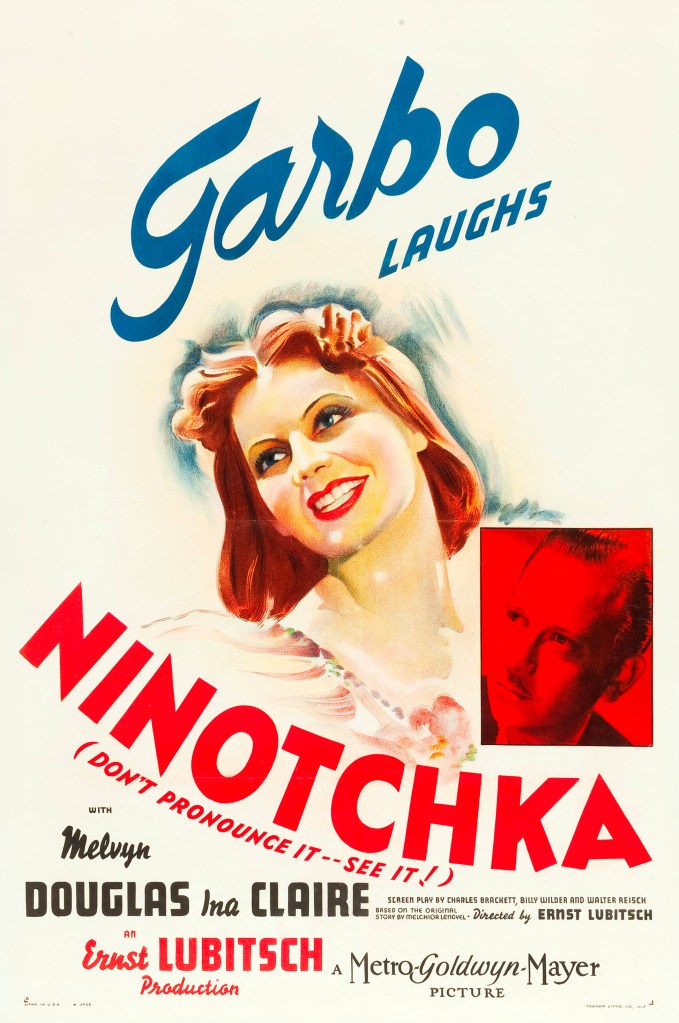
#646) Ninotchka (1939)
OR “Commie Dearest”
Directed by Ernst Lubitsch
Written by Charles Brackett & Billy Wilder and Walter Reisch. Based on an original story by Melchior Lengyel.
Class of 1990
The Plot: Sure I could give a detailed plot description of “Ninotchka”, but I will never be able to top Melchior Lengyel’s initial pitch for the film: “Russian girl [Greta Garbo] saturated with Bolshevist ideals goes to fearful, capitalistic, monopolistic Paris. She meets romance and has uproarious good time. Capitalism not so bad, after all.”
Why It Matters: The NFR calls the film a “sparkling romantic comedy”, praising the work of Garbo, Lubitsch, Wilder, and Brackett.
But Does It Really?: Oh yes. I had a good time watching “Ninotchka”. So many great films of the studio system are the magical combination of a solid script and the right star power, and “Ninotchka” has both in spades. “Ninotchka” holds up better than most romantic comedies because its core concept isn’t a battle of the sexes, it’s a battle of the ideals. Both Greta Garbo and Melvyn Douglas play their sides of the Communism vs. Capitalism debate quite well, Garbo in particular is giving her most human performance here. On top of the solid love story is the assured direction of Ernst Lubitsch and the expected brilliance of a Billy Wilder/Charles Brackett screenplay. “Ninotchka” is one of the jewels in the 1939 Classic Hollywood Crown, and while the film may not be as well remembered today, its NFR induction is certainly warranted.
Shout Outs: Garbo comes very close to quoting her famous “I vant to be alone” line from “Grand Hotel“, giving us such near-misses as “We want to be alone”. Such a tease.
Wow, That’s Dated: You should probably brush-up on your 1930s Communism in order to fully appreciate the film’s political commentary. For instance: I didn’t realize the Soviets had a five-year plan. Is this what they’re asking about in job interviews?
Seriously, Oscars?: A hit upon release, “Ninotchka” received four Oscar nominations: Best Picture, Actress, Story, and Screenplay. In another year “Ninotchka” would have had a legitimate shot at winning one or two of these categories, but unfortunately it was 1939, aka The Greatest Year for Movies, and the film lost three of these categories to “Gone with the Wind” and the fourth to “Mr. Smith Goes to Washington“.
Other notes
- Melchior Lengyel conceived “Ninotchka” during a conference to come up with star vehicles for Greta Garbo, whose film career took a hit when she was labeled “Box Office Poison” by the Independent Theater Owners Association in 1938 . Originally, Ernst Lubitsch was only meant to produce this film, with George Cukor set to direct. Once Cukor left the project in favor of “Gone with the Wind”, Lubitsch agreed to direct, as long as MGM allowed his next project to be “The Shop Around the Corner“. Lubitsch ordered a re-write, and apparently made enough contributions to the script that Wilder & Brackett unsuccessfully lobbied the Writers Guild to give Lubitsch a credit.
- That Wilder/Brackett dialogue comes at you fast and furious in the opening scenes. Lubitsch handles the screenwriters’ trademark repartee with the delicate touch synonymous with his movies. The pacing is quick enough to keep the momentum going, with time to let the dialogue sink in without feeling tossed off a la “Ball of Fire“.
- This is my first experience with young Melvyn Douglas, being more accustomed to his later career as an Oscar winning elder statesman. Here Douglas is quite charming as Count Leon, the kind of romantic cad you would expect to see Don Ameche play (apparently Cary Grant and William Powell were in consideration).
- Wasn’t Garbo in this? Seriously, it is a very long twenty minutes before she shows up. In the meantime there’s a lot of plot setup, plus some comic interludes with the three Russian Board of Trade agents (Sig Ruman, Felix Bressart, and Alexander Granach). There’s also a running gag about the agents ordering French maid/cigarette girls to come up to their hotel room. This is of course back when French maids still dressed like…well, French maids.
- The best exchange in the movie: Ninotchka, upon learning that a porter’s job is to take her bag, “That’s no business, that’s a social injustice.” The Porter: “That depends on the tip.”
- We have previously covered Garbo’s other two NFR films on this blog, and yet have never really talked about the woman herself. Garbo’s work in “Flesh and the Devil” and “Grand Hotel” plays to her established screen persona, the stoic woman caught in a forbidden and/or doomed romance, and I had nothing substantial to say about either other than “Yep, that’s a Garbo performance.” With “Ninotchka” Garbo still plays to type, but also gets the chance to be funny while doing it. Having Garbo play the first half of the movie with a total stone-face is the right choice; milking every laugh out of how thoroughly unamused Ninotchka is by her surroundings. It makes her eventual warming up all the more satisfying. This is the first Garbo performance I actually enjoyed watching; her statuesque exterior giving way to her proverbial feet of clay.
- The scene in the cafe when Leon finally gets Ninotchka to laugh is worth the wait. Side note: The film’s tagline “Garbo Laughs!” is a play on “Garbo Talks!”, the tagline for Garbo’s first sound picture “Anna Christie”.
- I like that Ninotchka is a little awkward upon being with Leon when she buys the hat. Again, it goes with letting Garbo actually play a nuanced character rather than her persona. It’s more entertaining to watch, and helps the film age better.
- Garbo drinks! Apparently Garbo had misgivings about playing a scene where Ninotchka gets drunk on champagne, which she consider vulgar. Lubitsch himself expressed his frustration in the press, calling Garbo “the most inhibited person I have ever worked with.”
- Wow, even Vladimir Lenin gets a laugh in this. There’s your Lubitsch Touch!
- Shoutout to Ina Claire, a stage actress making one of her rare film appearances as the Grand Duchess Swana, the woman Count Leon has a casual dalliance with. Unlike other rom-com third wheels, Grand Duchess Swana is more like 2E from “Breakfast at Tiffany’s“: yes she’s the other woman, but she’s holding all the cards. Claire doesn’t have much to do until the Grand Duchess’ confrontation with Ninotchka at the end, but she nails the scene, making us understand that this woman does not live or die by the love of one man. Interestingly enough, Ina Claire was briefly married to John Gilbert after his famous love affair with Garbo, so I can imagine there was a little extra friction behind the scenes that day.
- Wow, the last chunk of the movie when Ninotchka returns to Russia really drags. I don’t care about how bleak communist Russia is or what happened to the three agents, I just want to know how Ninotchka and Leon get back together.
- During the lulls of the final half hour, I thought, “Didn’t I see Bela Lugosi’s name in the opening credits? Did I miss him?” Turns out Lugosi only has one scene, right before the finale as Commissar Razinin, his only non-vampire NFR appearance. “Ninotchka” was one of Lugosi’s last forays into an A picture before being permanently typecast by his work with Universal monsters. Despite his brief screentime here, Lugosi receives 4th billing for his performance. Either someone at MGM really liked Lugosi or he had a great agent.
- And then we get a weird tag after Ninotchka and Leon’s “happily ever after”: a throwaway gag about the agents and their restaurant business. Once again, I don’t care about these subplots, just end the movie!
Legacy
- “Ninotchka” was the hit Garbo needed to combat her “Box Office Poison” label. MGM immediately re-teamed her with Melvyn Douglas for another rom-com, 1941’s “Two-Faced Woman”. The film was not well-received by critics, and while it did okay at the box office, didn’t make its money back and became one of many reasons Garbo left MGM. Garbo had every intention of returning to film after World War II, but every opportunity that arose either fell through or was rejected by Garbo, until eventually she opted for retirement. “Ninotchka” proved to be the penultimate film of Garbo’s career, and her last hit.
- Unsurprisingly, “Ninotchka” did not go over well with Soviet Russia, and an attempt to release the film in Vienna after the war was met with controversy. Vienna finally played “Ninotchka” in 1951 after the city reclaimed its full sovereignty from Russia.
- A musical adaptation by Cole Porter called “Silk Stockings” played Broadway in 1955 staring German actress Hildegard Knef and Don Ameche (I told you he’d be good in that part). The inevitable film adaptation came in 1957, starring Cyd Charisse and Fred Astaire, and was one of the last MGM musicals under the fabled “Freed Unit”.
- Other movies that share a bit of “Ninotchka” DNA include 1940’s “Comrade X” and 1956’s “The Iron Petticoat”.
- But the person who got the biggest career boost from “Ninotchka” was one of its screenwriters. “Ninotchka” was the first major hit for Billy Wilder, who would be directing his first Hollywood movie within three years of this film’s release, paving the way for his nearly 30 year run as one of Hollywood’s most celebrated writer/directors.
 The Horse's Head
3 thoughts on “#646) Ninotchka (1939)”