
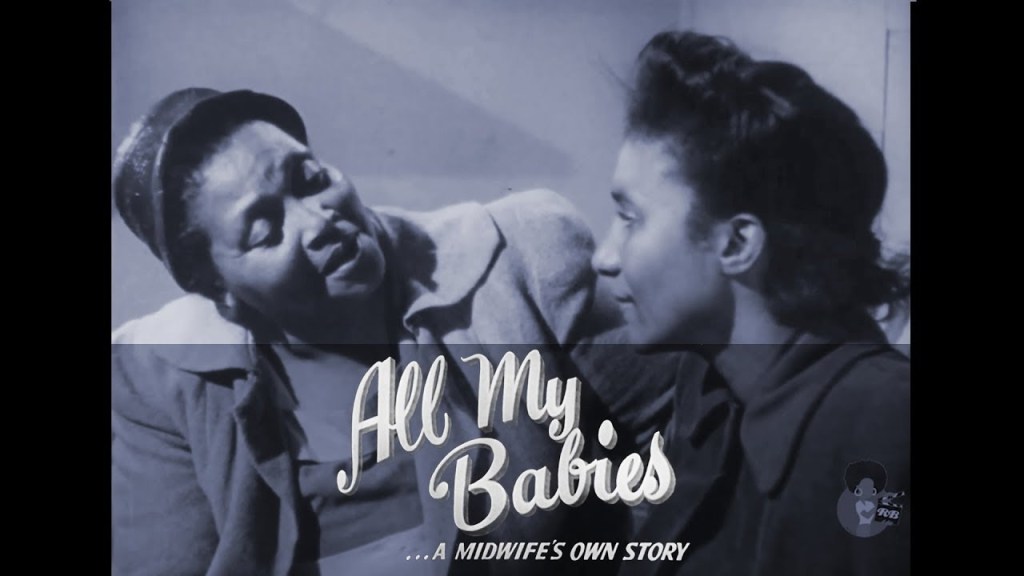
#649) All My Babies: A Midwife’s Own Story (1953)
Directed & Written by George C. Stoney
Class of 2002
“All My Babies” is available for viewing on the Library of Congress’ YouTube page. I can’t embed it here because it has an age-restriction (you’ll learn why in a minute) but you can watch it here.
The Plot: Produced by the Georgia Department of Public Health, “All My Babies” follows Mary Francis Hill Coley, a real life midwife in Albany, Georgia who helps deliver babies throughout Dougherty County. After a lecture from a doctor about the importance of proper hygiene, we witness Mary helping deliver babies for two families: one that practices healthy prenatal care, and one that doesn’t. Don’t worry, no one dies during this, but you will see an on-camera birth, so be prepared for that.
Why It Matters: The NFR calls the film a “landmark” that “inadvertently captured a telling snapshot at the socioeconomic conditions of the era”. Film historian Joshua Glick is on hand with a detailed essay on George Stoney and the film’s production.
But Does It Really?: “All My Babies” is the kind of unique film the NFR was made for, highlighting creative talent and exceptional communities far removed from Hollywood studios. Any NFR film gets points for me if I can instantly tell how and why it made the list and if nothing else, this is the NFR movie with a live childbirth. Definitely an unforgettable moment, though admittedly it overpowers and distracts from the rest of the movie (at least for me). Still, you can’t deny the importance of people like George Stoney and Mary Coley, and “All My Babies” is more than worthy of its NFR standing. Just don’t eat before watching it.
Everybody Gets One: George Stoney started off as a writer and field research assistant before pivoting to filmmaking after World War II. Using his pre-war experience, Stoney focused on educational films. His 1946 offering “Palmour Street” concerned mental health within the Black community and earned him a commission from the Georgia Department of Public Health to make a film about midwives. Stoney was given 118 talking points (!) to make in his midwife film, but was given the creative freedom to present these points however he wanted. Mary Coley was a veteran midwife in Albany, Georgia who was selected out of 20 potential candidates to appear in “All My Babies”. Aware of the “mammy” stereotype that could be associated with her appearance in the film, Coley worked with Stoney to present her community with respect and dignity. In addition, Coley helped craft the film’s overall structure.
Title Track: Mary says the title twice, including the final line: “I’m proud of all my babies.” Side note: On multiple occasions I have accidentally referred to this movie as “All My Sons” and “All My Children“. It’s just one of those titles, I guess.
Wow, That’s Dated: I’m definitely out of my element when it comes to medical practices, but I assume that modern midwifery is very different from how it’s depicted in this film.
Seriously, Oscars?: No Oscar for “All My Babies”. For the record: 1953’s Best Documentary Feature was fellow NFR entry “The Living Desert“.
Other notes
- I am very unqualified to discuss the aforementioned “socioeconomic conditions” of this movie, but it is worth mentioning that this film about a Black community was made by a White filmmaker. Stoney was able to gain the trust of the Black community depicted in this film with the help of Bishop Noah, a local pastor of Mary Coley’s church. The flip side of that is Stoney having to cow-tow to his (White) producers, depicting a South where both White and Black medical workers interact in harmony, definitely not the case in 1950s Georgia. Stoney also had to make a film that promoted midwives while simultaneously presenting them as “a temporary and unfortunate necessity” in rural Georgia.
- Shoutout to this film’s Chief Electrician Robert Downey, who to the best of my knowledge is of no relation to either Sr. or Jr.
- This movie is that “Forgotten Frontier” style of docudrama in which real people are recreating events from their own lives, which must have been weird. We also get a dangerous combination of thick southern accents and stilted non-acting from these performers. Patience is required for the more expositional scenes.
- The Musical Art Chorus of Washington D.C. lend their vocal talents to the film, underscoring several key moments as joyous and celebratory. That being said, at one point the choir sounds like they’re gonna start singing “Spider-Pig“.
- And now this movie’s most notable moment: a real-time live birth. Just when I think I’ve seen everything on this blog, I witness the beautiful, disgusting miracle of life. This is one of the rare times where going into a film cold was a disservice. Still, this was easier to watch than “Pink Flamingos“. And once the baby arrived, I immediately went into “look at that cute baby” mode. If that baby is still alive, he would be in his early ’70s and probably grossed out that he can watch his own birth.
- Also dated: Dads-to-be waiting in another room while the baby is being born. You get your ass in there and help out! This is your doing too, you bastard!
- A brief sequence of a mother breastfeeding her newborn child reminds me: Breastfeeding is neither gross nor sensual. If you’re on either extreme, mind your own business.
- At one point, the doctor’s admonishment “Something wasn’t clean” echoes in Mary’s head. Maybe I just needed to lighten the mood after this movie’s darker scenes, but all I could think of in that moment was “Pinch hitting for Pedro Borbón, Manny Mota-Mota-Mota.”
- Interesting that the second birth isn’t shown on camera. I guess the kid didn’t sign a release form.
- “My, what a husky little peanut we have here.” That may be the worst thing you can say about a newborn child. I hope that’s not the baby’s first memory.
Legacy
- “All My Babies” was well received within the medical community, and even managed to be screened at New York’s Cinema 16 as an “avant-garde” piece (This designation allowed a film with childbirth to be publicly screened).
- George Stoney continued making educational films for the next 50 years! Stoney also taught film at Columbia and NYU, and was an early advocate for democratic media, earning the moniker “the father of public-access television”.
- Mary Coley delivered over 3,000 babies during her three-decade midwife career, and continues to be celebrated for her accomplishments; being added to the Georgia Women of Achievement list in 2011.
 The Horse's Head
3 thoughts on “#649) All My Babies: A Midwife’s Own Story (1953)”