
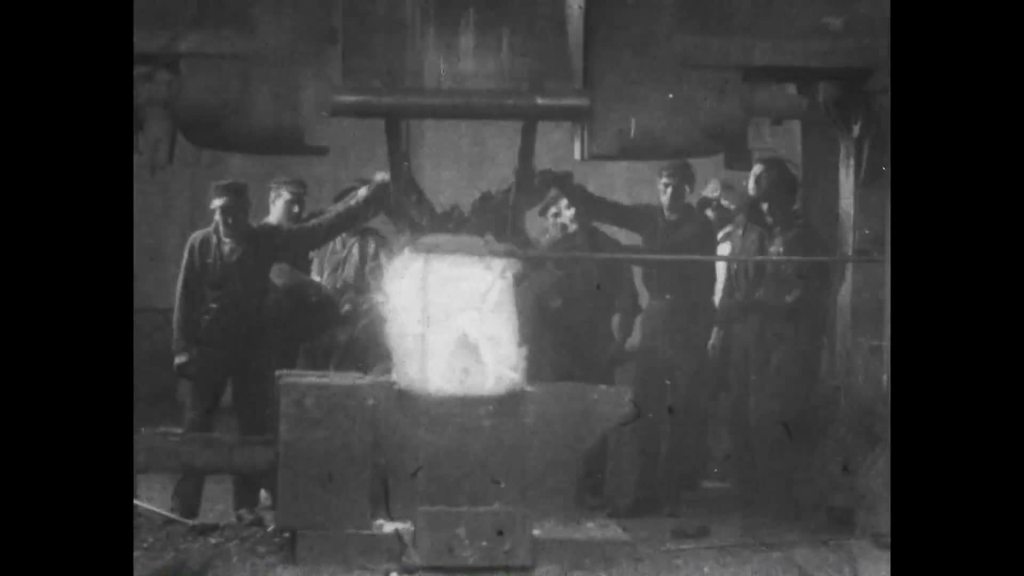
#652) Westinghouse Works, 1904 (1904)
OR “Steel This Movie”
Directed by G. W. Bitzer
Class of 1998
The Plot: When at the 1904 Louisiana Purchase Exposition (aka the St. Louis World’s Fair), be sure to visit the Westinghouse exhibit, featuring over an hour of footage from inside their main factory in Pittsburg, Pennsylvania. Filmed by legendary cinematographer G. W. Bitzer of the American Mutoscope and Biograph Company, “Westinghouse Works, 1904” showcases employees on the factory floor making turbines, generators, and an assortment of other products. Of the 29 Westinghouse films produced, 21 are known to survive.
Why It Matters: The NFR gives a rundown of the films, with the only superlative being a description of the shorts as “highly illustrative”.
But Does It Really?: I guess. “Westinghouse Works, 1904” is an interesting enough watch, with its blatant disregard for these workers’ safety serving as an unintentional suspense builder. Even then, this is a slog of a viewing given that I’m watching a film that was one component of a live presentation (more on that later). A historical pass for “Westinghouse Works”: another figure in the carpet of early filmmaking.
Everybody Gets One: Westinghouse Electric and Manufacturing Company (as it was known then) was founded in 1886 by engineer George Westinghouse, and specialized in making generators, turbines, and motors. The company focused on developing infrastructure for this new thing called electricity, and was the foremost rival of Thomas Edison (even employing Nikola Tesla for a time). Fun fact: George Westinghouse invented the railroad air brake, which can be seen being made in several of the films.
Wow, That’s Dated: Any sort of safe work environment. We won’t get the Bureau of Labor Standards for another 18 years, and then another 49 before that becomes the Occupational Safety and Health Administration (OSHA).
Other notes
- When presented at the 1904 World’s Fair, “Westinghouse Works” was accompanied by live narration and music, which makes this one of the rare times that a 1904 audience had a better viewing experience than I did. As these films are available online only in total silence, I had to supply my own soundtrack for the first time in a while. My viewing of “Westinghouse” was accompanied by a random Spotify playlist of Elton John, The Beatles, Bowie, etc. plus the occasional yapping from my neighbor’s dog.
- Most of my notes are about how big the machinery is and how easily everyone there could get injured. I was waiting for someone to be standing in the wrong spot and get an arm ripped off.
- I really should have looked up what kind of things Westinghouse makes before viewing, because I have no idea what any of this machinery is. It all looks like equipment from Dr. Frankenstein’s lab.
- I believe that Turbine machine makes Everlasting Gobstoppers.
- Do you think everyone on camera worked harder because they knew they were being filmed?
- Wow, the air brake makers have the slowest assembly line ever. I guess George Westinghouse really wanted plenty of TLC when making his babies. Lucy and Ethel would have been just fine if they had worked at Westinghouse.
- Of the 21 films, “Steam Hammer’ currently has the highest view count on YouTube, and it’s easy to see why: We watch the titular hammer forge – as it is officially described – “a large, glowing block”. Seriously, is that plutonium?
- Are these the first crane shots in film history? I guess someone had to invent them.
- Everyone in this movie looks like they’re in the opening credits of “Cheers”.
- A handful of the “Westinghouse” films feature the roles that women (or “Girls” as they’re called here) could work: mainly winding and taping coils. Based on how these women are dressed, this is either 1904 Westinghouse or present-day See’s Candies.
- The extended shot of the female employees punching out just feels like Mutoscope’s American remake of “Workers Leaving the Lumière Factory“. Also, several of the woman are smiling and laughing as they leave. Stop that! Everybody knows that nobody smiled or had fun of any kind in the 1900s.
- When you show an extended shot of a steam whistle going off at a factory there’s only one thing to say: Yabba-Dabba-Doo!
- Well they definitely saved the best for last. The camera goes outside and takes a train ride around the Westinghouse factory. After an hour of watching static shots of men working, it was great to see actual traveling shots.
- This is all well and good, but what did the Smith Family of St. Louis think of all this?
Legacy
- George Westinghouse resigned from his company following the Bankers’ Panic of 1907. In the ensuing decades, Westinghouse continued its reign as a leading electronic company, becoming a conglomerate in the 1990s when it bought CBS. Shortly thereafter, Westinghouse pivoted to media and sold off its industrial assets. Presently, Westinghouse is part of Paramount Global, and while Westinghouse no longer makes any of the products they built the original company on, the Westinghouse name is still loaned out to various electronic and motor companies.
- Westinghouse would continue its self-promotion at the World’s Fair with the greatest film on the NFR: 1939’s “The Middleton Family at the New York’s World’s Fair“.
 The Horse's Head
2 thoughts on “#652) Westinghouse Works, 1904 (1904)”