

#653) All That Heaven Allows (1955)
OR “Between a Rock and a Hard Place”
Directed by Douglas Sirk
Written by Peg Fenwick. Based on the novel by Edna and Harry Lee.
Class of 1995
The Plot: Cary Scott is deeply unfulfilled with her life in Stoningham, New England; widowed and spending her time with her college-age children (Gloria Talbott and William Reynolds) and shallow acquaintances at the local country club. One day Cary strikes up a friendship with her arborist Ron Kirby (Rock Hudson), and is immediately drawn to his intelligence and free-living philosophy. The two begin a romantic relationship, but when they become engaged Cary’s friends question their age-gap and view Ron as a gigolo mooching off of Cary’s wealth. Will the stuffy societal norms of the 1950s keep Cary and Ron apart? And what’s with the lighting?
Why It Matters: While the NFR admits that at first glance the film is a “standard weepie”, its “rich visual texture” and “soaring emotional score” turn the subject into “a deeply disturbing, deeply compassionate portrait”. An essay by author John Wills takes a deeper dive into the film’s metaphorical imagery.
But Does It Really?: This was…interesting. I can definitely say I was more intrigued than entertained by “All That Heaven Allows”. Yes, it’s a highly-stylized melodrama, but it has that Douglas Sirk touch to it that keeps it watchable. No other movies look or sound like a Douglas Sirk production, and “All That Heaven Allows” is no exception; from its borderline avant-garde lighting to its incredibly progressive stance on what a woman’s life can or can’t be. Plus, it’s 89 minutes; points as always if you keep your story moving. “All That Heaven Allows” is on the list to represent Sirk’s run of artistic soap operas at 1950s Universal, and there’s nothing wrong with that.
Everybody Gets One: Shoutout to Conrad Nagel, seen here as Cary’s would-be suitor Harvey. Nagel was a silent film veteran, and a founding member of both the Academy of Motion Pictures of Arts and Sciences and the Screen Actors Guild.
Wow, That’s Dated: All the usual ’50s suburbia stuff, but at least here Sirk is commenting on its banality, so that helps.
Title Track: “All That Heaven Allows” is the last line of the poem “Love and Life” by John Wilmot. In the poem, all that Heaven allows is the present moment, but Sirk chose the title because it felt ironic within the film’s context: “As far as I’m concerned, Heaven is stingy.”
Seriously, Oscars?: No Oscar love for “All That Heaven Allows”. In fact, no Oscar love for any of Universal’s 1955 releases. Keep in mind that Universal was cranking out mostly B pictures back then. Heck, in 1955 their biggest star was still Francis the Talking Mule.
Other notes
- “All That Heaven Allows” got greenlit based on the success of another Sirk film: 1954’s “Magnificent Obsession”. Like “All That Heaven Allows”, “Magnificent Obsession” was based on a novel, starred Wyman as a widow who falls in love with Hudson amidst controversy, featured a supporting turn by Agnes Moorehead, and included a finale involving one of the leads’ near-death experience. “Obsession” was one of the highest grossing films of 1954, and Sirk was given a bigger budget and more creative freedom on “All That Heaven Allows”.
- If Cary’s neighborhood looks familiar, it’s Colonial Street, the fake street on the Universal backlot. The houses and facades have been used for countless TV shows and movies, most notably “Leave It to Beaver”, “The Munsters”, and “Desperate Housewives”.
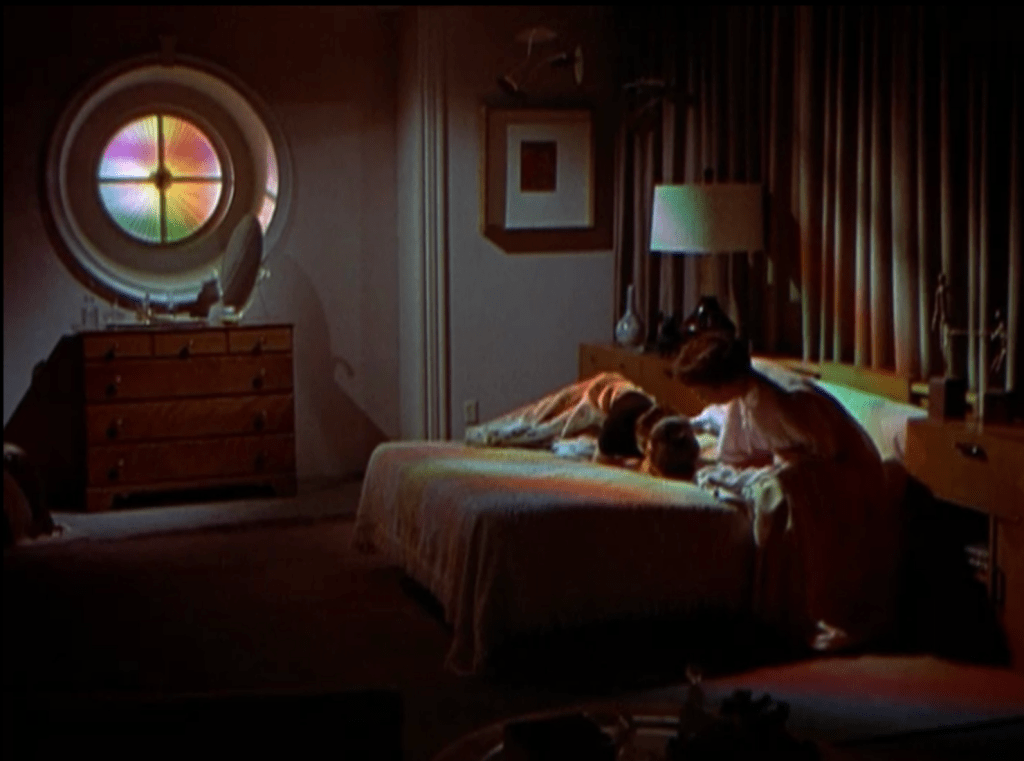
- You know something is up with this movie once you see the stylized lighting in Cary’s house. You don’t see this kind of lighting outside of film noir or a Gene Kelly third act ballet. It’s distracting, but also much more visually engaging than other domestic dramas of the time; very much the mis-en-scene that film critics love pointing out about this movie.
- I know it’s the point, but everyone at this country club is the worst. Mona’s a back-stabbing gossip, and Howard straight-up assaults Cary. It really says something when the nicest person in your community is Endora.
- Most of my viewing was me marveling at how progressive this film is. Everything about “All That Heaven Allows” would fit right in with the more laidback character studies of the 1970s with its challenging of social norms and nuanced female lead. And yet here it is in the middle of a Hollywood “product”. A rare sight indeed.
- I’ve realized I haven’t seen a lot of Jane Wyman’s filmography (and I’ve genuinely forgotten she was in “Lost Weekend“). I don’t have a lot to say about Wyman’s performance here, other than she’s good enough that I cared about Cary’s well-being throughout.
- Rock Hudson: the ’50s answer to Fabio. Hudson doesn’t have much to do in this film, but he’s the perfect combination of standard ’50s he-man and sensitive lover the part calls for. I was waiting for the neighbors to start gossiping about his apocryphal marriage to Jim Nabors.
- Continuing my inability to tell how old everyone is in classic movies: Wyman was 38 during filming, Hudson 30. Not so much a May-September romance as a May-April romance. There must not be a lot going on in this town if this is your big controversy.
- Today in Coda-era profanity censorship: “Here’s to those who wish us well, all the rest can go to Hackensack”.
- Interestingly enough, when Ron mentions his service in the war, I assumed he meant World War II. Turns out it was Korea.
- Cary’s kids really got on my nerves. Why are they so upset about having to move if Cary and Ron get married? They’re both in their mid-20s. Find a roommate, you freeloaders!
- Any movie scores points with me when there are character actor sightings. Among the party guests are Hayden Rorke (aka Dr. Bellows) and Eleanor Audley (aka Maleficent and the Evil Stepmother). Also at the party is – Howard again!? Oh no!
- Sirk’s lighting design goes a little too far in Kay’s room when Cary consoles her. Do they live next door to a kaleidoscope?
- Hey it’s a Die Hard Not-Christmas movie! I haven’t had one of those in a while.
- There’s a recurring thread in this movie about Cary buying a television. You never hear TV talked about so openly in the movies, especially in the 1950s when it was still the enemy as far as big movie studios were concerned. Universal had just started producing TV shows, so it seems they knew the writing was on the wall. And sure, getting a TV is all well and good, but wait until Cary sees who’s hosting “General Electric Theater“. She may end up shooting her screen Elvis-style.
- [Spoilers] What in the hell is that ending? Just when you think things are wrapping up, there’s a last-minute curveball as Ron falls of a cliff and becomes unconscious. Sirk toyed with the idea of Ron dying at the end, but producer Ross Hunter convinced him that the film needed a happy ending. This movie is already dramatic enough, we don’t need a brush with death too. Haven’t these two gone through enough already?
Legacy
- “All That Heaven Allows” opened on Christmas Day 1955. Both critics and audiences were dismissive of the film, finding it inferior to “Magnificent Obsession”. The film found a second life in the early 1970s, thanks to Jon Halliday’s book “Sirk on Sirk” and praise from German filmmaker Rainer Werner Fassbinder. Douglas Sirk’s entire filmography was reappraised in the ’70s, with “All That Heaven Allows” coming out from its predecessor’s shadow and receiving acclaim for its own merits.
- Douglas Sirk made a handful of films with Universal after “All That Heaven Allows”, including “Written on the Wind” (also starring Rock Hudson) and his final film: a remake of “Imitation of Life“.
- Heir apparent to the Douglas Sirk filmography is Todd Haynes, whose films “Far from Heaven” and “Carol” both play on the “repressed ’50s housewife” themes of “All That Heaven Allows”. Also he’s got a new movie called “May December” which may also tread the same water. What say you, readers of the future?
- Coincidentally, while I was writing this I learned about an HBO documentary about Rock Hudson subtitled “All That Heaven Allowed” that just premiered. What are the odds?
- And finally, Ross Hunter would go on to produce such bloated all-star movies as “Airport” and the musical remake of “Lost Horizon”, still considered one of the worst movies ever made. What a delightfully odd filmography.
 The Horse's Head
2 thoughts on “#653) All That Heaven Allows (1955)”