
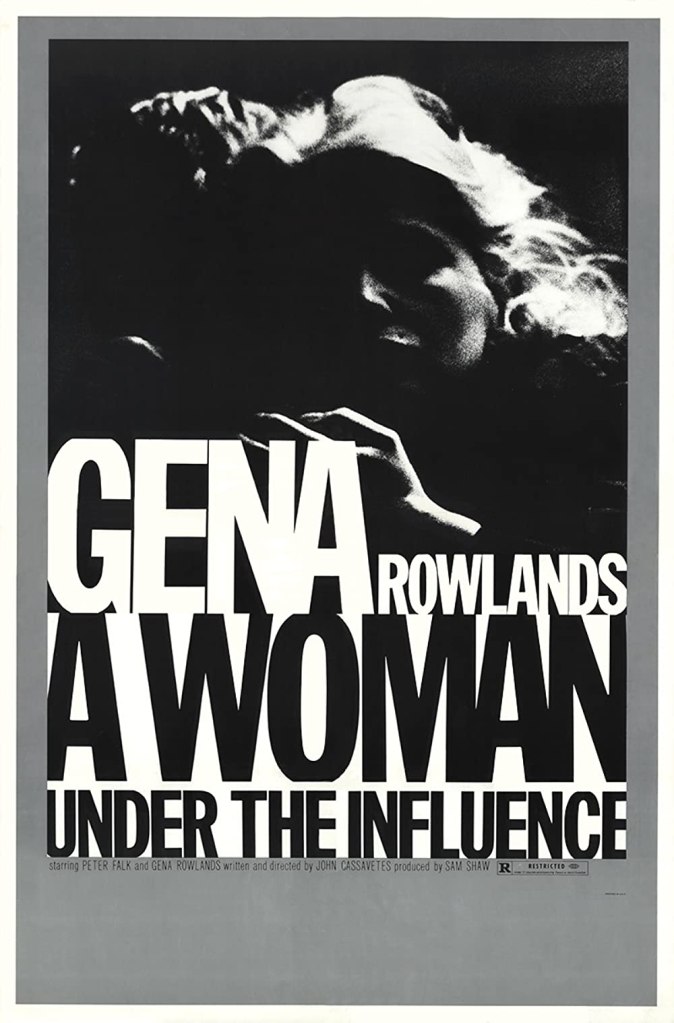
#654) A Woman Under the Influence (1974)
OR “Rowlands in the Deep”
Directed & Written by John Cassavetes
Class of 1990
The Plot: “A Woman Under the Influence” is several days in the life of Mabel and Nick Longhetti (Gena Rowlands and Peter Falk). Mabel is a housewife with an undiagnosed mental condition, and Nick is a construction worker who loves his wife, but lacks the overall empathy and support she needs to help her deal with her condition. After a particularly troublesome incident during a party Mabel throws for their children, Nick makes the difficult decision to have her institutionalized. That’s about it as far as story goes, with John Cassavetes focusing more on the complexities and unexplored dynamics between these two characters.
Why It Matters: The NFR write-up is lacking in superlatives specific to the movie, giving us instead a rundown of Cassavetes’ influence on independent films. Also they refer to Gena Rowlands’ character as a New York housewife even though the film is clearly set in Los Angeles. Whoops. An essay by Cassavetes expert Ray Carney posits that the character of Mabel is a semi-autobiographical depiction of Cassavetes rather than Rowlands.
But Does It Really?: “A Woman Under the Influence” is perhaps the definitive American independent film: a movie created, produced, and released purely through determination and love of the game. John Cassavetes is a maverick of American film, and I’m glad the NFR inducted him so early into their run. This all being said, did I like the actual film? Well, yes and no. Yes because of the incredible work of Cassavetes, Falk, and especially Rowlands, no because of my own issues with the film’s subject matter and overall length. We’ll get into all of this in more detail as we go, suffice it to say that even though I won’t be ranking “A Woman Under the Influence” on my personal list of favorites, it’s a no-brainer for inclusion among this roster of important American films.
Shout Outs: Not in the film directly, but “Woman Under the Influence” was produced by Cassavetes’ company Faces International, which gets its name from Cassavetes’ “Faces“, a fellow NFR inductee.
Title Track: Now that I think about it, the movie never explains what exactly Mabel is “under the influence” of. We never see her take drugs, and she only drinks in one scene. Like everything else about this movie, there are no easy answers.
Seriously, Oscars?: Despite its small release, “A Woman Under the Influence” managed to be seen by enough people to garner a string of critics awards, and eventually two Oscar nominations. John Cassavetes lost the only Best Director nomination of his career to Francis Ford Coppola for “Godfather Part II“, and Gena Rowlands lost her first Best Actress nod to Ellen Burstyn in “Alice Doesn’t Live Here Anymore”.
Other notes
- “A Woman Under the Influence” began as a play written by Cassavetes for his wife Gena Rowlands. Upon reading the play Rowlands quickly realized that the character would be too intense to perform on stage multiple times a week, and the material was adapted into a screenplay. Cassavetes self-financed the project (no studio was interested in a movie about “a crazy, middle-aged dame”), mortgaging his house and hiring a crew of students from the nearby American Film Institute. Peter Falk believed in the script so much he invested $500,000 of his own money into the project (which makes you wonder just how much they were paying him over at “Columbo”). The bulk of the film was shot in 1972, but delays in post-production shelved the film for two years.
- Another trademark Cassavetes cost-cutting measure, several of the actors are family members. Cassavetes and Rowlands’ children Nick and Xan make appearances, and both of their mothers play the lead characters’ moms (with Lady Rowlands acting alongside her real-life daughter). The Longhetti’s eldest son Tony (great name, by the way) is played by Matthew Cassel, son of longtime Cassavetes collaborator Seymour Cassel.
- As on the fence as I am about this movie, I gotta admit how great everyone is. Gena Rowlands as always is instantly compelling, and I stuck it out with her Mabel even during the more intense moments. Peter Falk manages to be the “Peter Falk type” we associate him with, but in this case it fits the character of Nick like a glove, and Falk somehow disappears into the character while maintaining his singular persona. Side note about Falk: If he looks directly into the camera, but only with his artificial eye, does that count as a fourth wall break?
- Maybe it’s just where we were in terms of mental health issues in the 1970s, but it’s never specified what exactly is going on with Mabel. All we get is characters referring to her as “crazy”, with Nick at one point correcting them by saying she’s “not crazy, she’s unusual.” The internet has more or less diagnosed Mabel as being bipolar, but I’m siding with the movie and leaving her undiagnosed.
- Hats off to Cassavetes, because I have no idea how you can direct a movie like this. Every scene is so natural and organic, I can’t imagine his direction being anything other than “Just be real.” This goes hand in hand with the cinematography by Mitch Breit and Al Ruban, who give the film its cinéma vérité style without drawing attention to itself. The cameras always feel like the proverbial fly-on-the-wall, capturing the action without ever knowing where it will go next. It’s all so natural I suspect that a 1974 audience was either in awe of the aesthetic or bored out of their minds.
- Admittedly, my issues with the movie are based in my own personal biases. “Woman Under the Influence” is about what happens when your family lacks the emotional tools to support you in times of crisis. Most of Mabel’s family wants to help, but don’t know how to go about it; Nick in particular unable to articulate his frustration while still loving his wife. I found this all very distressing, but also recognize that this is very intentional on Cassavetes’ part. So, well done I guess.
- My other issue with the movie is its length. I agree with critics of the time who said in essence, “It’s good, but does it have to be 2 1/2 hours?” Of course there are plenty of classic movies that are longer, but 148 minutes is a long time to watch a slice of life movie where “nothing happens”. In its favor, by the end of the film you feel just as emotionally drained as the characters do, something you can still achieve in under two hours but perhaps not with the same impact.
- This was another movie where I didn’t take a lot of notes. I was simultaneously engaged with and turned off by this movie, ultimately concerned for Mabel and her future. Like “The Deer Hunter“, I’m glad I saw “A Woman Under the Influence”, but it’s going to be a while before I feel up to a rewatch.
Legacy
- “A Woman Under the Influence” premiered at the New York Film Festival, and despite its positive reception, John Cassavetes was unable to secure a distributor. Cassavetes self-distributed through his company Faces International, booking the film in art house and college campuses. In the ensuing years, “A Woman Under the Influence” has been reappraised and declared Cassavetes’ definitive film.
- John Cassavetes directed five more films in his lifetime, including “The Killing of a Chinese Bookie” and “Opening Night”. His final film was 1986’s “Big Trouble” (a modern riff on “Double Indemnity“) before his death in 1989.
- Gena Rowlands continued acting on film and TV for the next 40 years, earning a second Best Actress Oscar nod for 1980’s “Gloria” (also directed by Cassavetes), and picking up an Emmy nomination seemingly every time she was on TV. In 2015, Rowlands received an Honorary Academy Award as “an original talent” and “an independent film icon”. The award was presented to her by her son Nick Cassavetes.
- “A Woman Under the Influence” is still considered a seminal piece of ’70s cinema. It is no coincidence that the 2003 documentary about the ’70s indie scene is called “A Decade Under the Influence”.
 The Horse's Head
2 thoughts on “#654) A Woman Under the Influence (1974)”