
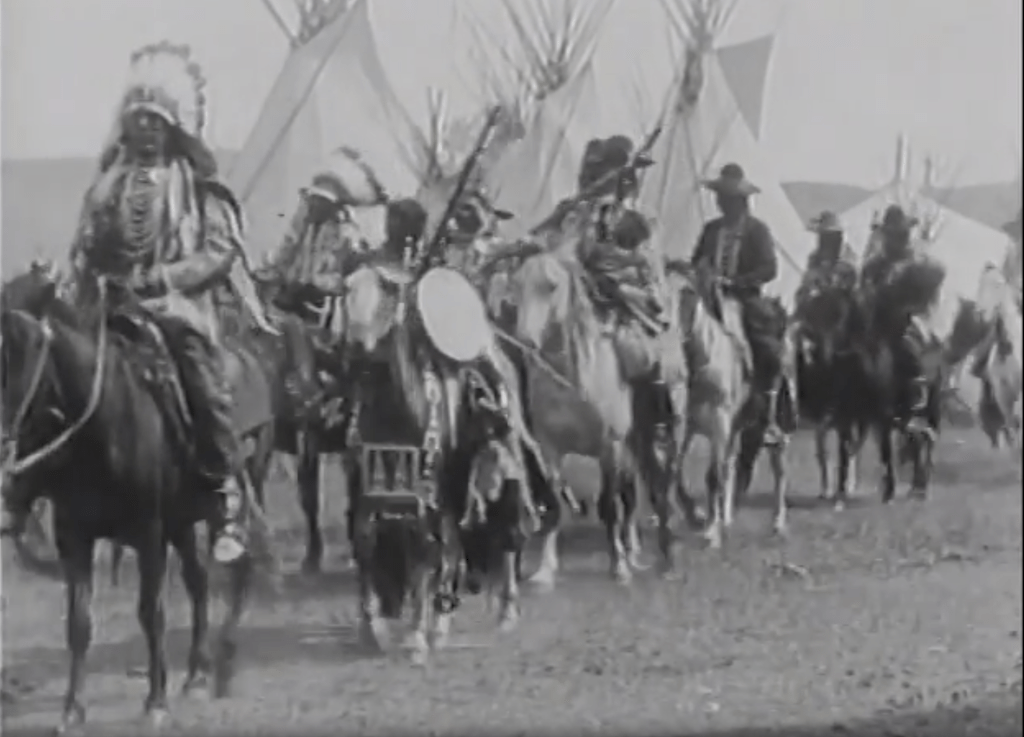
#655) Dixon-Wanamaker Expedition to Crow Agency (1908)
Directed by Joseph and Roland Dixon
Class of 2018
2025 UPDATE: The original version of this post was based on 3 ½ minutes of “Dixon-Wanamaker” I was able to find online. Another 45 minutes has recently resurfaced, and I’ve updated my thoughts on the film based on that. Thanks as always to Benjamin Wilson for finding this footage.
Around the turn-of-the-century, Indigenous tribes were considered a “vanishing race” by White America, and efforts were made to assimilate the tribes into quote-unquote American culture. Part of this effort was a series of expeditions led by pastor and self-ascribed Native American expert Joseph Dixon. Funded by department store magnate Rodman Wanamaker, the first Dixon-Wanamaker expedition in 1908 travelled to Crow Agency, Montana to meet with and document the Crow tribe. An avid photographer, Dixon and his son Roland took thousands of pictures (and of course film) of the tribe and their customs. Although Dixon’s intention was to present their lives “without any hint of the white man’s foot”, most of the results were staged for the camera and deemed by historians as “romanticized and commercialized”. This footage was projected at the Wanamaker’s flagship store in Philadelphia as part of an exhibition on Native Americans.
The available “Dixon-Wanamaker” footage is a seemingly random collection of shots, including various members of the Crow tribe and a handful of their customs. While there isn’t much to gauge about the Crow people in this footage, there is no doubt about this film’s historical significance. Of course the customs of any Indigenous tribe should be lived and practiced by their people rather than observed and studied by the likes of me, but the fact that any of this was documented and has survived is a mini-miracle and worthy of NFR induction.
Why It Matters: In keeping with the “historical significance” argument, the NFR’s write-up has no superlatives, only giving us an academic paragraph about the film’s production and preservation.
Other notes
- The additional 45 minutes I have seen are pretty much more of the same from the 3 ½ minute version, just longer. Why watch 10 seconds of a large caravan parading across the camera when you can watch 2 minutes?
- To the best of my knowledge, most of this footage comes from one of the first Crow Fairs. Started in 1904 to celebrate the Crow people and their customs (which were in danger at the time of being wiped out completely), the Crow Fair is still an annual tradition, and the footage here includes many elements of the Fair that continue to this day, including a parade and a rodeo. Watching the Crow ride bucking broncos circa 1908 is interesting given that for some, this may in fact have been their first rodeo.
- The notion that this film is from the Crow Fair would also explain the large group of White people appearing in these early shots. And I assume that’s Dixon trying to get onlookers to move out of the frame so the camera can get an unobstructed view.
- Of course, any footage of the Crow in this era is good to have, but this all feels so staged. Other than the performative events of the Crow Fair, I’m not getting a sense of actual culture and traditions. I don’t walk away from this knowing anything about the Crow and their centuries long struggle to survive. Maybe the shoppers watching this at the Wanamaker’s display got more context, but then again maybe not.
- Why are there nuns in this? So much for the whole “no White influence” credo. Why do Catholics have to spoil everything?
- Towards the end we spend a lot of time at a memorial in the Crow reservation for members of the 7th Cavalry Regiment who died in the Battle of the Little Bighorn, aka Custer’s Last Stand. Much like the Crow people and their history, the Battle of Little Bighorn is too monumental to cover here (and I have no memory of how it’s portrayed in “Little Big Man”), but it is noteworthy as part of the Great Sioux War of 1876, the culmination of decades of fighting by the Crow to protect their land from the encroaching Sioux and Lakota tribes.
Legacy
- The first Dixon-Wanamaker expedition was successful enough to warrant two more. The 1909 expedition returned to Crow Agency, and a recreation of the Battle of the Little Bighorn was filmed with four Crow tribe members who were part of the original battle. The third and final expedition in 1913 was a nationwide journey to 89 different tribes dubbed an “expedition of citizenship” to support Native Americans becoming recognized as U.S. citizens (a status they would eventually receive in 1924). Despite the good intentions of Dixon and Wanamaker, the 1913 expedition was not well-received by every tribe, particularly those in the Southwest (Navajo, Hopi, Pueblo, etc.)
- Although the film record of the 1908 expedition seemingly disappeared, the original nitrate was rediscovered in 1982 at a Montana antique store (and I hope some bartering was involved). The film was donated to the Smithsonian Institution’s Human Studies Film Archives, where it has been preserved. Additionally, Dixon’s extensive photography of the expedition has been archived at Indiana University.
- Joseph Dixon continued to advocate for Indigenous people for the rest of his life, including his efforts to create a National American Indian Memorial, which started construction in 1913 and was never finished. Dixon died in 1926 at age 70, with Rodman Wanamaker passing away three years later at age 65.
- Though all but forgotten now, Wanamaker’s department store was a major chain in the early 20th century. Although Wanamaker’s no longer exists, their original Philadelphia location was added to the National Register of Historical Places in 1976, and is currently a Macy’s. Fun Fact: Wanamaker’s Philadelphia store was the primary filming location for 1987’s “Mannequin”. Truly, nothing’s gonna stop us now.
- Because I refuse to end this post with a “Mannequin” reference: the Crow people of Montana are still around and 12,000 strong. If you’re ever visiting Crow Agency in August, be sure to check out their annual Crow Fair!
 The Horse's Head