
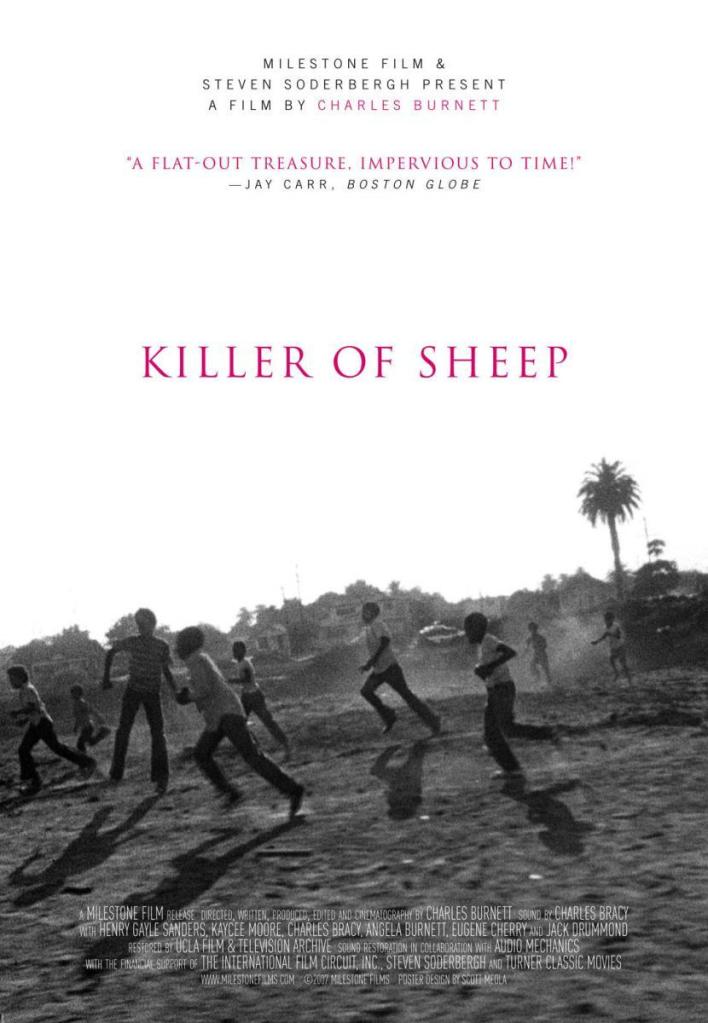
#657) Killer of Sheep (1978)
OR “Watts Going On?”
Directed & Written by Charles Burnett
Class of 1990
The Plot: Stan (Henry G. Sanders) lives in Watts, Los Angeles with his wife (Kaycee Moore) and children, earning a living by working at a slaughterhouse. Stan’s work has made him disillusioned with life as he becomes more despondent and unhappy. And if you’re wondering what is the inciting incident that kicks of the real plot of this movie, I’ve got some bad news for you.
Why It Matters: The NFR calls the film “simultaneously naturalistic and poetic, witty and heartbreaking”, praising its “sympathetic yet clear-eyed portrait of a community”.
But Does It Really?: Full disclosure: My first attempt to watch “Killer of Sheep” ended 10 minutes into the movie when I realized I was not in the right mood to watch it. Cut to a week later and a full viewing of the film, and I still don’t think I was in the right mood. I’m glad there are people out there who love and champion “Killer of Sheep” (though the comparisons to neorealism make my eyes glaze over), and I’m glad the NFR had the foresight to induct it so early into their run, but it’s just not for me. Maybe it’s the lack of story, maybe it’s the overall bleakness, but even at 80 minutes “Killer of Sheep” was a slog to watch. Still, you got to hand it to Charles Burnett for devoting nearly a decade to get this movie made, as well as to everyone who has helped keep this film in the conversation of great movies. Of course “Killer of Sheep” is deserving of its NFR status, but one viewing is enough for me.
Shout Outs: Perhaps the most obscure NFR shout-outs on this list: One of the songs on the “Killer of Sheep” soundtrack is Paul Robeson’s cover of “The House I Live In”, the title number from the Frank Sinatra short of the same name.
Wow, That’s Dated: The main giveaway of the film’s ’70s setting is all the afros and jive talk. Other than that, a depressingly large amount of this movie doesn’t feel dated at all.
Seriously, Oscars?: Fun Fact: In order to be eligible for an Oscar, you need a theatrical run. We’ll get into the interesting theatrical history (or lack thereof) of “Killer of Sheep” in a second, but for now I’ll say that outside of a prize at the 1981 Berlin International Film Festival, “Sheep” didn’t pick up any awards until its 2007 “re” release.
Other notes
- Charles Burnett was part of the L.A. Rebellion, a group of Black UCLA film students in the late 1960s/early 1970s, fueled by political and social movements of the day, and irked by the popular wave of Blaxploitation films hitting theaters, to create more realistic films about their Black experience. “Killer of Sheep” was inspired by the people in Burnett’s life from growing up in Watts, and was Burnett’s thesis film to get his Master’s degree. “Sheep” was filmed on a budget of $10,000 on weekends across 1972 and 1973, with some additional scenes shot in 1975. A majority of the film was shot in and around Watts with a cast of non-actors (including Burnett’s daughter Angela as Stan’s daughter).
- One of the films few professional actors, Henry G. Sanders was cast as Stan when Burnett’s first choice for the role didn’t make parole in time (!). Sanders does a good job of playing the character’s melancholia without making him too down or depressing. Since “Killer of Sheep”, Sanders has continued to grace our screens, working in film and plenty of episodic television.
- Oh yeah, this is definitely one of those films you think about when you think of arthouse independent cinema: the black-and-white cinematography, the real-life locations, the less-than-stellar sound mix (there were scenes where I could hear a chair creaking better than I could the dialogue).
- This is another NFR movie where I didn’t take a lot of notes. Unfortunately it’s not because I was so enthralled with the movie, it’s because nothing happens! Did I catch these people at a bad time? Should I come back later?
- If nothing else, this film as a good soundtrack. Burnett wanted the film’s soundtrack to be “an aural history of African-American popular music”, which explains the presence of such greats as Scott Joplin, Paul Robeson, Louis Armstrong, and Earth, Wind & Fire. It helps break up the movie for me.
- While researching this post, I re-read my write-up on “Bless Their Little Hearts“, a film by Burnett’s UCLA colleague Billy Woodberry and written by Burnett. Like “Sheep”, “Bless” also chronicles a working class Black man trying to raise a family and make ends meet in Watts. Both films have a slice of life “nothing happens” vibe to them, and yet something in “Bless” worked for me in a way “Sheep” didn’t. Maybe it’s the dramatic moments in the third act of “Bless” that have stayed with me. They at least gave me the sense that all of the previous scenes were building to something. The argument could be made that “Killer” also builds to something in the final moments, but I wasn’t entirely sold on that. It doesn’t help that the original song for that scene – Dinah Washington’s rendition of “Unforgettable” – was the only one that could not be cleared for the film’s eventual release, and replaced with Washington’s “This Bitter Earth” (played earlier in the film). Though seemingly inconsequential, this change of music alters how we perceive the final scene, ending on a slightly more optimistic note (if you will).
Legacy
- “Killer of Sheep” had its premiere in November 1978 at the Whitney Museum of American Art in Manhattan (appropriately enough, in Manhattan’s Meatpacking District). The film would play its share of festivals, but because Charles Burnett never planned to give his student film a theatrical release, he never paid the pricy licensing fees for the soundtrack, which became an issue years later. In the ensuing decades, “Killer of Sheep” would build up its reputation as an arthouse masterpiece (helped in part by its NFR induction) and play the occasional festival or museum exhibition. It was not until 2000, when the UCLA Film & Television Archive restored the film on 35mm, that talk of an official theatrical release began in earnest. Nearly six years was spent on maintaining the music rights to the soundtrack ($142,000 in total, paid in part with a generous donation from Steven Soderbergh) before “Killer of Sheep” finally got a proper theatrical release in spring 2007.
- Charles Burnett’s next film was 1983’s “My Brother’s Wedding”, which had its own share of production woes and subsequent re-evaluations. His third movie, 1990’s “To Sleep with Anger”, found its way into the National Film Registry, as did the aforementioned “Bless Their Little Hearts”.
- “Killer of Sheep” gets referenced from time to time, mainly in conjunction with other films by members of the L.A. Rebellion. A still frame from the scene of neighborhood kids jumping across rooftops was tinted red and used as the cover for the 2009 album “The Ecstatic” by Yasiin Bey (formerly Mos Def).
 The Horse's Head
3 thoughts on “#657) Killer of Sheep (1978)”