
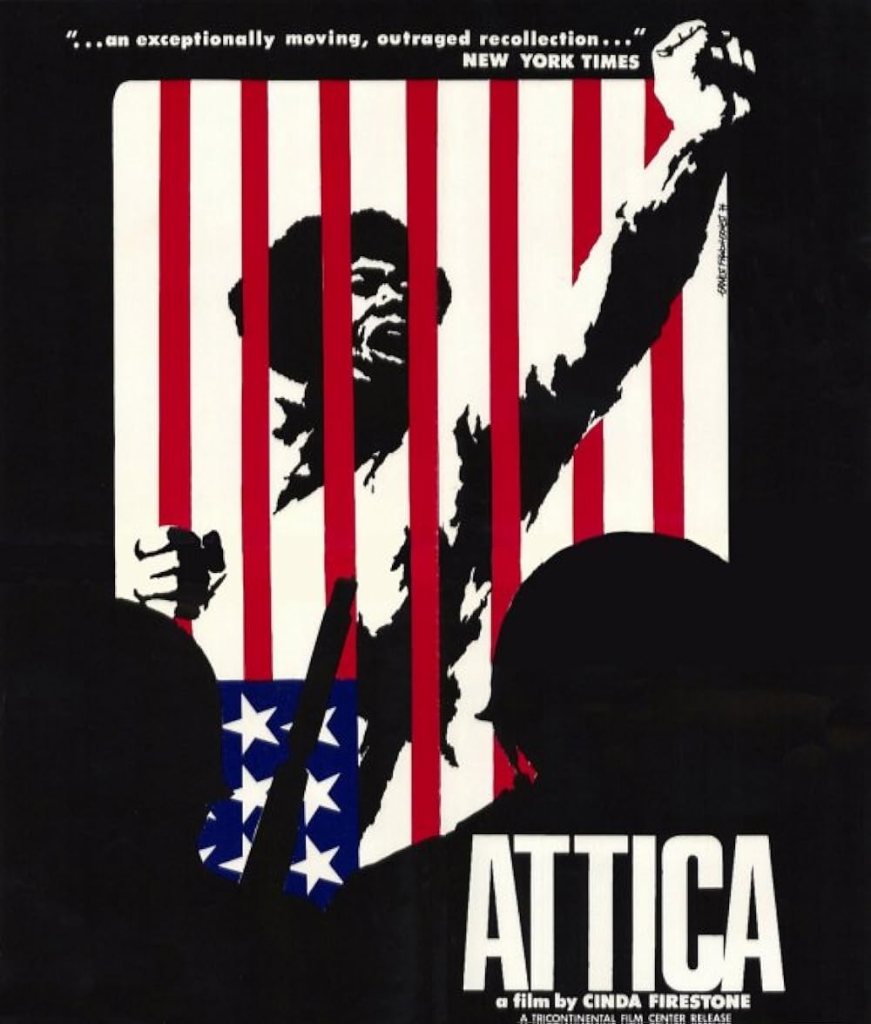
#670) Attica (1974)
Directed by Cinda Firestone
Class of 2022
Today’s oversimplified history lesson: The Attica prison riots. As always, I’m just here to watch the movie, but I encourage all of you to delve deeper into this pivotal moment in American history.
The Plot: By 1971, the Attica Correctional Facility in Attica, New York was overcrowded and subjecting its prisoners to an inhumane and racially discriminatory environment. Following the death of George Jackson, a prominent Black Panther member serving in San Quentin, the Attica inmates gave a list of demands for better living conditions to State Commissioner of Corrections Russell Oswald and New York Governor Nelson Rockefeller. When these demands – pertaining primarily to improved rehabilitation and education for inmates – were not met or even acknowledged, over 1200 inmates revolted and took control of half of the facility, holding 42 officers and employees hostage. From September 9th through 12th, 1971, negotiations between the inmates and Commissioner Oswald progressed, but ultimately reached a stalemate when authorities would not grant the inmates amnesty over the riot. On the morning of September 13th, armed local and state police took control of the facility, opening fire and killing 39 people: 29 inmates and 10 hostages. The story behind these events, as well as the aftermath, are chronicled by journalist/filmmaker Cinda Williams utilizing footage taken during the riots, as well as new interviews with the inmates who were there.
Why It Matters: The NFR write-up is mostly an abbreviated account of the Attica revolt, but Firestone’s “outstanding investigation of the tragedy” is praised.
But Does It Really?: “Attica” is part of a subset of NFR movies that, while not eye witness accounts of historic events, are a succinct encapsulation and reflection (“Point of Order” and “Freedom Riders” are of this ilk). If you’re like me and only know the barebones summary of what happened at Attica, this film is an eye-opener. Firestone chronicles this story while the wounds are still fresh, treating her subjects with respect and making the whole event seem vividly alive. An appreciative pass for “Attica”; not a landmark in documentary filmmaking, but an effective reportage of a current (and ultimately historic) event.
Everybody Gets One: A lifelong advocate, Cinda Firestone began her career as a journalist for independent paper Liberation News Service. Firestone became interested in film while interviewing director Emile de Antonio (of the aforementioned “Point of Order”) and learning he was looking for an assistant. Shortly after seeing news coverage of the Attica riots, Firestone decided to interview the subjects and make a 15-minute documentary about it. Once she learned of color news footage shot during the takeover, Firestone’s film quickly evolved into a feature-length documentary. And yes, that’s Firestone of tires fame. Her grandfather Harvey Firestone founded the company some 75 years before “Attica” was released, and this film allegedly cost Cinda her inheritance.
Seriously, Oscars?: As best I can tell, “Attica” did not play an Oscar-qualifying run, but 1974’s Best Documentary winner was another NFR entry about a controversial political event: “Hearts and Minds“.
Other notes
- My first thought in regards to the extensive prison footage in this movie was “How did they film inside a prison?”. It turns out one of the inmates’ demands was that their activities be recorded, so that the outside world could see how things really happened. You have to appreciate the foresight these inmates had. Roland Barnes and Jay Lamarch were camera operators from a local TV station in Buffalo (about a 45 minute drive from Attica), and their footage has been used in many pieces of media about the riots.
- The other major component of this film is footage from the McKay Commission; a 10-month investigation into the Attica riots that was ultimately very critical of the state’s handling of the situation. Since almost every non-inmate involved at Attica refused to be interviewed by Firestone for this film (and some were allegedly bullied into not speaking to her), this is the closest we get to hearing their side of the story, albeit the delicately worded version for a court investigation. Most of the interviews from the McKay Commission are intercut with the speakers’ oft-contradictory actions during the actual riot.
- Easily the most disturbing footage in this movie comes from right before the police assault and -as described on-screen – “Filmed Through Scope of State Troopers Rifle”. Christ almighty. This footage was intended for a police training film, but was subpoenaed by the McKay Commission and rebroadcast on WNET (New York’s PBS affiliate). Firestone has stated that one of the biggest hurdles of making this film was getting WNET to grant permission for her to use the scope footage.
- Ultimately, my takeaway from this movie is that it made me reflect (for the first time, frankly) about our prison system and the people inside it. Like any good movie, “Attica” made me look at an all-too-often marginalized group of people and see their humanity. These inmates are people forced to reside in an oppressive system that treats them like animals and doesn’t do all it can to truly rehabilitate them for their re-entry into society. There is of course an endless amount of nuance that I don’t have the space to engage with here (prison reform, systemic racism, etc.), but in the end I’m grateful to Cinda Firestone and the opportunity to really think about what it was (and probably still is) like to live within the American prison system.
- The last line of the movie comes from Frank Smith, Attica inmate and one of the revolt’s leaders, encouraging others to stay alert and active within their society: “Nothing come to a sleeper but a dream.”
Legacy
- “Attica” premiered at New York City’s First Avenue Screening Room on April 11th 1974, with proceeds from ticket sales going to the Attica Legal Defense Fund. The film played in a few more major cities before more or less disappearing, although in 2007 it was restored by the New York Women in Film & Television’s Film Preservation Fund and received a small re-release.
- Cinda Firestone made three more documentaries throughout the ’70s before pivoting to theater, writing several children’s musicals. Information on what Firestone is currently up to is scarce, but one article mentions her penning a memoir provocatively titled “Debutante to Attica”.
- There have been two TV movie adaptations of the Attica riots, both coincidentally earning their directors Emmys: Marvin J. Chomsky’s “Attica”, and John Frankenheimer’s “Against the Wall”.
- The Attica riots still get referenced every so often (most often around national conversations about prison reform), but when most people think Attica, they think Al Pacino’s famous improvised outburst during “Dog Day Afternoon“.
- There is another documentary about Attica – also titled “Attica” – released in 2021 to coincide with the event’s 50th anniversary. Like the 1974 film, this 2021 version also utilizes footage from the uprising, as well as present-day interviews from those involved. The film earned its director – fellow NFR filmmaker Stanley Nelson – his first Oscar nomination, which was quickly overshadowed by that category’s presentation by Chris Rock and an unscripted appearance by Will Smith.
- While there was an improvement in prison conditions in Attica in the immediate aftermath of the riots, many of these new policies were reversed in the ’80s and ’90s following various political “Hard on Crime” campaigns. In an interview in conjunction with the re-release of “Attica” in 2007, Cinda Firestone believed that the present prison conditions were worse than they had been in 1971.
Further Activism: There is so much more information out there about the Attica uprising, and plenty of ways to support its survivors and their families. I recommend checking out the Attica Brothers Foundation, which not only gives financial aid to survivors, but also archives documents and interviews pertaining to the riots.
 The Horse's Head