
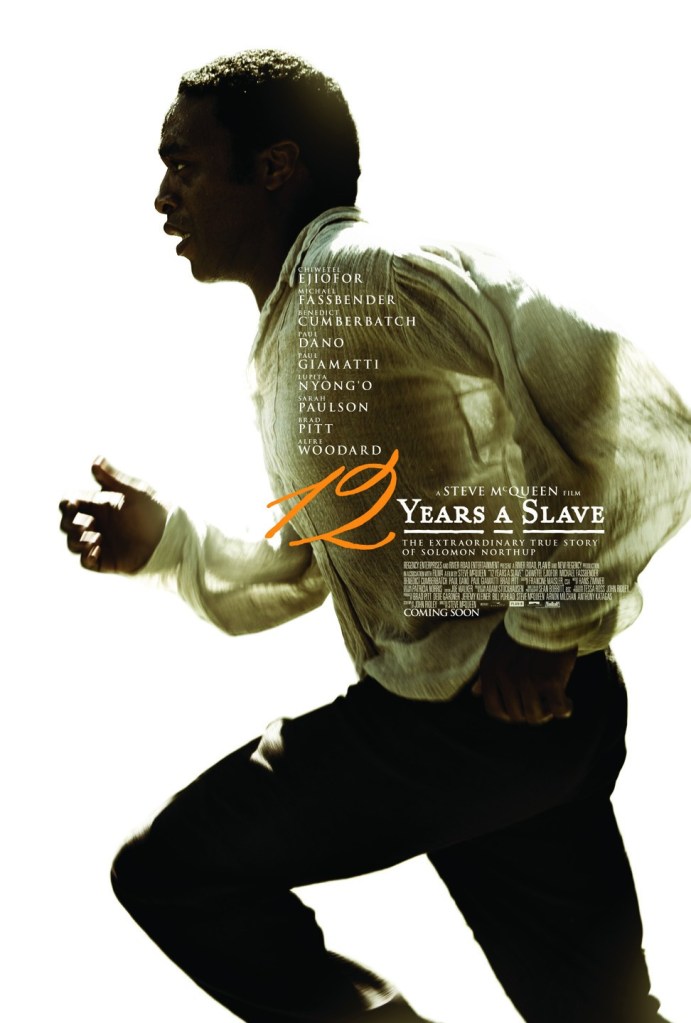
#675) 12 Years a Slave (2013)
OR “Nope, Definitely Not Doing a Pun-Based Subtitle for ’12 Years a Slave’. There’s No Way I Can Thread That Needle.”
Directed by Steve McQueen
Written by John Ridley. Based on the memoir by Solomon Northup.
Class of 2023
The Plot: Solomon Northup (Chiwetel Ejiofor) is a free Black man living in Saratoga Springs, New York with his family in 1841. An accomplished violinist, Northup is hired by two men (Scoot McNairy & Taran Killam) to play for their circus in Washington D.C., but the men are con artists who drug Northup and sell him into slavery. Shipped to New Orleans and forced to take the name “Platt”, Northup is sold to plantation owner William Ford (Benedict Cumberbatch). While Ford is a benevolent slave owner (if such a thing is possible), Northup’s frequent clashes with his White overseers leads to a near-lynching. Northup is sold to Edwin Epps (Michael Fassbender), another plantation owner who is more abusive to his slaves, particularly his top cotton picker Patsey (Lupita Nyong’o). Despite the horrors he experiences on a daily basis, Solomon never gives up hope that he will regain his freedom.
Why It Matters: Weirdly enough, the NFR’s official write-up is just a rehash of the movie’s plot and Oscar tally. The blurb on the NFR’s Class of 2023 press release, however, calls the film “raw, visceral” and “[o]ne of the key films of the 2000s”.
But Does It Really?: I never got around to seeing “12 Years a Slave” during its original run, but I have to say it was worth the wait. Slavery is always a difficult subject matter to create art from, but in the hands of Steve McQueen “12 Years a Slave” is a gripping, honest depiction of slavery that never shies away from the horrific elements but also never sensationalizes them. Aided by McQueen’s direction, a terrific cast, and some beautiful cinematography, “12 Years a Slave” – for better or worse – hasn’t aged a day, and will be an important viewing for any film lover for years to come.
Everybody Gets One: Born and raised in London, Steve McQueen became interested in film while studying at University of London’s Goldsmiths College. His early works were experimental shorts, including 1997’s “Deadpan”, in which he recreated Buster Keaton’s famous house-falling-around-him stunt. McQueen started gaining attention with his first feature, 2008’s “Hunger” about the Irish hunger strike of 1981. It was at a screening of “Hunger” where he met writer John Ridley, and the two began collaborating on a screenplay about American slavery, a topic they both felt was underrepresented in films. It was McQueen’s partner Bianca Stigter who suggested they adapt “12 Years a Slave”. And for the record: No, Steve McQueen was not named after the popular movie star with the same name. In fact, McQueen rarely acknowledges the connection in interviews, though he admitted recently that he likes “The Magnificent Seven“.
Title Track: It’s worth noting here that while there may have been some embellishment in Solomon Northup’s memoir (attributed to Northup’s copyist David Wilson), research has shown that the book “12 Years a Slave” is historically accurate. The film itself is a faithful adaptation, and considered by historians one of the most accurate portrayals of slavery in film.
Seriously, Oscars?: Going into the Oscar race, “12 Years a Slave” received nine nominations, one behind “American Hustle” and “Gravity”. Although “Gravity” swept the tech awards, “12 Years” prevailed with three important wins: Best Picture, Adapted Screenplay, and Supporting Actress for Lupita Nyong’o. With its win, “12 Years” became the first movie by a Black filmmaker to win the Best Picture Oscar. Ceremony host Ellen DeGeneres summed up the film’s frontrunner status in her opening monologue: “So many different possibilities. Possibility number one: ’12 Years a Slave’ wins Best Picture. Possibility number two: You’re all racists.”
Other notes
- “12 Years a Slave” was filmed over the course of six weeks in and around New Orleans in summer 2012. To keep costs down, the film was shot with only one camera, forcing McQueen and cinematographer Sean Bobbitt to be more decisive with their compositions, rather than just figuring it out in the edit.
- I have to mention that screenwriter John Ridley got his start writing for such sitcoms as “Martin” and “The Fresh Prince of Bel-Air”, and he co-wrote the screenplay for underrated blaxploitation parody “Undercover Brother”. Proof that every artist is one good movie away from winning an Oscar.
- Man, what a cast. Of course, it all begins and ends with Chiwetel Ejiofor, who quietly holds the film together with an impressively subtle performance. There’s a lot of the movie where Solomon is sidelined by bigger, flashier performances, but thanks to Ejiofor you know that it’s a deliberate choice; Solomon is always observing, choosing his words and actions very carefully.
- The run of “Who isn’t in this movie?” continues with SNL cast member Taran Killam (giving me some Jebidiah Atkinson vibes), followed by an all-too-brief appearance by the late great Michael K. Williams. Also, blink and you’ll miss Quvenzhané Wallis as Solomon’s daughter Margaret. By the time “12 Years” was released, Wallis had become the youngest Best Actress Oscar nominee in history with “Beasts of the Southern Wild”.
- Maybe I’ve just become desensitized to movie violence over the years, but while the abuse directed towards the slaves in “12 Years” is severe (and at times very hard to watch), I feel like it was restrained compared to other films. Even in its most intense moments, “12 Years” strives for a grounded reality. Compare that to a movie like “Django Unchained”, which goes for an amplified, cinematic version of slavery that turns into a full-on revenge fantasy. Obviously “12 Years” isn’t going for that, but if you were able to stomach the violence of “Django”, you can handle “12 Years”. On a similar note, while the n word is thrown around quite a bit here, it is nowhere near the amount in “Django”.
- We get another batch of familiar faces once Solomon is sold to the Ford plantation. There’s Paul Giamatti, Benedict Cumberbatch, and Paul Dano, but I was pleasantly surprised by seeing Adepero Oduye, aka Lee from “Pariah“. It’s been a full year since I watched “Pariah” for the blog, and I was genuinely happy to see Oduye again. Her time in “12 Years” as fellow slave Eliza is brief but impactful, and I’m glad she now has two movies on the NFR. Side Note: Adepero’s on-screen daughter is played by Storm Reid, who while I was writing this won an Emmy for her performance on “The Last of Us”. This cast is on a roll!
- Between this and “There Will Be Blood”, there was a point in time when the movies loved beating the shit out of Paul Dano.
- The scene where Solomon is almost lynched and left hanging from a noose for hours is definitely an indelible moment. If one image from this movie stays with me, it will surely be Solomon trying to reach the ground with his tiptoes while he goes unnoticed and unassisted by the rest of the plantation.
- Another round of familiar faces once we arrive at the Epps plantation. There’s of course Michael Fassbender, giving as much nuance as you can to a Simon Legree-type. Side note: Fassbender looks here like if Joaquin Phoenix played Vincent Van Gough. I’m also a fan of the brief supporting turns by Sarah Paulson and Alfre Woodard, Woodard in particular nailing her one scene as a preferred “house slave”. Also, shout out to Ryan Murphy, who rearranged the production schedule of “American Horror Story: Asylum” so Sarah Paulson could be in this movie.
- This is the feature film debut of Lupita Nyong’o! It’s incredible to think about the amazing film career she has already racked up in only the last ten years. It’s easy to see how Nyong’o won the Oscar for this: Her Patsey is the soul of the movie, somehow maintaining her optimism and faith in humanity despite all the cruelty around her. In both this film and in real life, what happened to Patsey after the events of “12 Years a Slave” is unknown.
- The other aspect that struck me about the film is the aura of immediacy about it. So many films dealing with America’s racist history present it as “that was then”; something that has already been overcome. Somehow in McQueen’s direction there is a sense of urgency: this is then and now. I don’t know how, but while obviously a period piece, the film contains a modern sensibility, making the viewer aware that while legalized slavery is long gone, the horrible treatment of our Black citizens prevails.
- The scene where Northup is forced to whip Patsey is easily the most intense in the movie, captured brilliantly in one seemingly uninterrupted take. Watching Patsey’s spirit finally get broken is just as distressing as the physical violence she endures.
- My one complaint about this movie is the same as everyone else’s: Brad Pitt. To be fair, Solomon Northup’s freedom was obtained as seen in the film: He got Canadian abolitionist Samuel Bass to deliver letters to his family giving his whereabouts, and local authorities arrived to free Northup. Within a film, however, this plays out as a White savior deus ex machina, especially when that savior is Brad Pitt, the only bona fide movie star in the cast. Pitt (a producer of the film under his “Plan B” company) has stated that he didn’t want to act in “12 Years”, but played the part in order to help secure more funding; making this ending one of the unfortunate casualties in the never-ending battle of art vs. commerce.
- This is one of the rare movies based on real events in which I appreciated the obligatory epilogue text. Without it, the film has a happy ending wrapped in a bow, but the text about Northup’s unsuccessful suit against those who kidnapped him reminds us that real-life evil rarely gets punished.
- “12 Years a Slave” is dedicated to Philbert John McQueen, Steve’s late father.
Legacy
- “12 Years a Slave” was a success upon its release in 2013, receiving critical praise, a strong box office, and the aforementioned Oscars. In the decade since, the film is routinely lauded as one of the best films of the 21st century (so far). “12 Years” has also joined the ranks of films inducted into the NFR in their first year of eligibility.
- Steve McQueen’s follow-up to “12 Years a Slave” was 2018’s “Widows”, based on the 1980s British crime series. He also directed the anthology series “Small Axe”, and his next film – “Blitz” – will be about the bombings in London during World War II.
Further Viewing: “Solomon Northup’s Odyssey”, a 1984 TV movie also based on “12 Years a Slave”, directed by fellow NFR filmmaker Gordon Parks.
 The Horse's Head
4 thoughts on “#675) 12 Years a Slave (2013)”