

#677) A Movie Trip Through Film Land (1921)
OR “A Kodak Moment”
Directed by Joseph de Frenes & Paul Felton
Class of 2023
Update: The original version of this post was a placeholder version pieced together from the 3 1/2 minute excerpt embedded above, a 21 minute version with French intertitles, and this copyright description from 1921 in the Library of Congress that gives a detailed overview of the film. But thanks to Mike Champlin of DeBergerac Productions, Inc., I was able to watch the full version of “Film Land”.
My immense thanks to Mike Champlin for getting me access to the original film, as well as for sharing his expansive film knowledge. Mike worked on a restoration of “Film Land” in 2004, and has informed me that DeBergerac Productions is working on a new restoration to celebrate its NFR induction, with a projected general release of later this year. Check out the DeBergerac Productions website to learn more about their other preservation work.
The Plot: An animated “international convention of movie fans” gather to watch “A Movie Trip Through Film Land”. The “Film Land” of the title is none other than Kodak Park in Rochester, New York: Home of Kodak film, the popular choice for both still photography and motion pictures! As we travel through Kodak Park, we get a very thorough explanation of how film nitrate is made. Produced by Bosworth, De Frenes and Felton of Wilkes-Barre, Pennsylvania.
Why It Matters: The NFR calls the film “educational and highly informative”, and gives a shoutout to the George Eastman Museum, Eastman Kodak laboratory, and the Eastman Kodak Company for their parts in this film’s restoration.
But Does It Really?: This is certainly one of the NFR’s more meta selections: a film about how physical film is made. I had never heard of “Film Land” before it made the Registry, and it has been fascinating to research this film and learn more about how physical film was actually made at the early stages of this new medium. A historical pass for “Film Land”; and keep an eye out for that new restoration.
Everybody Gets One: Information regarding Bosworth, De Frenes and Felton is pretty scarce, but what we do know is that it was a film production company that existed from roughly 1917 to 1927 in Wilkes-Barre, Pennsylvania. Among their major clients who commissioned films from them were Goodrich and, of course, Eastman Kodak. Paul M. Felton was an animator and musician, referred to in local papers as “that famous comic artist”. Felton drew the intertitle illustrations and animated opening of “Film Land”. Joseph De Frenes was a photographer and cinematographer, best known for his expeditions with fellow filmmaker Charles Urban, which resulted in some of the earliest travelogues in the film history. De Frenes is the only credited name in the opening “Film Land”, having shot the Kodak Park footage. C. R. Bosworth was a local businessman and producer, and that’s pretty much all we know about him.
Wow, That’s Dated: Nitrate film; that’s the big one. Film buffs (and longtime readers of this blog) know that nitrate film catches fire faster than a dried-up Christmas tree, which led to the loss of a majority of pre-1950 film, and the urgent need for film preservation. By 1952, film stock had finally made the switch to cellulose acetate (aka “safety film”), with polyester becoming the film base of choice by the 1990s.
Other notes
- Kodak Park was founded in 1890, two years after the Kodak camera was patented. The park was part of an expansion of Eastman Kodak as their camera and film stock became popular. Side note: George Eastman and his mother Maria made up the name Kodak from an Anagrams set; George wanted a name that was simple, easy to pronounce, and began with a K, which he felt was a strong letter.
- The NFR write-up describes the film’s prologue as “a gathering of animated multi-national characters, which some may find problematic, but were of the times”. It’s all well-intentioned, a message about the universal appeal of the movies, but…yeah it’s real bad. Whichever offensive racial caricature you’re thinking of right now, they are in this opening. Ultimately I would compare the opening to an early COVID test: uncomfortable, but brief. That being said, some of these racist characters pop up in Felton’s intertitle illustrations throughout the film.
- I appreciate that Kodak emphasizes the safety of its employees, especially with all these chemicals around. We’re a long way from “Westinghouse Works“.

- An interesting difference between the English and French intertitles: the French ones are more or less the scientific process of how film is made, while the English ones add in explanations “In plain English”. Maybe it’s my own American comprehension skills, but I appreciate the dumbing-down. This is a pretty dry process without a little American pizzaz. Also of note is that the French intertitles omit almost every reference to Kodak, making the final film more of a general educational short than a hard-sell for Kodak products.
- I never realized that the key ingredient of nitrate film was cotton. Kodak Park used over 8,000 bales (4 million pounds) of cotton every year. Just one of the many statistics this film is happy to provide.
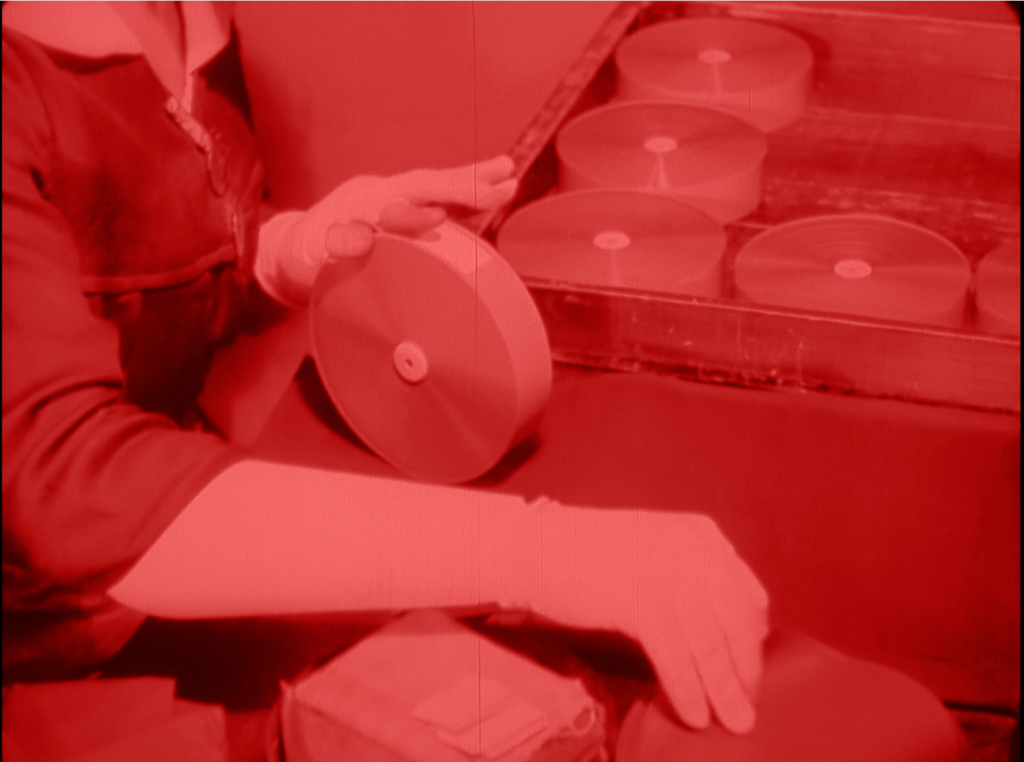
- Also appreciated: The red-tinted film during the “dark-room stage” of the process. Nice touch.
- I’m going to reproduce the final intertitle here, just because it tickles me so.
“Each year, 147,000 miles of motion picture film, enough to girdle the earth six times, goes out from Kodak Park to tell you the news of the world, to make you laugh and cry, to teach you science and history, and to show you the uttermost parts of the earth.”
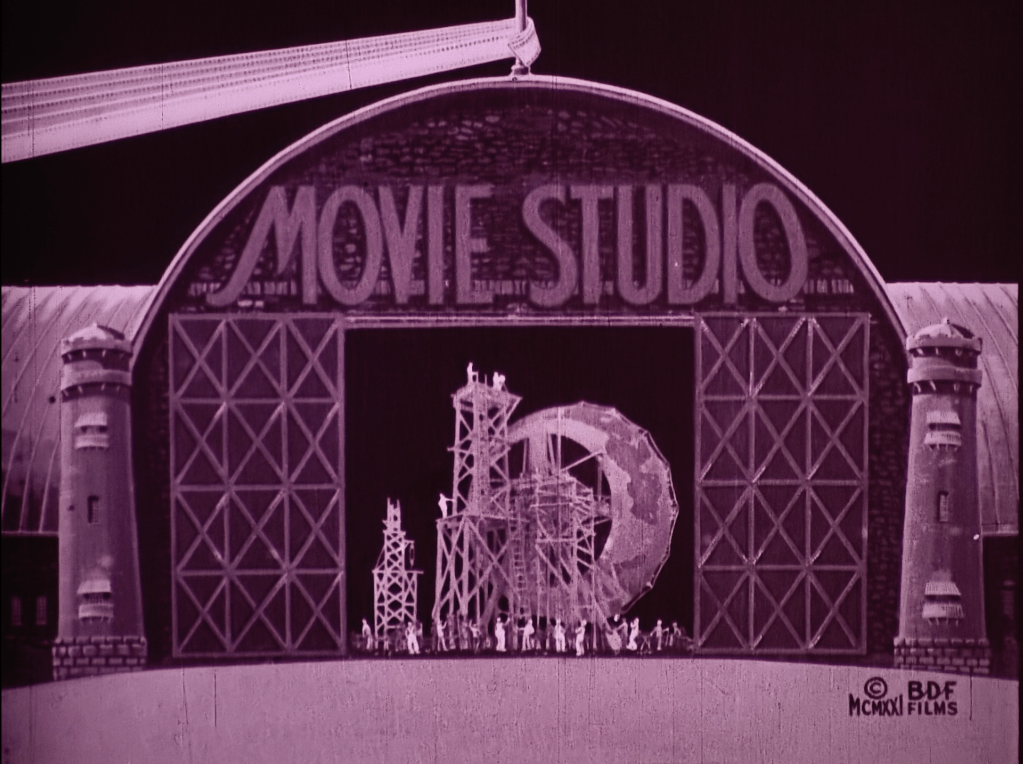
- The last sequence is a mock-up of the Earth as the completed film “girdles” the circumference six-times over, passing over the world’s major landmarks. Once the film reaches California we zoom in on a movie studio, revealing a crew filming the model of the Earth we’re currently watching! This movie may have gotten too meta for its own good.
Legacy
- At one point Kodak Park was the largest photographic manufacturing facility in the world, but as the demand for physical film declined, so did the size of Kodak Park. The park still exists, now known as Eastman Business Park, but very little of the “Film Land” seen here survives.
- Bosworth, De Frenes and Felton continued producing movies until 1927 with the sudden death of Bosworth and the advent of sound. Joseph de Frenes formed his own production company – De Frenes & Company – and continued making industrial films for the rest of his career. Paul Felton would go on to work with animation legend Max Fleischer, most notably in his iconic “Out of the Inkwell” films. When Paul Felton died in 1933 at age 47, one of the Wilkes-Barre papers memorialized him as “one of the pioneers in the motion picture field”.
 The Horse's Head