
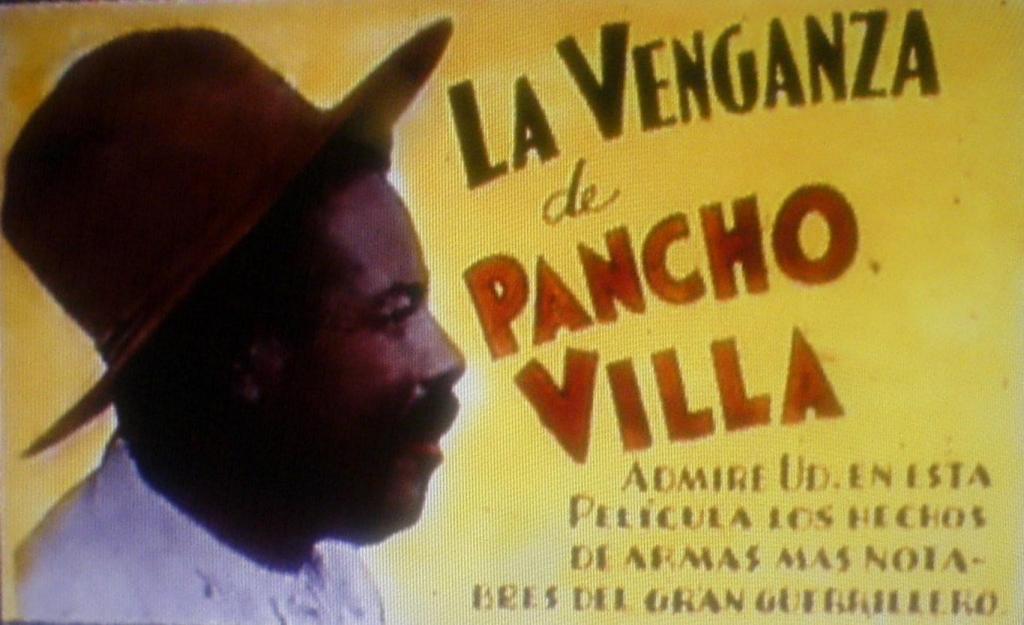
#680) La Venganza de Pancho Villa [The Revenge of Pancho Villa] (1930-1936)
OR “The Revolution Will Not Be Moralized”
Directed by Felix Padilla (and later Edmundo Padilla)
Class of 2009
Another very hard to find movie, “La Venganza de Pancho Villa” is currently available on a YouTube channel called “ArchiviaFilms”. Enjoy it while it lasts.
This post can only scratch the surface of the complex political life of Pancho Villa and the Mexican Revolution. As always, let this post be the beginning of your research, not the end.
The Plot: Culling from several narrative and documentary films of the era, Felix Padilla’s “La Venganza de Pancho Villa” is a retelling of the highs and lows of the famous Mexican revolutionary. Roughly chronicling Pancho Villa from his rise to prominence in 1913 to his death in 1923, the film combines its multiple film sources (plus original footage shot by Padilla himself) to paint a picture of the man that is simultaneously celebratory and condemning.
Why It Matters: The NFR rundown is a few brief sentences about what the film is, stating that it “combines the cinematic traditions of the United States and Mexico”. An essay by USC film professor Laura Isabel Serna, PhD is as detailed a write-up about the film and its creators as we’re ever going to get.
But Does It Really?: Oh yes. Right out the gate, “La Venganza” made it very clear why it was on the NFR. Everything about this film stood out to me as unique among its fellow NFR entries: its subject matter, its production, and its presentation all create a wholly original piece of filmmaking. This all being said, you should definitely do your homework before watching “La Venganza”. I got so much more out of my second viewing once I knew more about Pancho Villa and the Mexican Revolution. A yes for NFR inclusion, though definitely more on the historical side of things.
Everybody Gets One: All of my information regarding Felix Padilla comes from the NFR’s essay from Laura Isabel Serna. According to Serna, Felix Padilla was a film exhibitor in East El Paso, Texas who pivoted to traveling exhibitions when his theater closed. Like many a silent film exhibitor, Padilla knew how to curate and tailor his program to time allotment and regional tastes. Throughout the late ’20s and early ’30s, Padilla crisscrossed the US-Mexican border, collecting films on Pancho Villa from both countries and splicing them together to make his own film. When Padilla died in the mid-1930s, his son Edmundo continued work on his father’s film.
Everybody Gets One (Archival Edition): Pancho Villa rose to prominence in 1910 when he helped end the dictatorship of President Porfirio Diaz, which kicked off the Mexican Revolution. By 1914, after overthrowing yet another Mexican dictator (Victoriano Huerta), Villa was at the height of his fame and power, with his mythologized exploits coming to America thanks to journalist John Reed. Villa was in need of additional funding for the Revolution, and turned to Hollywood. He signed a contract with Mutual Film Corporation to make “The Life of General Villa” and film his subsequent battles (in daylight, night shooting hadn’t been perfected yet). Villa was given a $25,000 advance (roughly $760,000 today), and received 50% of all film profits.
Title Track: Earlier versions of the film went by the names “La Venganza del Guerrillero” [The Vengeance of the Guerrilla Fighter] and “El Vengador de la Raza” [The Avenger of the Common People]. “La Venganza de Pancho Villa” was the title given to the final version completed by Edmundo.
Other notes
- Among the clips utilized for “Venganza” are the pro-American “Liberty” (1916) and “Lieutenant Danny USA” (1916), the aforementioned pro-Villa “The Life of General Villa” (1914), and the after-the-fact documentary “Historia de la Revolución Mexicana” (1928). Many of these films are now lost with the sole exception of the excerpts used in this film.
- It’s also worth noting that in the decade following Pancho Villa’s death, the Mexican government did not acknowledge Villa’s controversial contributions to Mexican history. A film like “Venganza” was quite daring to not only feature Pancho Villa prominently, but to also praise him. Compare that with the only other major Villa film representation from the 1930s: 1934’s “Viva Villa!”, MGM’s attempt at a biopic with Villa played by…Wallace Beery?
- The first major event of the film is 1913’s First Battle of Torreón, which saw Villa and his revolutionaries occupying the city of Torreón, Coahuila. This is definitely taken from one of the anti-Villa films, as the occupation is depicted as an all-out attack on the town. Quick, someone call the Three Amigos!
- This compilation is not unlike “The Atomic Cafe“, in which historical footage is restructured to create a semi-revisionist narrative. It may also be film history’s first fan edit.
- As someone who knew of Pancho Villa in name only before this viewing, I kept asking myself, “Is he the good guy or the bad guy?” This film oscillates between making Pancho Villa the Robin Hood-esque savior of Mexico and, to quote another NFR movie, the Shame of a Nation. Very confusing if you don’t know Mexican history, but it definitely helps hold your interest.
- I know we’re working with duplicate positive prints here, but some of this newsreel footage is pretty rough. “Decasia” looked better.
- So the titular revenge is against America? Villa actually had a good reputation with America for a good chunk of the 1910s due to his public rejection of Venusitano Carranza, a fellow revolutionary that Villa had a falling out with. By 1915, however, after Villa’s defeat by Carranza’s Constitutionalists in the Battle of Celaya, President Woodrow Wilson shifted his support to Carranza, feeling the Constitutionalists could create a more stable Mexican government. And as we all know, getting Wilson’s endorsement wasn’t always a good thing.
- Pancho Villa exacts his “revenge” through two events depicted here: an attack on a train in Santa Isabel, Chihuaha that killed 18 Americans, and a border-crossing assault on Columbus, New Mexico in 1916. The Battle of Columbus is definitely the centerpiece of the film, with a lot of screentime devoted to it and probably the strongest pro-American bent in the entire film.
- All of this propoganda just reminds me of that “Viva Señor Burns!” scene from “The Simpsons”. “We did 20 takes, and that was the best one.”
- One attack on an American camp occurs (according to an intertitle) at “Midnight on April 6” …in broad daylight. This must be one of the Mutual-sanctioned day-shoots.
- It’s worth noting that the intertitles for most of this film are presented in both Spanish and English. The Serna essay is quick to point out, however, that the narrative changes depending on which one you read. During the attack on American troops, the Spanish intertitles translates to “The Villistas did away with the entire American deployment”, while the English intertitle informs us that “The Americans die like heroes”.
- Is it just me or does the real Pancho Villa kinda look like Teddy Roosevelt?
- The film ends with Villa’s peace settlement with the Mexican government and retirement in 1920, and his assassination in 1923, recreated using still photos. I didn’t realize Pancho Villa went out the same way as “Bonnie and Clyde“.
Legacy
- “La Venganza” was rediscovered in 2001 thanks to Mexican filmmaker Gregorio Rocha. While on his own quest to find newsreel footage of Pancho Villa (which became his 2003 film “Los rollos perdidos de Pancho Villa”), Rocha found “La Venganza” in a vault at the University of Texas, El Paso. The print had been donated by Edmundo Padilla’s daughter, Magdelena Arias, and was subsequently restored through funding from the Film Foundation.
- In addition to “Los rollos perdidos”, Gregoria Rocha made a film specifically about the making of “La Venganza de Pancho Villa”: 2006’s “Acme & Co.”
Further Viewing: 2003’s “And Starring Pancho Villa as Himself”, HBO’s take on the making of “The Life of General Villa” and the influence Hollywood had on the Mexican Revolution. Starring Antonio Banderas as Pancho Villa as Himself.
 The Horse's Head
One thought on “#680) La Venganza de Pancho Villa (1930-1936)”