#685) Jubilo (1919)
OR “Danger! Danger, Will Rogers!”
Directed by Clarence G. Badger
Written by Robert F. Hill (with an assist from Will Rogers). Based on the serial by Ben Ames Williams.
Class of 2021
The Plot: Jubilo (Will Rogers) is a hobo aimlessly wandering Oklahoma with an endless array of homespun witticisms. After witnessing a train robbery and not wanting to be noticed by either the robbers or the local sheriff, Jubilo lays low at the farm of Judge Jim Hardy and his daughter Rose (Charles K. French and Josie Sedgwick). Despite his aversion to actual labor, Jubilo agrees to work as a farmhand in exchange for food and shelter. While in town, Jubilo encounters Bert Rooker (Jim Mason), who he recognizes as the leader of the train robbers. When he learns of Bert’s plan to frame Judge Hardy for the robbery, Jubilo must learn to be unselfish and help his fellow man, as well as his fellow man’s cute daughter that he’s taken a liking to.
Why It Matters: The NFR really felt the need the justify this film’s inclusion, giving us a lengthy paragraph about Rogers’ stage and screen career, as well as the popularity of his films with critics, audiences, and even Erich von Stroheim! The NFR also highlights Rogers’ standing as “a multiracial member of the Cherokee nation” (both of his parents were of Cherokee descent), because for modern NFR picks, diversity is the name of the game (not a criticism, just an observation).
But Does It Really?: When I covered “State Fair” I questioned its NFR standing as representation of Will Rogers and vowed that “the second another one of his movies makes the list [‘State Fair’ is] getting a reevaluation.” Well here we are, five years after making that claim and 2 ½ years after “Jubilo” made the list (I’ve been busy, okay?). “Jubilo” is the star-vehicle for Will Rogers that “State Fair” isn’t, but I’m still not convinced it’s the right choice for this list. “Jubilo” is not Rogers’ most iconic film, being virtually forgotten until its NFR induction. On top of that, reading Rogers’ trademark one-liners via intertitles isn’t the same as getting to hear him deliver them as he did on stage, radio, or his later sound films (though to be fair, most of his audience in 1919 would have known him primarily from his various print columns). Still, “Jubilo” is a well-made movie and holds up reasonably well a century later. Maybe if “Jubilo” and “State Fair” held a joint spot in the NFR I’d be satisfied.
Wow, That’s Dated: The NFR’s extended write-up on the movie explains its most topical joke: When Hardy’s car breaks down, Jubilo quips, “No wonder he didn’t get into the Senate, with everyone owning one of these.” My instinct was correct: Jubilo is referring to Henry Ford, the automobile titan who unsuccessfully ran to represent Michigan in the U.S. Senate in November 1918.
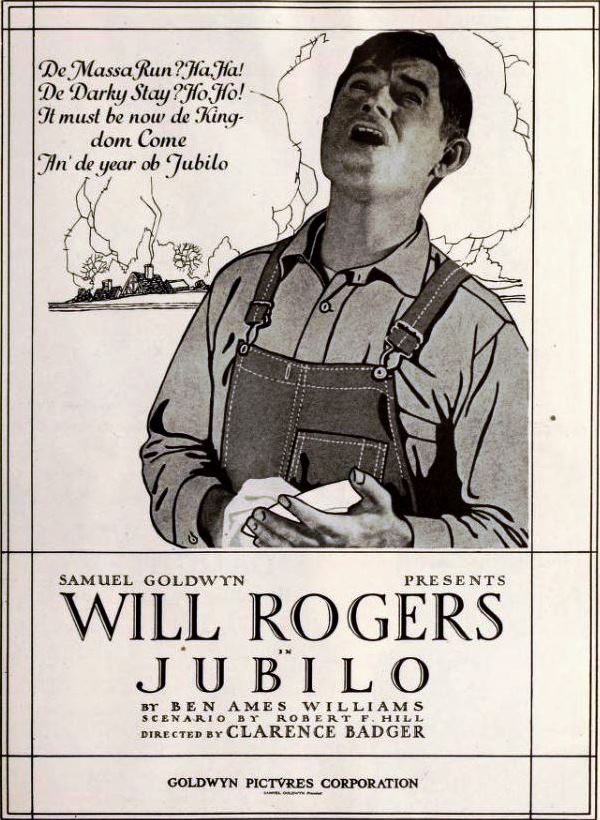
Title Track: Worst. Title Song. Ever. Jubilo gets his name from the Civil War-era song “Kingdom Coming”, in which slaves celebrate their upcoming freedom as a day of jubilee (or “jubilo” in the song’s super-racist approximation of a Black dialect). If you want an idea of just how bad these lyrics are, the refrain is printed in the film’s poster at the top of this post. And trust me, it gets worse.
Other notes
- Before I go any further, a huge tip of my hat to my fellow NFR-obsessed colleague over at “Registering the Registry” for writing the only thorough essay on “Jubilo” I could find online. “Registering” clearly enjoyed delving into Will Rogers’ career, with the post increasingly being written in a Rogers-esque folksy manner. Keep up the good work, Gargus!
- “Jubilo” originated as a serial in The Saturday Evening Post in June and July of 1919. The film adaptation was released that December, allowing me to once again marvel at just how quick the turnaround was with silent films. Allegedly there was no script, with the actors reading the short story and improvising their lines, but I don’t know if I believe that. What I do know is that Will Rogers definitely had a hand in re-writing some of the intertitles to better match his writing style.
- “Jubilo” was Will Rogers’ third movie, and the earliest known to still survive. It was also his second of an eventual 14 collaborations with director Clarence Badger, the first was “Almost a Husband”, released just two months before “Jubilo” in October 1919. Once again, the turnaround on these things, I tell ya.
- Well, this movie wastes no time getting started. The title cards play over a shot of Jubilo waking up in a field and starting his day, and then he immediately witnesses the train robbery. We got less than an hour, let’s keep it moving!
- Speaking of title cards, many of the intertitles feature some beautiful artwork, often showing us what is being mentioned by the characters (an illustration of Rose’s pie, etc.)
- It should be noted that Will Rogers does zero rope twirling in this movie. Heck, he barely does any humorous one-liners. Clearly the Will Rogers film vehicle had not been perfected in 1919.
- For a movie that is often labeled a comedy, there sure isn’t a lot of comedy. Aside from a few funny lines, the film’s only bit of comic schtick is a scene where Jubilo tries to milk a cow. It starts off as funny, and then turns into borderline animal abuse.
- One of Judge Hardy’s horses has the same large white mark on its rear end as one of the horses at the train robbery, which makes Jubilo suspicious of his new employer. That story again: Our first plot point involves a horse’s ass.
- Also, the Judge Jim Hardy of this movie is of no relation to the Judge James Hardy from those Mickey Rooney movies. In fact, the play that the Andy Hardy film series is based on wouldn’t be written for another decade.
- Sheriff Punt is played by Willard Louis, who looks like if Charles Durning played W.C. Fields (which would have been great casting in another movie). The sheriff comes by to inspect Hardy’s “white-rumped” horse, a phrase that continues to tickle me just right.
- The actor playing Bert Rooker is credited here as Jim Mason, though for most of his career he would go by James Mason – not to be confused with the British James Mason that would become a big movie star in the 1950s. In fact, Jim’s film career was virtually over by the time James started acting in England in the 1930s.
- Line that made me laugh out loud: “The barn wins by two-thirds majority.”
- Shout out to cinematographer Marcel Le Picard. The camerawork in “Jubilo” isn’t particularly artistic or revelatory but compared to other films of the time it’s well shot with a sharp eye for composition. Le Picard would continue to work as a Hollywood cinematographer for the next 30 years, almost exclusively for B movies at various Poverty Row studios (he worked with both the Bowery Boys and the East Side Kids!).
- This movie has not one but two fight scenes! The first one is Judge Hardy beating Jubilo for his laziness, but the other is a much more entertaining barroom brawl between Jubilo and Bert. You can’t fully hate any movie with a barroom brawl.
- There’s a lot of subtle hinting throughout the movie about Bert’s past connection to the Hardys, and I admit that it helped keep me engaged with this movie as it went on. No spoilers, but the eventual reveal is a fun twist in an otherwise predictable movie.
- Judge Hardy may be the best shot in any movie I’ve ever seen: He fires his gun from underneath his overalls!
- This movie ends with Jubilo and Rose singing “Kingdom Coming” together, which is always an odd choice for a silent movie.
Legacy
- I can’t find anything to confirm if “Jubilo” was a hit when released, but according to the NFR, “Kingdom Coming” became Will Rogers’ theme song because of its use in this film. So, there’s that.
- Will Rogers reprised his role as Jubilo a handful of times; first in a pair of shorts for Hal Roach: 1923’s “Jus’ Passin’ Through” and 1924’s “Jubilo Jr.” (one of the “Our Gang” shorts), and then one last time for the film’s 1932 sound remake “Too Busy to Work”.
- Among the many other film adaptations of Ben Ames Williams’ work is another future NFR inductee: the 1945 noir classic “Leave Her to Heaven“.
- Clarence G. Badger would go on to direct two more NFR movies: “Hands Up!” with Raymond Griffith and “It” with Clara Bow. Badger and Rogers would work together on 12 more films over the next three years, with such amusing titles as “The Ropin’ Fool”, “Jes’ Call Me Jim”, and “Cupid the Cowpuncher”.
- But of course, this film’s main legacy is the beginning of Will Rogers’ brief but successful film career, abruptly ending with his tragic death in 1935. Among Rogers’ other movies are the aforementioned “State Fair”, as well as “A Connecticut Yankee”, which I still think would work better as his NFR pick.
Bonus Clip: I have somehow gone two Will Rogers posts without mentioning “The Will Rogers Follies”, which played Broadway in the early ’90s and waved the flag for American musicals amid the dominance of Britain’s mega-musical imports. Here’s the always great Keith Carradine as Rogers, a role he has reprised from time to time.
 The Horse's Head
One thought on “#685) Jubilo (1919)”