
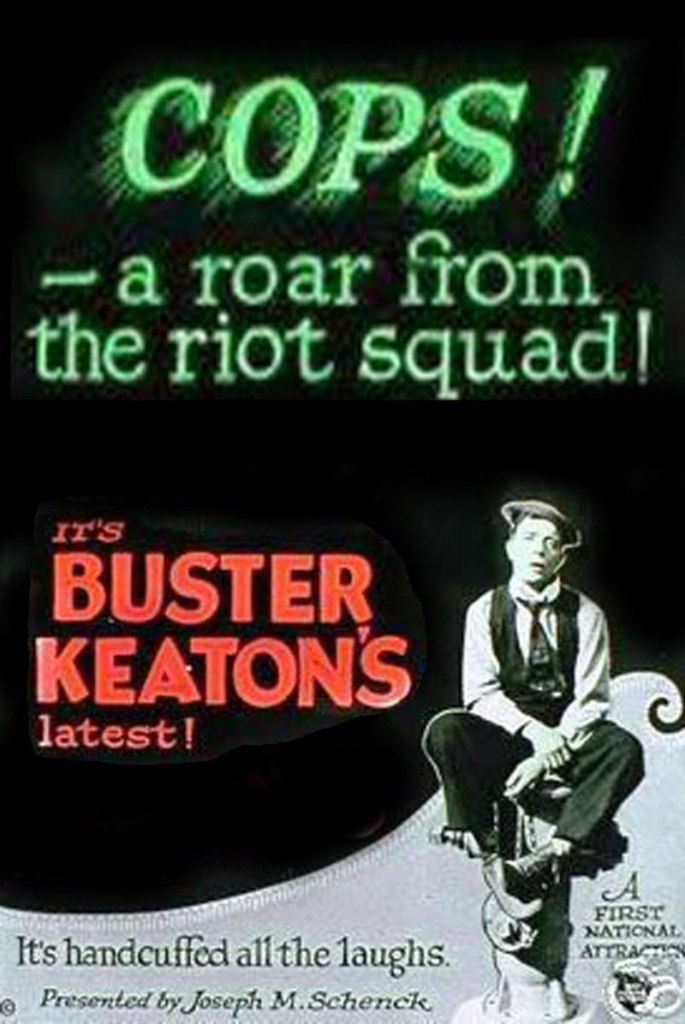
#688) Cops (1922)
OR “Law & Disorder”
Directed & Written by Buster Keaton and Edward F. Cline
Class of 1997
The Plot: Buster Keaton plays – as usual – a lovelorn sad sack trying to woo a young woman (Virginia Fox), who won’t be with him until he has become “a big business man”. Within a few short scenes, Keaton steals a rich man’s wallet, is conned into buying furniture from a seemingly destitute man (Steve Murphy), buys a horse and carriage that aren’t for sale, gets mistaken for a mover by the man who actually owns the furniture (Joe Roberts), crashes a policemen parade, sets off a bomb, and is chased through town by hundreds of cops. And all in 18 minutes!
Why It Matters: The NFR calls it “one of Buster Keaton’s best short films”, praising his “popular blending of athleticism and his unique stone-faced comedic style.” An essay by AMPAS archivist Randy Haberkamp is a love letter to the short, with an encouragement to see it on a big screen as intended.
But Does It Really?: I’ll try not to make this another gushfest, but this may be the funniest short I’ve gotten to watch for this blog. Keaton has quickly become my favorite of the silent film comedians, and “Cops” once again delivers a generous helping of his trademark inventiveness and laugh-out-loud gags. There’s definitely a lot of Keaton on the Registry (five features, two shorts, plus his cameo in “Sunset Boulevard“), but “Cops” shows us just how good he was right from the start. No argument from me for the NFR inclusion of “Cops”.
Wow, That’s Dated: The one joke that I needed to have explained to me is when Buster accidentally takes his horse to a “Goat gland specialist”. This is a reference to John R. Brinkley who was – according to the first sentence of his Wikipedia page – “an American quack.” Brinkley’s claim to fame was promoting the use of goat glands to cure erectile dysfunction, which got him nationwide notoriety despite the abundance of scientific evidence proving this procedure was a load of crap. Brinkley came to Los Angeles in 1922, so the reference to him in “Cops” is extremely topical.
Other notes
- A quick word on Buster Keaton: Buster was born to vaudeville-performing parents, and by the time he was three was recruited to join the act, learning how to perform comedy (both verbal and physical) at a young age. By the late 1910s, the slow death of vaudeville (mixed with his father’s alcoholism) threatened to end the Keaton family’s act, and Buster knew a career pivot was in order. While in New York, Buster met Roscoe Arbuckle, who convinced a reluctant Buster to act in short comedy films. Arbuckle’s producer Joseph Schenck was so impressed with Keaton that in 1920 he gave Keaton his own independent film unit: Buster Keaton Productions. From 1920 to 1923, Keaton wrote, directed, and starred in 19 shorts. The first was fellow NFR entry “One Week” in 1920, and “Cops” was the twelfth.
- Interestingly, Buster Keaton is credited here as “Buster” Keaton. Born Joseph Keaton (like his father), he earned the nickname “Buster” as a child (the word “buster” has had several meanings at various times; its usage here could be to describe an extraordinary occurrence, a bad fall, or a very sturdy child). It’s interesting that someone felt the need to put Buster in quotation marks, as if to tell audiences, “Don’t worry, he has a Christian name, too.”
- While it’s easy to give Keaton all the credit, we can’t forget his collaborator Edward F. Cline. Cline started off as a gagman for Mack Sennett and was hired by Keaton to work with him once he got his own production unit. The two co-wrote and co-directed all of Keaton’s shorts, as well as his first feature, “Three Ages”. Post-Keaton, Cline had a successful solo directing career, including several films with W.C. Fields. Cline and Keaton reunited in the 1950s when Keaton made the move to television.
- I’ve been holding off writing about “Cops” in more detail because what is there to say? I found the whole thing unequivocally funny. The opening bit with the wallet? Funny. Keaton buying a horse and taking the family’s stuff? Hilarious. Keaton inventing a turn signal with a boxing glove and accidentally punching a cop? Side-splittingly funny. It all works. Well, except the goat gland bit that had to be explained to me. But now even that part is funny…in theory.
- Admittedly, things slow down a bit in the middle, but once Keaton wanders into the police parade and inadvertently sets off a bomb, the short goes into full Keystone Cops mode. This also prompts the best line in the short: “Get some cops to protect our policemen!”
- I won’t spoil the ending, but it’s a fun twist for an old comedy short. Just watch it. Seriously, the whole thing is only 18 minutes and very easy to find online. What else are you doing?
Legacy
- Within a year and a half of “Cops” being released, Keaton would make the jump to feature films, with his first feature – “Three Ages” – being released in September 1923.
- As with most of Buster Keaton’s other iconic works, “Cops” is primarily remembered as part of the collective Buster Keaton filmography rather than as an individual entity. If you’ve seen one clip from this movie, it’s either Keaton being chased by a mob of police officers (as seen in “Precious Images“) or quickly grabbing hold of a moving vehicle and being whisked away (a bit emulated in many a film and TV show since).
- And finally, “Cops” is of no relation to “COPS” the FOX TV show. But hey, it’s a good excuse for me to play “Bad Boys”.
“Cops” was filmed on location with the men and women of Buster Keaton Productions. All fictional protagonists are innocent until proven guilty in a court of law.
 The Horse's Head
One thought on “#688) Cops (1922)”