
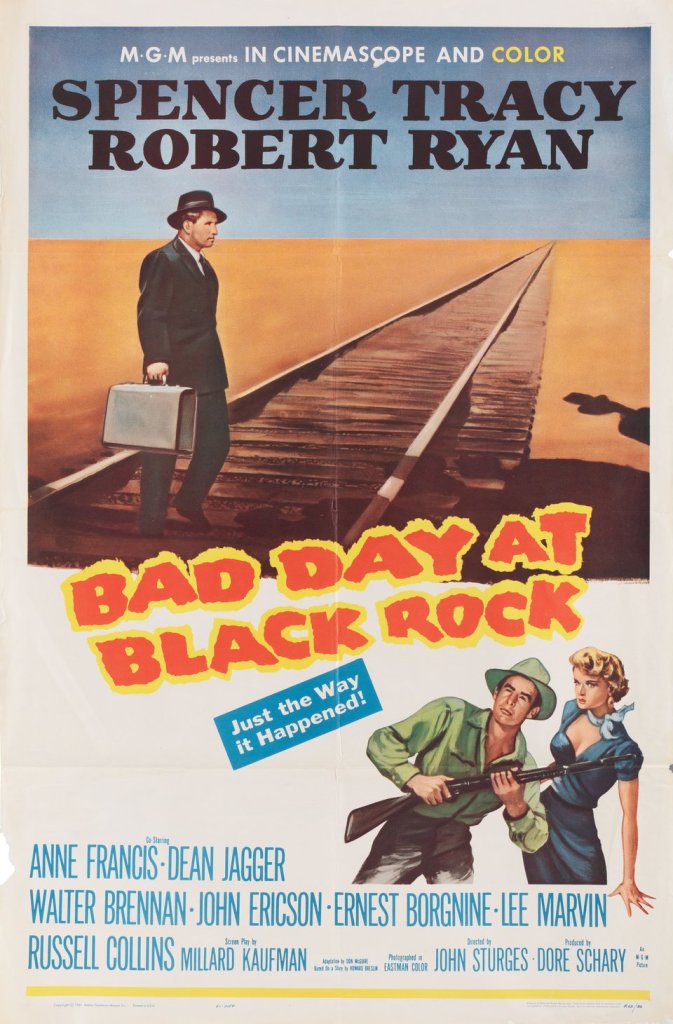
#691) Bad Day at Black Rock (1955)

#691) Bad Day at Black Rock (1955)

OR “Tracy and Slow Burn”

Directed by John Sturges

Written by Millard Kaufman. Adaptation by Don McGuire. Based on the short story “Bad Time at Honda” by Howard Breslin.

Class of 2018

The Plot: There’s a strange occurrence in the small town of Black Rock, California one day in 1945: the train stops there for the first time in four years. Off the train comes John J. Macreedy (Spencer Tracy), a one-armed man looking for someone in the town named Komoko. The townspeople do not take kindly to Macreedy, preventing him at every step from learning anything about Komoko’s whereabouts. Reno Smith (Robert Ryan), who seems to have an unspoken grip on the other townspeople, informs Macreedy that Komoko was sent to a Japanese internment camp during the war, but Macreedy suspects there is more to the story. In a span of roughly 24 hours, secrets will be revealed, prejudices will be confronted, and we find out what exactly makes this such a bad day at Black Rock.

Why It Matters: The NFR states that despite its short runtime, the film “packs a punch”, praising its “standout” cast, as well as its cinematography.

But Does It Really?: “Bad Day at Black Rock” has a lot going for it, but I kept wondering “How did this make the NFR?”, especially in recent years with the NFR making a conscious effort to include movies by more diverse filmmakers, and not just classic studio pictures by White guys. My best guess is that whoever made the argument for this film’s inclusion emphasized its condemnation of anti-Asian and anti-Asian American hate crimes (still depressingly relevant, by the way). I’ll be nice and give “Bad Day” the “minor classic” designation: While nowhere near as iconic a movie as its contemporaries on the list, “Bad Day” is still an engaging movie that delivers its message uniquely and devoid of preachiness. Plus, it’s 81 minutes. You know how much I love a movie that doesn’t waste anybody’s time.

Everybody Gets One: Don McGuire was primarily an actor, but by the early ’50s he was also dabbling in producing and screenwriting. McGuire paid $15,000 (over $170,000 today) to adapt “Bad Time at Honda” into a screenplay, and successfully pitched the idea to producer Dore Schary of MGM. While Schary liked the story (his movies tended to tackle social issues of the day), he had writer Millard Kaufman do another pass at the screenplay. Ultimately, Kaufman got the final screenplay credit for the movie, with McGuire getting an “Adaptation by” credit. Side note: Technically, this is Millard Kaufman’s only NFR movie. He is credited as the screenwriter for “Gun Crazy” but was merely acting as a front for the recently blacklisted Dalton Trumbo.

Title Track: As noted above, the short story the film is based on was called “Bad Time at Honda”. MGM requested a title change to avoid confusion with the recent John Wayne movie “Hondo”. Millard Kaufman suggested the name Black Rock after a real town in Arizona (although the fictional Black Rock of this film is in California).

Seriously, Oscars?: A hit upon release, “Bad Day” received three Oscar nominations: Director, Screenplay, and Lead Actor for Spencer Tracy. Unfortunately, it was a bad night for “Bad Day”, losing all three awards to “Marty” (With the extra irony of Ernest Borgnine beating out his own “Bad Day” co-star for Best Actor).

Other notes

  • I’m intrigued by the tagline on the film’s poster: “Just the Way It Happened!” To the best of my knowledge, this movie and its source material are not based on a real-world event.
  • “Bad Day at Black Rock” was filmed in the then-new Cinemascope widescreen format. At first glance it feels like an odd match, the film’s subdued, intimate setting vs. Cinemascope’s inherent grandness, but it ultimately works in the movie’s favor. The widescreen helps highlight the expansive nothingness beyond the city limits, showing how isolated Black Rock is from the rest of the world, making it a perfect spot for a racist like Reno to reign supreme. There’s also plenty of low angle shots, making everyone in this town loom seemingly as large as the nearby mountain ranges. It should be noted, however, that cinematographer William C. Mellor was not nominated for an Oscar for his impressive work here. And they had two cinematography categories back then! Seriously, Oscars?
  • MGM built the entire town of Black Rock on location in Lone Pine, a census-designated place in Inyo County, California, wedged between the Sierra Nevada and Death Valley. Coincidentally, Lone Pine is not too far away from Manzanar, site of a Japanese internment camp that is the subject of another NFR film.
  • The opening credits sequence of the train speeding across the landscape was added late in post-production after test audiences felt the film began too abruptly. John Sturges was unavailable, so associate producer Herman Hoffman filmed the sequence, including the helicopter shot of the train heading right towards the camera, with the camera flying out of the way at the last second. Sturges allegedly said of the opening years later, “It’s a helluva shot, but I didn’t make it.”
  • Spencer Tracy is one of my favorite actors, so of course I got nothing but praise for him in this movie. Tracy was always the right balance of old-school Hollywood acting and modern Method acting: Natural without calling attention to it. As Macreedy, Tracy is giving a nuanced, disciplined performance; somehow always in control while simultaneously looking like he wandered onto the wrong movie set. Not bad for someone who tried on multiple occasions to back out of making this movie. Side note: Tracy is dressed almost identically to how he’ll be dressed in one of my favorite movies: “It’s a Mad, Mad, Mad, Mad World”, making “Bad Day” look like it could be a prequel.
  • And yes, Macreedy is a one-armed man, which Tracy plays by stiffening up his left arm and keeping his hand in his pocket for the whole movie. [Insert Your Own “The Fugitive” One-Armed Man Joke Here. Janssen, Ford, Daly: Dealer’s choice.]
  • I was not familiar with the works of Robert Ryan before watching this movie, though he shows up in two NFR westerns I will be covering eventually (“The Naked Spur” and “The Wild Bunch“). As Reno Smith, Ryan is cast as the type of bigoted heavy he always seemed to play in the movies. Rare is the actor who seems like a genuine threat to Spencer Tracy, but Ryan gives Smith the right amount of menace; one of those guys that doesn’t need to do the dirty work himself but can and will if the situation calls for it. I look forward to seeing Ryan’s other NFR performances.
  • In addition to Spencer Tracy and Robert Ryan, you get great supporting turns by Walter Brennan as the town doctor and Dean Jagger as the ineffective sheriff, plus early-career Ernest Borgnine and Lee Marvin as two of Smith’s thugs. Marvin in particular gets some good moments as the first townsperson to openly threaten Macreedy. Going toe to toe with Spencer Tracy this early in your career is a gutsy move. In fact, between this and Marvin’s latter intimidating of Jimmy Stewart and John Wayne in “Liberty Valance“, his early acting strategy is the equivalent of shivving the biggest guy in the prison yard.
  • Anne Francis doesn’t get a lot to do as the only woman in this movie, but she shares her scenes with Spencer Tracy admirably. Oh well, at least we all have her work in “Forbidden Planet” to look forward to.
  • [Semi-spoiler] Funny how the movie has been highlighted for its progressive tolerance of Japanese Americans, and yet the only Japanese people mentioned (Komoko and his son) are never actually seen on screen. Seems a bit backwards, but this is 1955: the mere mention of any non-White characters (and acknowledgement of the bigotry directed at them) is a step forward…I guess.
  • In another universe Spencer Tracy would have been a great Lou Grant. I know that has nothing to do with anything, but if “The Mary Tyler Moore Show” was somehow a ’50s workplace comedy, Tracy would have nailed it. I can just hear him saying “You’ve got spunk; I hate spunk.”
  • The one downside to all the natural performances in this movie: Mumbling. So much mumbling. Everybody is mumbling. It really says something when the most coherent actor in your movie is Walter Brennan. On a positive note, it’s a testament to everyone’s performances that I was still able to follow what was going on at any given time without resorting to subtitles.
  • Spencer Tracy was never really an action star, so it’s fun watching him (or a convincing stunt double) give Ernest Borgnine a near fatal karate chop to the throat. It’s one of the first genuinely surprising moments in the movie for me. Speaking of…
  • [Spoilers] That climax really takes things up a notch, with Spencer Tracy MacGyvering a Molotov cocktail and setting Robert Ryan on fire! Didn’t see any of that coming.

Legacy

  • Although he had already been directing film for a decade at this point, John Sturges hit his filmmaking stride starting with “Bad Day”. In the ensuing years he would make “Gunfight at the O.K. Corral”, “The Old Man and the Sea” (reuniting with Spencer Tracy), “The Magnificent Seven” (which is on the NFR), and “The Great Escape” (which isn’t). Despite his later achievements, Sturges named “Bad Day at Black Rock” his favorite of his own films.
  • “Bad Day at Black Rock” marked Spencer Tracy’s final film as a contract player with MGM after 20 years, opting to spend the rest of his career as a freelance agent. Tracy would, however, briefly return to MGM in 1962 to narrate “How the West Was Won“.
  • “Bad Day at Black Rock” still gets referenced every so often in pop culture, though mostly just the title (including by me in a real stretch of a subtitle for my “Pillow Talk” post). There have also been episodes of such TV shows as “Kojak”, “Remington Steele”, and “The X-Files” that take the film’s basic premise of a stranger in a small town with a secret. Ever the movie buff, Remington Steele even calls out the connection in his episode (though he calls it “A Bad Day at Black Rock” and gets the year wrong. But hey, there was no internet back then.)
  • And finally, although Don McGuire lost out on a screenplay credit for “Bad Day”, he would go on to write the play “Would I Lie to You?” and successfully got a story credit (and Oscar nomination) on its eventual film version: “Tootsie“.

#690) Letter from an Unknown Woman (1948)

#690) Letter from an Unknown Woman (1948)

OR “The Ophüls Truth”

Directed by Max Ophüls

Written by Howard Koch. Based on the novella by Stefan Zweig.

Class of 1992

A modern trailer

The Plot: In turn-of-the-century Vienna, former piano prodigy Stefan Brand (Louis Jourdan) is planning to skip town rather than participate in a duel with an unknown challenger. Before leaving, his butler John (Art Smith) hands him a recently delivered letter that opens with “By the time you read this letter, I may be dead.” From reading the letter, Stefan learns of its author Lisa (Joan Fontaine) who, as a teenage girl, first met and immediately fell in love with Stefan. Growing up, Lisa rejects all other romantic advances and marriage proposals, clinging to the fantasy of one day being with Stefan, who has barely taken notice of her. In her adult years, Lisa finally has an extended encounter with Stefan, culminating in a romantic evening together. Although Stefan promises to return to Lisa after a two-week concert engagement in Milan, he never returns. There’s plenty more heartbreak where that came from courtesy of one of Europe’s greatest directors on a brief detour to Hollywood.

Why It Matters: The NFR gives a little background on Ophüls, praising his “stylish trademarks” such as “fluid long takes, elaborate camera movements, opulent detail, and visual repetition”.

But Does It Really?: I suspect this is one of those NFR movies that serves as a loophole to get an acclaimed international director on the list. We’ve covered NFR movies from the likes of Fritz Lang and Sergio Leone that, while not their definitive work, are worthy enough to be included due to the filmmakers’ overall contributions to world cinema. This might be the case with Max Ophüls, with “Letter from an Unknown Woman” being a respected entry in his filmography, albeit in the shadow of his European films. While we’ve had a few entries like this over the years, it’s interesting that the NFR chose to induct “Letter” so early (it’s among the Registry’s first 100 movies). “Letter from an Unknown Woman” is largely forgotten but, if you’re willing to go along with it, is an enjoyable classic Hollywood melodrama and a fine representation of Max Ophüls.

Everybody Gets One: Max Ophüls started off as a theater actor and director in his native Germany, and by the early 1930s was making his first short films. Following the rise of the Nazi party in 1933, Ophüls moved across Europe continuing to make movies, arriving in America in 1941 and staying for the remainder of the decade. In his brief time in Hollywood, Ophüls made five films and directed such stars as Douglas Fairbanks Jr., James Mason, Joan Bennett, Barbara Bel Geddes, and of course Joan Fontaine. Fun Fact: Max was born Max Oppenheimer but changed his last name to Ophüls (after a prominent family in German aristocracy) so that his family name wouldn’t be tainted if he failed as an artist. Turns out that’s not something he had to worry about.

Seriously, Oscars?: No Oscar nominations for “Letter”, a semi-independent entry during the studio system’s dominance over the awards. Ophüls would eventually receive two Oscar nominations in his career: a Screenplay nod for “La Ronde” and Art Direction for “Le Plaisir”.

Other notes

  • Up until this viewing, I always got this movie mixed up with “A Letter to Three Wives“. Same era of movies, same basic framing device; can you blame me?
  • “Letter from an Unknown Woman” was one of a handful of movies made by Rampart Productions, an independent company formed by Joan Fontaine and her husband William Dozier, who served as this film’s executive producer. Neither their production company nor their marriage lasted too much longer after this film’s release.
  • Shoutout to “Letter” producer John Houseman: former Orson Welles associate, one-time Joan Fontaine paramour, and future Oscar-winning “Paper Chase” actor. Funnily enough, Houseman is only on the Registry as a producer (this and “The Bad and the Beautiful“). Side note: Every time John Houseman is mentioned I just hear Jerry Seinfeld’s impression of him; “Alec Beeeerg. Miss-tah Beeeerg.”
  • In the original novella, both Lisa and Stefan are unnamed (because, you know, the title). For those of you keeping score, that would have been two NFR entries in which Joan Fontaine plays an unnamed woman. We were so close to me reprising my Mulva runner from the “Rebecca” post. Hey, that’s two “Seinfeld” references in one post! Not bad for a 75-year-old movie.
  • I appreciate that the letter Lisa writes – which serves as the narration for the entire movie – is multiple pages front and back. All I could think of was the massive carpal tunnel she must have had while writing it.
  • This movie’s flashbacks begin with Lisa as a teenager, still played by Joan Fontaine. It’s a little weird, especially in Joan’s scenes with an actual teenage girl playing her friend, but I give her credit for this performance. You can see Joan really focus on the specific physicality of an awkward teenager, a chance for a movie star to show off their skills as an actor with range. Lisa’s character arc works because of Joan, but the teenager stuff is a bumpy start.
  • Stefon’s mute butler John is played by Art Smith, one of the many character actors in this movie who have been quietly popping up in multiple NFR movies without me noticing, aside from the occasional “Who’s that guy? He looks familiar.” And for you MST3K fans out there: Art Smith played Pile-On Pete!
  • While we’re talking about the butler, making him mute is unique to the movie, and I assume is there mainly as a plot device. I don’t know; I feel like at any moment John could have written to Stefon, “That’s the same woman, you moron!” But of course, there would be no movie if that happened, so back to the sidelines with you, Pile-On.
  • Stefon is a real bastard, but Louis Jourdan is very charming in the part. Even when you know Stefon is not going to reciprocate Lisa’s feelings, you’re still drawn to the guy. And I liked him a lot better in this than in “Gigi“, but that’s a low bar.
  • The cinematography by longtime Ophüls collaborate Franz Planer, as expected, is wonderful. It’s all very much the kind of stylish gliding associated with Ophuls, but never distracting or in disservice to the story. I particularly love the shot of Lisa and Stefon in their private booth at the restaurant. The camera zooms in on a part between the curtains, as if we are spying on their secret romance.
  • Another little detail I enjoyed: the occasional side commentary from different workers on Lisa and Stefon’s date, like the ride operators at the amusement park, or the women in the band. It’s all some much appreciated comic relief a la the animal appliances on “The Flintstones” (“It’s a living”). In fact, one of the bandmembers’ lines made me laugh-out-loud: “I like to play for married people. They’ve got homes.”
  • It’s not a melodrama until we get a “teary farewell at the train station” scene, which of course always makes me think of the parody version in “Airplane!” Speaking of, to my great disappointment, the Howard Koch that wrote the screenplay to “Letter from an Unknown Woman” is not the same Howard Koch that produced “Airplane!” That would have been too incredible for me to handle.
  • [Spoilers] Whoa, did not realize that Lisa has Stefan’s baby! That’s pre-marital sex and a child out of wedlock in one movie! But of course, this was approved by the Production Code, which we all know means that this won’t end well for anyone.
  • Shoutout to Marcel Journet as Lisa’s husband Johann, the rare “other man” in a Hollywood romance movie. He’s got the right mix where we understand his actions without hoping he succeeds instead of our protagonists.
  • Wait, there’s two train scenes? It’s an embarrassment of riches! Of course, this one is Lisa saying goodbye to her son and setting up the plot convenience that makes sure their Code-era sins are atoned for.
  • It’s hard to watch a melodrama like this without applying my 2024 sensibilities like, “Where the hell was Stefan?” and “Why does Lisa still love him?” It’s always a good reminder to try and meet these movies where they’re at. This movie doesn’t care about my logic-poking, it just wants you to get swept away in the romance of it all.
  • [Spoilers] The ending is quite effective, with Stefon having his Keyser Söze moment where he pieces together his memories of Lisa and realizes it was her all along, including seeing a ghostly apparition of her teenage self at the same spot where they met. It’s all very beautiful, and almost distracts you from the fact that he is still a real S.O.B. Also, the reveal that Johann is the man who challenged Stefon to a duel is an inevitable Code-enforced workaround, but it does the job.

Legacy

  • Following his work in America, Max Ophüls returned to Europe and made what are widely considered his best films, including “La Ronde”, “Le Plasir”, and “The Earrings of Madame de…”. Ophüls died in 1957 while working on “Les Amants de Montparnasse 19”, a film that would ultimately be completed by his friend Jacques Becker.
  • Max Ophüls’ filmography made a big impression on the French New Wave that was just getting started when he passed, which has led to new generations of film lovers discovering his work. “Letter from an Unknown Woman” got swept up in the reappraisal and is generally considered his best American film.
  • Following its box office failure and the subsequent dissolvement of Rampart Productions, “Letter from an Unknown Woman” was sold to Mundus Television in 1954 and started making the late show movie rounds. At some point the film lapsed into public domain and is currently available on several internet video sites and streaming services for free.
  • The original novella of “Letter from an Unknown Woman” has been adapted into other movies many times over the years, as well as a Russian opera in the ’70s.
  • Joan Fontaine’s film career stayed steady through the 1950s, and while some of them were popular with audiences, none have retained any significant legacy. Outside a few TV movies in her later years, Ms. Fontaine’s last movie was 1966’s “The Witches” for Hammer Films. Joan Fontaine died in 2013 at age 96.
  • And finally, because of course it’s worth mentioning: Executive producer William Dozier would pivot to television later in his career, most notably as the producer and narrator of the Adam West “Batman” TV show. “What’s this!? Lonely Lisa’s letter of lost love left lingering by loathsome lothario!?”

Further Viewing: Any of Max Ophüls’ later filmography mentioned above. I haven’t seen any of them, but I’m adding them to my ever-expanding list of international movies to get around to once I’ve finally caught up with all these American movies.