
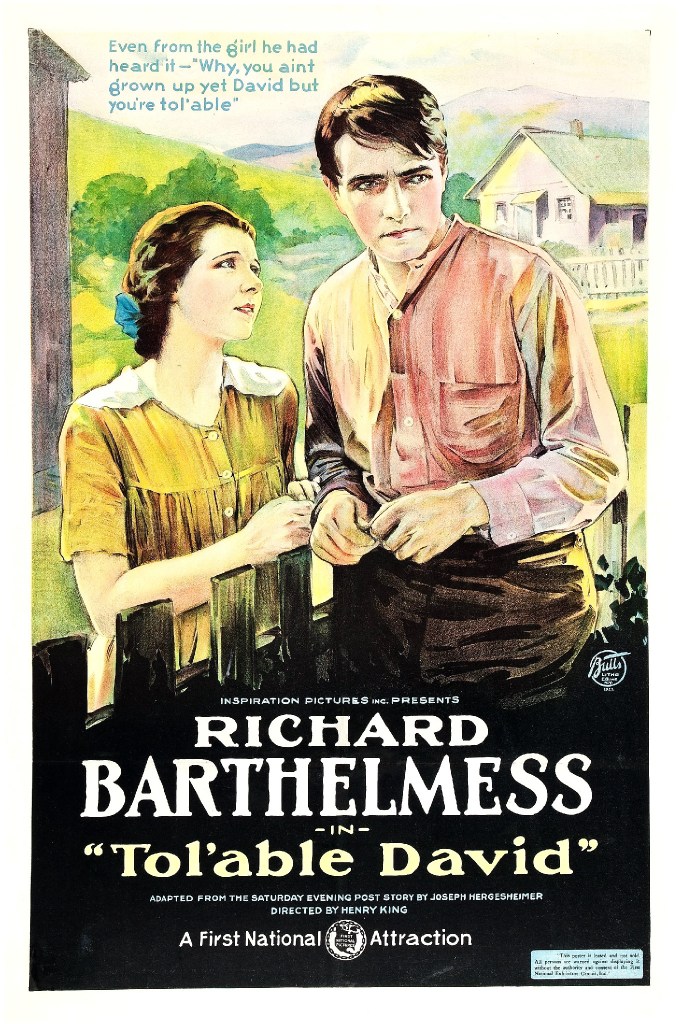
#693) Tol’able David (1921)
OR “Alpha Mail”
Directed by Henry King
Written by King and Edmund Goulding. Based on the short story by Joseph Hergesheimer.
Class of 2007
The Plot: In the hills of rural West Virginia, teenager David Kinemon (Richard Barthelmess) dreams of being seen by his family as a responsible adult and not just as tolerable (or “tol’able” as the intertitles say). Life on the family farm takes a turn when the Kinemon’s neighbors Grandpa Hatburn and his granddaughter/David’s crush Esther (Forrest Robinson and Gladys Hulette) take in their fugitive cousins (Walter P. Lewis, Ernest Torrence, Ralph Yearsley), who terrorize everyone in sight. When the Hatburn cousins injure David’s older brother Allen (Warner Richmond), which leads to the fatal heart attack of their father (Edmund Gurney), David takes over Allen’s job as the town mailman and becomes the family’s sole source of income. As the Hatburns continue to wreck havoc, David must gain the courage needed to stand up to those goliaths (get it?) and become a man. Because nothing says responsible adulthood like violent vengeance.
Why It Matters: The NFR calls the film “a powerful drama” that “was tremendously influential on subsequent filmmaking.” An essay by silent film expert Fritzi Kramer is mostly a recap of the movie, but also takes time to praise the contributions of both Henry King and Richard Barthelmess.
But Does It Really?: This is definitely on the “historical significance” side of things. “Tol’able David” was a nostalgic crowd-pleaser in its day, but over 100 years later it was a real slog for me to get through. There’s nothing inherently wrong with the movie, but there was a barrier between me and the film that I could never penetrate. Part of that is the film’s sluggish pacing, but part of that is also the casting of Barthelmess as David (more on that later). As one of the best received films of 1921, “Tol’able David” is as worthy of its NFR induction as any other silent film, but any modern viewing should be reserved strictly for film buffs.
Wow, That’s Dated: I had never heard of a “hack” before, which everyone refers to regarding the mail position David covets so much. Short for Hackney carriage, hacks were rentable horse-drawn carriages; the first ride-share, if you will.
Seriously, Oscars?: Obviously there were no Oscars when “Tol’able David” was released, but the film did win the second ever Photoplay Medal of Honor award for Picture of the Year: the first major American movie award. Also of note is that when the Oscars finally did come around, Richard Barthelmess was one of the first Best Actor nominees for his performances in the crime drama “The Noose” and the WWI drama “The Patent Leather Kid”.
Other notes
- “Tol’able David” was a passion project for Henry King and Richard Barthelmess, produced under their newly formed independent production company Inspiration Pictures (though neither is credited as a producer in the final cut). The film was originally to be made by D. W. Griffith as a vehicle for Barthelmess (one of his contract players), but he sold the rights to King and Barthelmess for $7500 (about $130,000 today). Henry King had grown up in Virginia, and filmed most of the movie in Crab Farm, not too far from where he was raised. Many locals, including the mayor of Crab Farm, appear as extras in the film.
- Here’s my main issue with this movie: David is a teenage boy, but Richard Barthelmess is a 26-year-old man. Sure, with a shaven face and a clean haircut Barthelmess has a boyish quality to him, but he’s still clearly an adult playing a teenager. It gives the film a borderline “Clifford” vibe, without the advantage of being played for laughs. Also, I initially assumed that I had never seen Barthelmess in a movie before, but my research reminded me that I have seen him in yellow face as the star of “Broken Blossoms“. Yeesh.
- Shoutout to Gladys Hulette as Esther. A stage veteran since she was three, Hulette is also too old to be playing a teenager (she was 25) but given her limited screentime it’s much less distracting here than it is with her co-star. Hulette also pops up in the NFR as one of the fairies in that truly bizarre “Princess Nicotine” short I covered some years back.
- This movie is filled with people who kind of look like other people. Esther reminds me a bit of Laura Linney, Luke Hatburn looks like Al Bundy on a particularly bad day, and Mr. Galt has a resemblance to an older Charles Nelson Reilly. When I’m not invested in the movie I’m watching, I guess I just start looking at faces.
- The Hatburns waste no time being the bad guys, threatening a cat and killing a dog! Is there an orphanage they can burn down while they’re at it?
- Speaking of the dog, why is a dog in 1921 named Rocket? Turns out the earliest known rockets (powered by gunpowder) were being used in China in the 1200s, and the earliest concept of a rocket being used for space travel dates to the 1860s. Shows what I know.
- This movie oscillates between nothing happening and then everything happening. Part of that is the adaptation of a short story into a feature film, which means lots of padding and dramatic pauses. There was a point where I was begging the movie to do something, and then they killed off two characters and I thought “That’s too much, movie. Reign it in.”
- Oh good, the movie’s comic relief is a drunk with an eye-patch. He’s the guy who initially takes over “the hack” from Allen but is fired for his drinking problem. It’s not unlike the drunk Santa at the beginning of “Miracle on 34th Street“. “A man’s gotta do something to keep warm…”
- Wow, that finale gets pretty violent (well, violent by 1921 standards), with lots of gunplay and some on-screen blood! Did Sam Peckinpah’s dad direct this?
- After a bit of foreshadowing during the opening, the finale shouts the “David & Goliath” comparisons louder for the people in the back. I mean come on: His name is David and the guy he’s fighting is like a full foot taller than him, it’s obvious where this is going. The only thing missing is the Claymation dog preaching morality and Lutheran values to children.
- It amuses me that David’s main goal at the end of the movie is to deliver the mail that was stolen by the Hatburns. Neither rain nor sleet nor hillbilly outlaws will keep David from his appointed rounds. The USPS won’t get another advertisement this good until “The Postman Always Rings Twice”.
- So, the moral of this movie is that true manhood is defined by courage and vengeance? I’ve said it before and I’ll say it again: Toxic masculinity sucks.
Legacy
- “Tol’able David” was a major hit upon its release in December 1921, receiving praise from the film critics, as well as from such artists as Mary Pickford and John Ford.
- The NFR write-up mentions the “subsequent filmmaking” that was influenced by this movie, but I’m not finding anything concrete to back that up. A few resources mention V.I. Pudovkin and Humberto Mauro as artists inspired by the film, but I can’t find anything on how exactly this film influenced their work.
- Henry King’s directing career went well into the sound era of film, giving us such movies as “In Old Chicago”, “The Song of Bernadette”, “Love Is a Many-Splendored Thing”, and fellow NFR entries “State Fair” and “Twelve O’Clock High“. Co-writer Edmund Goulding would also go on to a prolific directing career, helming, among others, Best Picture winner “Grand Hotel“, which coincidentally made the NFR the same year as “Tol’able David”.
- Between “Tol’able David” and D. W. Griffith’s “Way Down East”, Richard Barthelmess’ film career hit its peak in the early 1920s. As the 1930s started and Barthelmess was aging out of his boyish leading roles, he pivoted to supporting turns in sound films. We’ll see Barthelmess again when I get around to covering “Only Angels Have Wings“.
- Like many a classic silent film on this list, “Tol’able David” was remade with sound in 1930. Twenty-year-old Richard Cromwell played David (which is a little better I guess) and the cast includes a very young John Carradine.
- The one bit of pop culture that gets brought up in almost everything I’ve read about “Tol’able David”: It’s featured prominently in the third act of “The Tingler”, a 1959 William Castle horror movie with his infamous “Percepto” gimmick. The titular tingler is let loose in a revival movie house, and guess what movie is getting revived?
 The Horse's Head
One thought on “#693) Tol’able David (1921)”