#697) Touch of Evil (1958)
OR “Chuck and the Fatman”
Directed & Written by Orson Welles. Based on the novel “Badge of Evil” by Whit Masterson.
Class of 1993
NOTE: This post is based on my viewing of the 1998 Reconstructed version.
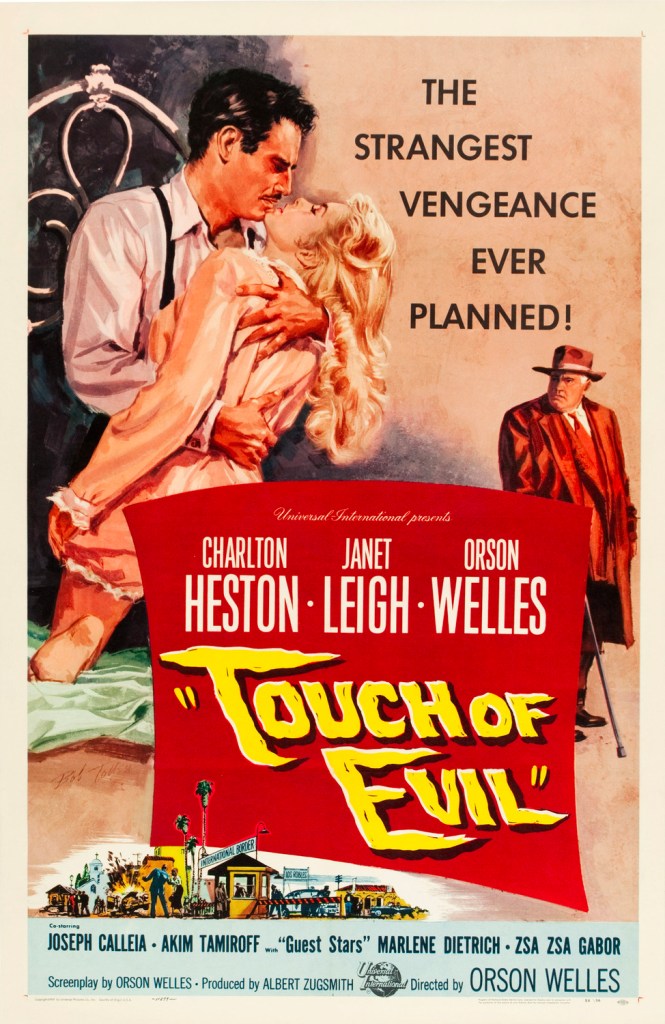
The Plot: While crossing the Mexican border into the US, special prosecutor Miguel Vargas (Charlton Heston) and his new bride Susan (Janet Leigh) witness a car explode as it travels into Mexico. Vargas immediately postpones his honeymoon and returns to Mexico to investigate. Leading the US side of the investigation is Police Captain Hank Quinlan (Orson Welles), a bigoted recovering alcoholic with an unblemished track record of successful arrests. When Quinlan interrogates his prime suspect – the victim’s son-in-law Manolo Sanchez (Victor Millan) – he discovers sticks of dynamite that match those used for the car bomb. Vargas realizes that the dynamite was planted, and suspects that Quinlan’s entire career has been founded on corruption. As Vargas gets closer to the truth, Quinlan works with crime boss Joe Grandi (Akim Tamiroff) to get Vargas off the case, including having the Grandi gang harass Susan, who is staying in a nearby motel waiting for her husband. There’s a lot going on in this seedy crime thriller, but because it’s Welles it compensates for its lack of cohesion with his trademark cinematic flair.
Why It Matters: The NFR calls it “one of cinema’s most influential and audacious suspense dramas”, praising Russell Metty’s “shadow-drenched cinematography”, particularly during the opening shot. An essay by film critic Michael Sragow is a thorough rundown of the film, its production, and subsequent restorations.
But Does It Really?: Confession: I’ve never seen “Touch of Evil”, and I was worried it wouldn’t live up to its hype. Having now seen it, while I’m not a new convert to the church of this movie, I enjoyed it and understand why it’s a lot of people’s favorite Orson Welles movie. In what was ultimately his last movie for a Hollywood studio, Welles shows that he still has plenty of tricks left up his sleeve, creating a stylish, unsettling, captivating movie. It is not without its faults (once again, Charlton Heston is playing a Mexican), but like so much of Welles’ filmography, “Touch of Evil” is an entertaining movie that becomes more intriguing the more you study it. Orson Welles already had his two most famous films on the Registry at this point, but “Touch of Evil” is just as worthy of being considered a significant American film.
Wow, That’s Dated: We all know what this is going to be: White actor Charlton Heston plays Miguel Vargas in full-on brownface. It’s a very difficult pill to swallow. Heston later said that he regretted not using a Hispanic accent when playing Miguel. Really? That’s the part you regret?
Title Track: The film began production with the novel’s original title “Badge of Evil”. At some point during filming, producer Albert Zugsmith changed it to “Touch of Evil” (Zugsmith had a history of changing his movie titles, reasoning “I pick my titles to get ’em into theatres.”) Welles initially hated the new title, but eventually came around to it.
Other notes
- The pulp novel “Badge of Evil” was published in March 1956, with Universal acquiring the film rights shortly thereafter. “King of the Bs” Albert Zugsmith was hired to produce, and in quite a coup got Charlton Heston – fresh off the blockbuster hit “The Ten Commandments” – to star as assistant D.A. Mitch Holt. When Orson Welles was cast as Hank Quinlan, Heston suggested the Welles also direct (or possibly assumed Welles was directing; sources vary). Eager to appease their star, Universal hired Welles to direct, co-star, and do a rewrite of the screenplay (Side note: There’s also a version of this story where Welles picked “Badge of Evil” because it was the worst script he was offered, and he challenged himself to make it into a great movie). Welles’ most significant changes to the script were moving the book’s San Diego setting to a border town in Texas and making the Holt character the Mexican Miguel Vargas. Unusually for a Welles movie, the six-week shoot went off without any major hitch, with Welles saying it was the most fun he ever had on a shoot.
- The most famous scene in “Touch of Evil” is its opening: a 3 ½ minute uninterrupted take in which we meet Miguel and Susan, establish the film’s border town setting, and follow a ticking time bomb hidden in the trunk of a car crossing the border. It’s a wonderful sequence, and a great set-up to the whole movie and its unconventional style. It’s just a shame that Universal felt the need to put the opening credits over the shot for its original theatrical release (the credits are removed from the 1998 cut and placed at the end).
- Hey another US/Mexican border movie! I told you the NFR loves these things.
- Susan doesn’t have a lot to do in this movie, but Janet Leigh is great in this, making the most out of her first scenes confronting Grandi. Funnily enough, I can see flashes of her daughter, Jamie Lee Curtis, in this performance.
- Of course Welles gives himself the best entrance, as Quinlan steps out of his car and towers both metaphorically and literally over the whole investigation. And shout out to makeup artist and “Citizen Kane” alumni Maurice Seiderman. The prosthetic makeup Welles is wearing is so convincing it took me about half the movie to remember that he would have been 20 years too young to play Quinlan.
- Another big case of ethnic miscasting: Armenian actor Akim Tamiroff plays Mexican Joe Grandi. One look at Tamiroff’s filmography shows he was the Anthony Quinn of his day, playing practically every ethnicity other than his own.
- I love when a movie has a “Guest Stars” credit, in this case Marlene Dietrich and Zsa Zsa Gabor! Dietrich agreed to play the local madam Tana for the opportunity to work with Welles, and shot all her scenes in one day, which explains why she appears almost entirely in close-up shots and rarely shares the screen with her scene partners. Gabor was friends with producer Albert Zugsmith (possibly dating at the time), and her brief appearance as the strip club owner makes one NFR film apiece for both showbiz Gabor sisters (Eva’s in “Gigi“).
- Among the other established actors who agreed to appear in “Touch of Evil” in small roles are Keenan Wynn, Oscar winner Mercedes McCambridge, and another longtime Welles collaborator, Joseph Cotten (though Cotten’s one line as the town coroner is dubbed by Welles).
- I had a good time watching “Touch of Evil”. It has a very tense quality throughout that keeps you on alert and compels you to watch. This movie has also helped me form a theory on how to become a classic: Break all the rules, then wait 20 years. Most groundbreaking movies aren’t recognized as groundbreaking at the time, but over the years other filmmakers start emulating the movie and before you know it, those broken rules become the norm and a movie like “Touch of Evil” is reevaluated as “ahead of its time”. The reconstructed version is great, but I also understand why Universal opted for a more conventional cut. Welles’ original version would have been too out there for your average 1958 moviegoer. Remember, these are the same people who hated “Vertigo“.
- The second Janet Leigh said she’s checking into a motel I knew things weren’t going to turn out great for her.
- Speaking of that motel: What in the actual fuck is going on with Dennis Weaver’s performance? It’s so out of whack with the rest of the movie it’s distracting to the point of irritating. Welles cast Weaver based on his work on the TV show “Gunsmoke”, and the two collaborated on making the motel night manager, in Welles words, “a Shakespearean loony”. I’m glad Welles enjoyed it because I sure didn’t.
- Kudos to everyone who worked on the 1998 reconstruction. It’s typically easy to spot reinstated film footage by an obvious dip in sound and picture quality, but this reconstruction is so seamless I genuinely didn’t know what changes were made until I researched it after my viewing.
- That ending with Miguel monitoring Quinlan and Sgt. Menzies packs in a lot. The surveillance sequence is an interesting precursor to “The Conversation“, and it’s nice of Quinlan to have zero peripheral vision while Miguel is trailing him with the recorder. After that, the last moments on the bridge focus on the decades-long work relationship between Quinlan and Menzies, which I guess we were supposed to care about this whole time? Seems like an odd choice that sidelines our supposed protagonist. And no spoilers, but what a twist!
Legacy
- “Touch of Evil” started getting into trouble during its lengthy post-production, when four different editors took a stab at cutting the film for studio approval (Welles was working on other projects throughout 1957 and was unavailable/not asked to participate in the editing). In late 1957, Universal hired director Harry Keller to shoot 15 minutes of new scenes to help clarify the plot and replace deleted scenes (Charlton Heston and Janet Leigh participated in these reshoots under protest). When Welles finally saw the film with these new scenes (running roughly 108 minutes), he wrote a 58-page memo to Universal head Edward Muhl expressing his artistic vision for the film and what changes should be made to match that vision. These requests were ignored, and “Touch of Evil” was released in February 1958 at 94 minutes on a double bill with fellow Universal B picture “The Female Animal”. “Touch” did good but not great box office in the US, faring much better in Europe.
- As with many a Welles movie, “Touch of Evil” got a reappraisal when the next generation of film lovers started discovering his work. In 1973, UCLA film professor Robert Epstein discovered the 108 minute “preview” version of “Touch of Evil” in the Universal film archives. This version was screened at festivals throughout the ’70s, being erroneously considered Welles’ “director’s cut” of the film.
- In 1998, film historian Rick Schmidlin and editor Walter Murch used both available versions of “Touch of Evil” to make a “reconstructed version” with Welles’ 58-page memo as a blueprint. This version was met with near-universal acclaim from critics, historians, and even Welles’ daughter Beatrice who, while initially miffed that Universal did not ask for her approval or input on the restoration, felt the reconstructed film was very close to her father’s original intent.
- “Touch of Evil” is one of those movies that gets referenced for its overall style rather than any specific line or moment. The film’s one-take opening sequence has been alluded to, emulated, and even topped by later movies. Most notable of these disciples is the eight-minute opening shot of Robert Altman’s “The Player”, which at least has the courtesy to mention “Touch of Evil” by name during the scene.
- I love the sequence in Tim Burton’s “Ed Wood” where the titular director, dismayed by the production setbacks of his “Plan 9 from Outer Space”, meets and is encouraged by Orson Welles. “Touch of Evil” is never referred to by name, but Welles (as played by Vincent D’Onofrio dubbed by Maurice LaMarche) mentions he’s doing “a thriller at Universal” where the studio heads “want Charlton Heston to play a Mexican”. Hey, that was your idea!
- After filming “Touch of Evil”, Orson Welles went to Mexico to film “Don Quixote”, a project he would continue on-and-off over the next decade but ultimately scrap. Welles completed five more feature films after “Touch of Evil” (including “Chimes at Midnight” and “F for Fake”), all of them independently financed productions. Welles returned to Hollywood in the 1970s, acting in any movie, TV show, or wine commercial that would have him to raise fundings for his projects. Orson Welles died in 1985 at age 70, leaving behind his undisputed classics and a seemingly endless collection of abandoned projects his devotees have spent the last 40 years trying to complete.
 The Horse's Head
9 thoughts on “#697) Touch of Evil (1958)”