#702) Mighty Like a Moose (1926)
OR “Cut to the Chase”
Directed by Leo McCarey
Written by Charley Chase and H.M. Walker
Class of 2007
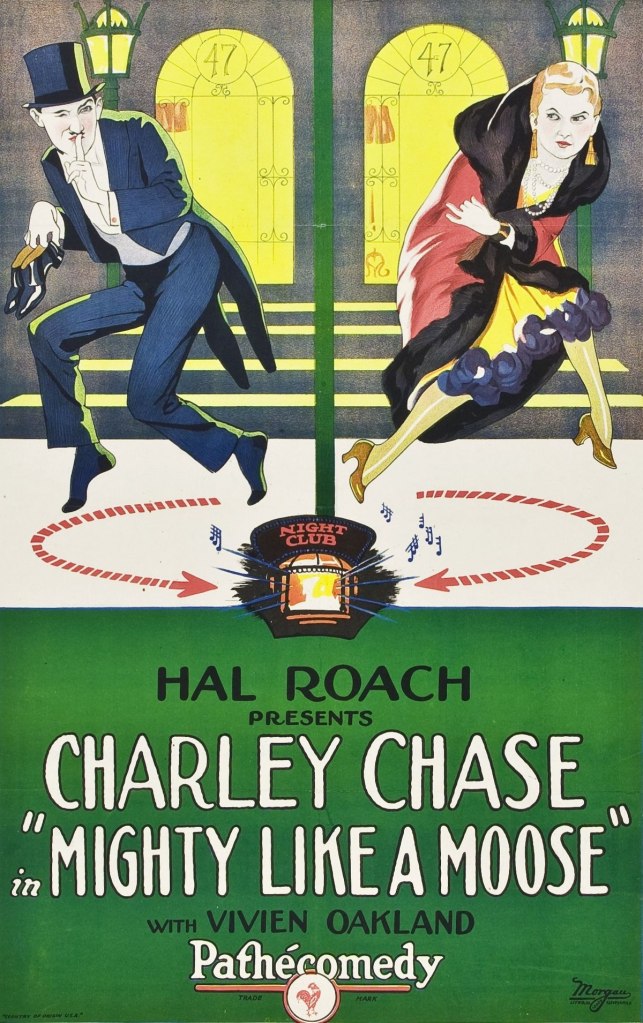
The Plot: Mr. and Mrs. Moose (Charley Chase and Vivien Oakland) each have a problem: Mr. has unsightly buck teeth, while Mrs. has a nose so large it makes kissing her husband nearly impossible. Without telling the other one, each quietly saves up money to have a secret operation. When they run into each other post-op, neither recognizes the other and they begin to flirt, eventually ending up at a wild party hosted by Mr. Moose’s dentist (Charles Clary). As you might expect, this leads to a lot of mistaken identity and shenanigans courtesy of one of the silent era’s most popular, albeit overlooked, comedians.
Why It Matters: The NFR write-up is a salute to Charley Chase, whom they call “underappreciated in the arena of early comedy shorts”. The short proper is praised for its “side-splitting series of sight gags”.
But Does It Really?: If there’s one thing the NFR loves, it’s obscure silent comedians who were famous in their day and all-but-forgotten now. “Mighty Like a Moose” is on this list to represent Charley Chase, whose filmography was finding a new wave of appreciation around the time he joined the NFR’s ranks. On its own, “Mighty Like a Moose” holds up well in the laughs department, if not so much for its overall subject matter. Ultimately, I found myself laughing quite a bit, a testament to Chase’s comic talents as both actor and writer. A pass for “Mighty” on this list; if nothing else its induction means that every so often someone attempting this NFR gauntlet will stumble upon the works of another underrated pioneer of film comedy.
Everybody Gets One: Born Charles Parrott, Charley Chase began his showbiz career when he was 19 playing bit parts in Keystone comedies. By the time he started working for Hal Roach, Chase was primarily a director, though he did star in his own series of comedy shorts, where he adopted the stage name Charley Chase. Although shorts like “Mighty Like a Moose” were directed by other people (in this case a 28-year-old gagman named Leo McCarey), Chase was always the muscle behind the scenes, contributing to his shorts’ writing, directing, and editing.
Wow, That’s Dated: Turns out the practice of surgery has existed for centuries, though modern plastic surgery didn’t come to be until a few technological breakthroughs during World War I. Cosmetic surgery as seen in this film would have been relatively new in 1926, though nowhere near as commonplace as it is today. And that’s as much research on plastic surgery I’m willing to stomach at this time.
Other notes
- My main beef with this short is its overall comic premise: How in the hell do these two not recognize their own spouses after their operation? They don’t look that different. Even with Mrs.’ hair dye and new wardrobe her husband should still be able to figure out who she is. But as always, I am overanalyzing something that wasn’t meant to be analyzed in the first place, so I’ll suspend my disbelief as high as I can and just go along with it.
- Chase and Walker are clearly having fun with the intertitles, especially the ones poking fun at the couple’s abnormalities. For example: When Mrs. Moose gets her nose job, the intertitles describe her as “winning by a nose”. There’s also a joking reference to Mussolini, which seems a bit extreme. What did Mussolini ever do to yo—oh right, never mind.
- After Mr. Moose’s surgery, the dentist gives him a false set of buck teeth for identification. Really? Are you sure this isn’t just for comic mishaps? Sorry, I will stop analyzing, starting…now.
- I enjoyed the sequence where Mr. and Mrs. Moose are both sneaking around their house trying to get ready for their “affair” without being seen by the other one. The near misses are clever and fun to watch. The wide shots of Mr. on the second floor overlooking Mrs. on the first are staged in a way that reminded me of the quote from Chase’s former colleague Charlie Chaplin: “Life is a tragedy when seen in close-up, but a comedy in long-shot.”
- At the party, Mr. Moose gets stuck dancing with Floradora, a homely woman who hasn’t danced “since 1888”. So according to this movie, people who don’t conform to societal norms serve no purpose whatsoever? Okay, that was my last analysis. Back to the funnies.
- The Moose’s maid is played by Ann Howe, who gets the intriguing credit in the cast list as “Ann Howe (The Radio Girl)”. My research hasn’t pulled up anything substantial, but who is Ann Howe and what did she do that made her so synonymous with radio? Even if she was big in the ’20s but obscure now, anyone dubbed “The Radio Girl” should have left some kind of cultural footprint. And of course, the irony of a radio star being promoted as such in a silent movie is not lost on me.
- Like every comedy, everyone must find out about the huge misunderstanding eventually, and the final sequence of Mr. Moose messing with Mrs. Moose and staging a fight with himself is a very funny farcical conclusion.
- I was not expecting the comedy short from the ’20s to have one of the most terrifying final shots in any movie I’ve ever seen: The Moose’s dog Buddy wearing Mr. Moose’s false buck teeth! Have fun trying to sleep tonight.

Legacy
- Unlike most of his contemporaries, Charley Chase successfully transitioned into the sound era. While his shorts were still successful, Chase found it hard to crack into features (though he does appear in a supporting role in fellow NFR film “Sons of the Desert” with his friends Laurel & Hardy). In fact, Chase’s only big attempt at a feature film, 1936’s “Neighborhood House”, had so many production woes Hal Roach Studios fired Chase, drastically cut the film down and released it as a short. Chase spent the last few years of his life directing shorts at Columbia (including a few with the Three Stooges), before his death in 1940 from a heart attack exacerbated by his heavy drinking.
- Although Charley Chase lingered in the shadows of his more famous contemporaries for many decades, the last 20 years have seen a renewal of interest in Chase’s career. His shorts started to get released on DVD and aired on TCM, leading to new generations discovering his work. Chase’s legacy was further solidified by the induction of “Mighty Like a Moose” into the NFR in 2007.
 The Horse's Head