
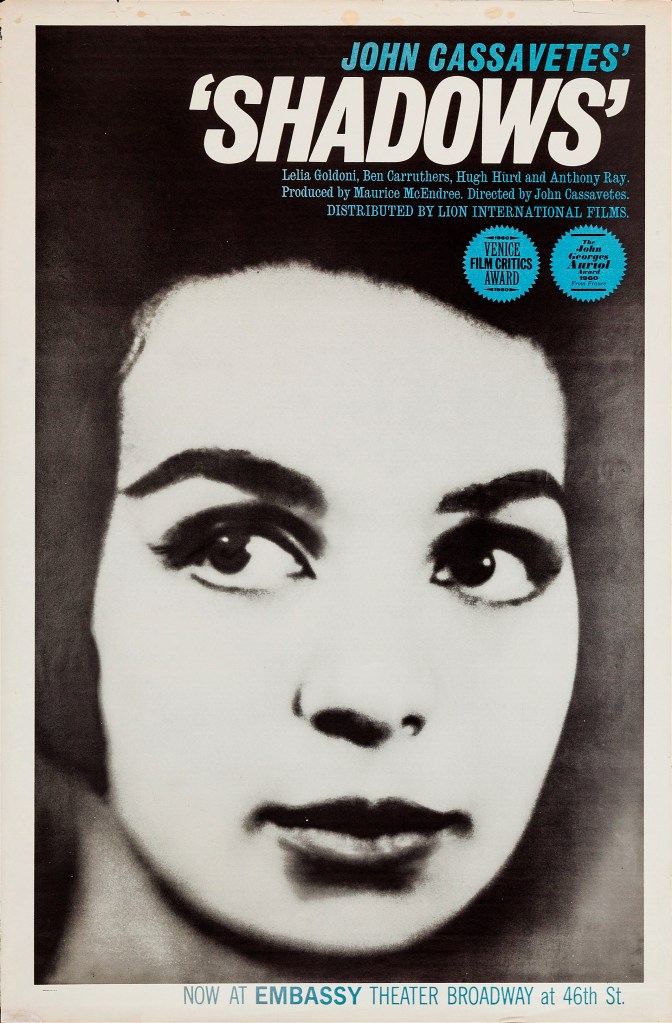
#703) Shadows (1959)
OR “Whose Race Is It Anyway?”
Directed by John Cassavetes
Written by Cassavetes, Robert Alan Aurthur, and the cast.
Class of 1993
The Plot: Ben, Hugh, and Lelia (Ben Carruthers, Hugh Hurd, Lelia Goldoni) are three siblings living in New York at the height of the Beat Generation. The siblings are all African American, though Lelia is light skinned and often passes for White. Both Ben and Hugh have musical aspirations, but Ben wastes his days loafing about with friends at the local bars, while Hugh’s act can’t catch a break, despite the efforts of his agent Rupert (Rupert Crosse). Lelia’s love life takes a turn when she starts seeing Tony (Anthony Ray), a White man who doesn’t realize she’s Black. But all of this is place-setting for a freeform character study completely improvised by the actors.
Why It Matters: The NFR gives a rundown of the film’s production, and praises Cassavetes’ choice to make a film that “treats race and identity not as sociological discourse but as a sort of free jazz.” An essay by Cassavetes expert Ray Carney delves into the film’s theme of identity.
But Does It Really?: “Shadows” is one of those movies that needs a little explanation to fully appreciate. Unlike most movies, “Shadows” isn’t so much a piece of entertainment as it is the results of an experimental exercise, a filmed acting workshop. The results are far from the high production quality of many an NFR entry, but even with the film’s rough presentation, you can see Cassavetes’ love of the game: an artist determined to tell this story, whatever it ends up being. While I found the film a bit stagnant and unfocused, I get that without the film’s production context I wasn’t approaching it from the right angle. Still, I’m willing to justify “Shadows” on the NFR as an important “stepping-stone movie”: Cassavetes’ best work was still ahead of him, but none of those exist without “Shadows”.
Shout Outs: Look closely for a movie theater marquee advertising “The Ten Commandments“. Speaking of…
Wow, That’s Dated: Lots of marquee advertisements throughout for such ’50s films as “The Night Heaven Fell” and “Naked Paradise”, as well as the Broadway musical “The Most Happy Fella”. Also, we get not one but two shoutouts to Steve Allen, who at this point in his career had left “The Tonight Show” and was hosting his primetime variety series “The Steve Allen Show”. Hi-ho, Steverino!
Seriously, Oscars?: In a year dominated by “Ben-Hur” there was no way a little movie like “Shadows” was going to squeak into the Oscar conversation. The film did, however, fare better in Europe, winning the Critics Award at the 1960 Venice Film Festival and receiving four BAFTA nominations.
Other notes
- At this point in his career, John Cassavetes was starting to make a name for himself not only as an actor, but as an acting teacher, co-founding “The Cassavetes-Lane Drama Workshop” in New York with Burt (future father of Diane) Lane. An alternative to the Actors Studio and “the method”, Cassavetes’ workshop emphasized performances stemming from character rather than psychology or emotions. One day his class performed an improvised scene about a light-skinned Black woman dating a racist White man. Cassavetes was so inspired by this scene that while he was on Jean Shepherd’s local radio program to promote “Edge of the City”, he pitched a movie based on this concept to the listening audience, who sent in money to help finance the film (hence this film’s credit “Presented by Jean Shepherd’s Night People”, a nickname for Shepherd’s listeners). “Shadows” was filmed throughout 1957 with actors from Cassavetes’ acting workshops and a script with a detailed plot description but no dialogue, which was improvised by the actors during rehearsals.
- After the completion of “Shadows”, Cassavetes screened the film in 1958, and reception was mixed to negative. Knowing he could salvage the film, Cassavetes wrote a revised screenplay with writer and friend Robert Alan Aurthur, and reunited the cast to reshoot several new scenes that emphasized the sibling relationship over the original themes of racism and prejudice. It is this reworked version that is widely available today, with an estimated 60% of the final film being comprised of these reshoots. We’ll come back to the original cut in the “Legacy” section.
- I must acknowledge the elephant in the room: despite her casting as one of the Black characters, Lelia Goldoni was of Sicilian descent. Ben Carruthers was 1/16th Black and used a sunlamp to make his skin appear darker, though he only did this for the original shoot, resulting in a handful of cringy shots in the final film. While this casting is obviously problematic and wouldn’t fly today, I will admit it didn’t bother me as much as I thought it would (Except for those sunlamp shots. What were you thinking, Ben?)
- The print I watched was the UCLA restoration, which received a grant from (among others) the Hollywood Foreign Press Association, aka the organization behind the Golden Globes. I didn’t realize they did things other than hobnob with A-listers and give out awards to said A-listers.
- “Shadows” is filmmaking at its most raw: Full-on guerrilla filming (multiple passersby look at the camera), disjointed continuity from the improvisations, and lots and lots of dubbed dialogue. It makes Cassavetes’ later films seem very polished by comparison. Given this film’s rough aesthetic, late ’50s setting, and fondness for jazz music, I was expecting it to turn into “The Cry of Jazz” at any moment.
- I was captivated by Lelia Goldoni’s performance. The character of Lelia is flighty and indecisive, but always compelling. Goldoni really is the breakout star of this movie, and it’s a shame her film career never really took off.
- Side note: Lelia Goldoni and Ben Carruthers, who play siblings in this movie, were briefly married shortly after this film was made. So that’s how it is in their family…
- Both Cassavetes and his wife Gena Rowlands make cameos in this movie: Cassavetes as the man helping Lelia outside the movie theater, and Rowlands as a nightclub patron. I must have blinked during that nightclub scene because I definitely missed Rowlands.
- This movie takes its time getting started, but when it does…it still takes its time.
- Things escalate quickly between Lelia and Tony, with Lelia losing her virginity to Tony just a few quick scenes after their first meeting. I’m sure 1959 audiences were scandalized by the film’s depiction of pre-marital sex (although we only see them post-coital with zero nudity), to say nothing of Lelia’s line “I didn’t know it could be so awful”. I don’t know if I can endorse a movie where a guy named Tony is secretly racist and bad in bed.
- Shout out to Rupert Crosse as Hugh’s agent Rupert Crosse. The character is nothing to write home about, but it’s worth noting that Crosse’s acting career would eventually lead to his work in the 1969 Steve McQueen film “The Reivers”, for which he became the first African American to receive an Oscar nomination for Best Supporting Actor. That’s a milestone that gets ignored way too often. Get it, Rupert!
- The final credit reads “The film you have just seen was an improvisation.” Interesting choice, though I wonder if having this disclaimer at the beginning of the movie would have helped audiences understand/appreciate it more. It definitely would have helped me.
Legacy
- Although “Shadows” wasn’t well received upon its initial release, the film found success in Europe and was part of an ever-growing new wave of independent American filmmakers who were able to create and successfully distribute their movies outside of the Hollywood system. The reputation of “Shadows” grew as Cassavetes’ future filmography developed a following.
- John Cassavetes was able to parlay his direction of “Shadows” into bigger directing gigs, helming two films for Hollywood: 1961’s “Too Late Blues” and 1963’s “A Child Is Waiting”. Neither experience was particularly great for Cassavetes, who shifted back to acting on film and TV, saving up enough money to fund his next indie feature: 1968’s “Faces“.
- As for the first cut of “Shadows”, the aforementioned Ray Carney spent over 20 years trying to track down the original 1958 version, a journey that eventually led him to an attic in Florida and the daughter of the second-hand shop owner who had inadvertently bought the missing film years earlier. The original “Shadows” was restored in 2004, though screenings of this version are scarce as the Cassavetes estate has questioned its legitimacy and have pursued legal action to prevent its release.
- With its structured improvisational format, can we claim “Shadows” as an influence on “Curb Your Enthusiasm”? I mean, there were a few episodes where Larry dated Vivica A. Fox’s character with disastrous results; the parallels are right there.
 The Horse's Head
3 thoughts on “#703) Shadows (1959)”