#705) The Lady Eve (1941)
OR “Con Heir”
Directed & Written by Preston Sturges. Based on the story “Two Bad Hats” by Monckton Hoffe.
Class of 1994
The Plot: Charles Pike (Henry Fonda) is the heir to his family’s ale company and has been studying snakes in the Amazon for the past year. As he returns home on an ocean liner, every woman onboard vies for his attention, but the socially awkward Charles pays them no mind, except for Jean Harrington (Barbara Stanwyck), a glamorous, assertive Barbara Stanwyck-type. What Charles doesn’t know is that Jean, along with her father “Colonel” Harrington (Charles Coburn), is a renowned con artist with an eye on fleecing Charles out of his fortune during a card game. During her long con, Jean ends up falling in love with Charles, who rejects her once he learns of her true identity. Upon returning to his family home in Connecticut, Charles is introduced to the Lady Eve Sidwich, a British socialite who looks an awful lot like Jean. And that’s only the beginning of the complications in another bona-fide Preston Sturges screwball comedy.
Why It Matters: The NFR praises the film for having “sparkling dialog, a quick pace and more than a touch of Sturges’ trademark screwiness”. The supporting work of Charles Coburn and William Demarest are also highlighted.
But Does It Really?: I first saw “The Lady Eve” about 12 years ago, and I must have been in a bad mood that day because I enjoyed myself much more during this viewing. Having now watched all four of Preston Sturges’ NFR movies, there isn’t one that stands out over the others as his definitive work, but each is a good example of the kind of quality comedies Sturges was famous for. As for “The Lady Eve” itself, it’s good and very close to great. There’s a lot of top-notch jokes delivered by a very game cast, but the more sincere moments and the almost impenetrable ’40s jargon prevented me from fully enjoying myself. Regardless of my feelings, “The Lady Eve” has left its mark as one of Hollywood’s definitive screwball comedies, and I have no qualms about it making the NFR alongside Sturges’ other classics.
Everybody Gets One: Hailing from Connemara, Ireland, Monckton Hoffe was primarily an actor and a playwright, with his first hit play “The Little Damozel” playing London in 1909. The inevitable film version in 1916 started Hoffe’s screenwriting career, and by the 1930s he had made it to Hollywood. Although Hoffe was under contract at MGM in the late ’30s, his 19-page story “Two Bad Hats”, ended up at Paramount, where Preston Sturges was assigned to write the screenplay. This marks one of the rare occurrences where Sturges adapted someone else’s work, though he ended up throwing out everything but the bare bones of “Two Bad Hats” and creating most of the characters and situations himself.
Wow, That’s Dated: Ocean liners for international travel, an allusion to zoologist Raymond Ditmars, and Charles’ book “Are Snakes Necessary?“
Seriously, Oscars?: Despite winning the Oscar for his “Great McGinty” screenplay a year earlier, Preston Sturges was not nominated for “The Lady Eve”. In fact, the film’s sole nomination was for Monckton Hoffe in the now-defunct Best Original Story category, losing to “Here Comes Mr. Jordan”. Coincidentally, two members of the “Lady Eve” cast received Oscar nominations that year for other movies: Charles Coburn in Best Supporting Actor for “The Devil and Miss Jones”, and Barbara Stanwyck in Best Actress for her other 1941 NFR comedy “Ball of Fire“.
Other notes
- Preston Sturges was originally assigned to write “The Lady Eve” as a vehicle for Paramount star Claudette Colbert, though by the time production finally commenced in 1940 Colbert had left the studio. Two months before filming began, Fred MacMurray and Madeleine Carroll were announced as the leads, only to be replaced by Henry Fonda (on loan from Fox) and Paulette Goddard, with Barbara Stanwyck as a last-minute replacement for Goddard. It’s a testament to Fonda and Stanwyck that you can’t imagine any of these other actors playing Charles and Jean.
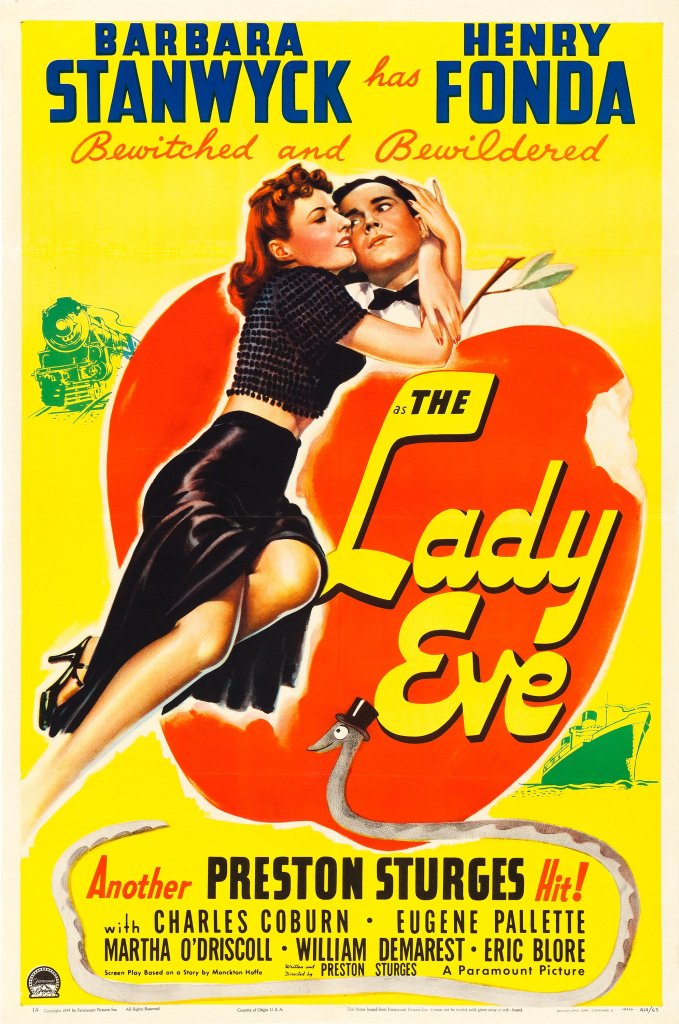
- I don’t know what’s more terrifying about these animated credits; opening your movie with a cartoon snake, or that the snake is wearing a top hat and winking at me.
- The brief Amazon sequence was filmed in the exotic location of Baldwin Lake at the Los Angeles County Arboretum and Botanic Garden. Keep an ear out for the stock Kookaburra sound effect (“ooh-ooh-ooh-ah-ah-ah”). which, as I’ve mentioned before, is out of place given that the bird is native to Australia and New Guinea.
- Today in Code era profanity workarounds, one of the frustrated bartenders receiving another order for Pike’s Pale – the ale that won for Yale: “Tell ’em to go to Harvard!”
- Speaking of Pike’s Pale, Charles and Jean have a brief beer vs. ale debate. Hipsters must love this movie.
- Stanwyck is of course wonderful in this, playing the kind of fast-talking free-spirited dame she always excelled at. The revelation for me, however, was Henry Fonda, here in one of the few comedies on his resume (and the only comedy of his nine NFR appearances). Being more accustomed to the stoic, moral persona of his later career, it’s fun watching Fonda loosen up and play a naïve rom-com lead. Allegedly Sturges’ colleagues suggested he reduce the number of pratfalls Charles endures throughout the movie, but I’m glad he didn’t listen because I laughed out loud every time.
- Preston Sturges must have found something amusing about the phrase “up the Amazon”; Charles says it no less than five times during the movie. I guess Sturges was the David Letterman of his time: when he thought a phrase was funny, he ran it into the ground.
- While most of the Preston Sturges stock company won’t show up until this movie’s second half, we do spend a lot of the first half with the reliably funny grouchiness of William Demarest as Charles’ bodyguard Muggsy. Demarest also gets to say the very ’40s phrase “cock-eyed cookie pusser”, which I’m told isn’t as dirty as it sounds.
- Oof, Stanwyck is bringing the heat in the chaise scene. The dialogue is subtle enough, but Stanwyck’s line readings leave no room for misinterpretation; she wants some. I assume Charles spending the scene on the floor next to the chaise is another code-era workaround, it technically can’t be about sex if they’re not on the same surface.
- I really enjoyed the card game, where Jean, having now fallen for Charles, tries to prevent her father from taking Charles to the cleaners. It’s an expertly crafted scene with three well-defined characters, each knowing something the other two don’t know, and Fonda, Stanwyck, and especially Coburn play it brilliantly.
- If you know one line from this movie, it’s Jean’s line about her unfinished business with Charles: “I need him like the ax needs the turkey.”
- The good news: This movie has Eric Blore, one of my favorite Classic Hollywood character actors. The bad news: He doesn’t get to do anything remarkably funny in this. We don’t even get one of his double-takes! What are we even doing here?
- More bad news: This movie has one of my least favorite Classic Hollywood character actors: Eugene Pallette. The gruff-voiced, real-life racist Pallette is grating and off-putting as Fonda’s dad. Adding insult to injury, Pallette enters the movie singing. No thank you.
- When I first watched “The Lady Eve” all those years ago, it bothered me that Charles didn’t immediately recognize Jean in disguise as Eve. Clearly I wasn’t paying attention, as this movie goes out of its way to state that Charles has his suspicions, but figures that if it really is Jean she would have put more effort into a disguise, so the similarities between Jean and Eve must be a coincidence.
- The other part that’s hard to comprehend through a modern lens is how much easier it was to con people back then. I guess people were more trustworthy and weren’t expecting it as much. Perhaps my decades of big city living have conditioned me to automatically not trust people.
- Another great moment is Charles proposing to “Eve” while they take a break from horseback riding, with Charles’ horse constantly upstaging them by butting in between them. You can even see Barbara Stanwyck trying to stifle her laugh during the take.
- You have a character prone to pratfalls and a multi-tiered wedding cake, yet you don’t have him fall into it? Come on Preston. What is this, your first day or something?
- The Harringtons’ confidante Gerald (Melville Cooper) suggests that Jean push her new husband off a moving train. File that one away for later, Stanwyck, it’s a good way to collect double the insurance money. I forget what that’s called.
- While the laughs start to diminish as this movie ties up its romantic loose ends, the last few minutes clip along at the right speed, and we get an unexpected and very funny curtain line.
Legacy
- “The Lady Eve” was a hit upon release, with the New York Times naming it the best film of 1941. “Lady Eve” was such a hit with audiences and critics it completely overshadowed Preston Sturges’ other movie that year: “Sullivan’s Travels“.
- Like a majority of Paramount’s pre-1950 film library, “The Lady Eve” was sold to Universal in the late ’50s, which led to its frequent TV airings and rediscovery. Since then, “Lady Eve” routinely ranks among not only the best comedies ever made, but the best films period.
- Although many movies have used plot elements from “The Lady Eve”, the film proper has only one remake: 1956’s “The Birds and the Bees” starring Mitzi Gaynor, David Niven, and most confusingly, George Gobel. This was at the peak of Gobel’s TV fame as he tried to parlay that into a film career. Didn’t take.
 The Horse's Head
3 thoughts on “#705) The Lady Eve (1941)”