#710) Martha Graham Early Dance Films (1931, 1936, 1943, 1944)
OR “Movers and Shakers”
Choreographed by Martha Graham
Class of 2013
This write-up is another one of my “placeholder posts”. Of the four shorts that comprise the “Martha Graham Early Dance Films”, 2 ½ of them are currently viewable online. To cover the 1 ½ I couldn’t watch, I found later recordings of these same dances, which to the best of my knowledge are faithful recreations of Martha Graham’s original pieces.
The Plot: Hailed as the “Picasso of Dance”, Martha Graham revolutionized the dance world with movements we now refer to as Modern Dance. While Graham’s domain was primarily the stage, a few of her pieces were filmed for teaching purposes, with four films of her early work (all with her as the central dancer) being included in this NFR selection. “Heretic” (1931) is a brief scene of a woman ostracized by a group of Puritans. “Frontier” (1936) showcases a pioneer woman celebrating the exciting promise of a new land. “Lamentation” (1943) is a physical exploration of mourning and grief. “Appalachian Spring” (1944) is a lengthy character study about a newly married couple, a frontier woman, a preacher, and his “flock”.
Why It Matters: The NFR proclaims Martha Graham to be “one of the most important artists of the 20th century” and highlight the films as “four of the artist’s most important early works.” The “lyrical beauty” of “Appalachian Spring” also gets a shoutout.
But Does It Really?: Oh boy, am I out of my element on this one. Modern dance is one of my artistic blind spots, but I appreciated the chance to learn more about it. The Martha Graham films represent an important American artist and her important American art form, but they also acknowledge one of the less recognized perks of the National Film Registry. Yes, the NFR is primarily for preserving classic narrative movies and important historical events, but it can also preserve this country’s other arts. Thanks to the growing use of film in the 20th century, future generations can see artists of all stripes creating their passion projects: paintings, poems, songs (cough Broadway cast recordings cough), and yes, even modern dance. A yes for the inclusion of the “Martha Graham Early Dance Films” and for broadening the definition of what an NFR film can be.
Everybody Gets One: Born in Pennsylvania to a Presbyterian family, Martha Graham grew up in a house that discouraged dancing, and she didn’t see her first dance recital until she was 14. After watching Ruth St. Denis perform in Los Angeles, Graham was hooked, and within a few years was studying at the dance school co-founded by St. Denis. While performing as a dancer in Greenwich Village in the early 1920s, Graham started experimenting with a new, more emotionally driven form of dance, eventually creating what is now known as “Graham technique”. In 1926, she established the Martha Graham Dance Company and began teaching her new method of modern dancing, a style of movement that, among other things, focuses on the correlation between contraction and release of the body. Although Graham believed that live theater should never be filmed, she eventually relented to having some of her own work recorded for posterity.
Other notes
Heretic (1931)
- Premiering in 1929, “Heretic” was Martha Graham’s first public performance with her concert ensemble (she had previously only performed as a solo dancer). The group is put to excellent use here: 12 members dressed in black and forming an imposing semi-circle around Martha, dressed in white (the symbolism of “Heretic” is hard to miss). “Heretic” is also the first of Graham’s dance pieces to move away from more traditional ballet and apply the Graham method, with was well received upon its premiere.
- Although all four of the Martha Graham dance films are silent, most uploads include the original music for a more complete viewing experience. The music for “Heretic” is the folk song “Tetus Breton”, providing a perfect tense atmosphere.
- There are many hallmarks to a Martha Graham dance, but there’s one on display here that no one talks about: flowy dresses. I don’t know what it is, but Martha loves a good flowy dress. They show up in all the pieces covered here.
- I can see how “Heretic” went over so well at the time; it introduces this new form of dance in a simple, concise presentation. It also meshes well with the other experimental art movements happening at the same time (painting, music, film, etc.). If you’re a member of New York’s cultural elite in the 1930s, something like “Heretic” is easy to engage with.
Frontier (1936)
- First off, the clip embedded above is NOT, I repeat NOT the original 1936 clip. It is a recreation from 2009 at New York’s 92nd St. Y, performed by Blakeley White-McGuire.
- Martha Graham’s inspiration for “Frontier” came from her family’s move to California by train, and young Martha seeing the parallel lines of the railroad stretching out into the seemingly infinite horizon. This is the first of many pieces where Graham explores Americana and American archetypes through dance (we’ll see much more of that in “Appalachian Spring”).
- Of Martha Graham’s solo pieces, “Frontier” is the one most associated with her. Graham even performed it for Eleanor Roosevelt at the White House, the first dancer to be invited to perform there.
- The music of “Frontier” is an original score by Louis Horst, longtime Graham collaborator and fellow choreographer. Horst also composed a few film scores, though his best-known work is his compositions for Martha Graham.
- Obviously, I can’t comment too much on the 2009 revival of “Frontier”, so I’ll focus instead on the dance itself. Unsurprising for a Martha Graham piece, I was drawn to the contrast in the movement: boisterous leaps through the air followed by small, feeble movements on the floor (floor work is another key component to Graham technique). The title “Frontier” evokes, of course, our country’s pioneer days as we traveled westward, and I read this dance as the dichotomy that frontier women would have faced; the freedom of a new land, yet still restrained to their position as daughters, wives, and mothers. Probably not what Martha Graham had in mind, but there you go.
Lamentation (1943)
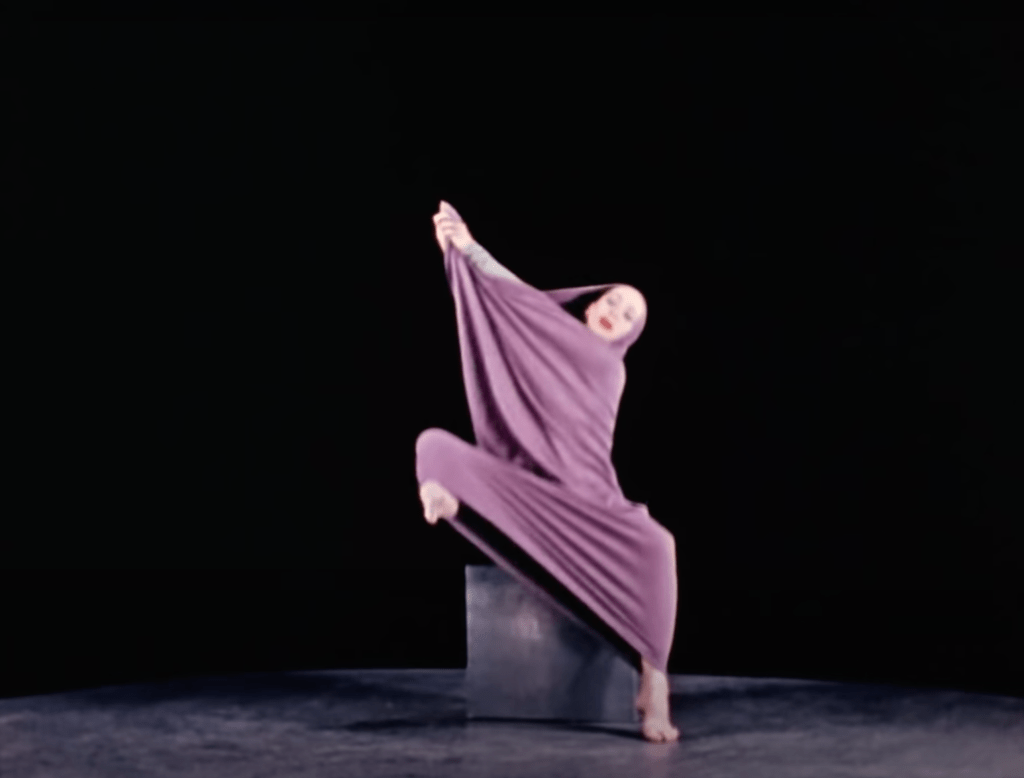
- Unlike the other three dance films, we have a little bit of information of who actually filmed “Lamentation”; sculptor Simon Moselsio, with his wife taking still photos during the filming. “Lamentation” stands out for being filmed with two cameras (allowing for some cross-cutting), as well as for being filmed in color!
- We get Martha in her flowiest dress yet: a purple tube-like garb that covers her almost completely. It’s practically a Snuggie. Martha performs the entire piece sitting on a small bench, never standing up but still fully utilizing her body while sitting down. I wonder if she thought the constant leaping in her pieces was getting stale.
- For “Lamentation”, Graham needle-drops Zoltan Kodaly’s Piano Piece, Op. 3, No. 2. Like Graham, Kodaly also has a method named after him, in his case the Kodaly method of music education.
- Graham stated at the time that she wasn’t trying to represent any specific sorrow with this piece, but rather “the personification of grief itself”. I gotta say, even while being engaging to watch, “Lamentation” does get a little depressing. So, well done, I guess.
Appalachian Spring (1944)
- This is the “half” in the 2 ½ films I mentioned upfront. “Appalachian Spring” is a 30-minute piece, and roughly 11 minutes of the 1944 film can be seen online. For the full piece, I also watched a 1959 re-enactment that Martha Graham and her dancers filmed for TV.
- Of the four, “Appalachian Spring” was the one I understood the least. Perhaps due to its longer runtime I was expecting a full story through dance, and maybe there was one, but I sure couldn’t follow it. There’s lots of tableaus and variations of dance throughout “Appalachian”, but ultimately, I couldn’t fully comprehend what this piece was trying to say. Just when I thought I was beginning to understand modern dance, along comes “Appalachian Spring” to make me doubt everything.
- The piece’s rustic setting got me to thinking about the dream ballet from “Oklahoma!“, which would have premiered a year before “Appalachian Spring”. While I initially thought that Agnes de Mille’s “Oklahoma!” choreography might have influenced this piece, my research shows that “Appalachian Spring” was a long gestating project for Graham (dating back to 1941), so we can most likely chalk the comparisons up to parallel thinking. For the record, Graham and de Mille were contemporaries, friends, and supporters of each other’s work.
- The preacher in this piece is most likely a Shaker, a sect of Christianity that was known for its enthusiastic revivals, earning the description “Shaking Quakers”, later shortened to Shaker. The Shaker community stopped accepting new members in the late 1950s, and today only 2 official members survive. I didn’t realize you could shut down a religion. Something to think about. Anyway, where was I…
- “Appalachian Spring” has an original score by Aaron Copland, who utilizes the traditional song “Simple Gifts”, which I know from somewhere, but I can’t put my finger on where exactly. Side note: Copland won the Pulitzer Prize for Music for his “Appalachian Spring” composition. For those of you keeping track, that’s two films on the NFR with a Pulitzer-winning score.
Legacy
- Martha Graham continued dancing until the late 1960s (when she was in her mid-70s!) and continued to choreograph new dance pieces until just before her death in 1991 at age 96. Her final decades were also spent receiving every national arts award under the sun, including the Presidential Medal of Freedom and the Kennedy Center Honors.
- The Martha Graham Dance Company is still going strong almost a century after its founding, now known as the Martha Graham Center of Contemporary Dance with two locations in New York. The Graham technique is still being taught as part of modern dance, though be aware that since the early 2000s the term “Graham technique” is a registered trademark, so please be careful with how you use it.
- The pieces highlighted in these films have been revived by the Martha Graham Dance Company over the years, some more frequently than others. “Appalachian Spring” has become so popular and so celebrated it is one of the rare Martha Graham pieces to be licensed out for other dance companies to perform.
Bonus Clip: Because I love it so much, here’s that clip from “The Birdcage”. Thanks to “Lamentation”, you now understand why Robin Williams puts his shirt over his head as he shouts “Martha Graham! Martha Graham! Martha Graham!”
 The Horse's Head
2 thoughts on “#710) Martha Graham Early Dance Films (1931, 1936, 1943, 1944)”