#711) The Cool World (1963)
OR “A Piece of the Action”
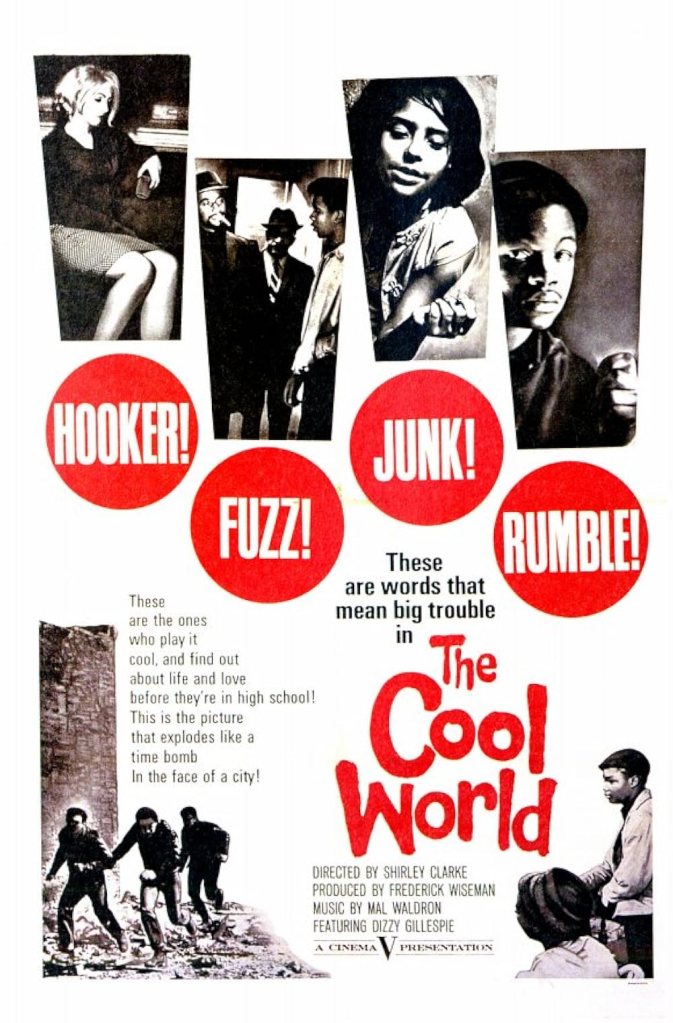
Directed by Shirley Clarke
Written by Clarke and Carl Lee. Based on the novel by Warren Miller and the play by Miller and Robert Rossen.
Class of 1994
“The Cool World” is very hard to track down (I’ll explain why later), but I was able to find an upload of the film here. This version is missing a bit of the opening, which is embedded below.
The Plot: Duke Custis (Rony “Hampton” Clanton) is a 15-year-old Black boy growing up in Harlem, and a member of the street gang the Royal Pythons. Duke’s dream is to be leader of the Pythons and a “big shot” in Harlem, which he feels he can achieve by purchasing a gun (or “piece”) from neighborhood lowlife Priest (Carl Lee). Filmed in a pseudo-documentary style, “The Cool World” chronicles Duke as he navigates the seedy sides of Harlem, the politics of gang leadership, and the futile struggle to escape this perilous lifestyle.
Why It Matters: The NFR calls the film a “stark semi-documentary” and cribs from Bosley Crowther’s New York Times review, in which he praises the film’s “pounding vitality” and “hideous visual truths”.
But Does It Really?: I appreciated “Cool World” more than I enjoyed it. As a film it’s fine, with a rough presentation augmenting the characters’ rough conditions, but ultimately, it’s not my thing. Still, watching movies like “Cool World” for the blog have helped me further appreciate independent filmmakers, especially those of this era where filmmaking equipment was much harder to come by. Shirley Clarke is one of the unsung heroes of the independent film scene, and I’m glad the NFR has made room for her.
Everybody Gets One: Born to a wealthy family in New York, Shirley Clarke started off as a dancer, studying with, among others, Martha Graham. In her mid-30s, Shirley became interested in film making, and her first short, 1953’s “A Dance in the Sun” documented the choreography of modern dancer Daniel Nagrin. She soon found herself in the same circles as fellow independent filmmakers/NFR directors Jonas Mekas, Lionel Rogosian, and Stan Brakhage, all of whom, along with Clarke and several others, founded The Film-Makers’ Cooperative in 1961 (which is still in operation today). Clarke’s first feature – 1961’s “The Connection” – was as controversial as the play it was adapted from, and its frank depiction of heroin addiction led to the film being banned in New York state. During production of “The Connection”, Clarke met actor Carl Lee, who would be her creative and romantic partner for the next 20 years.
Seriously, Oscars?: Like many an independent feature of the era, “The Cool World’ received zero Oscar nominations, but did better with European awards, in this case being nominated for the Golden Lion at the 1963 Venice Film Festival. At this point in Shirley Clarke’s career, she had already received her sole Oscar nomination for her 1959 short “Skyscraper”. Coincidentally, Clarke’s other 1963 feature, “Robert Frost: A Lover’s Quarrel with the World”, won the Oscar for Best Documentary Feature, though due to Academy rules at the time the nomination and award were given solely to the film’s producer, Robert Hughes.
Other notes
- Before we go any further, “The Cool World” should not be confused with “Cool World“, that weird “Roger Rabbit” knock-off starring a young Brad Pitt. Rest assured at no point during this post am I referring to that movie.
- It should be noted that among the creatives behind the original novel, its play adaptation, and this film adaptation, the only person of color is co-screenwriter Carl Lee. The novel is narrated by Duke and written entirely in deeply offensive “black” phonetics, and while the film’s dialogue is exponentially better, I still question its authenticity. Side note: the stage version of “Cool World” only played Broadway for two performances in February 1960, but its cast featured such up-and-comers as Billy Dee Williams (as Duke), James Earl Jones, and Cicely Tyson.
- “Cool World” is also notable for being the first film produced by Frederick Wiseman, former law teacher and future documentarian. We’ll talk more Wiseman’s involvement in the “Legacy” section.
- There’s a lot to take in during the film’s opening sequences, especially if you’re like me and did zero research prior to your viewing. This film’s documentary approach, with its shaky cam cinematography and overlapping dialogue, takes some getting used to. At one point I thought I was watching outtakes from “Shadows“. The opening sequence of Duke and his classmates on an end-of-year field trip is especially cacophonous. Thankfully, the pace slows down afterwards. Adding to the authenticity (and the film’s overall unpolished feel), most of the cast are non-actors, though no one’s unprofessional background stuck out to me in a way that detracted from the film.
- Speaking of “before they were famous”, among the film’s professional actors are Clarence Williams III (Linc from “Mod Squad”) as Python leader Blood, and Gloria Foster (the Oracle in “The Matrix“) making the most of her limited screentime as Duke’s mother. And apparently Antonio Fargas (Huggy Bear from “Starsky and Hutch”) is also in this film, but I can’t confirm who he played. Fargas would have been about 17 during filming, maybe he’s one of the rival gang members?
- Shout out to Mal Waldron, who composed the film’s jazz score, performed by the Dizzy Gillespie Quintet and expertly matching the film’s shifting moods.
- Duke needs $75 for a gun, which adjusted for inflation would be about $770 today. Yikes. Too bad there aren’t any lawns for Duke to mow in Harlem.
- And then we get LuAnne, Blood’s supposed girlfriend who for all intents and purposes is a sex worker, hanging out at the Pythons’ headquarters and offering her services for $1.50 (about $15 today). It works within the world of the movie, but it’s still icky if you think about it for too long. LuAnne’s performer Yolanda Rodriguez didn’t have much of a film career after “Cool World”, though she did produce a handful of projects in the 2000s.
- Between LuAnne and Priest’s girlfriend (who seems to be auditioning for Miss Adelaide in “Guys and Dolls”) , I would have assumed this movie was directed by a man with some serious issues. Shirley Clarke once mentioned that she made films about other cultures and other races to avoid directly dealing with “the woman question”, so I suspect the objectified female characters in this movie are an offshoot of that, conscious or otherwise.
- Shoutout to cinematographer Baird Bryant for his great work throughout the movie. While the outdoor scenes are your typical documentary-style shaky cam, the scenes inside cramped apartments make the most of their limited space, with creative compositions and blocking of the characters.
- Noteworthy to me for its brief NFR connection is a sequence with Blood’s brother Douglas, who mentions that he was traveling with the Freedom Riders, or as Duke mistakenly calls it, the “free bus rides”.
- I’m pretty confident that the Pythons could beat the crap out of the Sharks and the Jets. Now that’s a movie I’d want to see.
- I liked the montage of Duke and LuAnne at Coney Island, with the two having a fun day and LuAnne seeing the ocean for the first time. It’s the movie’s last bit of levity before it all goes to hell. Plus all of the shooting games on the boardwalk emphasize the “gun equals manhood” toxic masculinity drilled into Duke his whole life. Bonus points to LuAnne/Yolanda for making the behind-the-back basketball shot in one uninterrupted take.
- An interesting time capsule: the sign in the Pythons’ hangout that reads, “This house has NO fallout shelter”.
- The climactic fight between the Pythons and the Wolves occurs on a playground; the symbolism is not hard to miss. The moment that really struck me was when Duke fatally stabs one of the Wolves, the boy’s dying words are “thank you.” This all concludes with Duke being driven away in a police car as we hear snippets of the conversations happening on the streets of Harlem, a sign of how insignificant the gang warfare really is compared to the rest of the world.
Legacy
- “The Cool World” premiered at the Venice Film Festival in September 1963, but struggled to find a distributor for a general release, mostly due to its subject matter. Producer Frederick Wiseman ended up distributing the film himself under his company Wiseman Film Productions. “Cool World” opened in Paris in April 1964 and received its US release shortly thereafter. While the film was financially successful (by independent feature standards), critics had mixed reactions, with the LA Times write-up wondering aloud why this film wasn’t made by an African American director.
- Shirley Clarke followed up “Cool World” with her other NFR film, the 1967 LGBT documentary “Portrait of Jason“. As funding for her movies became harder to come by, Clarke pivoted to making experimental films on the new video format, as well as teaching film and video production at UCLA. Shirley Clarke died in 1997 at the age of 78.
- While Shirley Clarke’s filmography had started to become forgotten during her lifetime, she did live long enough to see “Cool World” make the NFR in 1994. Thankfully in more recent years there has been a renewal of interest in her films, largely due to “Project Shirley”, an undertaking by the good people at Milestone Films to restore and re-release all of Shirley’s films for future generations. Well, almost all of Shirley’s films…
- “Cool World” producer Frederick Wiseman would go on to become a renowned documentary filmmaker, including “Hospital“, which was inducted into the NFR the same year as “Cool World”. Wiseman still owns the distribution rights to “Cool World” and for whatever reason will only license it out to schools for educational purposes, meaning the film is not readily available to the public, nor is it part of Milestone Film’s “Project Shirley”. Wiseman is 94 years old as of this writing, and still making documentaries! While I wish him continued good health, I look forward to “The Cool World” getting a proper restoration and release in…the 2030s?
 The Horse's Head
5 thoughts on “#711) The Cool World (1963)”