
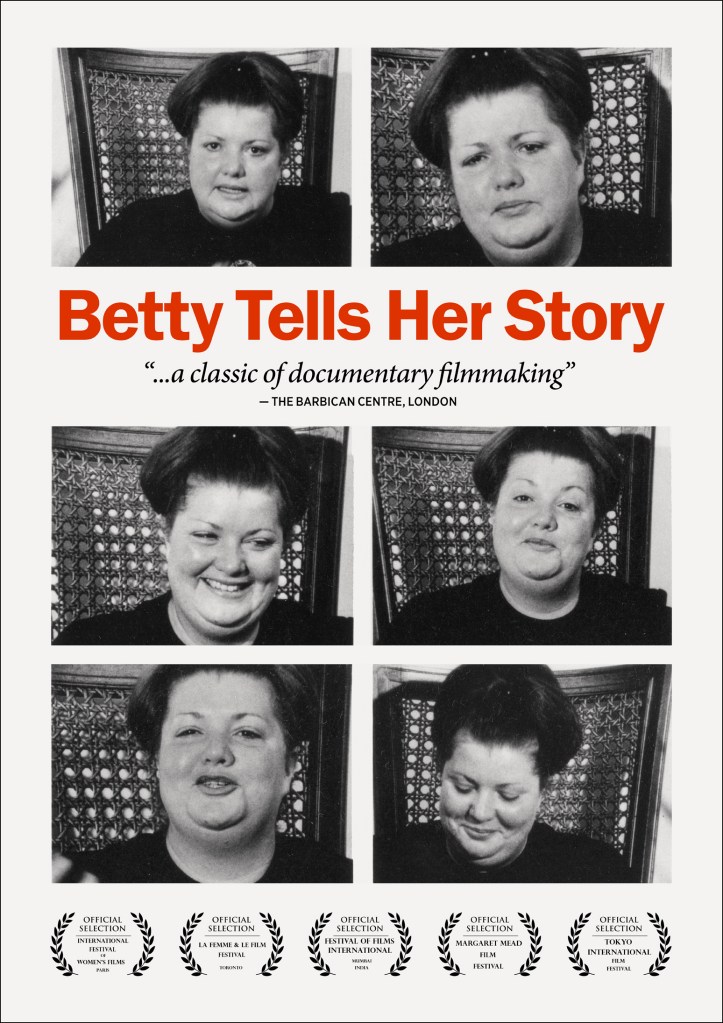
#712) Betty Tells Her Story (1972)
OR “Change of a Dress”
Directed by Liane Brandon
Class of 2022
The Plot: In the category of movies that live up to their title, “Betty Tells Her Story” is indeed a film in which Massachusetts resident Elizabeth “Betty” Murray tells you a story from her life. Sitting in a comfortable chair in her living room, Betty recounts an incident a few years earlier in which she purchased a very expensive emerald-green dress for the Governor’s Ball in Connecticut, only to lose the dress when she accidentally left it on the trunk of her car and drove off. Halfway through this short, Betty has finished her story, but is asked by the filmmaker to tell it again. The second telling is strikingly different from the first, not so much in the details, but rather in how she tells it, focusing more on her feelings during the events. It’s a surprisingly deep exploration of the impossible physical expectations we put on women, captured by one of the pioneers of the women filmmakers’ movement of the early ’70s.
Why It Matters: Wow, someone really loves “Betty Tells Her Story” over at the NFR. The film gets a longer write-up than many of the Registry’s more iconic entries, being hailed as “classic” and “poignant”. The film’s historical place in the Women’s Movement is also mentioned. Added bonus: A photo of Liane Brandon with her official NFR inductees’ certificate!
But Does It Really?: I enjoyed “Betty Tells Her Story”. The first half is listening to an engaging storyteller with an amusing anecdote, and the second half suddenly becomes a much more personal confession. “Betty Tells Her Story” perfectly exemplifies this style of filmmaking the women’s movement was known for; intimate portraits of ordinary women, helping to add a personal connection and layers of humanity to the growing movement. I’m glad “Betty Tells Her Story” has found its spot on the NFR, and I can’t recommend it enough.
Everybody Gets One: Liane Brandon started out as a substitute teacher at Quincy’s Central Junior High, eventually becoming their full-time English teacher. On a dare from her students, Brandon assigned one of her classes to make a film, borrowing a 16mm camera from the school’s football team. Invigorated by the experience and appalled by some of the more performative aspects of the women’s lib movement, Brandon was motivated to film real women living their real lives, beginning with her 1971 short “Anything You Want to Be”. Brandon met Betty Murray while the two were serving on an educational advisory board in the early 1970s, and Betty would tell Liane amusing stories when they would grab coffee after the meetings. Brandon filmed Betty telling her dress story twice, planning to use only one take, but a viewing of the two back-to-back inspired her to include both takes.
Other notes
- Both versions of Betty’s story are told in one uninterrupted take, with the camera occasionally zooming in or out. The zooming keeps things from being too static, but the cinematography is all you need to tell you, “Don’t worry about the visuals, listen to what she is saying.”
- At one point Betty mentions being a teacher. I assume she’s an English teacher based on her excellent storytelling skills and choice vocabulary.
- Betty recalls that the price of the second dress was $7.98 off the rack, which would be about $60 today. Betty never discloses how much the original dress cost, other than it was “three weeks’ pay”. Based on a couple of factors (average teacher’s salary in 1972, pay discrepancies for women, etc.), I’m estimating the cost of the emerald-green dress at $430, or $3200 today. But this is just me speculating; only Betty knows for sure.
- You can tell immediately that the second telling is going to be different. Betty’s emotions from the story are much more front and center from the beginning. I wouldn’t be surprised if this was take two and she was still feeling the impact of telling the story the first time.
- Honestly, I strongly recommend a viewing of this film. Betty is such an engaging storyteller, and comparing the two versions was a fun experience. By the time Betty laments about “a prettiness I never had”, you feel for her so much. As of this writing, “Betty Tells Her Story” is streaming on the Criterion Channel as well as on Kanopy (which I get for free with my library membership. Support your local library!)
Legacy
- “Betty Tells Her Story” was distributed to libraries and film groups across the country through New Day Films, the distribution company co-founded by Brandon and fellow NFR filmmakers Julia Reichert and Jim Klein. It also played several film festivals and special screenings. One such screening at the Film Center in Chicago in 1973 was attended by critic Gene Siskel, who gave the film a glowing review. (Side note: Siskel’s review unfortunately focuses a lot on Betty’s weight. I get where he’s coming from, but save the fat shaming for Roger, Gene).
- Liane Brandon would go on to direct two more influential shorts, 1980’s “Once Upon a Choice” and 1987’s “How to Prevent a Nuclear War”. She also continued teaching, moving to the University of Massachusetts in 1973 and teaching media and film production for 30 years. Although Brandon is retired from teaching and now focuses on still photography (primarily for PBS programs), she is open to the idea of making another movie.
- Liane remained in contact with Betty Murray up until Betty’s death in 1991. According to Brandon, Betty would send Liane a Christmas card every year, signing it with some variation of “Call me, I’ll tell you another story.”
- Upon learning that “Betty Tells Her Story” was to be added to the NFR, Brandon called the experience “overwhelming. I’m in a very select group.”
 The Horse's Head