
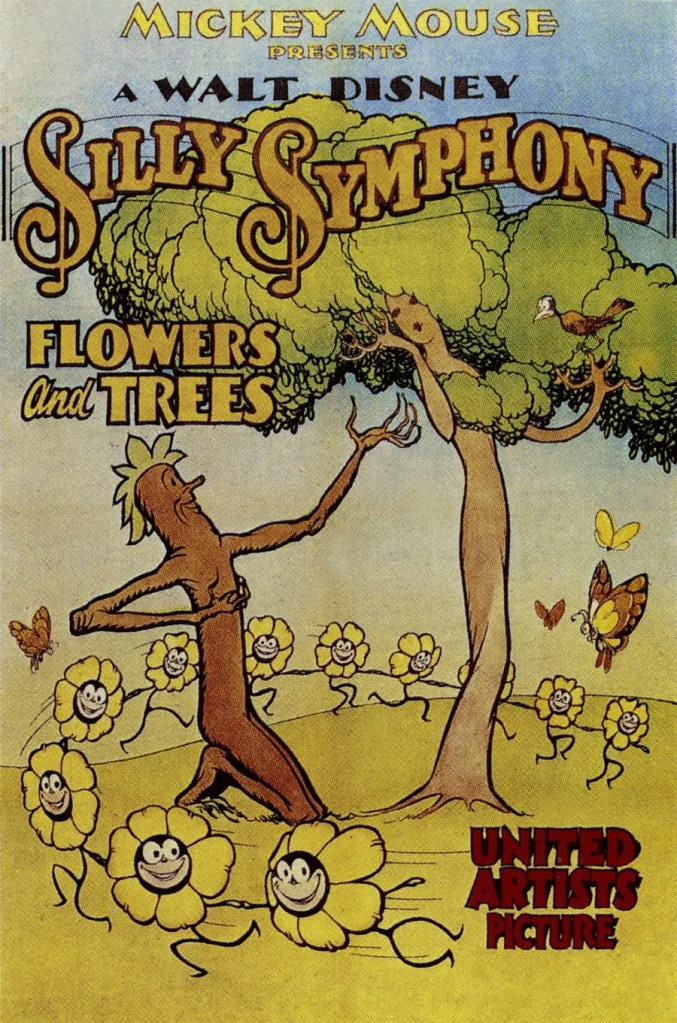
#717) Flowers and Trees (1932)
OR “Hue’s Woods These Are”
Directed by Burt Gillett
Class of 2021
The Plot: “Flowers and Trees” lives up to its title as an animated tale of anthropomorphized flowers and trees…well, mostly trees. As dawn breaks in an idyllic forest, a Boy Tree woos a Girl Tree with a harp made of vines. All this wooing angers a nearby Old Man Tree, who wants the Girl Tree for his own. Boy Tree easily wins a fight for Girl Tree’s honor, and Old Man Tree retaliates by starting a forest fire. But all ends happily in this Disney Silly Symphony; the first film (animated or otherwise) to utilize the new technological marvel of three-strip Technicolor.
Why It Matters: The NFR gives the short its technical achievement, singling out the film’s “vibrant Technicolor”.
But Does It Really?: “Flowers and Trees” is a pleasant, agreeable short, though ultimately its technical innovation is what pushes it into the “important film” column. As a lifelong Disney history buff, I have seen “Flowers and Trees” before and was aware of its significance in Disney history, but even that wasn’t enough for me to include it on my own NFR nomination ballot over the years. Still, it’s nice to see that other people advocated for its NFR inclusion, and it’s refreshing to know that there’s at least one Disney short from this era that can go on Disney+ without any disclaimers or backlash. A pass for “Flowers and Trees”; an important, though not monumental, moment in the history of color film and Disney animation.
Seriously, Oscars?: At the 5th Academy Awards, “Flowers and Trees” was the first winner in a brand-new category: Best Short Subjects, Cartoons (now known as Best Animated Short). Oscar rules at the time gave the award to a short’s producer, not its director, so Walt Disney collected the first of his eventual 26 Oscars (which is still the record). Disney also received an Honorary Oscar that evening for the creation of Mickey Mouse.
Other notes
- While Technicolor had been around since 1916, the company didn’t perfect their three-color film technique until the early 1930s (I covered this process in greater detail in my “Becky Sharp” post). Technicolor co-founder Herbert Kalmus and his team created a camera that could handle this new process in 1932, but the expensive device attracted few takers in Hollywood (this being the Great Depression and all). While waiting for his team to make enough cameras to be able to loan out to live-action productions, Kalmus wanted to test the camera on an animated short and convinced Walt Disney to sign an exclusive three-year contract with Technicolor. Knowing that his “Silly Symphony” shorts needed a boost in popularity, Disney picked “Flowers and Trees”, already in production, as a test subject. This meant that all the black-and-white animation already completed for the film had to be scrapped and reshot in Technicolor, a move that quickly increased the short’s budget.
- Even though he’s not in the short, Mickey Mouse’s popularity can be felt here with the opening credit “Mickey Mouse Presents a Walt Disney Silly Symphony”.
- I assume “Flowers and Trees” was most audiences’ first experience with color film (aside from the more muted two-strip of such 1920s films as “The Black Pirate“). It must have been astonishing to see this on a big screen, probably like people today going ape for that 18K Darren Aronofsky film at the Sphere in Las Vegas.
- As with all of Disney’s early productions, there is no credited voice cast. Granted there’s no spoken dialogue in this, but dammit Walt I want to know who did the birds’ chirping and the Old Tree’s growling!
- Do we know what kind of trees these are? The Disney Fandom wiki lists our three main trees with very unhelpful descriptions of their size and bark color. But I guess that is to be expected from a niche wiki page.
- I don’t know how else to describe it, but Girl Tree has a very ’30s look to her. Maybe it’s her overall slenderness. She also kinda looks like Edvard Munch’s “The Scream” with leaves.
- My favorite artistic choice in the film: the Old Man Tree’s tongue is a lizard that lives in his hollow trunk.
- I forgot that this movie’s big dramatic climax is a forest fire. Given the number of fires here in California in recent years, this scene is perhaps more relevant now than it was 90 years ago. Now I understand why that fir tree makes a run for it; he knows he’s the redshirt of the forest.
- This short’s deus ex machina comes from the little birdies flying up into the sky and poking holes through the clouds, therefore creating rain. Is that how that works? Man, I really should’ve paid more attention in school.
Legacy
- Although the ballooning budget of “Flowers and Trees” made Disney and their distributor United Artists nervous, the film premiered at Grauman’s Chinese Theatre in July 1932 after Sid Grauman was won over by a rough cut. Playing before the prestige MGM drama “Strange Interlude”, “Flowers and Trees” was an instant hit.
- The popularity of “Flowers and Trees” helped save the Silly Symphonies series, which was further boosted by another Technicolor short the next year: “The Three Little Pigs“. Disney would continue producing shorts and eventually features using Technicolor, or at the very least the Technicolor dye-transfer technique, through the late 1970s.
- The trees from “Flowers and Trees” have made a few cameos over the years, usually as a tip of the hat to their place in Disney history. Boy Tree and Girl Tree have appeared in “Who Framed Roger Rabbit“, episodes of the TV show “House of Mouse”, and in the final group shot of “Once Upon a Studio”, a short that I absolutely adore.
 The Horse's Head
2 thoughts on “#717) Flowers and Trees (1932)”