
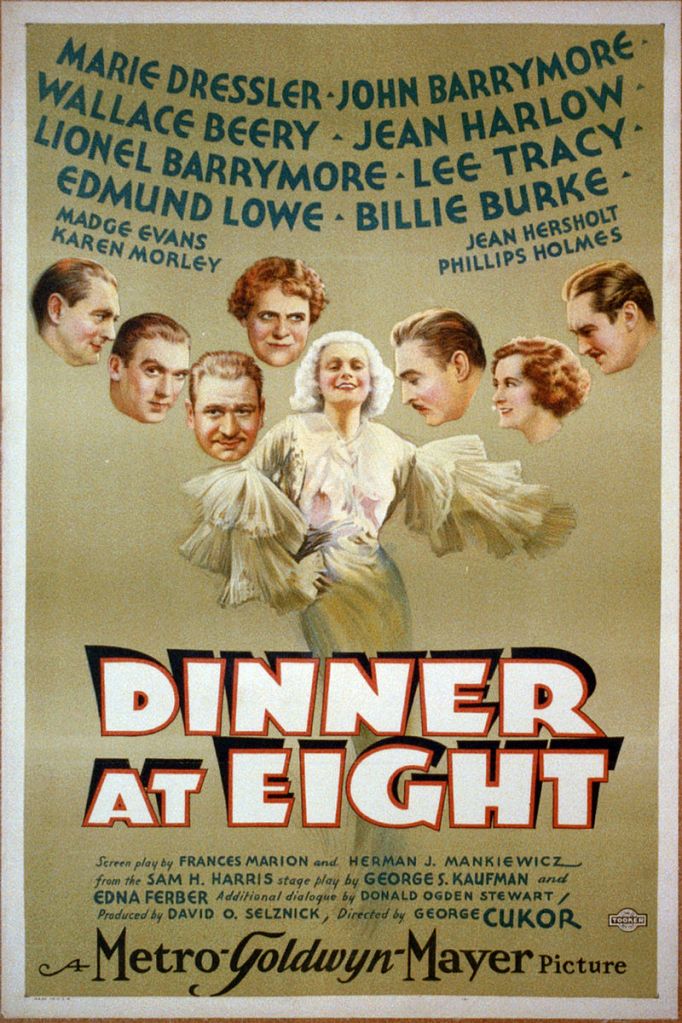
#720) Dinner at Eight (1933)
OR “There Goes Mr. Jordan”
Directed by George Cukor
Written by Frances Marion and Herman J. Mankiewicz; additional dialogue by Donald Ogden Stewart. Based on the play by George S. Kaufman and Edna Ferber.
Class of 2023
The Plot: Socialite Millicent Jordan (Billie Burke) is holding a dinner for the wealthy Lord and Lady Ferncliffe upon their arrival in New York. Her husband Oliver (Lionel Barrymore) isn’t thrilled with the idea, preoccupied with his underperforming shipping business and his declining health. Millicent does, however, concede to send a dinner invitation to Carlotta Vance (Marie Dressler) a famous stage actress who was romantically involved with Oliver many years earlier. Also invited are Oliver’s business rival Dan Packard (Wallace Beery), Dan’s young vivacious wife Kitty (Jean Harlow), who is having an affair with her physician Dr. Talbot (Edmund Lowe) and washed-up silent film star Larry Renault (John Barrymore) who is having an affair with the Jordans’ daughter Paula (Madge Evans). There are plenty of secrets to go around – and an equal number of laughs – as our characters get ready for…an evening meal at a set time.
Why It Matters: Goddammit Class of 2023, why are your write-ups so bad? The film’s official write-up on the NFR website gives a plot recap but no reasoning behind its induction, with the only superlative going to Jean Harlow’s character – “sultry”. The NFR 2023 press release, however, singles out George Cukor’s ability to successfully adapt plays into films, and heralds the ensemble as “arguably one of the greatest assembled to that point in cinema history.” Why wouldn’t you just copy and paste the press release paragraph to the official NFR page?
But Does It Really?: “Dinner at Eight’ is one of those movies that, while not as well remembered today, has lingered on in pop culture enough that its NFR inclusion isn’t too farfetched. Overall, the movie still provides plenty of laughs over 90 years later, though a few of these subplots border on the melodramatic and prevent the film from being an all-out laugh fest. While the whole ensemble is great, in true Cukor fashion this is a “women’s picture”, with Billie Burke, Marie Dressler, and Jean Harlow giving the standout performances. At a time when less and less Classic Hollywood movies are getting inducted into the NFR, I’m glad somebody remembered to add “Dinner at Eight”.
Everybody Gets One: A lifelong veteran of the theater, Marie Dressler found film success in the first feature-length film comedy, 1914’s “Tillie’s Punctured Romance” with Mabel Normand and Charlie Chaplin. Although her acting career waned in the 1920s, Dressler found new success in the sound era at MGM, winning one of the first Best Actress Oscars for her performance in “Min and Bill” alongside her future “Dinner at Eight” co-star Wallace Beery. Sadly, “Dinner at Eight” is one of Marie Dressler’s final films, as she died of cancer the summer after the film’s release at age 65.
Wow, That’s Dated: Obviously there’s references to the Great Depression, plus obscure shoutouts to Peter Stuyvesant, Jenny Lind, and John L. Sullivan (presumably the boxer and not the local car dealership).
Seriously, Oscars?: “Dinner at Eight” received no nominations at the 6th annual Oscars, though several of the film’s creatives were nominated that year for other films: director George Cukor for “Little Women”, screenwriter Frances Marion for “The Prizefighter and the Lady”, and actor May Robson for “Lady for a Day”.
Other notes
- The play “Dinner at Eight” premiered on Broadway in October 1932, with the film rights initially being purchased in February 1933 by Joseph M. Schenck at United Artists. Shortly thereafter, the rights went to David O. Selznick, who had just jumped ship from RKO to rejoin the MGM family (literally, Louis B. Mayer was his father-in-law) as vice president with his own production unit. “Dinner at Eight” was Selznick’s first film as producer at MGM, sensing it was the property that could recapture the all-star glamor of “Grand Hotel“, the MGM hit which had just won the Oscar for Best Picture. Selznick also brought with him from RKO George Cukor, a stage director who pivoted to film with the advent of sound, and who would go on to direct pictures at MGM on and off for the next 25 years.
- The more of these NFR movies I watch, the more I realize that Mr. Potter is the outlier in Lionel Barrymore’s career; his bread-and-butter was rascally old guys like Oliver Jordan. Funny how the one time you play against type is in the movie that goes down as your legacy.
- Marie Dressler’s doing a nice job of playing theatrical without it being overblown for the camera. You get the sense that Carlotta was a real scene-stealer in the play. Also, let us relish this time in cinema’s youth when a stage actress in her early 60s could be a big movie star, and receive top billing in an all-star cast!
- The brief scene of Marie Dressler, Lionel Barrymore, and Wallace Beery together made me theorize that “Dinner at Eight” may be the earliest film to feature three Oscar winning actors after their wins. There had only been five ceremonies up to this point, so it’s possible.
- Like most movies from the 1930s, “Dinner at Eight” has dialogue that contains so much era-specific jargon and obscure references that it makes modern viewings more challenging. It’s almost like watching a Shakespeare play: you have to really pay attention to the dialogue, but a good cast can still get the main points across. “Dinner at Eight” is a very entertaining film, but there’s a little bit more homework you have to do to fully appreciate it.
- MGM meta-reference #1: Millicent’s cousin Hattie mentions her husband constantly going to the movies, referring to herself as a “Garbo widow”.
- Jean Harlow has more dialogue in her first scene of this movie than she had in all of “The Public Enemy“. The character of Kitty could easily be grating or unlikeable in the wrong hands, but Harlow gives her a lot of life. Harlow had such command of her vocal register; shifting from low and natural to high and whiny so well that you sense it’s all strategic on Kitty’s part to get what she wants.
- Billie Burke is absolutely delightful in this. Watching Millicent try to maintain a chipper disposition as her dinner plans continue to unravel is the funniest part of the movie. Glinda the Good Witch may be Burke’s legacy, but this is her best performance.
- Despite being one of the most acclaimed actors of his or any generation, John Barrymore can’t do much with his subplot as a depressed has-been actor, dragging the picture to a grinding halt. Adding insult to injury, he doesn’t even have any scenes with his brother!
- A few of the actors in smaller parts deserve mention here as well. Larry’s agent is played by Lee Tracy, who 30 years later would receive an Oscar nomination for playing a dying ex-president in “The Best Man”. The stage producer who meets with Larry is played by Jean Hersholt, of “Humanitarian Award” fame. Among the hotel staff are a waiter played by Herman Bing, who also voices the Ringmaster in “Dumbo“, and a bellboy played by Edward Woods, whose post-“Public Enemy” career clearly didn’t take off as much as Harlow’s or James Cagney’s.
- MGM meta-reference #2: Carlotta’s dog is named Tarzan, though if you listen closely you can tell that the dog’s name has been dubbed over. It was originally written to be Mussolini, but a cautious MGM had it changed to something less controversial and more synergetic.
- I was very patient with this movie’s first half, knowing that most of it was necessary set-up for the film’s second half, which I presumed would take place during the dinner. As the second half of the movie went along, I kept asking “But when do they get to the dinner?” This movie should be on a double feature with “Guess Who’s Coming to Dinner” as two NFR movies about people gathering for a titular dinner we never actually see!
- Despite my frustrations, “Dinner at Eight” ends with an exchange between Kitty and Carlotta that has one of the best curtain lines of any movie.
Legacy
- “Dinner at Eight’ was a critical and financial success, landing at #10 on the US box office for 1933. Selznick followed up “Dinner at Eight” with three more films in 1933 alone, including “Dancing Lady”: Fred Astaire’s film debut. Selznick stayed at MGM for two more years before founding his own independent production company.
- George Cukor’s next film was back at RKO: the 1933 version of “Little Women” with Katharine Hepburn. As of this writing, George Cukor has directed eight films on the National Film Registry, from “Dinner at Eight” to 1964’s “My Fair Lady“. We can also give Cukor honorable mention for directing a few scenes of “The Prisoner of Zenda“, as well as for being the original director of “Gone with the Wind” before Selznick fired him.
- “Dinner at Eight” is another one of those classic movies that gets referenced more than it gets parodied. Clips from “Dinner at Eight” pop up any time there’s a retrospective on one of its cast or crew, and the title is a mainstay of many sitcoms, including an early episode of “Frasier”.
- To date there have been two remakes of “Dinner at Eight”, both for TV. A one-hour version starring Mary Astor and Pat O’Brien aired in 1955 on CBS’ short-lived “Front Row Center”, and a modernized version aired on TNT in 1989 with an all-star cast including Marsha Mason, Charles Durning, John Mahoney, and Lauren Bacall.
- The original stage version of “Dinner at Eight” gets revived from time to time, with two revivals on Broadway, though neither ran as long as the original 1932 production. In 2017, “Dinner at Eight” was adapted into an opera, which…sure why not?
- And finally, you can definitely see the influence Jean Harlow’s performance had on Lesley Ann Warren’s work as James Garner’s “moll” in “Victor/Victoria”. The hair, the clothes, the voice: it’s all there.
 The Horse's Head
One thought on “#720) Dinner at Eight (1933)”