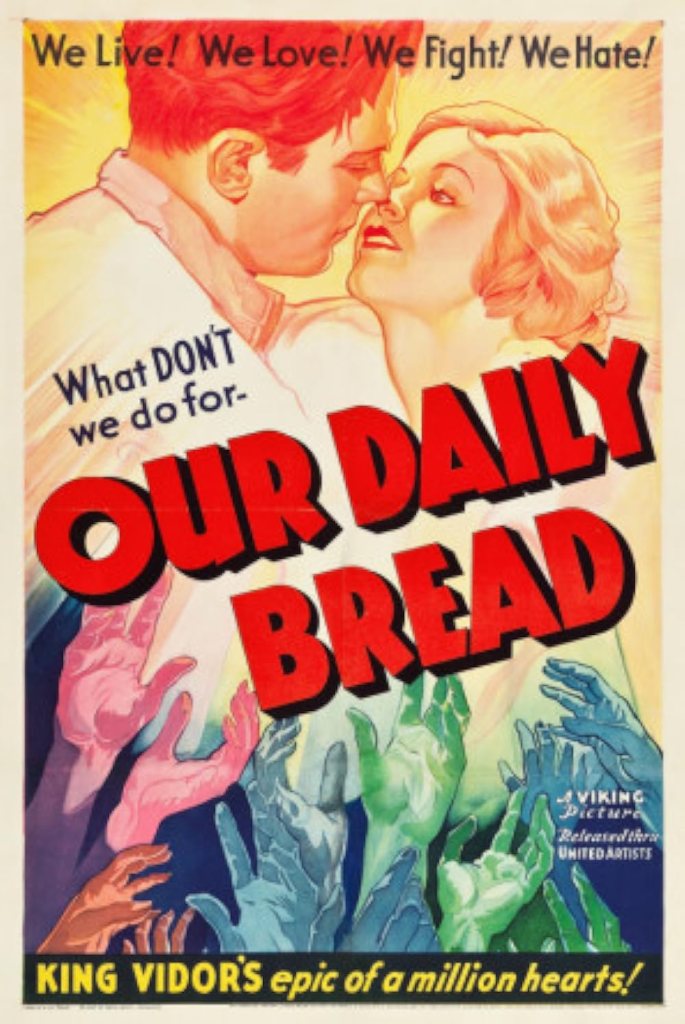
#722) Our Daily Bread (1934)
OR “Red Acres”
Directed King Vidor
Written by Vidor, Elizabeth Hill, and Joseph Mankiewicz
Class of 2015
The Plot: Big city dwellers John and Mary Sims (Tom Keene and Karen Morley) are hit hard by the Depression and struggle to pay their bills. Desperate for help, the Sims accept an offer from Mary’s Uncle Anthony (Lloyd Ingraham) to move to farmland he is paying mortgage on and grow crops to earn a living. John and Mary quickly relocate to the country, only to discover the land is barren and that they have zero farm skills. With the help of local farmer Chris Larsen (John Qualen), John develops a co-op community where men lend their trades to the farm in exchange for a place to live. Soon dozens of men and their families join the co-op and work amidst many setbacks to grow corn for harvest. It’s a tale of community and creative problem solving, set during the last time this country ever had an overall positive reaction to Socialism.
Why It Matters: The NFR gives the film its historical context, calling it a “radical exception” to the typical escapist films of the day. The write-up also admits that the film was “[c]riticized for its purportedly socialist ideas and also for its seemingly fascistic traits.”
But Does It Really?: This is on the “historically significant” side of things. As a film, “Our Daily Bread” is a bit clunky and heavy-handed, focusing more on its ideas than its story or characters. But the film’s unique Depression-era viewpoint, as well as its interesting behind-the-scenes development, help it stand out among so many other films of the era. I get why “Our Daily Bread” is on the NFR, but I also understand why there was no rush to get it on there; this is another movie whose viewing should be reserved just for us film list completists.
Shout Outs: If the names John and Mary Sims sound familiar, that’s because they are the same names King Vidor used for his leads in “The Crowd“. “Our Daily Bread” began life as a continuation of “The Crowd”, though all that survives of that concept are the names.
Wow, That’s Dated: This movie could only be made during the 1930s when America, discouraged by the politics that got it into the Depression, was still willing to consider Communism, Socialism, and other alternatives to representative democracy. Damn it Stalin, you just had to ruin it for everyone didn’t you?
Title Track: “Our Daily Bread” is one of two NFR movies that get its title from the Lord’s Prayer. The title is said once in the film proper when the Lord’s Prayer is being recited after the first crop growth.
Other notes
- Once the Great Depression hit, King Vidor started thinking about how John and Mary from “The Crowd” would be affected. The idea of them moving to a farm and starting a co-op came about when Vidor saw a Reader’s Digest article proposing a similar idea as a solution to unemployment (hence the film’s declaration “Inspired by the Headlines of Today”). In 1933, Vidor had a deal with RKO to finance the picture, but after months of development the deal fell through once RKO realized that Vidor could make a higher profit on the film than the studio. Unable to get any other studio interested, Vidor financed the film himself under his newly formed Viking Productions (though he did eventually secure a loan from Bank of America) and used his friendship with Charlie Chaplin to get a distribution deal with United Artists.
- King Vidor had originally planned on hiring his leads from “The Crowd” – James Murray and Eleanor Boardman – to reprise their roles as John and Mary. By the time production began, however, James Murray had relapsed into alcoholism and Eleanor Boardman had separated from her husband…King Vidor. Tom Keene and Karen Morley were cast instead based in part on their physical resemblances to the original actors. Once you know that casting tidbit it becomes obvious that these actors were cast based on their looks because neither one is that great. Heck, Tom Keene would go on to star in “Plan 9 from Outer Space”!
- All this “Crowd” talk begs the question: Is “Our Daily Bread” a sequel to “The Crowd” or not? While most internet listings refer to this film as a sequel, the real answer is “Not really”. Despite the same lead characters, the two films aren’t directly connected, and no prior knowledge of “The Crowd” is needed to understand “Our Daily Bread”. Still, there’s nothing stopping you from considering it a direct sequel if that’s what you really want, although at some point in the intervening six years, John and Mary have learned to speak without the use of intertitles. And didn’t they have kids?
- This film continues the early film trope that Swedes by their very nature are hilarious. They pronounce j’s like they’re y’s! Isn’t that nutty? Side note: Chris’ actor John Qualen played Swedes/Scandinavians for comic relief in several movies, including another NFR film; “The Searchers“.
- Having no prior knowledge of the plot, I was worried that this movie would just be the tribulations of two city folk adjusting to farm life. Once John proposed a co-op, the film finally piqued my interest, and its NFR placement made a lot more sense. Side note: As someone whose primary skill set is watching and writing about films, I would not do well in a commune. “If you help build my house, I can put ‘Citizen Kane‘ in its proper historical context for you. Please?”
- Shoutout to whoever did the production design. I love the makeshift co-op village constructed from whatever materials were on hand. My favorite is the house made from a disassembled car, with a dismantled car door serving as their front door, complete with roll-down window! Related Fun Fact: The farm scenes were partially filmed on Edgar Rice Burroughs’ Los Angeles ranch: the appropriately named Tarzana.
- “There’s nothing for people to worry about, not when they’ve got the earth.” Okay sure, but what if we screwed up so badly we don’t have the earth anymore? Can one of you build the Axiom for us?
- All this plowing footage and no stirring narration about how great our government’s New Deal programs are?
- The most inconspicuous part of the film for me was the arrival of Sally, a young Joan Blondell-type who winds up in the co-op and causes some marital strife between John and Mary. In a movie with so much inherent conflict regarding the survival of the land and its inhabitants, did we need a homewrecker subplot? Maybe sassy platinum blondes were a requirement for all 1930s films. Also, it turns out my “Green Acres” joke at the top wasn’t too far off, because Sally is played by Barbara Pepper, 30 years before her work as Doris Ziffel. It’s all connected!
- Today in lines that sound dirty but aren’t: John comforting Mary with “We’ve licked everything together so far.” John, that stays between you and your wife, alright?
- The last act of the film is devoted to the community coming together to build the irrigation needed to water their crops. It’s long, but it perfectly encapsulates the film’s “The needs of the many outweigh the needs of the few” mentality, and it’s easily the film’s most exciting sequence. Like the sniper scene in “The Big Parade“, Vidor filmed this with a metronome to time the action and increase the pace as the sequence progresses.
Legacy
- “Our Daily Bread” premiered at the Chicago World’s Fair in August 1934 before its general release that October. At some point after its initial run, “Our Daily Bread” was re-released by its new distributor Astor Pictures Corp. under the much more evocative name “Hell’s Crossroads”. King Vidor revealed years later that while the film recouped its investment, it did so just barely with little to no profit.
- As with many a film on this list (especially those not financed by a major studio), “Our Daily Bread” lapsed into public domain and was frequently played on TV. In fact, “Our Daily Bread” was one of the first films ever shown on TV, airing on New York’s experimental W2XBS (now WNBC Channel 4) in April 1940! If a movie airs on TV but no one owns a TV yet…
- While “Our Daily Bread” has lingered in relative obscurity for the last 90 years, it is not without its fans, including Orson Welles who once called it one of his top 10 favorite movies. The film’s reputation has improved over the last decade, starting with the film’s NFR induction in 2015, plus a screening at the 2020 Berlin International Film Festival as part of a King Vidor retrospective.
 The Horse's Head
2 thoughts on “#722) Our Daily Bread (1934)”