#723) Lady Helen’s Escapade (1909)
OR “The Woman with No Name”
Directed by D. W. Griffith
Written by Stanner E. V. Taylor
Class of 2004
Until recently, “Lady Helen’s Escapade” was one of the hardest NFR titles to track down; no physical media release, no internet uploads, nothing short of scheduling a screening at the Library of Congress. That all changed recently thanks to the efforts of Benjamin Wilson (curator of this comprehensive NFR YouTube playlist) and a GoFundMe campaign to get a print from the Library of Congress digitized and uploaded to YouTube. Additional thanks to Eric Levy from filmregistry.net for bringing this development to my attention and hosting the film’s online premiere.
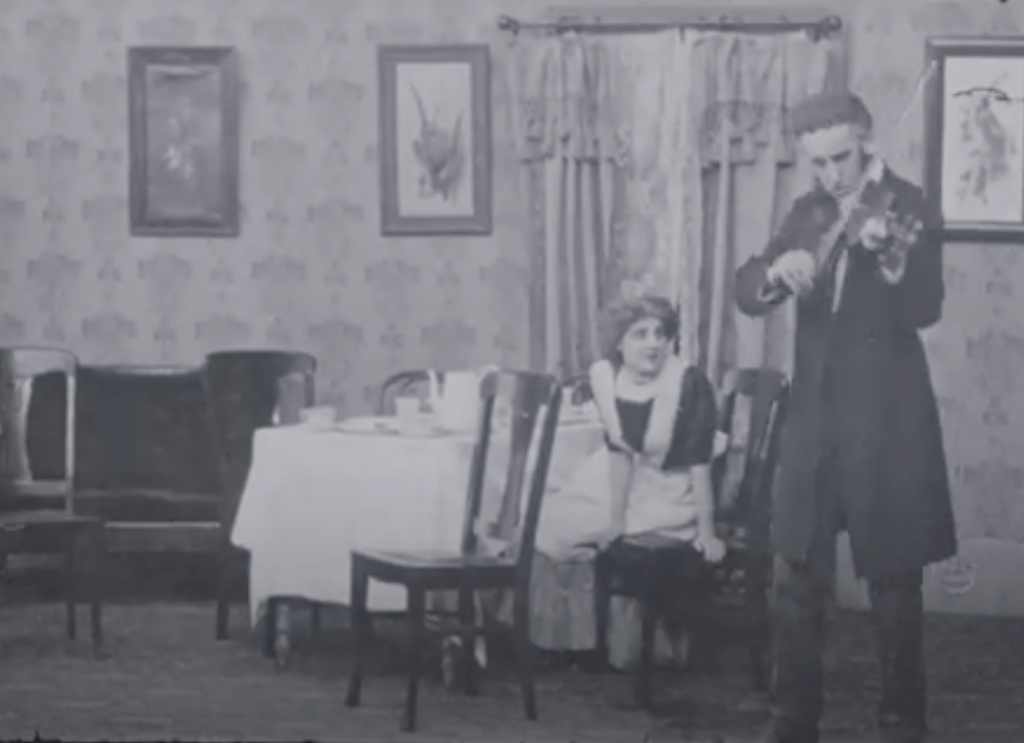
The Plot: Bored socialite Lady Helen (Florence Lawrence) wants to add some excitement to her life, so she answers a newspaper ad and takes a job as a boarding house servant. Much hilarity ensues as she stumbles through her new job, while simultaneously pining for a tenant – a handsome violinist (David Miles) – and fending off the advances of some enamored dinner guests. But the real story behind this short is one about its lead’s run as the first American movie star, as well as the story of this film’s recent resurrection.
Why It Matters: The NFR write-up is a brief ode to Florence Lawrence – “the first true star in American cinema”, with the film proper being referred to only as “sprightly”. An essay by NFR expert Daniel Eagan is a biography of Florence Lawrence, mixed with the little information we have regarding “Lady Helen’s”.
But Does It Really?: This is definitely another early 2000s “What don’t we have yet?” NFR entry. Florence Lawrence, while almost entirely forgotten today, is an important player in American film history, and having one of her films in the NFR makes sense. As a film, “Lady Helen’s Escapade” is fine if not outstanding, but it does a good job of representing Florence Lawrence as an actor (and is sadly one of her few surviving films). Why it took so long for this film to become readily available is beyond me, but thankfully that has been rectified, and hopefully a new generation of film lovers can discover Florence Lawrence and keep her legacy alive.
Everybody Gets One: Turns out the first American movie star is Canadian; Florence Lawrence was born Florence Bridgwood in Hamilton, Ontario. Her mother was Charlotte Bridgwood, a stage actor who performed under the name Lotta Lawrence. Florence began acting in her mother’s theater troupe at age three, though they eventually settled in New York after Florence’s father died and the Lawrence Dramatic Company disbanded. Unable to find work on the New York stage, Florence (now using “Lawrence” from her mother’s stage name) started acting in the new medium of film, eventually signing with Biograph in 1908. “Lady Helen’s Escapade” was one of dozens of shorts Lawrence made for Biograph in 1908 and 1909; though always uncredited. Film studios at the time never credited their actors, partly because most actors did not want to be associated with this new “low-brow” medium; but mainly for fear from the studios that name recognition would lead to actors demanding higher salaries (they were right). Fans of Florence Lawrence didn’t know who to address their letters to, so Biograph received tons of fan mail praising “The Biograph Girl”.
Wow, That’s Dated: Mostly the kind of slum tourism, aka slumming, that Lady Helen participates in by taking this job. The idea of visiting impoverished or disadvantaged places out of adventure or curiosity is still around but is now widely (and justifiably) criticized.
Other notes
- One very important note regarding this film’s YouTube presentation: for whatever reason, the print made available by the Library of Congress did not include intertitles which, as you can gather from the complex plot synopsis, would have been very helpful to have. During our post-screening discussion back in September, it was theorized that the digital version was scanned from a paper print (which would have only included the visuals and not the text). If you’re going to watch “Lady Helen’s Escapade”, do yourself a favor and read a plot description beforehand (feel free to read mine again).
- If nothing else, “Lady Helen’s Escapade” is a chance for me to watch and write about a D. W. Griffith film that isn’t mired in controversy. It’s also interesting to watch a Griffith film while he’s still figuring out this new medium. No revolutionary close-ups or cross-cutting, just point and shoot. “Lady Helen’s” was released eight months before “A Corner in Wheat”; one of Griffith’s first toe dips into the pool of artistic filmmaking.
- Florence Lawrence is quite a capable leading lady, never overselling the comedy the way some of her co-stars do, which unfortunately leads to her getting wrongfully upstaged in her own movie. It’s a shame there isn’t more of Lawrence’s filmography around to see what kind of range she must have had.
- I’m amused by the massive fur coat being worn by Lady Helen’s boyfriend. It looks like he’s being eaten by a wooly mammoth in real time. PETA would need an entire Sherwin-Williams to take this guy down.
- As is often the case in these kinds of early romantic comedies, the men pining for Florence are ignoring her obvious disinterest in them. If only this print had intertitles, then she could have made her plea.
- Once again, you owe it to yourself to read a plot synopsis before watching “Lady Helen’s Escapade”. The ending is so quick and disjointed that you get the sense the intertitles did a lot of heavy lifting. At the online premiere, our excitement before the film turned into bafflement by the end; a sort of “That was nice, but what happened?”
Legacy
- Shortly after making “Lady Helen’s Escapade”, Florence Lawrence was lured away from Biograph to Independent Moving Pictures with the promise of better pay and – more importantly – billing. Lawrence’s reign as America’s first movie star continued into the 1910s, though a series of personal setbacks, as well as injuries sustained in a 1915 fire, led to her decline in stardom. By the 1920s, Lawrence was working solely as an extra or bit player (almost always uncredited, somewhat ironically). Florence Lawrence’s final films were as a bit player for MGM before her death in 1938.
- Perhaps Florence Lawrence’s greatest contribution to history is one outside of her film work. In 1914, Lawrence invented an “auto signaling arm” for cars, but didn’t patent her idea, which would go on to become both the turn signal and the brake signal. Sadly, given my own experience on the road, most people do not use Lawrence’s invention when changing lanes on the freeway. Do not let her legacy be in vain!
- D. W. Griffith continued to crank out shorts for Biograph through 1914, when he left following disputes regarding budget overruns. Griffith continued to push the envelope for films as an artform, and if you’ve read this far then you’re well aware of what he made in 1915. Moving on…
- Although most of Florence Lawrence’s filmography has been deemed lost, “Lady Helen’s Escapade” survives, and in 2024 was finally made available online. My thanks again to Benjamin Wilson for his work campaigning for this film’s digitization, and Eric Levy for inviting me to its online premiere. It was wonderful meeting so many film lovers face-to-face (via Zoom) and sharing our silent film knowledge with each other. Bonus shoutout to Isabel of “Irresistible Cinema”, who was also in virtual attendance and covers the NFR on her website. Check her out!
 The Horse's Head
As of October, 2025 over 50% of Florence’s films are known to be extant. She made between 280 and 300 films in total and I have not only seen 150 of them, but can confirm that every single one of her Biograph films still exist and are available to watch, although some effort is required to get access. Thanks.
LikeLike