
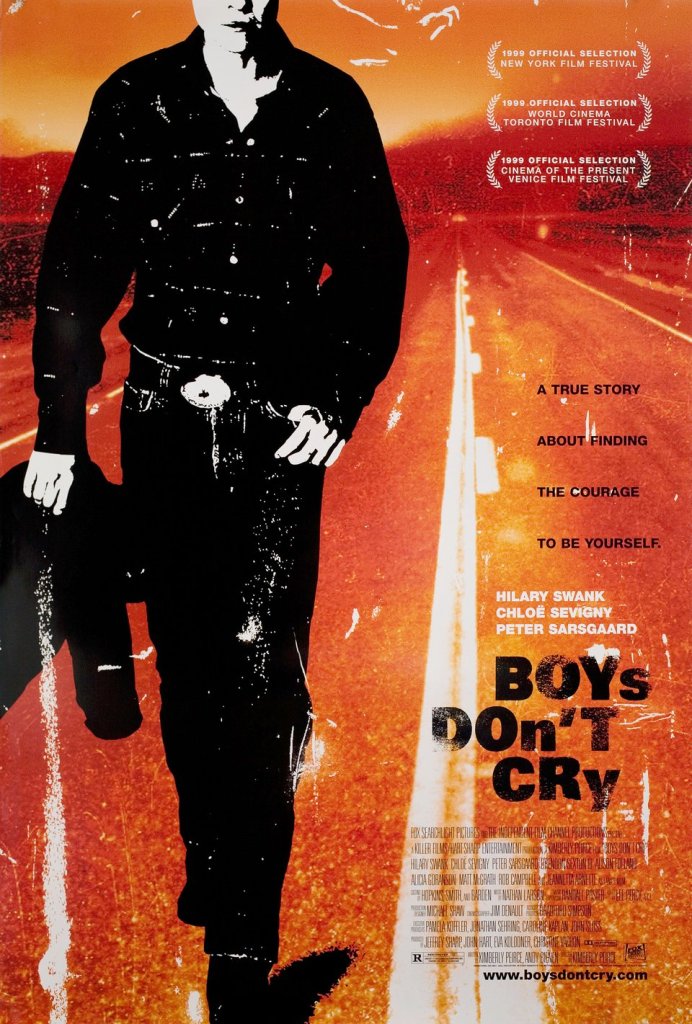
#725) Boys Don’t Cry (1999)
OR “Brandon Recognition”
Directed by Kimberly Peirce
Written by Peirce and Andy Bienen.
Class of 2019
The Plot: “Boys Don’t Cry” is based on the true story of Brandon Teena, a transgender man who was raped and murdered in 1993, one of many cases in the 1990s that led to more state and federal laws against hate crimes. Upon his arrival in Falls City, Nebraska, Brandon (Hilary Swank) befriends ex-con John Lotter (Peter Sarsgaard) and his group of friends, including John’s ex-girlfriend Lana Tisdel (Chloë Sevigny). Brandon keeps his biological gender a secret, with his new social circle totally unaware of his previous life as a woman (and as a wanted criminal for check forgery). Things get complicated as Brandon begins a romantic relationship with Lana, and everyone gets closer to the truth…or as close to the truth as we were able to comprehend in 1999.
Why It Matters: The NFR calls the film a “searing docudrama”, singling out Swank’s performance. The write-up also acknowledges the issues regarding sexual identity and transphobia brought up by this movie and includes a snippet from Janet Maslin’s New York Times review which praised the film for its uplifting qualities.
But Does It Really?: Admittedly, I was apprehensive about watching “Boys Don’t Cry” given what I knew about the film’s tragic ending, but I was quickly won over, thanks to Swank’s commanding performance and Peirce’s sensitive, caring direction. “Boys Don’t Cry” somehow manages to take a very distressing historical event and focus on the person at the center, helping an audience recognize our transgender citizens for the dimensional humans that they are. “Boys Don’t Cry” makes the NFR for its refreshing and respectful approach to its subject matter, and for its reminder of how far we’ve come in terms of transgender representation, and how much we still have left to go.
Everybody Gets One: While working on her MFA at Columbia University in the mid-90s, Kimberly Peirce read a Village Voice article about Brandon Teena’s murder, and was inspired to make a short film about Brandon that went beyond the sensationalist media headlines and focused on Brandon as a person. Peirce conducted research by traveling to Falls City, Nebraska, interviewing Lana Tisdale, and even attending the trial of Teena’s murderers. The eventual short film (also titled “Boys Don’t Cry”) caught the eye of producer Christine Vachon, who helped Peirce develop it into a narrative feature film. Film production stalled when Peirce was unable to cast the role of Brandon after auditioning hundreds of cisgender women (as well as several transgender men), but was finally won over by Hilary Swank, then best known as “The Next Karate Kid” and freshly fired from “Beverly Hills, 90210”. Swank prepared to play Brandon by living as a man for a month prior to shooting, to the point where Swank’s neighbors thought her brother had moved in with her. Reflecting on the part 20 years later, Swank stated that if she were offered the role of Brandon today, she would turn it down, believing that the character should be played by a transgender actor.
Title Track: The film was written and filmed under its original title “Take It Like a Man” but was changed to “Boys Don’t Cry” late in production. The film takes its name from The Cure song of the same name, and while the song does appear in the final film, it’s a cover/soundalike by Nathan Larson, then-guitarist for Shudder to Think.
Seriously, Oscars?: Despite playing in only a handful of theaters when initially released, “Boys Don’t Cry” was a strong awards contender throughout the season, ultimately receiving two Academy Award nominations. Chloë Sevigny lost Best Supporting Actress to Angelina Jolie in “Girl, Interrupted”, but Hilary Swank prevailed in the Best Actress category, beating out more established actors Annette Bening, Janet McTeer, Julianne Moore, and Meryl Streep.
Other notes
- First, let’s pour one out for Fox Searchlight Pictures, which dropped the “Fox” from its name after being acquired by Disney in 2019. “Boys Don’t Cry” is the first Fox Searchlight film on the Registry, joined four years later by “12 Years a Slave”.
- One of Peirce’s goals with this film was not to mythologize or lionize Brandon Teena, and I feel she succeed on that front. The film always feels authentic; everyone’s dialogue sounds true to life (a very difficult feat to pull off), and all the performances are grounded and realistic. Even the moments where emotions run high never feel too forced or overly dramatic. It makes you trust the film and its portrayal of Brandon as a real person caught in a horrible situation.
- Everyone in this movie is great, but Swank is the undeniable MVP. There is something quite compelling about Swank’s work; her Brandon is so instantly likeable that you accept his situation immediately and root for him, even if you know this story won’t end well for Brandon. On a lighter note, my favorite detail in Swank’s performance is the aggressive manspreading Brandon has while seated. It’s a nice subtle touch.
- The rest of the ensemble rises to Swank’s level and delivers good work. Peter Sarsgaard is the right balance of charismatic and threatening without ever tipping over into cartoon villain territory. You recognize John (and his accomplice Tom as played by Brendan Sexton III) as a regular guy whose internal struggles led to some very bad decisions. I also really enjoyed Chloë Sevigny, playing Lana as troubled and contradictory, but always real and alluring. And no, you are not seeing things; Lana’s friend Candace is played by Lecy Goranson, aka Becky #1 from “Roseanne”. Goranson was cast based on her resemblance to Lisa Lambert, the real person the composite character of Candace is based on.
- I don’t have a lot to say about the film itself, mainly because I was so engrossed with it during my viewing, but also because the film is just that good: there’s only so many ways I can complement any aspect of this film without becoming repetitive or breaking out my thesaurus. Also, as a cisgender male I do not feel qualified to discuss the nuances of transgender identity presented by this film. I will, however, give one more department their due and shoutout this movie’s cinematography. Kimberly Peirce started out as a photographer, which explains why she and cinematographer Jim Denault include several shots of the Nebraska night sky presented through timelapse photography (inspired by the work of Jan Staller). I’m not sure what it all means, but you can’t begrudge Peirce for wanting to add a bit of artistic flourish to the proceedings, especially something that doesn’t harm or disrespect the real story being told.
- The sex scenes between Brandon and Lana are noteworthy because of the double standard that seemed to stem from them. Peirce has talked at length about how “Boys Don’t Cry” was initially rated NC-17 but was bumped down to an R after some trims. While most of these edits pertained to the rapes scenes later in the movie, Peirce was upset that it was the sex scenes between a cisgender woman and a transgender man that more concerned the MPAA, particularly the length of Lana’s orgasm. Peirce talks more about her issues with the MPAA rating system in the great documentary “This Film is Not Yet Rated”.
- At some point I knew that “Boys Don’t Cry” was based on real events, but I forgot prior to this viewing, so it was a surprise to me when the film ended with text explaining what happened to John and Lana after Brandon’s death. The film mercifully doesn’t begin with some variation of “Based on a True Story”, which allowed me to get caught up in the lives of these characters rather than the historical accuracy of it all (I spent the last third of my viewing yelling at Brandon and Lana to get out of town like it was a horror movie). The end text was a sobering reminder that this all happened, and despite the progress made in the last quarter century, is still happening.
Legacy
- After premiering at the New York Film Festival, “Boys Don’t Cry” opened in October 1999 in about 25 theaters across the country. The film went in a wider release following its two Oscar nominations, and by March 2000 (the same month of the Oscars) the film had grossed almost three times its production budget.
- While “Boys Don’t Cry” was a hit with critics and award shows, one person who didn’t like it was the real Lana Tisdel, who sued Fox Searchlight for unauthorized use of her name, and for portraying her in the film as “lazy white trash” (Tisdel eventually settled out of court). While Brandon’s mother JoAnn Brandon never accepted Brandon’s lifestyle and refused to be interviewed by Peirce for the movie, she has since become more understanding of Brandon and those like him, and appreciates what “Boys Don’t’ Cry” has done to raise awareness for the transgender community.
- “Boys Don’t Cry’ has gone on to be a landmark in queer representation in film, helping pave the way for larger conversations about our transgender community. While the film’s cultural footprint throughout the 2000s was primarily as a transphobic punchline on TV, that has thankfully lessened in more recent years, and the film and its subject matter continue to receive the respect they deserve.
- Hilary Swank followed up “Boys Don’t Cry” with several big movies, including Clint Eastwood’s “Million Dollar Baby”, for which she won her second Best Actress Oscar. Peter Sarsgaard continues to grace our screens with reliable character work, as does Chloë Sevigny, whose work as an actor is matched by her work confusing the internet with her fashion choices.
- Kimberly Peirce’s next film was 2008’s “Stop-Loss” based on the experience of American soldiers in the Iraq War. To date, Peirce has only made one other theatrical movie – a 2013 adaptation of Stephen King’s “Carrie” – but she continues to work frequently in episodic TV. Peirce is also an activist for queer and woman’s rights. Upon the NFR induction of “Boys Don’t Cry” in 2019, Peirce called the moment “a culmination, unimaginable and wonderful.”
Further Viewing: “The Brandon Teena Story”, the 1998 documentary by Susan Muska and Greta Olafsdottir which features interviews from many people that knew Brandon, including JoAnn Brandon and Lana Tisdel.
 The Horse's Head
3 thoughts on “#725) Boys Don’t Cry (1999)”