
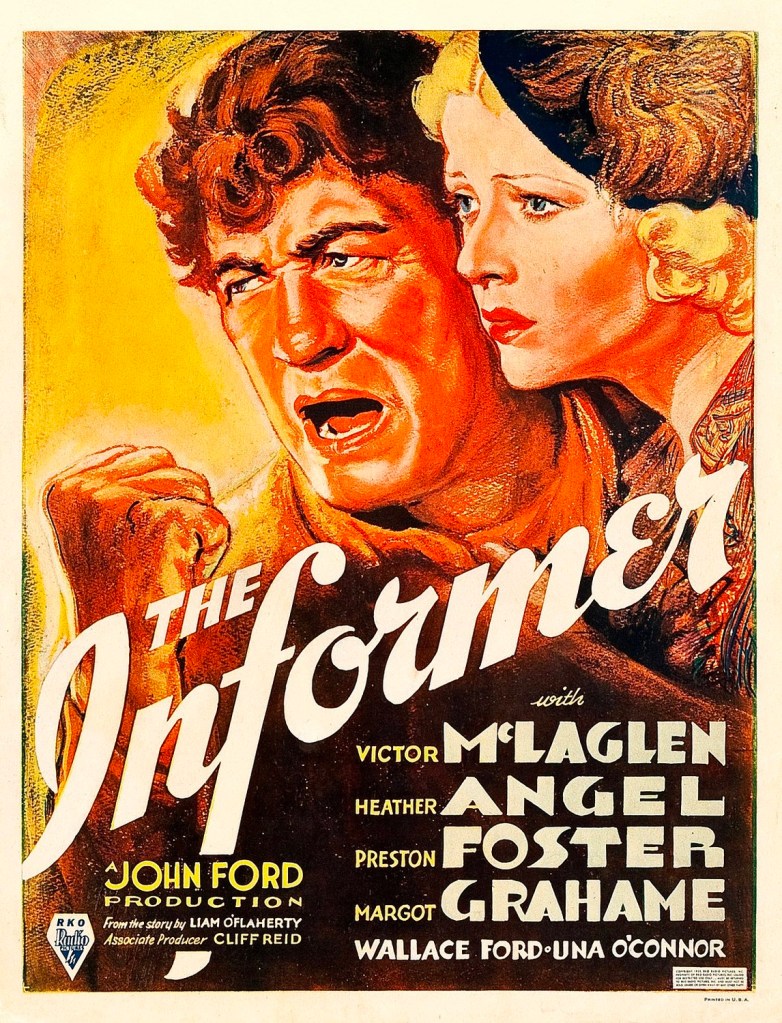
#734) The Informer (1935)
OR “Irish Risky”
Directed by John Ford
Written by Dudley Nichols. Based on the novel by Liam O’Flaherty.
Class of 2018
No trailer, but here’s a clip
The Plot: In Dublin following the tumultuous Irish War of Independence, Gypo Nolan (Victor McLaglen) is broke, unemployed, recently expelled from the IRA, and perpetually drunk. Trying to figure out a fresh start for himself and his girlfriend Katie (Margot Grahame), Gypo runs into his old friend Frankie McPhillip (Wallace Ford), who Gypo has recently learned is wanted by the Black and Tans, with a 20-pound reward for information on his whereabouts. With a half-baked plan to use the money to get him and Katie to America, Gypo informs on Frankie, who is gunned down in a confrontation with the Black and Tans shortly thereafter. Distraught and guilt-ridden, Gypo blows the money on drinks and other distractions, but learns he can rejoin the IRA if he can find out who informed on Frankie. There’s plenty of Irish guilt to go around in this early offering from John Ford.
Why It Matters: The NFR gives a rundown of the film’s story, as well as historical context on John Ford’s career. Joseph August’s cinematography is highlighted, as is Ford’s status as the most represented director in the NFR with 11 films (though one of those is a segment of “How the West Was Won”).
But Does It Really?: “The Informer” is one of those “Important Movies” that, while considered one of the greatest movies ever made in the decades following its release, has been eclipsed over the years by other movies. Heck, “The Informer” even gets left out among highlights of John Ford’s own filmography. It’s still a very good movie 90 years later, and I get what a breakthrough this must have been in 1935, but “The Informer” no longer has that je ne sais quoi that all the great movies seem to possess. Still, it gets mentioned often enough (mostly in conjunction with the John Ford canon) that its NFR recognition is understandable, even if no one was in a rush to get it on the list.
Shout Outs: Not a direct reference, but John Ford was greatly inspired by F. W. Murnau’s “Sunrise”, especially its cinematography, and he and Joseph August infused “The Informer” with the kind of shadowy camerawork associated with German expressionism.
Wow, That’s Dated: The nickname “Gypo” is of course derived from “gypsy”, so that wouldn’t fly today. We never learn Nolan’s real first name, though with that nickname I assume it’s Rose Louise.
Seriously, Oscars?: The 8th Oscars had their share of interesting occurrences, almost all of them concerning this movie. “The Informer” entered the race with six nominations, winning four of them, the most wins at that ceremony. Both John Ford and Max Steiner received their first Oscars (for, respectively, Best Director and Best Scoring), and although “Informer” lost Best Picture to “Mutiny on the Bounty”, Victor McLaglen beat out all three of the “Mutiny” leads for Best Actor. The most noteworthy of the film’s wins was writer Dudley Nichols for Best Adaptation, who became the first person to ever refuse an Oscar, in response to the tensions between the Academy and the newly formed Writers Guild (this is back when the Academy was a union-busting front first and an awards organization second). Nichols accepted his Oscar three years later when the Academy was completely restructured and added a bylaw prohibiting any union interference.
Other notes
- At this point in his career, John Ford had been cranking out critically acclaimed hit movies for a decade, starting with “The Iron Horse” in 1924. While at Fox in 1933, Ford and screenwriter Dudley Nichols pitched a film adaptation of “The Informer” (Ford was friends with Liam O’Flaherty), but the studio wouldn’t acquire the film rights. When Ford moved to RKO, he tried to sell them on “Informer” as well, but they were skeptical about the story’s box office potential, as well as concerns about comparisons to a 1929 film adaptation. The success of Ford’s 1934 film “The Lost Patrol”, which also had a risky subject matter and a previous film version, gave RKO the confidence to greenlight the project, but only gave Ford a budget of about $243,000 (some sources claim even less). Ford continued his streak of bringing his films in on time and under budget by shooting “The Informer” in three weeks and wrapping production with $50,000 to spare.
- “The Informer” may have held the record for most Irish opening credits ever, with an abundance of Fitzgerald’s, Corrigan’s, Kerrigan’s, and O’Whatever’s (despite being headlined by the English/Scottish McLaglen). The credits conclude with a Bible passage from the Book of Matthew: “Then Judas repented himself – and cast down the thirty pieces of silver – and departed.” Umm…spoiler?
- If you are going to watch this movie, definitely brush up on your Irish history, particularly their fights for independence from the British in the early 1920s. To appease film censor boards (both in the US and England), “The Informer” downplays the War of Independence, not explicitly mentioning the IRA by name (though there are a few references to “Tans”). If you know this historical context going in, the film makes sense, but it’s all spoken in such vague terms (not to mention with thick Irish accents) that someone like me with zero prior knowledge will be lost.
- I didn’t know a lot about Victor McLaglen going into this movie (I forgot he was in “Gunga Din”) and I enjoyed his work here. Gypo is one of the dumbest protagonists in movie history, but McLaglen keeps him human, never resorting to the obvious Irish stereotypes. Stories of John Ford’s treatment of McLaglen during production to “trick” him into a good performance – changing the shooting schedule on him at the last minute, berating him in front of the crew, etc. – are most likely apocryphal, though Ford did reveal at the time that McLaglen purposefully waited until the last minute to learn his lines so that they would sound more spontaneous.
- As Frankie’s grieving mother Mrs. McPhillip, this has got to be Una O’Connor’s least grating film performance. It helps that this is not a horror movie, so Una doesn’t have to scream and be hysterical, though given that her son is gunned down in her own house you’d think she would.
- Longtime readers know that I love calculating inflation, so of course I needed to know how much 20 pounds in 1922 Ireland would be in 2024 US dollars. The conversion rates are a bit tricky (Ireland uses the Euro now), but my math comes out to about $1400. Imagine getting $1400 and blowing the whole thing in one night, mainly on alcohol. No wonder everyone’s suspicious of Gypo.
- I was not counting on this film to have not one but two romance subplots. In addition to Gypo and Kate, there’s revolutionist leader Dan Gallagher (Preston Foster) and his relationship with Frankie’s sister Mary (Heather Angel). I don’t know if this secondary relationship is in the book, but it feels like a studio mandate. Fun Fact: Heather Angel (who gets second billing here despite her short screentime) would go on to voice two Disney characters: Alice’s older sister in “Alice in Wonderland” and Wendy’s mother in “Peter Pan”. I guess she sounds like she must be related to Kathryn Beaumont.
- [Spoiler] As “The Informer” went along it started to feel more like homework. Again, there’s nothing wrong with the movie, but it isn’t the piece of entertainment it would have been in 1935. That all being said, I did enjoy the final scene with Gypo at the church. That is one of the great Hollywood death scenes; one of those where our protagonist can live as long as he needs to after getting shot in order to have a dramatic final scene.
Legacy
- While “The Informer” was a critical success upon its release, the film barely made its budget back at the box office. Following its Oscar wins, however, the film was re-released and was a much bigger hit with audiences.
- I have nowhere else to put this bit of trivia, but “The Informer” is the only movie to win the New York Film Critics Circle award for Best Picture by a unanimous vote on the first ballot. I found that interesting, and it’s my blog so it’s going in!
- “The Informer” received the remake treatment in 1968 as “Uptight”, which transported the story to a Black neighborhood in modern-day Cleveland. Despite being directed by Jules Dassin and starring Julian Mayfield and Ruby Dee, “Uptight” still sits in the shadow of its predecessor. Ironically, several crew members informed on the production of “Uptight” to the FBI, who had “concerns” about a film centered around Black revolutionists.
- References to “The Informer” are primarily reserved for discussions about John Ford, though a clip of the ending does show up in “The Departed” during a scene where a character learns that another character is…wait for it…an informer! Marty, you’ve done it again!
- Perhaps the film’s biggest influence: Shortly after production wrapped, John Ford learned that RKO was doing re-shoots without his approval or input. This incident, among many, many others, inspired Ford to join the group of Hollywood directors who were considering unionizing. The result was the foundation in 1936 of the Screen Directors Guild, now known as the Directors Guild of America (DGA).
 The Horse's Head