
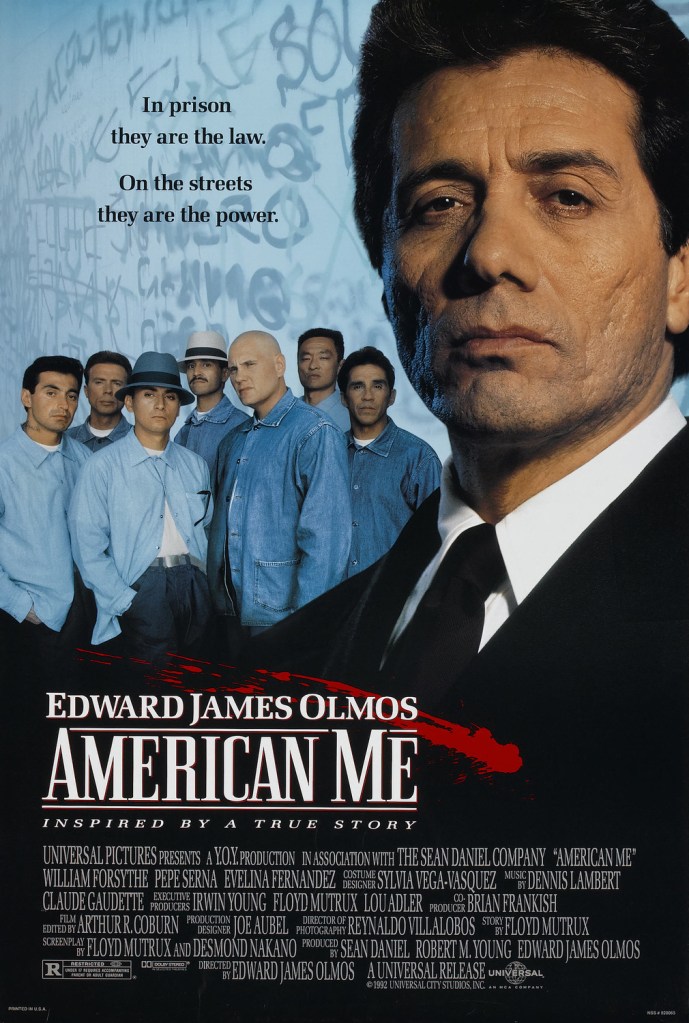
#735) American Me (1992)
OR “Inside Out”
Directed by Edward James Olmos
Written by Floyd Mutrux and Desmond Nakano
Class of 2024
The Plot: “American Me” is a semi-fictional, decade-spanning epic about the rise to power of an L.A.-based Mexican Mafia. In 1959, teenager Montoya Santana (Panchito Gomez) starts a neighborhood gang with his friends, and quickly finds himself in juvenile hall. Upon murdering a fellow prisoner who assaults him, Santana gains the respect of the other inmates while simultaneously guaranteeing a transfer to Folsom once he turns 18. As an adult (Edward James Olmos), Santana is the leader of La Eme, a prison gang that has expanded into a full-blown criminal organization selling drugs throughout California. Upon Santana’s release and return to his old neighborhood, he meets Julie (Evelina Fernández), who shows him what a life outside of the criminal world can be like. Will Santana change his ways and break the vicious cycle of gang life? In his film directorial debut, Edward James Olmos tells a monumental story that is definitely not based on real-life Mexican Mafia boss Rodolfo Cadena. Not at all. Please don’t kill me.
Why It Matters: The NFR praises the film’s portrayal of the “dark, brutal realities” of L.A. gang life, and goes out of its way to remind you that this film is a work of fiction. There’s also a quote from Edward James Olmos about his struggle to get the film made.
But Does It Really?: In the NFR’s mission to induct every Edward James Olmos movie ever made, it was only a matter of time before we got one of his directing efforts. As an indictment of L.A. gang warfare, “American Me” succeeds at presenting a gritty, unflinching depiction of gangster life which, while seemingly accurate, is also quite distressing and hard to watch. While the film hasn’t really stuck around in our pop culture, it is the kind of quality filmmaking by and about Latinos that the NFR has made a conscious effort to induct in recent years. I’ll give “American Me” an NFR pass for its content and controversy (see “Legacy”), but I’m in no rush to watch it again.
Everybody Gets One: Not a lot of information out there about Floyd Mutrux, whose sporadic screenwriting credits include “Freebie and the Bean” and “Dick Tracy”. For “American Me”, Floyd Mutrux wrote the story and screenplay, and served as an executive producer. Coincidentally (or not), Mutrux also wrote the 1993 film “Blood In, Blood Out”, which covers a lot of the same ground as “American Me”.
Seriously, Oscars?: No nominations for “American Me” from the Oscars or practically any other awards body. Universal’s major awards contender that year was the much more conventional “Scent of a Woman” Hoo-ha!
Other notes
- The screenplay for “American Me” had been floating around since the 1970s, at one point with Al Pacino attached to star and Hal Ashby directing (which would have been a very different but very intriguing movie). Once Pacino and Ashby dropped out, screenwriter Floyd Mutrux planned to direct the film himself, casting an unknown in the lead. He was in talks with a young actor named Edward James Olmos before the project stalled indefinitely. Cut to a decade later when Olmos, now a highly acclaimed actor riding high on his Oscar nomination for “Stand and Deliver”, reached out to Universal about taking on the project himself. “American Me” was Olmos’ feature directing debut; his only previous directing credit was an episode of “Miami Vice” (which unsurprisingly focuses on his character Lt. Castillo).
- The film’s opening disclaimer is twofold: to remind the audience that this is “inspired by a true story” (heavy emphasis on “inspired by”), and that the violent altercations within the film are “strong and brutal, but they happen every day”. The violence in this movie is indeed tough to stomach, but the whole point in showcasing it is to raise awareness and hopefully end it permanently. While I respect Olmos’ choice not to glamorize the gangster lifestyle, it leads to an unfortunate Catch-22 scenario. Because the film portrays everything in a negative light, it’s a very depressing viewing experience. But of course, if Olmos had done anything to make the film more entertaining it would have compromised his vision. So you’re stuck with a movie that, while powerful in its presentation, doesn’t lend itself to repeat viewings.
- The first scene is a prologue set during the Zoot Suit riots of the 1940s, an event Edward James Olmos knows a little something about. The attack on Santana’s parents by a group of racist sailors does a good job of setting up the rest of this movie: this is not going to shy away from the darker aspects of criminal life and race relations.
- The screenplay is co-written by Desmond Nakano, who you may remember as the screenwriter for “Boulevard Nights”. Thankfully, this film is much better written than “Boulevard”, falling into far less cliché traps than its predecessor (though what the hell is going on with Santana’s rhyming narration?). Also greatly improved since “Boulevard Nights”; the acting of Danny De La Paz, the troublesome younger brother Chuco in “Boulevard”, seen here as La Eme devotee “Puppet”, who gets a great final scene.
- The most off-putting thing about this movie is that it includes four, FOUR, rape scenes. The scene in which Santana is assaulted by a male inmate at Juvie sparked the most controversy within the real-life La Eme. The scene was created especially for the film, but several members saw it as a slander on the late Rodolfo Cadena.
- “American Me” filmed on location in Folsom Prison for three weeks. Professional extras were used for prisoners in some scenes, though allegedly most of them were mistaken for actual Folsom prisoners and treated poorly, with several of them quitting after one day. In addition to its location shooting, there’s something about the presentation of prison life in “American Me” that feels more authentic than your typical movie prison. Perhaps it’s the unapologetic violence, but you get a sense that this is what prison must really be like.
- One of the movie’s prison murders takes place during a screening of a Woody Woodpecker short. In terms of cinematic prison movie screenings this ain’t exactly Rita Hayworth in “Gilda”, but I respect them for keeping it in the Universal family. Side note: The Woody Woodpecker short is 1953’s “Hypnotic Hick”, the first Woody Woodpecker short in 3-D, something I’m very glad this movie wasn’t filmed in.
- Once Santana is released from prison, we get a few endearing scenes of him bonding with Julia and trying to adjust to life on the outside (I particularly enjoyed the brief scene of Santana learning to drive). But of course, this can’t last too long, as a sex scene between Santana and Julie not only takes a turn for the worst but is intercut with one of the aforementioned rape scenes, easily the toughest watch in the movie.
- Another Universal property randomly showing up here: “Abbott and Costello Goes to Mars”, which a few gang members watch on TV (dubbed in Spanish) while preparing a drug shipment. Despite the title, Abbott and Costello travel to Venus, not Mars. The fact that I’m willing to devote this much of the post to “Abbott and Costello Goes to Mars” should give you an idea of how little I have to say about “American Me”.
- When you make an epic gangster picture like “American Me”, comparisons to “The Godfather” are unavoidable (it doesn’t help that actor Tony Giorgio plays a powerful member of the Italian mafia in both films). Despite the similarities, these are two gangster movies with very different goals. Most of the more iconic gangster pictures show gangster life as exciting and desirable with the protagonist’s downfall the result of some internal struggle, while “American Me” is more interested in the systemic issues of gang life, which may be too wide a scope for any movie (or its audience) to fully comprehend.
- Despite my problems with this movie, I will give it points for how well it’s shot. Kudos to cinematographer Reynaldo Villalobos, who is also represented on the NFR with “Love & Basketball”.
- [Spoilers] The film’s ending is powerful, though it spends a lot of time taxiing on the runway before it finally takes off. The “Julius Caesar” ending was another point of contention with La Eme upon the film’s release. Rodolfo Cadena was murdered by a rival prison gang and not, as depicted here with Santana, by his own men. Following this scene, and a final sequence of children being initiated into a gang, the film ends the way it began with another “Inspired by a true story” disclaimer, which as we’ll see, didn’t appease the real La Eme.
Legacy
- “American Me” was released in spring 1992 and was a moderate hit and critical success. But as I’ve mentioned throughout this post, La Eme was not amused. Within a year of the film’s release, at least three current or former members of La Eme who served as consultants on “American Me” were murdered by La Eme, although Olmos has denied any connection between his film and these murders. Also unhappy with this film was Joseph “Pegleg” Morgan, a La Eme member who the major character of J.D. is obviously based on. Morgan sued Olmos and Universal for their portrayal of him without his permission, but sadly died from inoperable liver cancer shortly after filing the suit.
- Among the film’s admirers was the late Tupac Shakur, and apparently this was his favorite movie. He even sampled a line in the chorus of his song “Death Around the Corner”. “When we were kids, belonging felt good. But having respect, that feels even better.”
- While Edward James Olmos’ primary domain continues to be acting, he has directed a handful of other projects since “American Me”, most recently the 2019 film “The Devil Has a Name”. Olmos also directed four episodes of that “Battlestar Galactica” revival he starred in.
 The Horse's Head
One thought on “#735) American Me (1992)”