#738) Angels with Dirty Faces (1938)
OR “Crime Don’t Pray”
Directed by Michael Curtiz
Written by John Wexley and Warren Duff. Story by Rowland Brown.
Class of 2024
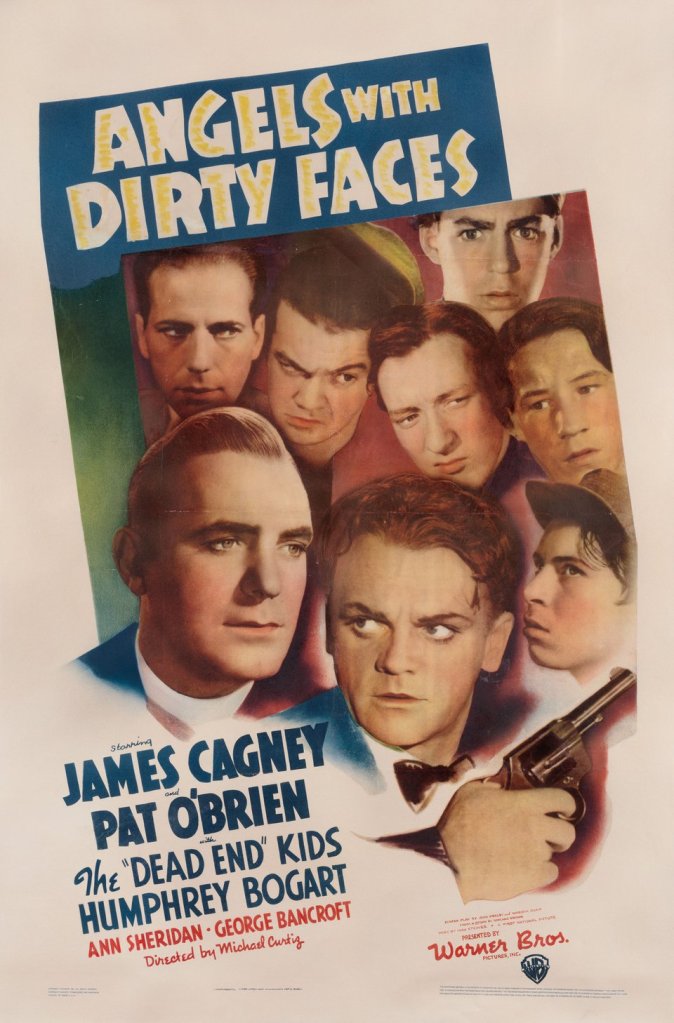
The Plot: “Rocky” Sullivan and Jerry Connolly (James Cagney and Pat O’Brien) are two childhood friends who grow up to become moral opposites; Rocky is a notorious gangster, Jerry is a priest. After serving a three-year prison stint, Rocky reunites with Father Jerry, and befriends some tough neighborhood kids (The Dead End Kids) who look up to his criminal behavior, which greatly concerns Father Jerry. When Rocky’s crooked lawyer Jim Frazier (Humphrey Bogart) reneges on a promise to give Rocky his share of the robbery that got him imprisoned, Rocky holds Jim hostage and fights his organized crime syndicate for the money. As Rocky starts making headlines, Father Jerry makes headlines of his own condemning the actions of the crime world. Oh, and Ann Sheridan is there as another childhood acquaintance of Rocky’s, because there’s always a woman in these kinds of pictures.
Why It Matters: The NFR praises the film’s ability to toe the line between gangster glorification and Code era compliance. The only major superlative goes to the “lovable” Dead End Kids.
But Does It Really?: I’ll give “Angels with Dirty Faces” a “minor classic” designation. While not as iconic as Cagney’s other gangster fare, “Angels” has its supporters and holds up reasonably well almost 90 years later. Like “The Public Enemy” before it, “Angels with Dirty Faces” is well-known enough within the gangster genre that its NFR inclusion was inevitable, if not imperative (it’s been over 20 years since a Cagney gangster pic has been added to the Registry). While I have no qualms about “Angels with Dirty Faces” making the NFR, I’m not too excited about it either.
Everybody Gets One: An aspiring actor in her native Texas, Ann Sheridan made her film debut in 1934’s “Search for Beauty” playing a small role she won as part of a beauty contest. After getting good notices at Paramount, she joined Warner Bros. and successfully oscillated between supporting roles in the A pictures and lead roles in the B pictures. In addition to “Angels”, Sheridan appeared in “Dodge City” with Errol Flynn and Olivia de Havilland, “The Man Who Came to Dinner” with Bette Davis, and “I Was a Male War Bride” with Cary Grant. Sheridan was also a sex symbol/pin-up girl in the late ‘30s and early ‘40s, being declared Hollywood’s “Oomph” girl in 1939, a title she detested.
Wow, That’s Dated: The $100,000 Rocky is owed for the robbery comes out to about 2.2 million dollars today. If I were owed that much money and didn’t get it, I too would resort to a life of crime.
Seriously, Oscars?: “Angels with Dirty Faces” received three Oscar nominations: Director, Story, and Actor. James Cagney’s nomination was the first of his career, and he lost to Spencer Tracy in “Boys Town” (which also beat out this movie in the Best Story category). Michael Curtiz’s Best Director nomination was noteworthy because one of his fellow nominees was…Michael Curtiz for “Four Daughters”. Curtiz lost both nominations to Frank Capra for “You Can’t Take It With You”, and shortly after this the Academy rules were changed to prevent directors from being nominated twice in the same year (this change was later reversed, allowing Steven Soderbergh to win the category in 2001 for “Traffic” over himself for “Erin Brockovich”).
Other notes
- By the mid-1930s, James Cagney was the biggest star at Warner Bros., but was unhappy with being overworked and underpaid by his studio. In 1935, Cagney sued Warner Bros. for breach of contract, and left the studio to work for the newly formed independent company Grand National Films. It was here that Cagney was first offered “Angels with Dirty Faces”, a role he turned down to avoid being typecast as a gangster like he had been at Warner Bros. In 1937, the court ruled in favor of Cagney, and Warner Bros. offered him a new, better contract. At the insistence of his brother and business partner William, Cagney brought the story of “Angels with Dirty Faces” with him back to Warner Bros., knowing that the studio would want another gangster picture from him and recognizing that the character of Rocky offered more of an acting challenge than other gangster characters he had played.
- In addition to “Angels with Dirty Faces” and “Four Daughters”, Michael Curtiz directed three other films that were released in 1938, including “The Adventures of Robin Hood”! That’s the studio system assembly line for you, they just cranked these things out, with directors going from picture to picture with little downtime in between.
- Having recently watched “The Public Enemy” for the blog, I caught myself using that film as a comparison point to “Angels”. While “Public Enemy” is the overall better movie, “Angels” showcases how far “talkies” had come in only seven years, with much better sound quality, plus a score! Also, “Angels” has a much more believable actor playing a younger version of James Cagney’s character. Young Rocky is played here by Frankie Burke, who got into acting because people told him he looked like James Cagney. “Angels” was Burke’s film debut.
- For those of you keeping score, that’s two NFR Class of 2024 movies where our main character is a juvenile delinquent who grows up to be a famous criminal. Admittedly this is more a note to myself for my eventual Class of 2024 recap post. You’re welcome, Future Tony.
- The acting in this movie is pretty solid: Cagney’s great, O’Brien’s great. Ann Sheridan doesn’t get much to do, but she’s got moxie, and that goes a long way with me. In fact, the only performances I didn’t like were the ones from the Dead End Kids. Originally cast in the Broadway play “Dead End” and brought over to Hollywood for the 1937 film version, the Dead End Kids are doing the same schtick here as they would in countless other movies: streetwise smart-alecky city kids getting into mischief/petty crimes. And my god are they annoying. Cagney’s performance earned bonus points from me every time he roughed up these kids.
- Side Note: In my “Going My Way” post, I joked about the turf wars between the Dead End Kids and the Bowery Boys. Further research has shown that the Bowery Boys were a later permutation of the Dead End Kids, with at least three overlapping members. My apologies to the 0.0000001% of you who caught that mistake. Mea culpa.
- The most interesting performance for me was Humphrey Bogart as Rocky’s lawyer. In 1938, Bogart was a rising star at Warner Bros., but was still three years away from “The Maltese Falcon”, which cemented his leading man status. Being so used to Bogart as a bonafide movie star, it’s funny seeing him here not only in a supporting role, but a supporting role where he gets pushed around by James Cagney. Jim Frazier clashes with Bogart’s later screen persona in an interesting-in-hindsight kinda way.
- As I’ve learned many times on this blog, most movie quotes are famous because they get repeated within their film. Case in point: “Whaddya hear, whaddya say?” is said at least seven times in ”Angels”. Cagney attributed the line to a pimp that lived in his neighborhood growing up and he was a bit irked when the line became a go-to for Cagney impersonators.
- Also dated: the film’s occasional use of the word “boner”, here meaning a major mistake or error and not…well, you know.
- Father Jerry, during one of his radio addresses calling for sweeping reform in city politics: “We must wipe out those we have ignorantly elected.” There’s your “why is this still relevant” line for 2025.
- Once again, we have a movie using real ammunition for their shootout scenes because the technology for blanks had not been perfected yet. How no one got killed during these movies is a miracle, though Cagney admitted years later in his autobiography that he had a close call with a bullet during production of this movie.
- I don’t have a lot else to say about “Angels with Dirty Faces”. It’s one of the smarter gangster pictures, with Rocky cunningly evading the mob and the police in an ongoing cat and mouse game. The film’s final shootout and death row finale are memorable moments, but I don’t have any additional thoughts. It’s good, very good, but that’s all I got.
Legacy
- “Angels with Dirty Faces” was released in November 1938, and was met with near-universal praise, becoming one of the highest grossing movies of the year and earning Cagney the best notices of his career up to that point. Since then, “Angels” has maintained a spot in film history as one of Cagney’s most iconic gangster roles.
- Cagney’s triumphant return to Warner Bros. peaked with “Yankee Doodle Dandy”, the film that earned Cagney his only Academy Award. By the time Cagney had won that Oscar in 1943, he had already left Warner Bros. again to start his own production company, though by decade’s end Cagney Productions, facing financial difficulties, folded into Warner Bros., with Cagney returning to the Warner roster of stars.
- Some sources list the 1939 film “The Angels Wash Their Faces” as a sequel to “Angels with Dirty Faces”, and while both films star Ann Sheridan and the Dead End Kids, it is definitely not a sequel. In fact, “The Angels Wash Their Faces” was filmed under the title “The Battle of the City Hall”, but had its title changed to capitalize on the success of “Angels with Dirty Faces”.
- And finally, “Angels with Dirty Faces” is not to be confused with “Angels with Filthy Souls”, the greatest movie within a movie ever made. “Keep the change, ya filthy animal.”
 The Horse's Head
One thought on “#738) Angels with Dirty Faces (1938)”